Apple
iPad lesson: Apple is in control
From top to bottom, Steve Jobs' latest gizmo is locked down. But that hardly means the death of open computing
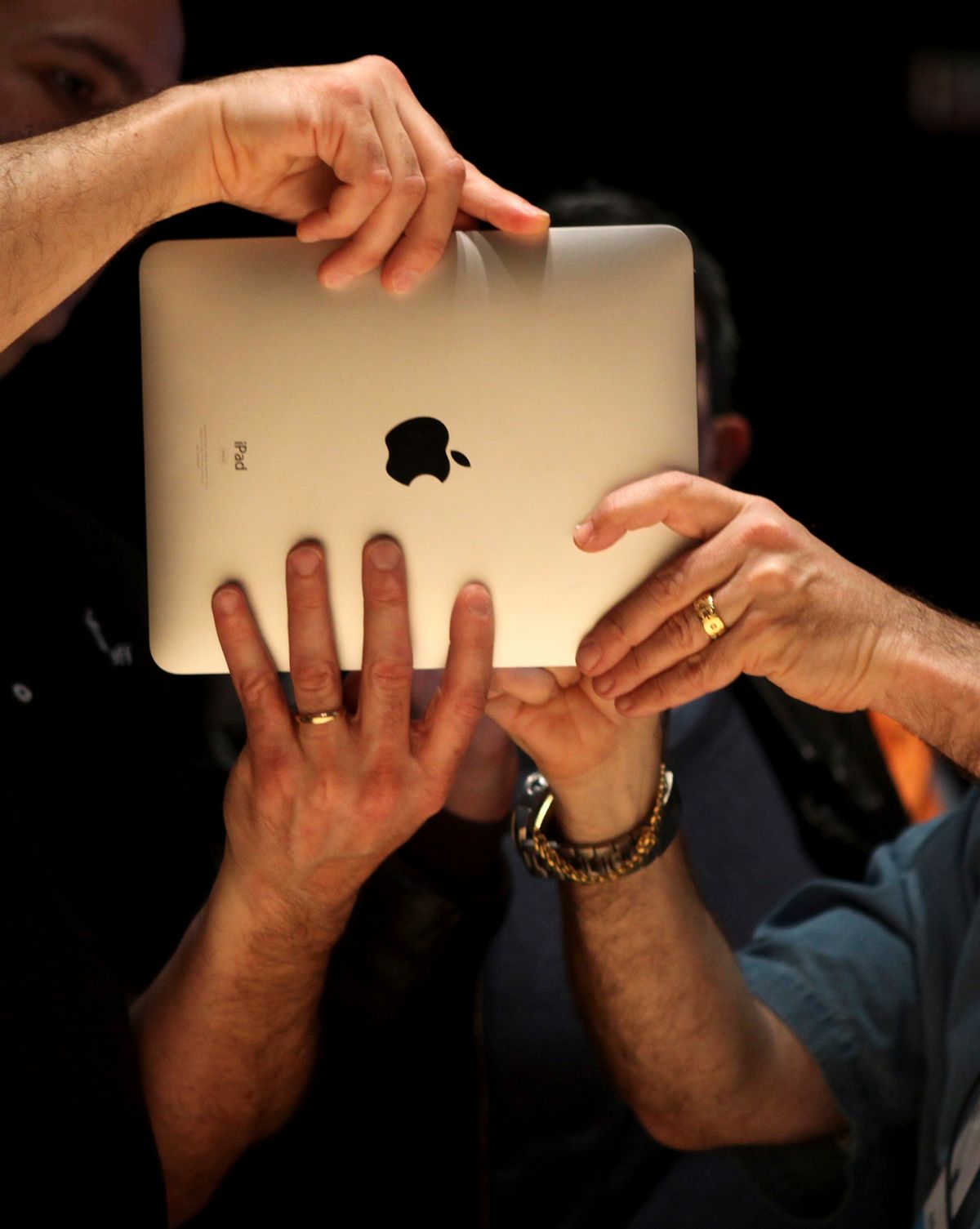
Members of the technology media try out Apple's "iPad" , a new tablet computing device, after its launch event in San Francisco, California, January 27, 2010. REUTERS/Kimberly White (UNITED STATES - Tags: BUSINESS SCI TECH)(Credit: Reuters) I never imagined a day when I might hear Apple described as a combination of “Microsoft and Intel rolled into one.” It makes me feel dirty just thinking about it. But after sifting through the reams of media coverage generated by the iPad’s launch on Wednesday, I’m beginning to think that the most interesting feature of the iPad, symbolically speaking, is Apple’s decision to incorporate a proprietary microprocessor chip — i.e., one designed by Apple — in the iPad’s design.
Jobs mentioned the chip — dubbed the “A4″ — early on in his presentation at San Francisco’s Moscone Center. That was noteworthy alone, as the perspicacious John Gruber observes, because Apple generally eschews public discussion of the technology specs of its products. (You wanna know what’s in the iPhone? Buy one, and take it apart.)
So, clearly, Apple considers the A4 to be a big deal. Apple paid $278 million for a semiconductor start-up staffed by illustrious industry veterans in 2008, because the company wanted more control over the most important part (choose your favorite metaphor — brains … heart… lungs …) of a computing device’s hardware. That’s not a game Microsoft or Google is playing, yet.
By all accounts, the chip dazzles. A common refrain coming from people who have had a chance to handle the iPad is that it is fast. Really, really fast. In a world where teenagers go nuts when “World of Warcraft” starts to suffer nanoseconds of lag, that virtue should not be underestimated as a selling point for new hardware. The most sublime user interface in the world is useless if Web pages render slowly or it takes ages to switch from app to app.
From a sheer engineering standpoint, Apple’s ability to execute such an ambitious strategy is impressive. A superfast chip that is easy on the battery consumption is the ever-receding holy grail of microprocessor manufacturing. But in the context of the globalization of the computer hardware industry the feat is even more interesting.
The global chip industry is a model for how high-tech production chains have become distributed around the world. Outside of Intel, the notion of a vertically organized hardware company that owns and operates every aspect of production from design to manufacturing is archaic. Today, a fabless start-up in Palo Alto comes up with the specs (perhaps with help from Indian designers), a state-of-the-art foundry in Taiwan manufactures it out of raw silicon, a testing outfit in South Korea checks to see if it works, and then the finished product gets plugged into a device in some giant Chinese factory.
Five years ago, I explored the inner workings of the iPod as an introduction to globalization. More than most companies, Apple appeared exquisitely comfortable at the leading edge of this new industrial revolution.
And that’s still true, to a certain extent. We won’t know for a while exactly where the A4 is made or what strands of intellectual property licensed from other chip consortiums are incorporated in its DNA. My bet is that the A4 is still made in Taiwan. But so what? The decision to bring the chip’s design in-house speaks to a desire for control so profound as to make the physical location of manufacturing meaningless. It is proof, in other words, that outsourcing production does not mean giving up ownership.
And it is that issue of control that is at the heart of most thoughtful critiques of the iPad (or iPhone, for that matter). The iPad is the antithesis of the open, infinitely configurable, general-purpose computer. As such it represents the apotheosis of a strain of Apple culture that’s been apparent ever since the company made clear in the 1980s that cloning Apple hardware was unacceptable heresy. From the microprocessor to the fact that the device won’t render Flash to the lack of multitasking or a USB port to the organization around “stores” (iTunes, iBooks) — Apple’s iPad is all about control. That’s one reason why media companies are supposedly so gaga about the device. In their view, control equates to a potentially profitable business model.
Maybe it does, but only if users get something in return, which the New York Times had better remember. Apple’s deal has always been that in return for giving up some freedom, the company will provide a fabulous user experience.
And I’m not sure why that isn’t enough for the critics. Unlike Microsoft at its height, Apple is not crushing the life force out of its competitors and imposing its will on the marketplace via monopolistic tactics. It is succeeding by providing a popular choice. And in the current wide-open computing marketplace, there will always be other choices. The death of open computing is hardly imminent. Don’t like a locked-down iPhone? Get a Google Nexus One and start hacking. Don’t like the iPad? Someone will be manufacturing a cheap laptop in China that will do everything you could possibly want. It just might not be as slick and easy and fun to play with.
UPDATE: Even Hitler has issues with the lack of multitasking!
Andrew Leonard is a staff writer at Salon. On Twitter, @koxinga21. More Andrew Leonard.
America’s great divergence
The new innovation economy is making some cities richer, many cities poorer -- and it's transforming our country
(Credit: karamysh via Shutterstock) Menlo Park is a lively community in the heart of Silicon Valley, just minutes from Stanford University’s manicured campus and many of the Valley’s most dynamic high-tech companies. Surrounded by some of the wealthiest zip codes in California, its streets are lined with an eclectic mix of midcentury ranch houses side by side with newly built mini-mansions and low-rise apartment buildings. In 1969, David Breedlove was a young engineer with a beautiful wife and a house in Menlo Park. They were expecting their first child. Breedlove liked his job and had even turned down an offer from Hewlett-Packard, the iconic high-tech giant in the Valley. Nevertheless, he was considering leaving Menlo Park to move to a medium-sized town called Visalia. About a three-hour drive from Menlo Park, Visalia sits on a flat, dry plain in the heart of the agricultural San Joaquin Valley. Its residential neighborhoods have the typical feel of many Southern California communities, with wide streets lined with one-story houses, lawns with shrubs and palm trees, and the occasional backyard pool. It’s hot in the summer, with a typical maximum temperature in July of ninety-four degrees, and cold in the winter.
Continue Reading CloseEnrico Moretti is a professor of economics at the University of California, Berkeley, whose research has been supported by the National Science Foundation, the National Institutes of Health and has been featured in the New York Times, the Wall Street Journal and Slate, among other publications. More Enrico Moretti.
The Foxconn raise paradox
The Apple manufacturer's decision to increase wages in China isn't necessarily good news for its workers there
In this May 26, 2010 file photo, staff members work on the production line at the Foxconn complex in the southern Chinese city of Shenzhen, southern China (Credit: AP Photo/Kin Cheung) TAIPEI, Taiwan — Guilt-ridden iPad users were ready to rejoice last weekend, after Foxconn announced that it would bump up pay, reduce overtime and improve living conditions and safety protocols for its legions of Chinese workers producing Apple products in the coastal boomtown of Shenzhen.
For years, the Taiwanese electronics giant has been dodging accusations of bad labor practices, charges that have tarnished the reputation of the world’s hottest gadget retailer.
The trial of Mike Daisey
Salon writers debate the backlash around "This American Life's" retraction scandal
Mike Daisey and Ira Glass (Credit: mikedaisey.blogspot.com/AP/Seth Wenig) Laura Miller: The retraction by the radio program “This American Life” of an episode based on Mike Daisey’s stage show, “The Agony and the Ecstasy of Steve Jobs,” raises (once more) the question of how much fiction we’re getting in our nonfiction. “This American Life” found that several incidents and facts in Daisey’s account of his firsthand investigation of working conditions in the Chinese factories where Apple devices are made were fabricated or otherwise inaccurate.
Continue Reading Close
Mary Elizabeth Williams is a staff writer for Salon and the author of "Gimme Shelter: My Three Years Searching for the American Dream." Follow her on Twitter: @embeedub. More Mary Elizabeth Williams.
Laura Miller is a senior writer for Salon. She is the author of "The Magician's Book: A Skeptic's Adventures in Narnia" and has a Web site, magiciansbook.com. More Laura Miller.
Mike Daisey and the inconvenient truth
When storytellers exaggerate facts -- as a "This American Life" episode about Apple did -- the audience loses
In this undated image released by The Public Theater, Mike Daisey is shown in a scene from "The Agony and The Ecstasy of Steve Jobs," in New York. Daisey, whose latest show has been being credited with sparking probes into how Apple's high-tech devices are made, is finding himself under fire for distorting the truth. The public radio show This American Life retracted a story Friday, March 16, 2012, that it broadcast in January about what Daisey said he saw while visiting a factory in China where iPads and iPhones are made. (AP Photo/The Public Theater, Stan Barouh) (Credit: AP) I can’t be the only listener who thought this past weekend’s edition of “This American Life,” the public-radio show, was among the most compelling work Ira Glass and his team of producers had ever done. As I sat in my rental car stuck in Los Angeles gridlock listening to the radio, I felt certain I was part of a community of people across the country listening to the radio thinking Unbelievable.
Episode 460, “Retraction,” was an hour-long correction to Episode 454, “Mr. Daisey and the Apple Factory,” which aired January 6. That episode was a special hour-long condensation of Mike Daisey’s one-man show, “The Agony and the Ecstasy of Steve Jobs.” In that show, which ended Sunday in New York and heads next to Washington, D.C., Daisey recounts his trip to China to interview workers in the Foxconn factory, which makes Apple products. And in fact that episode — in which Daisey describes meeting workers who had to sleep in prison-like barracks; whose hands shook from the neurotoxins in cleaning solutions that Apple forced them to handle; whose arms were mangled from industrial accidents for which they were not compensated — had also been among the most compelling hours of radio I had ever heard. It launched Daisey into a role as a nationally prominent critic of Apple, appearing on MSNBC and elsewhere.
Continue Reading CloseMark Oppenheimer writes the Beliefs column for The New York Times. He can be followed on Twitter @markopp1. His website is www.MarkOppenheimer.com More Mark Oppenheimer.
Scott Turow on why we should fear Amazon
The feds might sue Apple and publishers over pricing. But a top author suggests the e-retailer's playing monopoly
(Credit: AP/Ben Margot) Late last week, the Justice Department warned Apple and five of the nation’s largest publishers that it was planning to sue them for price fixing. At issue is the agency model, a method of wholesaling e-books in which the publisher sets the retail price and the retailer takes a 30 percent cut. Most print and many e-books are sold under the traditional wholesale model, in which publishers sell books at a discounted price, and the retailer can resell them for whatever price it likes.
The unnamed player in this drama is Amazon, which had been selling e-books at a loss until two years ago, when the iPad came along and publishers used the emergence of the new device to pressure the online megaretailer into adopting the agency model, too. If Amazon wanted to sell e-books from the Big Six (as the six largest book publishers are called), it could no longer sell those titles for $9.99.
Continue Reading Close
Laura Miller is a senior writer for Salon. She is the author of "The Magician's Book: A Skeptic's Adventures in Narnia" and has a Web site, magiciansbook.com. More Laura Miller.
Page 1 of 51 in Apple