Body Wars

In fighting obesity, Michelle Obama eats foot

Did the first lady mess up by talking about her daughters' weight?

  • more
    • All Share Services

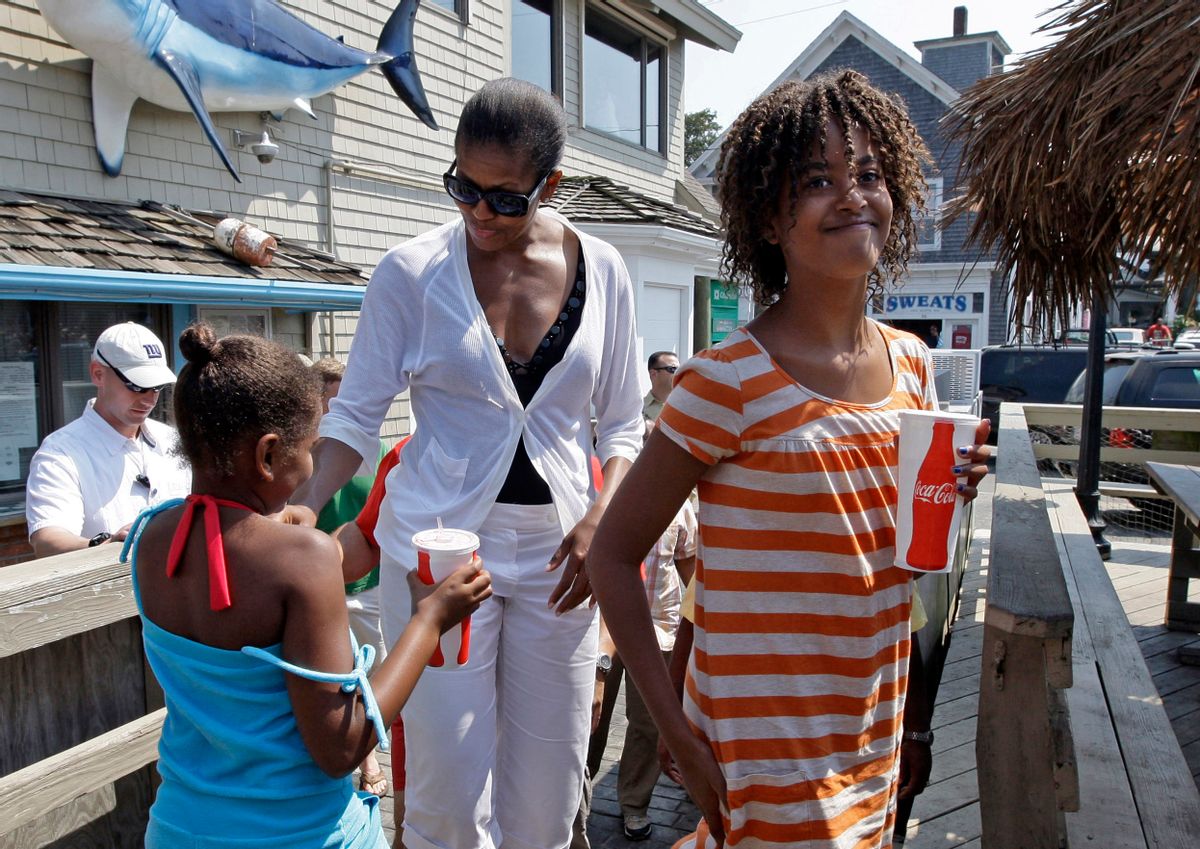
In fighting obesity, Michelle Obama eats footFILE - In this Aug. 26, 2009, file photo, first lady Michelle Obama walks with daughter Malia, 11, right, and Sasha, 8, while they wait to get lunch at Nancy's in Oak Bluffs, Mass., while vacationing on Martha's Vineyard. (AP Photo/Alex Brandon, File)(Credit: Associated Press)

As she takes up the pressing issue of childhood obesity in America, Michelle Obama seems to have started by putting something in her mouth. Namely, her foot.

As our friends at Jezebel WTFed earlier this week, the first lady kicked off her cause last weekend by telling the world that her own pediatrician “cautioned me that I had to look at my children’s BMI. He was concerned that something was getting off balance. In my eyes I thought my children were perfect,” she said. “I didn’t see the changes.”

But oh my God, they weren’t perfect! Their BMI was off balance!

Now, Mrs. Obama is trying here. She’s a real woman who is raising two little girls in a country with a mounting obesity problem and an incredibly fucked-up relationship to body image. She understands our challenges in getting our kids to exercise and eat right, and she wants us to see her family is like our family. So when she stood up and said, “Knowing that you’re going home to an empty refrigerator and kids who are hungry and fussy and not wanting to eat anything you have in mind. All they want is some pizza and some burgers. Right? And you don’t want to argue, you want a peaceful meal. You want everyone to be quiet and just eat,” it was like she was looking at every mother’s life. But while to the rest of the world she’s an accomplished  leader, to Sasha and Malia, she’s Mom. And Mom just made an example of their less than perfectness. Lesson here: Parents are so embarrassing – even when they’re the first lady of the United States. (Dad’s no slouch either. In 2008 he told Parents magazine, “A couple of years ago — you’d never know it by looking at her now — Malia was getting a little chubby.”)

As it happens, Sasha and Malia have two physically fit, slender parents, so the genetic deck is already stacked in their favor. And while some studies show a correlation between childhood obesity and future weight and health problems, it’s not the only thing. Many people, like our president, for instance, go through a variety of childhood fluctuations before settling into their adult body type. I was a lumbering, chubby kid myself — though my parents were neither of those two things. But my eventual slimmed-down outcome didn’t help when I was a little girl and, in my whippet-thin mother’s words, had “thunder thighs.”

I live in a lower-income, predominantly immigrant neighborhood where the rate of childhood obesity is downright grim. It’s a problem that affects everything from future health to academic performance.  Getting kids away from the computer and TV screens, away from the fast, overprocessed foods, is something we can all get behind, but not first and foremost because they might wind up with a higher BMI — a number that is not the be-all and end-all by a long shot anyway.

The way to instill healthy habits in children cannot involve anything that smacks of critique. Trust me, they’ve got the entirety of pop culture to make them feel bad about themselves, they don’t need our help. We’ve got to sweeten the deal, so to speak. It’s fun to run around! It’s fun to help with the grocery shopping and the cooking! We’ve got to walk the walk ourselves as mothers, in the way we eat and live and keep our damn mouths shut when we feel a wave of criticism about our own or anybody else’s body coming on. We’ve got to similarly zip it about food being “good” or “bad” and let it just be food, because our kids are going to have to spend the rest of their lives eating the stuff. It’s not always easy. Believe you me, there are days when my own daughters give me the “you’re not fooling anybody” look when I offer them apples for an afternoon snack. But if we don’t obsess or fetishize, if we demand better options at the supermarket and support initiatives like Wellness in Schools  and generally bring in more broccoli than corn dogs, it’ll be OK. And if after all the running and the cooking and the broccoli and periodic corn dogs, our kids grow up healthy and with a number on a scale or BMI that’s somehow different than the ideal one on the chart, that’s OK too. Because they’re still our kids. And they’re perfect.

Mary Elizabeth Williams

Mary Elizabeth Williams is a staff writer for Salon and the author of "Gimme Shelter: My Three Years Searching for the American Dream." Follow her on Twitter: @embeedub.

Old ladies who didn’t love me

I thought a gym class with elderly women would ease my aging anxiety, but it made me miserable in new ways

  • more
    • All Share Services

Old ladies who didn't love me

“Isn’t it soon for me to be getting arthritis?” I asked my orthopedist. I assumed I had a young person’s pain: an injury, or maybe a cyst.

“No,” he said, then checked my chart again for my age. “No, not at all.”

At 36, I had been preoccupied by my age, and this didn’t help. I’d been looking at every woman’s neck to see when the accordion stretch of the chin would kick in. Could I stave it off a few more years? Had I blown it by not being skinny, so that I couldn’t later gain five pounds to smooth out my wrinkles?

But it wasn’t just about my appearance. With each passing year, I counted all the things I could no longer do: be an athlete, be a model, be a ballerina. It didn’t matter that I never aspired to these things. The things I had aspired to do, like write a novel and be a young mother, were also undone. (I am a mother, but not a young one.) The world and its opportunities were closing like a window. I felt like I was choking.

And even as I thought of this, I knew the basic existential dilemma: Thinking about age wouldn’t make me young. And worse, I would never be younger than I was now. I was fairly accomplished for my age: I’d traveled and known many interesting people. I’d been in love with the wrong guy. I’d been in love with the right guy. Everything seemed right on schedule. But I was weighed down by the truth of time, that it’s coming for all of us.

The orthopedist, who was close to my age (another bad sign: The doctors were my age now), recommended I swim until the swelling went down, then start physical therapy. I’m bored by regular swimming. And that’s what brought me to this — that bastion of aged flesh, this hotbed of liver spots and teased hair, my YMCA’s aqua aerobics class.

I knew the class was populated by old women; I had a view of them from my treadmill, where I’d exercised back when I was young and could run for my health, bounding like a deer toward a television that only played shows about the Kardashians. Beyond that TV were the old ladies, splashing and working out.  I would take water aerobics and emerge feeling young, grateful for the plump of my skin, the relative tightness of my jowls. We’d all be buoyant in the water, but only I would remain so as we dried off. The older women would love me. Bonds would be forged.

My grandmother, a Russian immigrant, had taken these kinds of classes when she had been alive. She had a whole social group around the class, women who were kind and joyful, who played Rummikub and made honey cakes for each other at the Jewish new year. I had joined her once, in Brooklyn, N.Y., for the class. The poolies, as we called her chlorinated friends, were always so interested in hearing about my life, my boyfriends, my classes. My grandmother, slick with water, gleamed with pride.

And so it would be this time. I’d remind the old ladies of their daughters. They’d pass on wisdom. I would confide that I didn’t think I could wear a miniskirt anymore, at my age. They would snort and hoot and tell me what a child I am. I’d realize how silly I’ve been. I would learn that I had plenty of time.

- – - – - – - – - -

My poolies, the ones at my gym, had necks that had long since defied definition. Massive freckled cleavage became neck became chin became face and so on. They wore bathing caps with plastic flowers and swim suits with pointy foam bra cups. Underneath, their hair was teased and thinning in shades of copper and yellow.

I wore a tankini — the illusion of the self-confidence requisite for a bikini but none of the skin reveal — and I immersed myself in the water. It was warm, and it would have been easy to mistake the high concentration of chlorine for a urine scent. I walked over to where the action was. The women were all friends. I waited shyly for someone to say hello to me, to ask me what the hell a youngster like me was doing in a place like this. No one did.

“You need a noodle,” said the instructor, a 40-something man in shorts and a T-shirt who stayed on the deck of the pool to give instructions.

I retrieved a foam noodle and was descending the ladder into the pool in silence when I heard a large woman in a red, skirted bathing suit, probably around 70, say to her friends, “The girls with the leg hair. No one shaves anymore.” There was no way she was talking about me. Right?

“I wax,” said another in a pink bathing suit, maybe mid-60s. Then to me, “You should wax.”

She was talking about me.

“Oh, I, uh, I shave my legs,” I stammered. “I’m just … I just had a baby. It’s a miracle I can get here, right?”

“Oooooh, when did you have a baby?” asked the first one, with a smile.

“He’s 14 months old,” I said.

Two others cackled.

“Yes, I just had a baby, too,” said one with a rubber swim cap with flowers, mid-60s, grabbing her stomach in her fists. Red bathing suit snorted. “She’s 47!”

I rushed as quickly as the water would let me to the back of the class. I thought of my yoga class, where people applauded when you just showed up. The class started, and we jogged for 10 minutes. By minute five, I couldn’t do it anymore. The others looked barely winded. When it was time to stop, the instructor said to me, “It gets easier with time.”

All the ladies — the next youngest to me was perhaps 55 — turned around. When they saw me, they squealed with laughter.

“Leave her alone!” said one in a black suit with a back so low that you could see folds of fat. I thought she was an ally until: “She just had a baby, don’t forget!” Then they laughed and laughed and splashed.

We did kicking and push-ups against the wall. We brought our knees to our chins while we floated on noodles. At the end of class, the instructor made an announcement.

“I’ll be out next week, but class is still going on.”

The ladies collectively cooed and oohed their suspicion. “Do you have a hot date?” asked one.

“Yeah, with his mother!” came one answer. Again, hysterics.

I tried to make eye contact with the instructor — both of us victims, after all — but he closed his eyes and took a breath. He was used to this. He hadn’t always been this meek. The poolies had brought him to this. They were old people and they were tired of being called cute by young people. They had become mean.

No one was safe here. My grandmother’s friends had seemed so much kinder, so much more, I don’t know, grandmotherly. Had it all been a show? Had it been a front for grandmothers everywhere? I had come here to seek the gratuitous validation that only grandmothers can provide, and learned it was only my grandmother who would provide it.

I missed my grandmother. I missed her kindness, her forgiveness. I missed how I looked through her eyes. I missed how her love made me feel perfect. Maybe that’s what was upsetting me: That in addition to not being a ballerina or a model, I would also never be perfect. Or maybe what was bothering me was that I was just ganged up on by a bunch of nasty septuagenarians.

I was only 25 when my grandmother died. Back then, I hadn’t known yet that I’d get old. To me, the young were born young; the middle aged stayed that way. Her death promoted my parents to old people and me to someone who worried about death. We held her hand as she died; “Oh, Ima,” my mother whispered into her hair. We didn’t mourn gracefully. We wailed for days.

I kissed her forehead as it began to turn cold. How could her body turn cold so quickly? Shouldn’t her extraordinary warmth grant her body a few more minutes of heat than the average person gets once she passes?

Now, I looked around at these women in the pool, the ones who resembled my grandmother but certainly were not her. I wondered how they found the resolve to keep going. Didn’t they know how close to the end they were? Did they ever just want to give up? Were they ever obsessed with age like I was? Maybe that struggle had grown tiresome, like caring about the sexiness of your shoe wear. I had recently bought a pair of Danskos, big clunky things that make my Size 11 feet look like Size 12 feet. I had resigned to this because it no longer felt like it mattered what my feet looked like. It felt like I was old enough to not care anymore.

Maybe there was another way to look at them. These women didn’t fall into the role I assigned them, because they were busy being their own people. They were exercising. They were keeping their bodies strong. And they knew something I didn’t: That you’re alive until you’re not.

I floated on my back for the next minute, my ears under the water so I couldn’t hear anything. I remembered a time long ago when, at a pool party, a boy told me he’d heard that I thought he looked like Tom Cruise. I dunked under water then, like now because I was embarrassed, left alone in the eerie silence with my bubbles and with my shame. I left the pool and dried off.

On Wednesday, under the cover of late afternoon, I swam laps.

Continue Reading Close

Taffy Brodesser-Akner has written for the New York Times, Los Angeles Times, Self, Redbook, and other publications.

Ashley Judd’s facial war

In a bold new essay, the actress confronts the critics of her body head-on -- and makes some incisive points

  • more
    • All Share Services

Ashley Judd's facial warAshley Judd (Credit: Reuters/Jean Amet)

Ashley Judd would like you to get out of her face. The 43-year-old actress, activist and sometime controversial memoirist has had a high-profile return to the public eye, with the debut of her new drama “Missing.” And it’s a profile that has been the subject of much snark and WTFing.

In the past few weeks, Radar has lamented that she’s gone from “pretty to puffy” and “fattened her face with fillers” while Us declared her “nearly unrecognizable.” SheKnows hit her even harder, complaining that “the pretty face we’re used to [has been] replaced by a puffy disaster.” And when her reps declared that her swollen look was the result of steroids for a sinus infection, they only fanned the flames, leading The Stir to snap of her “way chubbier than usual” look, “Come on, Ashley, we may be dumb, but we’re not stupid.”

Now Judd, never one to shy away from expressing her feelings, has penned a rebuttal to the face haters. In a column for the Daily Beast, Judd addresses the tongue wagging about her “puffy” face and straightforwardly declares that “the conversation was pointedly nasty, gendered, and misogynistic and embodies what all girls and women in our culture, to a greater or lesser degree, endure every day, in ways both outrageous and subtle.”

While it’s a vast step up from Samantha Brick’s already notorious defense of her looks, Judd’s piece is not without its own flaws. Even in high dudgeon, she manages to come off as impossibly pleased with herself — she humbly brags about her “nearly flawless” skin and still has time to mention her “serious work, such as publishing op-eds about preventing HIV, empowering poor youth worldwide, and conflict mineral mining in Democratic Republic of Congo.”

But the point Judd makes — about how wildly screwed up the relentless public scrutiny is — is valid and necessary. Of her weight fluctuations, Judd says that “We won’t even address how extraordinary it is that a size eight would be heckled as fat.” And, perhaps most tellingly, she addresses the absurdity of the suggestion that she’s “messed up” just because “my 2012 face looks different than it did when I filmed ‘Double Jeopardy’ in 1998.”

The lengths to which celebrities — mostly women – go in the name of youth and beauty are a matter of public discourse. We grapple with questions about women and aging and body image by talking about Nicole Kidman’s forehead and Megan Fox’s nose and plus-size models. But the gotcha! put-downs any time a woman expands or contracts in size or seems too creased or too smooth — the “general incessant objectification” and “abnormal obsession with women’s faces and bodies,” as Judd calls it — create a culture of viciousness and perpetual dissatisfaction. Look at that girl. She’s so fat/thin/wrinkled/fake. Who does she think she is? How dare she? That’s not just hateful. That’s lazy.

That Judd looks different than she did in 1998 is a fact. How she arrived at her current look is her business. By confronting the speculation head-on, Judd has acknowledged her place in an often cruel, unwinnable war of public opinion. One opinion column likely won’t make the tabloids and blogs pause in their daily digging on who is displaying cellulite or a trout pout. But by calling out the critics, Judd reminds us how useless and hollow the sport of body snarking truly is, and the fact that expecting anybody to be the same kind of “pretty” she was 14 years ago is, in her word, pure insanity.

Continue Reading Close
Mary Elizabeth Williams

Mary Elizabeth Williams is a staff writer for Salon and the author of "Gimme Shelter: My Three Years Searching for the American Dream." Follow her on Twitter: @embeedub.

Fat-shaming a child into a book deal

A mom's horrible dieting strategy for her 7-year-old pays off

  • more
    • All Share Services

Fat-shaming a child into a book dealDara-Lynn Weiss with her daughter, Bea.

How could a story that Jezebel last week declared  “The Worst Vogue Article Ever” get even more terrible? By becoming a book.

It began with a feature called “Weight Watchers” in the April Vogue, written by Dara-Lynn Weiss. In it, Weiss chronicles her then 7-year-old daughter Bea’s dieting odyssey after the child had “grown fat.” It was a tale that involved putting Bea — who at 4-foot-4 and 93 pounds was veering toward childhood obesity — on an intense regimen of calorie restriction and public shaming. “I once reproachfully deprived Bea of her dinner after learning that her observation of French Heritage Day at school involved nearly 800 calories of Brie, filet mignon, baguette and chocolate,” she writes. “And there have been many awkward moments at parties, when Bea has wanted to eat, say, both cookies and cake, and I’ve engaged in a heated public discussion about why she can’t.”

Ultimately, after an “exhausting” year with her often “humiliated” daughter, Bea dutifully dropped 16 pounds, and just for lagniappe, grew 2 inches. Unsurprisingly, her mother, who admits, “I have not ingested any food, looked at a restaurant menu or been sick to the point of vomiting without silently launching a complicated mental algorithm about how it will affect my weight,” was pleased — and turned the story into glossy magazine fodder. But Bea admits, “I’m not a different person just because I lost 16 pounds. Just because it’s in the past doesn’t mean it didn’t happen.”

The story hadn’t gained much traction until Jezebel writer Katie J.M. Baker unflinchingly called Weiss “one of the most … selfish women to ever grace the magazine’s pages” — and a lot of people agreed. MSNBC leadingly asked if she was “responsible or reprehensible” while Fashionista called her “obsessive.” And a disgusted commenter on New York magazine who described herself as a former eating-disordered teen wrote, “What you hate is what you see in her that reminds you of yourself.”

And that’s the kind of talk that lands ladies book deals. The new book, tentatively and appallingly called “The Heavy,” will be published by Random House’s Ballantine imprint.

I admit the Weiss story strikes an acute personal chord: I have a daughter of the same age and name as Weiss’, one who spent part of this past weekend in the emergency room with gastroenteritis. I’m not always thrilled with her general preference for chocolate milk and hot dogs myself, but I know that watching your little girl so wiped out she has to have an IV drip makes a parent grateful in all kinds of new ways for the gift of her health and appetite. And while I am greatly concerned about rising rates of childhood obesity and the health toll they will take on an entire generation, I am convinced that the way to promote healthy eating and activity isn’t by berating or shaming 7-year-olds.

But what makes the book deal for this truly revolting story even more reprehensible is that there is likely no one involved who doesn’t realize exactly how contemptible Weiss’ story is – including Weiss herself. Everything about this unholy arrangement smacks of “Let’s cash in on that whole ‘Tiger Mom’ thing! Nobody’s hated a woman like this since Amy Chua!” Ka-ching. Ka-ching.

So that’s how you get a book published, ladies. Just write an article about what a mean mommy you are, get a lot of sexy media attention and hate mail for it, and watch the bidding war commence! That way, we can be intergenerationally negative toward females — the “fat” little girls we put on diets, the daughters we call “garbage,” and the mothers who behave in such frosty, neurotic and controlling ways toward them. Want a bestseller? Try being a contemptible bitch.

It’s a depressing way to sell books, and an even more depressing way to parent. Like an episode of “Toddlers and Tiaras,” it rewards the kind of mothering that makes many of us shudder. It doesn’t even matter that most the attention Weiss gets is negative. It’s a spotlight. It’s validation. Weiss, enjoying her imminent advance, likely doesn’t care about anything else. And as a bonus, she’d probably be happy if she made a whole lot of people – both parents and readers – lose their appetites.

Continue Reading Close
Mary Elizabeth Williams

Mary Elizabeth Williams is a staff writer for Salon and the author of "Gimme Shelter: My Three Years Searching for the American Dream." Follow her on Twitter: @embeedub.

Surprised to see me

The biggest shock of losing weight is the (sometimes weird) reaction by my old friends

  • more
    • All Share Services

Surprised to see me

It’s funny what you notice when you lose 40 pounds. I have noticed, for instance, that it is much easier to get dressed when your clothes actually fit. I have noticed the way certain bones feel underneath my hands (my rib cage, my pelvis) or how I look in the mirrored glass of a store I am passing. I have also noticed how people react to me. Mostly, I have noticed what they say.

“You look healthy!” they exclaim, giving me a hug, or grabbing my shoulders like an aunt at a family reunion. They say it so often and with such enthusiasm that it can have the inverse effect of upsetting me. I can’t help wondering how unhealthy I used to look.

“People won’t stop telling me I look healthy,” I complained to my friend Mary.

She laughed. “Those assholes.”

Don’t get me wrong: I love compliments. But I feel a stab of mortification for the bloated, slightly sweaty woman who thought she had everyone fooled with Target hoodies and elastic waistbands. I have spent a lifetime hoping no one noticed my weight, and so it is a special terror that everyone now does. I tend to deflect in these moments. I say things like, “It’s amazing what you can accomplish when you stop burying your misery in Chipotle burritos.” Or I pass the weight loss off to quitting drinking, which is not a lie, since I was a beer-binger who could put away a six-pack on a Tuesday. (It’s hard to keep your girlish figure when even a casual night out includes 2,000 calories in sheer lager.)

It’s interesting, though, that so few people mention the word “weight.” It’s almost like they’re afraid of it. Like it would sound crass. Not putting a focus on weight happens to be what most reasonable diets do these days. The counselors will tell you about “healthy lifestyle choices” (not “calorie restriction”). They will explain concepts like “portion control” and talk about “a new way of eating.” (Classic motto: “It’s not a diet — it’s a live it.”) Restaurants rarely tout their “low-calorie” options but instead offer meals that are “heart-healthy,” as though when I lost 40 pounds, what I really had in mind was a stellar cardiogram.

We are a society badly messed up about body image. We mock celebrities for getting fat and then mock Keira Knightley for staying thin. We scream about the dangers of the obesity epidemic while half of us continue to text and drive. So I can’t blame anyone for being weird on the subject of weight. I am super weird on the subject of weight. In middle school, I ate iceberg lettuce for lunch and scissor-kicked my way through Kathy Smith’s aerobics video three to five times a week. By college, I had settled into serious “screw-it” mode: The worse any food was for me, the more I wanted it. I was all bacon and melted cheese and Camel Lights. Over the next 15 years, I gained 20 pounds, lost 15, gained 30, lost 10. My closet contained enough sizes for many sister wives. I agonized about my weight all the time. But I did very little about it. New Year’s resolutions dissolved mid-January. Broccoli and cucumbers bought with the best of intentions turned squishy with neglect. I relied on the optical illusions of the Dillard’s hosiery department: Spandex and control-top pantyhose and enough bizarre, constrictive doodads to outfit all of Madonna’s backup dancers.

When I quit drinking, I hoped the pounds would melt away. But I had swapped imported beer for peanut-butter-chocolate ice cream and pasta with cream sauce. Four months into sobriety, I was at the hairstylist in Brooklyn, seated in that hateful little chair where you are forced to look at yourself speak in a full-length mirror (I despise that chair!) when my self-loathing became radioactive. There I was, getting pampered in my fancy first-world way, but what I thought was: “I am going to have to lose weight, or I am going to rip off my own face.” Those were the words that formed in my brain. I knew drinking had kept me from losing weight. I did not realize, until that moment, how it had buffered me from the misery I felt about it.

So when I moved back to Dallas, I went on a diet. Not a clipped-from-the-magazines, let-me-try-this-for-a-week diet, but the kind where you step on a scale once a week and pay for the privilege. I didn’t tell anyone but my family and a few friends, which is a little off-script for a woman who has written publicly about making out while wearing Spanx. But on this matter, I felt deeply private. I have known people who trumpet weight-loss regimens like a sparkly new ring on the finger: Have I told you about my diet? Do you want to hear about these pills/this lap band/this juice fast/this amazing injectable hormone? Not me. In high school, I went on Jenny Craig, and I was so terrified people would find out that I refused to eat lunch until I came home at 4 p.m., because the food was branded with a logo. I had nightmares my classmates would look inside our kitchen cabinet and see a beef-and-bean chili.

When it comes to our bodies, we all have no-fly zones. I have a friend who has lost weight, and she couldn’t care less if you know she’s on a diet. But she refuses to say how much weight she’s lost. Recently a co-worker grilled her, and when she politely demurred, the woman kept pushing. No really, how much? Come on, you can tell me. “She definitely wasn’t nervous about touching the weight issue,” my friend said. She added that the woman was heavy, and the candor may have come from an assumed “we’re in this together” solidarity. Still, can’t people take a hint? This stuff cuts deep.

And because it cuts so deep, different rules apply to different people, which makes the conversation that much trickier. My friend doesn’t want to share that number with you because when she finally screwed up her courage enough to step on a scale, she was shocked by how big she had gotten, and the number plunges her back into that shame. I don’t want to admit that I’m on a diet because, on some basic level, I seem unable to forgive myself for needing it in the first place — for not being born tall and thin with the metabolism of a marathon runner. I never wanted to be a woman on a diet. (I also never wanted to be a woman who cried easily, or showed people pictures of her cat. This did not work out as planned.) The fact that everyone notices I lost weight reminds me that everyone noticed I had gained weight in the first place but they said nothing because, seriously now, what is there to say? They said, “Your hair looks great.” They said, “I like those shoes.”

There is the added conflict of being all too aware that most diets fail, that our culture is slavishly focused on appearance, much to the detriment of our souls, and that I’m supposed to love my body at any size, not “rip off my own face” if I can’t wear short-shorts in the summertime. But what do you do? Recently, I heard a story about a woman who had lost more than 100 pounds on a strict diet. With tears in her eyes, she admitted that she told everyone she was doing it to be healthier, but that was a lie. She didn’t give a damn about being healthy. She did it because she was sick of being fat.

Can you blame her? We’re a fat-phobic culture. That obsession drives toxic behavior. Another friend of mine tells a story of being at her thinnest in college. She tried crazy stuff to keep the weight down: Diet pills, Ipecac. People kept telling her, too, “You look so healthy!” And she would think, “Really? Because three hours ago I was crying over a toilet trying to make myself throw up.”

I don’t know what to say to someone losing weight, any more than I know how to respond when people remark on my own transformation. And so I reached out to Kate Harding, a friend and the founder of the blog Shapely Prose, who has written more on body image than anyone I know. When I was her editor at Salon, Kate challenged my thinking about the ways we conflate thinness with healthiness, how fat people (her term, which she uses with pride) get railroaded for so many societal ills. She was the kind of eloquent, compassionate feminist who would know exactly what to say in these situations. Except, she didn’t.

“I do struggle with what, if anything, to say to friends who have clearly lost weight,” she wrote by email. “I don’t want to be like, ‘Yippee! Weight loss rocks!,’ but I also don’t want them to think I’m being a jerk who doesn’t even notice, or worse yet that I’m judging them for losing weight and/or being proud of it. It’s a big effort, and lord knows I understand why people want to do it, so I want to be like, ‘Hey, I see you doing a tough thing that is making you happy. High five.’”

Actually, that’s as good a reaction as any. Kate also pointed out to me that it’s likely people keep telling me I look healthier because I am, in fact, healthier. After all, I quit drinking and, though I rarely talk about it, I quit smoking at the same time. (One never made sense without the other.) If you had taken a peek in my bathroom cabinet during my last years in New York, you would have seen the signals of a body in distress: Tagamet for an ulcer, melatonin to sleep through the night, antihistamine for a mysterious skin rash that erupted across my legs, antidepressants attempted and abandoned. At 36, I got an EKG because I was convinced I was having a heart attack. The stress and pain and discomfort were so unbearable that, while it is impressive that I lost 40 pounds, it is far more impressive to me that I kept on 40 pounds for as long as I did, knowing how unhappy it made me, what a drain it was on my system.

It’s funny what you notice when you lose 40 pounds. I notice that I no longer flinch when someone’s eyes linger on me. I notice that I rarely try to smother a bad day with a plate of cheese enchiladas. I notice that my body is a marvelous engine capable of feats I never knew possible.

I notice how friends’ eyes light up when they see me, and I worry that I need that too much — that part of what got me here was being too needy for the spark in other people’s eyes — but I also wonder if that has less to do with my weight and more to do with me. They often tell me I look happy. And that is an easy compliment to take.

I just say, “I am.”

Continue Reading Close

Sarah Hepola is an editor at Salon.

Can a viral video save an obese man?

A 700-pound man begs for his life -- and becomes an online sensation VIDEO

  • more
    • All Share Services

Can a viral video save an obese man?Robert Gibbs (Credit: YouTube screen shot)

It’s difficult to watch Robert Gibbs. But it has nothing to do with the fact that he weighs nearly 700 pounds.

In a candid and wrenching plea on the eve of his 23rdbirthday last week, the Livermore, Calif., man did something extraordinary. He braved the mockery and opprobrium of the entire Internet in the calculated hope of “trying to go viral” and turn his life around. In a clip self-explanatorily called “Overweight guy asks for help,” Gibbs explains, “I’m making this video because I don’t know what else to do. I’ve tried losing weight on my own. Tried doing everything possible. Been on diets, been hospitalized. Always done what needed to be done at the time and then I’d just gain the weight back.”

Gibbs’ first wish — to go viral — has already come true. Within 24 hours, Gibbs’ video had over 200,000 hits. It’s now surged well past a million. And after Gibbs mentioned Dr. Phil in his video, the show reached out to him and is reportedly paying a visit to his home Wednesday.

The rapidity with which a sincere, life-or-death request for help can be met by the global community is heartening. In addition to Dr. Phil’s response, Gibbs received an offer of assistance from “transformation specialist” Chris Powell this past weekend. Gibbs has also been deluged with advice and supportive response messages, including a deeply heartfelt video from YouTube heavyweight Boogie2988, who tells him, “You’re inspiring me …You’re making a good decision and you’re making a healthy choice … May you get everything you want.”

But can the Internet truly save a man’s life? And is going viral now the go-to solution to a seemingly insurmountable crisis? Gibbs is already declining to be interviewed because of a claimed “exclusivity agreement with ‘Dr. Phil,’” a trust you can only hope the show will treat honorably. He has also opened himself up to the kind of vicious, evil, “fat people deserve to die” trolling upon which YouTube was built. So what happens when Dr. Phil or Chris Powell pack up their TV cameras and the television advice-givers and the social media support system move on to the next thing? You’ve got to wince at the sustained cruelty the man — who says he has diabetes, sores all over his body, is on disability and believes he has depression — is in for.

Maybe Gibbs will fare as well as the “golden voiced” Ted Williams, who after a few setbacks and false starts is now, a year after he was discovered panhandling in Ohio, working steadily and has a roof over his head. Or he may become another victim of an insatiable, novelty-seeking public and the opportunism of daytime talk. But what’s certain is that this isn’t a story about losing weight. It’s about something much bigger. Robert Gibbs did not become morbidly obese overnight. A man who’s been hospitalized in the past needs more than mere diet or encouragement.

Gibbs says in his video, “For everyone that’s going to make fun of me, I really don’t care. This is my last chance, my last hope. I’m really scared that I’m not going to watch my niece and nephew grow up and I’m never going to have a family of my own. I’ve never had a life.” That’s why it’s hard to watch Robert Gibbs, even as millions of us continue to do just that. He’s a fellow human being in pain, asking us to look past his exterior and truly see him. Asking us to do what he says he can’t do for himself: to save him.

Continue Reading Close
Mary Elizabeth Williams

Mary Elizabeth Williams is a staff writer for Salon and the author of "Gimme Shelter: My Three Years Searching for the American Dream." Follow her on Twitter: @embeedub.

Page 1 of 21 in Body Wars