Food Crawls
The incredible expanding noodle, and where to eat it
Hand-pulled to order, served in fragrant soups and monumentally satisfying, here are our favorite bowls
By Francis LamTopics: Food, Food Crawls, Immigrant cuisine, International cuisine
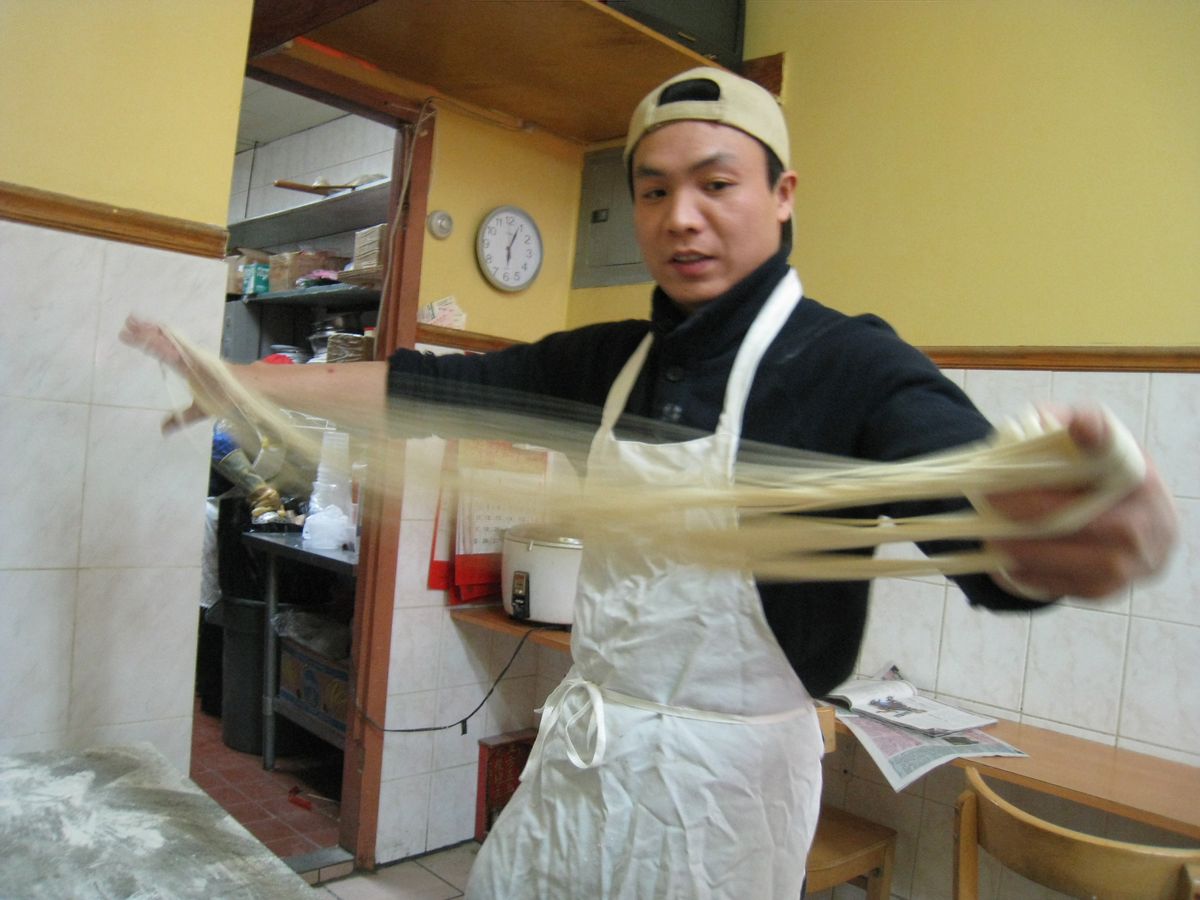
The master at work at Lam Zhou Handmade Noodle I suppose I’m easily entertained, but it’s hard to deny that you get a bit of a show with your lunch at the Lanzhou-style hand-pulled noodle shops popping up all over New York’s several Chinatowns: You order and a flour-covered cook will wrestle with a snake’s-length of white dough, wrap it around his fingers, and, like some elaborate, wheaty cat’s cradle, stretch, tug, and fold its way into a bundle of noodles. It’s cooking as manual acrobatics: You can watch it over and over and still be surprised at how the dough strands multiply, at how the hands move with such surety.
Of course, these things aren’t made for looking, and minutes after the cook casts your hank into boiling water, it comes to you in bowls of nearly boiling soup, deep-tasting and brown with beef to its core, scented with warming spices like star anise and slicks of red chili oil, sporting garnishes and meats of many textures.
Ever since the intrepid Robert Sietsema brought New York’s first and most almost-famous of these places — the excellently named Super Taste — into food-nerd prominence four years ago, these noodles named for an obscure city smack dab in the center of China have become a bit of a cottage industry here, with nearly a dozen shops specializing in them within blocks of each other. Ready to eat our weight in wheat, some friends and I slurped our way through four remarkable shops, and learned a little about what we were eating and who was feeding us in the process. (Check out the map below!)
Fitting for the elder statesman of the hand-pulled noodle crowd, Super Taste‘s menu features an extensive essay introducing its specialty to the uninitiated, and placing it in historical context:
It is said they were sold in the streets of Lanzhou as early as Han dynasty and Tong dynasty … There are four characteristics of genuine Lanzhou Hand-pulled noodles:
1) Clear, which means that soup should be clear
2) White, means that flour must be white with t endon
3) Red, means that hot chili oil must be used
4) Green, means that parsley, garlic bolt must be fresh and green.
Beef noodles vary in their sizes. They are commonly seen as wide, wider, thin, thinner as well as the side of chive leaf.
If you read past the typos and consider the poetics of the non-native speaker, there is an animating philosophy here, an exacting tradition to be accountable to, and it’s not every day one finds what is basically a feeding station with such pride in the story of its work.
But Super Taste has reason to be proud. Its noodles are pleasingly elastic, the broth is clear and deep, and former Gourmet editor and New York Times restaurant critic Ruth Reichl considers its “Beef in Hot & Spicy Soup” fair consolation for jury duty. Still, the finest work here is one of the side orders: steamed dumplings the size of babies’ fists, the skins so delicate they’re translucent, the filling juicy and porky, the flavor alternating between chews with garlic chives and sweet spices. “Cinnamon!” Charlotte exclaimed, her eyes opening wide. Those dumplings are awesome. I want to date those dumplings.
Plus, despite the fact that this mere slip of a closet of a restaurant serves everything in plastic bowls, Super Taste has an environmentally friendly paperless ordering system! It involves a woman screeching orders back into the kitchen — directly at sitting-ear-level — in a voice that can sandblast the sides of buildings. Eating those dumplings with this unearthly wail erupting behind me, I haven’t been so horrified and excited at the same time since I tried to get into industrial music in high school.
According to Eileen Yin-Fei Lo, one of the great teachers of Chinese food and the author of “Mastering the Art of Chinese Cooking,” all that slapping and working of the dough is to get the proteins in the flour activated and aligned. “The noodles should be very strong but not tough,” she told me, and at Kuai An, they have not only integrity but a velvety feel, as if they were drawing the broth to themselves.
Kuai An is a happy-making place, and not just because halfway through our meal I saw employees gather sweetly around a freshly opened durian in the kitchen with smiles usually reserved for birthday cake. The House Special noodles floats hunks of duck, two forms of whistle-clean beef tripe and the intense freshness of celery leaves in a broth that trades clarity for meaty complexity. Gilding the lily is what my mother calls a “wallet egg,” an egg fried so ferociously that it sits on the top of the bowl like a UFO covered in gold lace, so hot it’s literally still crackling, the outsides crisp and chewy, the yolk cooked through and floury, mimicking the satisfying roughness of the noodles. I should warn you to eat the noodles quickly, since the hot soup can waterlog them after a while, but I don’t imagine they’ll last that long.
It was also at Kuai An that I learned a fascinating footnote to culinary history. One bowl of noodles in a duck and taro soup was gorgeous with the sweet and floral notes of rice wine, and I talked with the server about it. “That is a specialty from Fujian,” she said. “We are Fujianese.”
“Wait, you’re not from Lanzhou?” I asked. Fujian is on the southeastern coast of China, about a million miles from where these noodles are supposed to be from.
“No, we are from Fujian. Our noodle master’s teacher was from Lanzhou. All the Lanzhou noodle shops in New York are owned by Fujianese.”
This was exactly as shocking as if I’d just found out that all the Texas barbecue I’ve ever eaten was made by people from Maine.
“Many masters from Lanzhou opened noodle shops in Fujian, so we learned the dish from them and brought it here,” she said. And, as shown by the duck and taro soup, they put their own stamp on it too. (Jennifer 8. Lee’s “Fortune Cookie Chronicles” has a fascinating chapter on how so many Fujianese have emigrated to become restaurant workers in America that whole towns there are deserted.)
Next door to Lam Zhou Handmade Noodle (you know, that whole transliteration thing is never easy) the Chinatown Lumber Co. has a warehouse, where you hear heavy pallets crashing about all day long. But if you’re inside the restaurant, the noise will be coming from the corner of the dining room, from the man at the marble-topped table. He pulls, stretches, and, lifting his arms way out to get good leverage, whips the dough down with a certain violence. The slapping sound cracks loud enough to make the unaware jump from their chair, and I began to wonder if that table was put there because the kitchen was too small, or because it was useful in intimidating people. Chinatown can get kinda rough, you know.
Here, the beef brisket soup took me instantly to my childhood. The noodles were silky and strong, the brisket pleasantly chewy, and the broth, on an impossibly cold night, so warming with star anise that it suddenly felt like my odd little childhood could be universally understood.
The pork bone soup is gnawin’ food. Instead of bite-size chunks of beef or whatever as a topping, you get a big caveman-style bone, boiled clean, from which to suck the marrow and chew the meat and tendon. It’s a primal pleasure for which there is no polite method. The presence of the bone shows in the broth, too, which Charlotte described as being “like a murky pond,” with just a touch, a connoisseur’s tickle, of barnyard stank. It’s so luxurious with dissolved gelatin, so mouth-coating, you just know it gets solid when cold.
Finally, after this most animal specimen, it was a real change of pace to arrive at Tasty Hand-Pulled Noodle, located closer in the older, more Cantonese-speaking part of Chinatown. There are decorations on the walls, helpful picture menus, and a notable dedication to creature comforts like clean floors.
These things made me suspicious. I looked into the kitchen, and the man dealing with the noodles did so in soporific fashion, as if barely able to stand up, much less handle the dough with any vigor. I was even less heartened.
But then the server brought our pan-fried chicken dumplings, which were filled with juice and sang with ginger. Our seafood soup tasted cleanly, magnificently of clams and other things in shells, with yards of wonderfully structured noodles, tender and resilient. The server directed us to be generous in our beef soups with cilantro and chili oil, and she could not have steered us more rightly — the long-cooked taste of meat and spice lightened with the fresh herbs and the rich slick of hot oil extended through the flavors. My suspicions were confirmed, but in a good way: Like the dining room, these were bowls of a more refined order.
As I left, I saw a man in an elegant wool greatcoat wiping down bowls behind the counter. I’m serious. This is a class joint! The Fujianese makers of Lanzhou-style noodles, it seems, are moving up in the world.
Do you have places that serve this dish near you? Give us your favorites in the comments!
View Hand pulled noodle grub crawl in a larger map
Super Taste
26 N. Eldridge Street
New York, NY 10013
212.625.1198
Kuai An Hand Pull Noodles
28 Forsyth Street
New York, NY 10002
212.941.7678
Lam Zhou Handmade Noodle
144 East Broadway
New York, NY 10002
212.566.6933
Tasty Hand-Pulled Noodle
1 Doyers Street
New York, NY 10013
212.791.1817
Francis Lam is Features Editor at Gilt Taste, provides color commentary for the Cooking Channel show Food(ography), and tweets at @francis_lam. More Francis Lam.
Building a perfect Paris picnic
A guided food tour with a dash of history, culture and hot teenagers making out (with a handy map!)
By Francis LamTopics: Food, Food Crawls, Francis in France!
The perfect Paris picnic Vacation multitasking is one of the most sorrowful ideas imaginable. You’re on vacation! Try to enjoy it! But if your time is short in Paris, (or even if it’s not), why not see half the city and have lunch at the same time? Because this town is built for picnics, and here’s a highly recommended trail of crumbs.
First of all, have a few friends with you, because you’re going to need help eating all this stuff. Or a lover! It’s going to be a romantic stroll. But you’ll still need extra stomachs … better to have a few lovers then. Hey, it’s cool. It’s France!
Start in the morning, of course, with bread, and for that, head to the original Eric Kayser on Rue Monge in the 5th arrondissement, in the shadow of Notre Dame. Eric Kayser is home of a deliriously good baguette — several, in fact: the classic, with an extra-crisp crust and clean flavor, and the baguette Monge, with its thicker, richer crunch and the aroma of a slow rise, and well, OK, you can probably end up getting swept away with any number of other breads there. But choose wisely; we’ve got more bread coming later. (Note that there is an organic — “biologique” — Eric Kayser bakery a few doors down. The bread is not nearly as good there, in my opinion.)
No, it’s not too early for ice cream, and I wouldn’t look askance if you decide to take a little detour right now to Berthillon. I mean, it’s just a few blocks, a bridge, and a shoulder-to-shoulder line of tourists away, and the chocolate ice cream is so rich it’s chewy, the caramel ice cream has the power of a hundred caramel candies, and if you happen to be there for wild strawberry (fraise des bois) season, a taste of that sorbet will make you realize that the only way to get closer to the fruit is by getting buck naked and rolling around in a strawberry patch. (Don’t do that in the sorbet. People will disapprove.)
With or without ice cream coursing through your veins, now we’re going to make the first of several pastry stops. MasMoudi is fascinating, a shop on the chic Boulevard Saint-Germain that looks like a fancy jeweler, selling instead gemlike Middle Eastern sweets in a room so intensely, gorgeously blue you’ll feel like you’re fever-dreaming on a raft in the Mediterranean. Skip the baklava and pay attention to the phenomenally meticulous quarter-size pistachio and pine nut confections, made with the crispest, lightest phyllo dough, rich nut bases, fragrant floral essences and stunningly arranged as if flower buds themselves.

MasMoudi’s pistachio and pine nut sweets
Now it’s time to go to church. Pierre Hermé is a demigod among pastry chefs, and a god among normal men. His pastries are part fashion (he releases them in seasonal “lines” of themed flavor combinations), part art, and all kick-ass. The Ispahan is a signature, an expression of raspberries, rose and litchi in the form of fresh berries, macarons and litchi cream, so gorgeous and subtle and wonderful, it seems almost a shame to pick it up and eat it like a hamburger, bits and pieces falling from your hands. Choose a few tarts and such from the case, but don’t forget the little corner in the back of the shop featuring phenomenal croissants and other less-showy products. And really don’t miss the canneles; shy and dumpy-looking amid all the gorgeousness, these brown little plugs are fantastic: Caramelized, pliant crunch giving way to a near-custard center.

Flickr/Meg Zimbeck
The Ispahan
Oh wait, now it’s time to go to church: Right outside of Pierre Hermé is Saint-Sulpice, a stunning building that would be the absolute pride of any other city, but in Paris is just another around-the-corner breathtaker. Ornate and grand but still intimate and human-scaled, a slow, quiet walk through Saint-Sulpice was for me a grounding moment, a meditative pause in a morning of earthy pleasures.

Francis Lam
This guy grows the craziest strawberries
Pierre Hermé is renowned for his macarons (and for good reason — his passion fruit and chocolate version combines those flavors so seamlessly you think they’re the same), but to my mind, the finest-textured macarons I had were from nearby, by the Japanese-French master Sadaharu Aoki. Delicately brittle with an airy, chewy center, his macarons beautifully essentialize and deliver their flavors. Most are traditionally French, but he also features a few unique Japanese fillings, including a crowd-pleasing black sesame and a warm, toasty genmaicha tea. And as a bonus, Aoki’s macarons cost nearly half of Pierre Hermé’s.
This may not mean much to most people, but for many years, Lionel Poilâne was the most famous bread baker in the world, and he lived the celebrity lifestyle to prove it. He had a private island, his own helicopter, mailed Robert De Niro daily loaves and made art with Salvador Dalí, including a famous bread birdcage from which the bird ate its way to freedom.
But before sourdough money allowed him to be a dandy, he was just a serious-as-hell baker, continuing in his father’s footsteps of making naturally leavened, old-time country loaves in a Paris that was increasingly turning to industrial, lifeless bread. Lionel went even further, becoming a sort of national bread archivist, collecting and preserving traditional recipes and techniques from all over the country.
His miche loaves, with their chewy, meaty texture, were considered by many to be the best bread in the world, but of course, with fame and success come successors and detractors. Some say Poilâne’s bread is no longer even the best in Paris, including my friend Brandon, who knows a thing or two about dough. But we had to go there anyway, if only to pay our respects (Poilâne died in a helicopter crash years ago), and upon tasting the miche again, Brandon took a considered pause. Finally, he said, “OK, well, with a little butter on it, I bet that bread will make me cry.”
Now with all that bread and several rounds of dessert taken care of, let’s get you set up with the other four food groups. (There are five food groups in France: Butter gets its own.) Strap a seat belt on your shopping cart and get ready for Le Grande Epicerie de Paris. You could literally spend hours here shopping for everything from Christine Ferber’s epic jams to exotic teas to four or five different breeds of chickens. But here are some highlights: first, butter. Bordier butter. This is the King of Butters, so cultured and yellow it looks like a brick of cheese, with a firm texture and flavor so full it sticks around for days. The demi-sel is salted and magnificent, but I’m really into the “algues,” with bits of seaweed mixed in. Seriously — it gives a fascinating, fresh flavor of the sea.
Stroll through the produce section, and be on the lookout for little plastic boxes of lettuces, berries and other produce with a red label and cute photos of earnest-looking men, pictures of the farmers who grew that particular handful of berries or pile of greens. Everything we tried from those boxes was magic — arugula like fresh pepper, strawberries as refreshing as a cold glass of water.
And then, of course, acquaint yourself with the counters of cured meats. There are literally dozens of hams, dried and fresh sausages, pâtes and terrines and all the rest of it, and the people behind the counter will not look at you funny if you ask for just a few paper-thin slices, which they then wrap and seal in a cool little hot-seaming machine. I really loved the smoked dry-cured ham from Alsace (jambon cru fumé Alsace), the jambon de Bayonne (France’s answer to prosciutto), the dry sausage called rosette de Lyon, and the spreadable goose (rillettes d’oie).
This may be impolitic of me to say since we are in France, but France is also in Europe, which means that the incredible Spanish ham jamón iberico de bellota 1) is widely available, and 2) instead of costing as much as your house, it only costs as much as your car. But three paper-thin slices of the stuff will keep you smiling for hours, and isn’t that worth a few bucks? (Grab a few knives and maybe forks here, too.)
OK, last stop, because as you may have noticed, we skipped the entirety of the cheese section. Why? Because just a few blocks away is the Crèmerie Quatrehomme, where it’s nearly impossible to go wrong with any cheese. Owner Marie Quatrehomme was the first woman to win the super-prestigious Meilleurs Ouvriers de France, sort of a national medal of honor for craftspeople. Yes, she won a national medal of honor for running a cheese shop. I don’t know what that means exactly (superb alphabetizing?), but I do know it means you can trust her. Go with an idea of what you like (goat cheese makes you want to die? Don’t get goat cheese!), but an open mind. And here’s a tip: anything with the words “au lait cru” (made from raw milk) is probably something you can’t get back home. I am in love with long-aged Comte, with its Pac-Man wheels and salty nuttiness, and definitely give some serious thought to the soft cheeses, the Brie de Melun and such, whose creaminess and complexity have nothing to do with the wan versions sold shrink-wrapped in our supermarkets or found baked on wedding buffets. If they’re soft and kinda bulgy, like they’re melting in slow motion, eat them. Pay for them first, but eat them.
Now, with eight arms’ worth of food, go up the street and around the Jardin Catherine Labouré, a little gem of a park and garden with plenty of plush grass, shade, children playing, country-style restrooms and, if you’re (un?)lucky, hot young things making out. There, while Brandon cried over his bread and butter, Molly sat wild-eyed from her bite of Ispahan and Winnie sipped thoughtfully on a fruit juice, I gazed out over the lawn at a young couple.
“In health class they called that ‘heavy petting,’ I said, retraining my attention on the hams before me rather than the hams being caressed.
But a few bites later, I looked up again. “Whoa. And on wildlife documentaries I believe they call that ‘presenting.’” And we spent our afternoon with no worries, no multitasking, just enjoying the sun overhead, the animal funk of meat and cheese, and love in the air.
Continue Reading CloseFrancis Lam is Features Editor at Gilt Taste, provides color commentary for the Cooking Channel show Food(ography), and tweets at @francis_lam. More Francis Lam.
Recommendations
-
Does Being Rich Protect Women from Post-Partum Depression?
divorcedpauline -
Mr. Shyam, the Subzi-Wala
Ranjani Iyer Mohanty -
Do's and Don'ts of Dumpster Diving
Con Chapman
