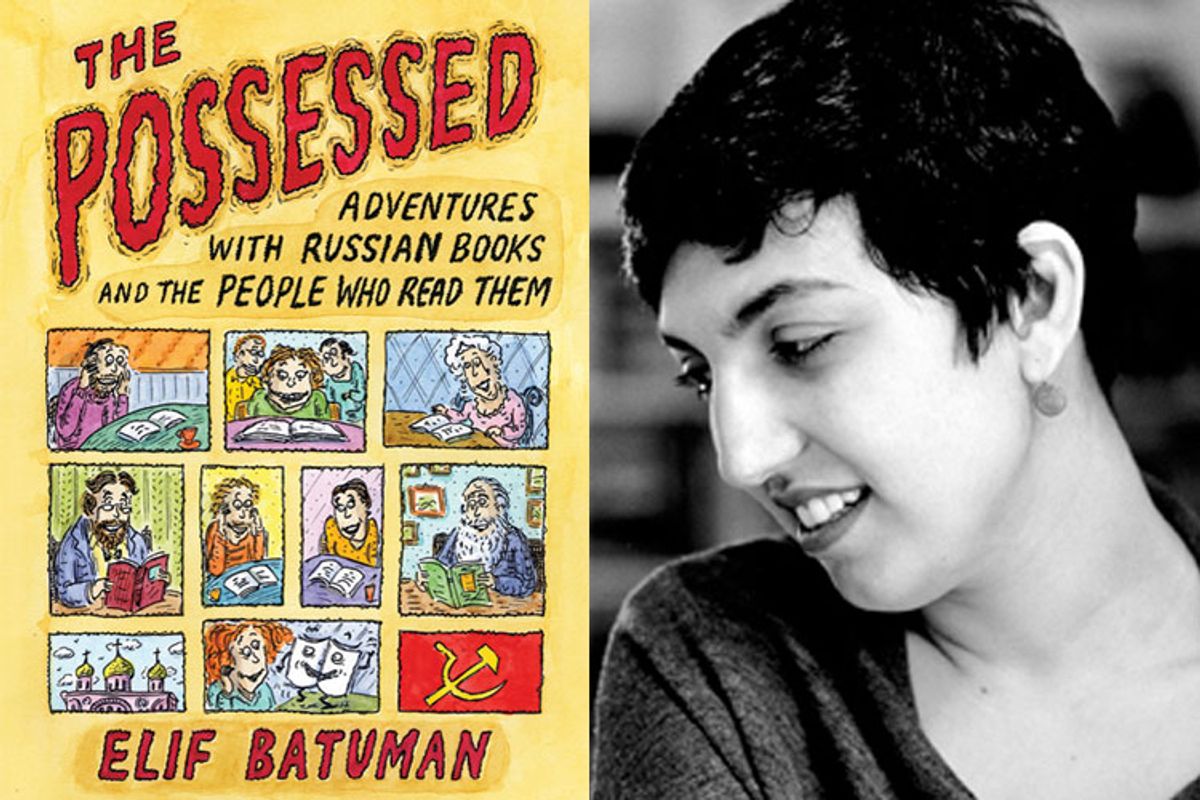
I ought to begin this with a disclaimer: I’m no great partisan of the Russian novel. There are some I love (“Crime and Punishment”), some I admire (“War and Peace”) and others I could never finish (“Dead Souls”), but I can’t claim to have read very many of them. So when I rave to you, dear readers, about Elif Batuman’s hilarious and charming “The Possessed: Adventures With Russian Books and the People Who Read Them,” understand that the author has entirely bewitched me despite my relative indifference to her subject. Ten pages in, I already knew I’d read her on pretty much anything.
Which is not to say that “The Possessed” failed to enlighten me about both Russian books and the people who adore them. For a while now, my beef with Russian literature has been that it is too confusing, not because of the names (the usual reason people give), but because of the manners. One character will do or say something seemingly innocuous — offer another character a cup of tea or compliment him on his hat — and the other character will react in some extravagant yet utterly unpredictable way, with fury, say, or abject gratitude. Why? I know of only one example in which this sort of thing has been explained: the famous case of Irena, in Chekhov’s “Three Sisters,” who is distraught to receive an expensive samovar as a gift because (experts will tell you) the urns were traditionally given to older women.
The fact that I could never quite understand what was going on put me off of Russian novels; for Batuman, it’s a prime attraction. Her “fascination with Russianness” dates back to her early youth when, as a first-generation Turkish-American from New Jersey, she took violin lessons from a Russian named Maxim. His behavior baffled her, particularly the period during which he exhaustively coached her for a juried examination, repeatedly insisting, “We have to be very well prepared because we do not know who is on this jury.” When she turned up for the exam, she found the panel headed up by “not some unknown judge, but Maxim himself.“
Captivated, Batuman developed an appetite for what she calls “mystifications.” “What I used to enjoy in poetry,” she writes, “was precisely the feeling of only half understanding.” Most essayists would probably approach the cognitive netherland of semi-communication as a sad and serious dilemma, but for Batuman it’s a kind of heaven, lush with comic possibility. Russians, with their unfathomable and melodramatic behavior, strike her as both awe-inspiring and amusing. “The Possessed” describes Batuman’s experiences at scholarly conferences where, in the middle of dinner, elderly ladies suddenly say things like “I would like to know if it is TRUE THAT YOU DESPISE ME,” and on assignment meeting people who “told me about their dream to reestablish Petersburg as ‘the birthplace of ice sculpture.’”
Quite a few of the adventures Batuman recounts, however, took place not in Russia but in Samarkand, Uzbekistan. In her early 20s, as a result of a series of misunderstandings and inexplicable actions, she wound up spending a summer there, studying “Old Uzbek,” a language and culture that was half invented, half stolen by the Soviets; it is at once tragic, bizarre and ridiculous. Batuman got interested in the Uzbek language because she’d hoped it would bridge Turkish and Russian, the languages of her heritage and her literary passion, respectively. In Samarkand, a ramshackle town with a glorious, if very distant, past, she trudged along unpaved streets (“a few times I saw a chicken walking around importantly, like some kind of a regional manager”) to a landmark known only as “the nine-story building,” where an instructor informed her of the indignities suffered by the Uzbeks at the hands of assorted barbaric conquerors. “Shaking her head sorrowfully, she told me that Genghis Khan not only rode a bull, but he didn’t wear any pants. She said that God should forgive her for mentioning such things to me, ‘but he didn’t wear any pants.’”
The language known as “Old Uzbek,” despite its dubious history and the fact that no books printed in it could be found in any of the Samarkand bookstores, was portrayed to Batuman as infinitely more illustrious and refined than Persian. “Old Uzbek had special verbs for being unable to sleep, for speaking while feeding animals, for being a hypocrite, for gazing imploringly into a lover’s face, for dispersing a crowd. It was all just like a Borges story — except that Borges stories are always so short, whereas life in Samarkand kept dragging obscurely on and on.” One great Old Uzbek poet, blind from birth, evidenced his talent by “molding a cooked bean into the shape of a ram, an animal he had never seen before.” A medieval Uzbek poem takes the form of love letters exchanged between the colors red and green.
Batuman’s affinity for the intersection of the grandiose and the absurd led her — unsurprisingly to anyone but herself — into an academic career. As a graduate student, she attracted the kind of friend who’d call up for advice on how to deal with dirty underwear, or who came over in the pouring rain to expound on “the two simple keys that were necessary for a perfect understanding of the poet Osip Mandelstam” or who, in one memorable example, wound up joining a monastery on an Adriatic island.
Batuman’s various scholarly projects have a sprightly aspect one doesn’t ordinarily associate with comp lit departments. They include: a dissertation comparing novel-writing to double-entry bookkeeping, a consideration of the “narrating sidekick” as a literary device (I should add that she seems nearly as obsessed with Sherlock Holmes as with any Russian character) and a contemplation of “the hugeness of novels, the way they devour time and material.” In hopes of obtaining a field-research grant to get her to a conference at Tolstoy’s former estate, she concocted a theory that the novelist might have been murdered. Then she seems to have half-convinced herself that it might be true. Meanwhile, her beloved Russians continued to provide her with fodder. On the flight over, Aeroflot lost her luggage, and when she called to check on it, she was told it would be sent to her eventually, but “in the meantime, are you familiar with our Russian phrase, resignation of the soul?“
The very funny voice Batuman uses to recount her exploits can be drolly formal, as if all the old books she reads have infected her with the antique air of a provincial czarist official. An incident in which she is bored by a fellow traveler on a layover in the Frankfurt airport is characterized as “having extinguished two hours of my youth.” And who under the age of 60 uses the word “comportment”? Or perhaps this is just the way you wind up writing when you’re the sort of person who gets dragooned into judging a boys’ “leg contest” in a Hungarian summer camp.
Possibly there isn’t enough direct discussion of Russian literature in Batuman’s book to please those who will pick it up with that expectation. Even the chapter devoted to the Dostoevsky novel that gives the book its title (relating “the descent into madness of a circle of intellectuals in a remote Russian village”) spends most of its pages detailing how disturbingly her friends in graduate school replicated the same story. (The current, more accurate translation of Dostoevsky’s title for that book is “The Demons.”) Perhaps it’s all just another mystification. Regardless, I’m hooked.
An ancient and priceless book, a murky history of evasions and coverups, an underground of sinister and possibly violent dealers, a former spy who drops tantalizing hints and a wily 84-year-old millionaire who says stuff like, “The problem with this story is that it could damage your health”: Are these the ingredients for a cheesy, improbable historical thriller? Yet “The Aleppo Codex,” Matti Friedman’s account of his attempts to learn the history of one of the world’s most precious books, sports all of these assets, and it’s nonfiction. If reporting this story damaged Friedman’s health, it probably happened when he realized what he’d stumbled into and his reporter’s heart started beating in doubletime.
The Aleppo Codex is the most authoritative version of the Hebrew Bible, produced in the 10th century by the great rabbi Aaron Ben-Asher and the scribe Shlomo ben Buya. Friedman, who lives in Israel and has covered the Mideast and the Caucasus for the Associated Press and other publications, explains that the codex’s significance to Jewish faith and identity is more than symbolic. As a people scattered across the globe, “instead of being bound by a king, a temple, or geography, [Jews] needed to be bound by something else, something portable. What emerged was the idea that a people could be held together by words.” Yet in the centuries before printing, when words were transmitted orally and by copyists, it was all too easy for mistakes and variations to creep in, and “Jews could not be held together by a book if they were not reading precisely the same one.”
The codex was the perfect version of the Bible, a sort of atomic clock of Judaism, and intended to be the model for all subsequent copies. Its early history was fraught: captured by Crusaders in the fall of Jerusalem, ransomed by the Jewish community in Cairo and consulted by the fabled sage Maimonides, it was eventually taken to the Syrian city of Aleppo. There, it resided for half a century. Although it was well-cared-for by Aleppo’s Jewish community, it had come to be revered as a relic or treasure; few were allowed to see it and no one was allowed to copy it.
All that changed in 1947, when the establishment of the state of Israel by a United Nations resolution led to unrest in the Arab world and the harassment and persecution of Jewish communities in Muslim nations. In Aleppo, this took the form of riots and the sacking of the synagogue. The codex — commonly referred to as the Crown — was supposed to have been consumed in a fire set by the mob.
It was not, and in 1958, the Crown was smuggled into Jerusalem by a cheese merchant who was one of the few Syrian Jews to receive official permission to emigrate to Israel. Friedman became interested in this “lonely treasure and millennium-old traveler” in 2008, when he decided to write an article about it. He imagined the piece would be “an uplifting and uncomplicated account of the rescue of a cultural artifact,” but what he discovered instead was a thicket of conflicting reports, missing records, puzzling omissions, stonewalling officials and obsessed amateur sleuths.
The mysteries surround not the ancient history of the book, but what happened to it between 1947 and the mid-1970s, although even establishing where things got dodgy proved to be a challenge. Friedman relates each piece of the story as he untangled it himself, and part of the pleasure of “The Aleppo Codex” is getting to tag along on the heels of a real-life investigative journalist as he does his detective work. Those years spent writing wire copy have not eroded the author’s eloquence, either, as the book’s headier touches attest: “Down in those streets, the stores now shuttered, the women of the manzul were receiving clients, and the men were submerged in cafe smoke like deep-sea divers, tubes between their lips, inhaling the rose-scented oxygen of water pipes.”
While the official story simply states that the Crown was presented to the president of Israel, Itzhak Ben-Zvi, upon its arrival in Jerusalem in 1958, Friedman unearthed evidence that this was no simple handoff. Most of the Jewish community of Aleppo had immigrated to Israel, and their rabbis insisted that the Crown was supposed to have been delivered to them. The cheese merchant maintained that the rabbis still living in Aleppo, the ones who had passed him the book, told him no more than to give it to “a religious man.” (The Syrian government prevented communication with the Jews in Aleppo, so his story could not be confirmed or disproved.) The Aleppo rabbis decided to take their complaint to court.
This dispute embodied major tensions within the newly formed state. The Aleppo rabbis had presided over what was, as Friedman writes, “an old community by the time Roman legions destroyed the Jewish temple in Jerusalem in AD 70.” The Israeli leadership, “largely secular European socialists,” did not strike the Aleppo Jews as “representing the entire Jewish people.” Why should these interlopers be allowed to appropriate a book that had been the focal point of Aleppo’s venerable Jewish community for half a millennium?
The codex lawsuit was also a dramatic example of what Friedman describes as a “largely untold story” concerning the migration of the Jewish Diaspora to Israel after the formation of the state. Along with the movement of people, there was also a “great migration of books.” Jews from all over the Muslim world were forced to leave neighborhoods their families had inhabited for centuries. Not only did distinctive local cultures vanish overnight, but so did many of their treasured texts, left at docks and airstrips with the promise that they would be forwarded on to their owners in Israel, and then never seen again. Well, not exactly never: Some of these books and scrolls turned up later in state archives and even in booksellers’ shops.
If that were all there was to the story of the Aleppo Codex, it would be fascinating (and dismaying) enough, but after wrestling with the shadowy story of how the Crown got to Jerusalem, Friedman turns to a second and even more disturbing question: Where is the rest of it? About 200 pages, some 40 percent of the Crown, are missing. These are the most important parts of all: the first five books of the Bible, also known as the Pentateuch and the Torah. Again, the official story holds that portions of the Crown were burned in the 1947 fire, but this has since been disproved. A couple of single pages have been found in places as far-flung as Brooklyn, N.Y., where they were carried around by Aleppo old-timers as good-luck charms. The bulk of the Torah, however, remains MIA.
This is where Friedman’s investigation gets especially lively, as he consults with a former Mossad case officer and secretly records an impromptu interview with one of the dozen or so men rich enough to have bought the missing pages. Supposedly, this collector and his daughter were approached by two dealers with a briefcase at a Jerusalem book fair in the 1980s. They were shown an old codex identified as part of the Crown, but the collector says he refused to buy it because the price was too high. One of the dealers later turned up dead in a Tel Aviv hotel room registered to a man who didn’t exist.
Friedman has his suspicions about the collector’s story: Would this man really consider $1 million too much to pay for a supposedly priceless text? He devotes most of his energy, however, to getting to the bottom of who is responsible for ripping out the heart of the Crown and selling it on the black market. As he settles on three likely culprits, “The Aleppo Codex” builds to a moral crescendo more impressive than the climactic fight scene in any thriller. “A volume that survived one thousand years of turbulent history was betrayed in our times by the people charged with guarding it,” Friedman writes. “We might file this tale between Cain and Abel and the golden calf, parables about the many ways we fail.”
Continue Reading
Close
“Bring Up the Bodies,” Hilary Mantel’s follow-up to her Man Booker Prize-winning 2009 novel, “Wolf Hall,” is a high-wire act, a feat of novelistic derring-do. Mantel makes bold not with form — by now meaningful experimentation in that area seems exhausted — but with the very material that brings most readers to novels in the first place: our imaginative identification with fictional characters and the experiences we feel we’re sharing with them.
As with “Wolf Hall,” the central character in “Bring Up the Bodies” is Thomas Cromwell, master secretary to King Henry VIII of England. The son of a drunken, abusive blacksmith, Cromwell has risen about as high as any commoner could hope to, entirely on the strength of his acumen, industry, cunning and resilience. As an often-quoted passage from “Wolf Hall” declares, “He is at home in courtroom and waterfront, bishop’s palace or inn yard. He can draft a contract, train a falcon, draw a map, stop a street fight, furnish a house and fix a jury.”
This is, incidentally, Cromwell’s own assessment, but he’s saved from vanity by the fact that his confidence is not just well-placed but precisely placed; he is the ultimate realist, and he possesses that most potent of assets, an excellent knowledge of himself. In the thousands of fictional retellings of Henry’s reign — most of them focused on his ambitious second wife, Anne Boleyn — Cromwell is typically depicted as a ruthless schemer. He got rid of Henry’s first wife, Catherine of Aragon, when Henry wanted Anne, and he got rid of Anne, too, when the time came. The first ejection led to the foundation of the Church of England and the second to the execution of six people.
As Mantel tells it — she describes the novel as “a proposal, an offer,” rather than an assertion of historical truth — Cromwell represents the vanguard of a new era, one in which ability trumps noble birth. He can countenance any number of insults from the arrogant aristocrats he works with because he knows that “chivalry’s day is over. One day soon moss will grow in the tilt yard. The days of the money lender have arrived, and the days of the swaggering privateer; banker sits down with banker, and the kings are their waiting boys.”
He would never dream of voicing such thoughts, of course, and part of the marvel of Cromwell the character is his self-control. “I never forget myself,” he tells the ambassador from the Holy Roman Empire at a moment when his temper has been sorely provoked. “What I do, I mean to do.” The style Mantel employs to write about this exemplar of the will is declarative to the point of bullishness; her voice is his. The character’s allure lies in his energy and his resilience, and it’s thrilling to hitch your readerly perspective to a man who can seemingly do anything and furthermore has the nerve to try.
But if Cromwell is a man of action, he’s also, at age 50, prone to reflection and haunted by the dead. “Bring Up the Bodies” opens with falconry in the picture-book English countryside during the king’s summer “progress” (a sort of nationwide tour) of 1535. Cromwell’s falcons are named after his two daughters, who, with his beloved wife, died in London’s intermittent epidemics. He hasn’t forgotten them, but it’s significant that he’s memorialized them as birds of prey. Above all, Cromwell nurses a grudge against all who participated in the downfall of his mentor, Cardinal Thomas Wolsey. Yet, he is not without warmth. A conscientious and covertly tender householder, he presides over the lives of assorted dependents from various social classes. His carefully concealed soft spot for distressed gentlewomen and exiled court figures like Catherine and her daughter, Mary Tudor, leads him to make small but largely unappreciated efforts on their behalf.
We are shown that Cromwell is ruthless — there’s passing mention of hangings in Ireland, among other things — but we also know that he is loyal. This is his saving virtue. His allegiance is to England and to Henry, who, like the late Cardinal, has recognized his worth and raised him up. Some of the more notorious highlights of Cromwell’s career — the dissolution and sacking of monasteries and other Church property and the execution of Thomas More, depicted in “Wolf Hall” — are cast in this light: England’s riches should belong to the state, not to Rome, and be utilized for the benefit of her king and people. Like a modern Labor Party politician, Cromwell tries to pass poor laws and work programs in the face of mighty resistance from Parliament and the aristocracy.
Throughout the first two parts of “Bring Up the Bodies,” this is the Cromwell we accompany. He is the king’s most valued councilor and is effectively running the country. His enemies are preening, scornful and often foolish noblemen, out to promote clannish interests or reconciliation with Rome. Anne Boleyn, his former ally, has turned on him, and turned off the king. “He has always rated Anne highly as a strategist,” Cromwell thinks. “He has never believed in her as a passionate, spontaneous woman. Everything she does is calculated, like everything he does,” yet she has overestimated her own security. They are two of a kind, perhaps, but unlike him, she has let her success go to her head and will, in consequence, lose both.
Discouraged by Anne’s inability to give him a son and harried by the vixenish ways that once enthralled him, Henry falls for Jane Seymour, “a plain young woman with a silvery pallor, a habit of silence and a trick of looking at men as if they represent an unpleasant surprise.” It becomes Cromwell’s job not only to clear the way for Jane to become Henry’s third wife, but to make the king feel that he is justified in discarding a second spouse. Cromwell pursues this goal in the conviction that sooner or later Anne would have come after him and his friends.
That’s the setup, but as the interrogation and trials of Anne and her alleged lovers commence, Mantel carries the reader into harrowing territory. Cromwell tricks a foppishly romantic musician into boasting of having slept with the queen (Mantel does not endorse the view that the man was tortured into this admission) and conducts a series of interviews with the four doomed noblemen accused of being her lovers and of plotting against the king. The four also happen to be Cromwell’s political enemies and, furthermore, key participants in a satirical court entertainment that depicted Cardinal Wolsey being dragged to hell by devils. “He needs guilty men,” Cromwell tells himself. “So he has found men who are guilty. Though perhaps not guilty as charged.”
Political horror is not a new literary mode — you can find it in the New Testament as well as in such 20th-century works as George Orwell’s “1984.” However, the protagonist in those stories is invariably the victim. “Bring Up the Bodies” devotes 270 pages to developing its hero, investing the reader in the superiority of his personality and cause, and then ushers him into the interrogator’s chair. Cromwell is contriving to send these people to the scaffold for crimes they quite possibly did not commit, however “guilty” they may be of others. Because he is our man ever bit as much as he is Henry’s man, we are, in some obscure way native to the laws of fiction, implicated. These are not easy chapters to read, although they are magnificently realized.
As assured as her implacable protagonist, Mantel walks the edge of a very sharp knife in the last part of “Bring Up the Bodies.” I don’t believe she cuts her feet on it, but sometimes it felt as if she were cutting mine. It’s impossible to repudiate Cromwell, but embracing him has become infinitely complicated. Of all the many fictional depictions of the moral quandaries involved in the exercise of great power, this may be one of the most disturbing. It comes much closer than any I’ve ever encountered to letting you know how it must feel to manage the fate of a nation: how intoxicating and how very, very perilous.
Continue Reading
Close
When people use the term “rhetoric” these days, they usually mean empty language — be it high-flown or spoken in high dudgeon. A few may think of rhetoric as a deadly classical discipline devoted to the exhaustive parsing and labeling of figures of speech: zeugma, anyone? Yet as Sam Leith points out in his delightful and illuminating “Words Like Loaded Pistols: Rhetoric from Aristotle to Obama,” we live in the most rhetorical era in human history, surrounded by and embroiled in argument, enticement, invective and panegyric wherever we turn.
The Greeks and Romans studied and scrutinized rhetoric so intently because they understood it to be the very stuff of power, specifically the power of persuasion — which, as Leith points out, is even more potent today than it was in the fourth century BC, when Aristotle produced the first treatise on the subject. The master’s “Rhetoric” is a work which (unlike much of his scientific writing) remains as useful today as it did in ancient Athens; Leith sprinkles shrewd tips from it (such as, construct your argument so that your audience thinks it’s their own idea) throughout his book. “He was the first person,” Leith writes of Aristotle, “really to grasp that the study of rhetoric is the study of humanity itself.”
Rhetoric is also, to be blunt, the art of talking people into things, and it flourishes in courtrooms and on campaign trails, in singles bars and television commercials, over dinner tables and in Internet forums. Leith, a British journalist and novelist, wants to revive the formal appreciation of rhetorical technique, but he acknowledges that today it’s precisely when we are most aware of rhetorical skill that we condemn it. If Barack Obama won the presidency largely on his strengths as an orator (a testimony to rhetoric’s importance if there ever was one), that same eloquence has become a stick to beat him with in the hands of his critics. Rick Santorum is typical in dismissing Obama “just a person of words.” “It seemed,” Leith writes of the 2008 election, “that though we expected politicians to make speeches, we didn’t like them to be too good at it.”
This isn’t precisely true; Obama’s supporters celebrate his speechmaking. But the potshots do illustrate the contemporary ambivalence toward smooth-talking of any kind. Whereas the ancients admired rhetoric as a consciously mastered skill, we prefer (we think) people who speak “from the heart” — if not quite spontaneously, then at the very least approximating a free outflowing of their supposedly true selves. To appear to have thought too much about what you’re saying, to be obviously conscious of it as a performance, is to seem insincere. No wonder the study of rhetoric per se has fallen by the wayside.
But of course, as Leith also points out, “being anti-rhetoric is, finally, just another rhetorical strategy.” “Words Like Loaded Pistols” sports a fabulous assortment of examples of time-tested rhetorical gambits in action. Exhibit A for “anti-rhetorical rhetoric” is Sarah Palin’s taped television address following the 2011 shooting of Rep. Gabrielle Giffords and 13 others in Arizona. The lunatic gunman, some observers felt, had been egged on by the paramilitaristic language and imagery of right-wingers in general and Palin’s own website in particular. Leith breaks down Palin’s statement using classical rhetorical terminology, but he also holds it up as an illustration of the ironic paradoxes of anti-rhetoric. “The way she chose to defend herself against trial by media was through the media; while denying that words could be held responsible for inciting hatred and violence, she asserted that media reporting on her” was inciting hatred and violence.
In further case studies, Leith examines the rhetorical technique of everyone from Eminem and “South Park” to Frederick Douglass, the courtroom combatants in “A Few Good Men,” Richard Nixon and his famous Checkers speech and Earl Spencer in the eulogy for his sister, Princess Diana. Interstitial chapters highlight “Champions of Rhetoric”: Abraham Lincoln, Winston Churchill, Cicero and Martin Luther King Jr., etc. (not excepting Hitler, because whatever else can be said about the man, he knew how to fire up a crowd).
Although this greatest-hits element is key to the appeal of “Words Like Loaded Pistols,” Leith also provides a brisk overview of rhetorical principles and terms — the latter of which, in tongue-twisting Greek and Latin, many readers will promptly forget. (It is amusing to learn that the lyrics to the Carpenters’ “Close to You” present a textbook specimen of hypophora.) However obscure the terminology may seem to modern readers, however, the thinking underlying it is rock solid.
And to judge by much of the public speaking and ostensibly persuasive writing one sees these days, it’s also woefully neglected. “Words Like Loaded Pistols” isn’t a how-to book, but chances are that anyone who reads it will acquire a trick or two. Many a catastrophic best-man toast or limping pitch meeting demonstrates the need for a better understanding of the elementary guidelines laid down well over 2,000 years ago: Know your audience and strive to portray yourself as one of them; adjust your style to the tenor of the occasion; consider starting with a tactical concession; and so on. The marvel is not that the old techniques still work, but that we ever persuaded ourselves that we could do without them.
Continue Reading
Close
In the hours after the 1995 bombing of the Murrah Federal Building in Oklahoma City, cable news breathlessly reported that authorities were searching for three Middle Eastern men supposedly seen fleeing the scene. True, this was just two years after the bombing of the World Trade Center by a Islamist cell led by Ramzi Yousef, but even so, the notion that foreign terrorists would target an ordinary office building in the middle of flyover country was far-fetched. Yet not as far-fetched, it seems, as the idea that Americans would do it, and end up killing 168 of their fellow citizens, 19 of them little children.
An FBI agent from Dallas, Danny Coulson, knew better. As Andrew Gumbel and Roger Charles relate in their impressive new book, “Oklahoma City: What the Investigation Missed — and Why It Still Matters,” Coulson jumped in his car and headed to Oklahoma City as soon as he heard about the bombing, fielding a call from a CBS correspondent along the way. She told him “everybody in Washington” said the perpetrators were Middle Eastern, but he said no way. “It’s a Bubba job,” he told her. “It’s Bubbas.”
It was Bubbas. But how many of them? Timothy McVeigh was convicted on 11 counts of murder and conspiracy and was executed for his role in the crime. Terry Nichols, who helped McVeigh construct the truck bomb, is still in federal prison serving a sentence of life without parole. A third conspirator, Mike Fortier, received a reduced sentence (and immunity for his wife, Lori) in exchange for testifying against the other two. Officially, these are all the parties responsible for the bombing, the most devastating act of terrorism committed in this country until 9/11. But many, many people are not satisfied with the official account.
Of course, a lot of these malcontents are cranks, offering paint-by-numbers scenarios in which 1) the attack really was “Middle Eastern” after all and 2) the government rigged the whole thing in order to discredit the right-wing militia movement to which McVeigh and Nichols belonged. Gumbel, an investigative journalist, and Charles, a former Marine Corps lieutenant colonel who consults with national news organizations on military and national intelligence stories, are obliged to distinguish themselves from such fantasists. Nevertheless, they assert, there are good reasons to feel “skeptical that all the perpetrators have been caught,” a sentiment they say is shared by many of their sources both outside the government and within it.
Their argument, unlike other conspiracy theories about Oklahoma City, is not outlandish. Gumbel and Charles (who also worked as an evidence analyst for McVeigh’s defense team) suspect that McVeigh had other accomplices in planning the attack, in assembling the materials for the bomb and in planting it on April 19. This help came from several nodes in a loose network of right-wing extremists — gun nuts, would-be-revolutionaries and separatist Christian sects — who have never been fully investigated or called to account.
Not a fanciful change, but at the same time a bold one, given that the multi-agency federal investigation collected a Brobdingnagian quantity of evidence: 13 million hotel and motel records, 6 million truck rental records, 28,000 interviews — an estimated 1 billion pieces of information. Yet for all this exhaustiveness, certain promising trails in the investigation went largely unexplored: over 1,000 latent fingerprints found in McVeigh’s car and motel room, for example, as well as his links to a gang of bank robbers belonging to the Aryan Republican Army, a rich gun dealer and a creepy fundamentalist compound called Elohim City.
The authors believe that federal agencies, shamed and stinging after bloody clashes with right-wing militants at Waco and Ruby Ridge, preferred not to mess with leads that might end in further confrontations. The prosecution concurred, having tried and failed in an earlier sedition trial against similar militants. They felt they’d learned not to test a jury’s ability to follow complex conspiratorial narratives with too many characters, or that asked it to believe that trash-talking backwoods paranoids could pose a serious threat to the U.S government.
“Oklahoma City” compiles a hefty collection of those unplumbed leads, some of it gleaned from newly released files and a jailhouse interview with Nichols that, they report, went into “great detail.” Given the milieus McVeigh and Nichols frequented, there are enough freak-show touches to keep an FX drama stocked for three seasons: a double-wide trailer full of snakes, a neo-Nazi with a secret life as a cross-dresser, a hot blonde with a swastika tattoo who agreed to act as an informant for the Bureau of Alcohol, Tobacco and Firearms, and so on. The authors refrain from milking this material for all its lurid charm, but somehow their deadpan delivery only makes it more grotesque.
They have excellent reasons for not treating this pack of alienated misfits as merely contemptible. As Gumbel and Rogers point out, McVeigh and many of his pals were veterans whose Gulf War battlefield experience left them with both military skills and emotional damage. “It is not difficult to see,” they write, “how new McVeighs could emerge from the wars in Iraq and Afghanistan, the lingering devastation of the 2008 economic meltdown and the anti-establishment rage embodied by everyone from the Tea Party and Occupy Wall Street to the violent racists threatening to put a bullet in the brain of America’s first black president.”
The book does suffer a bit from its authors’ submersion in the story. The narrative thread — so necessary for readers whose memories of the attack and investigation have faded — occasionally gets lost as they jump around chronologically to demonstrate the shakiness of some points in the government’s version of the story. Still, it’s shocking to learn that over two dozen eyewitnesses reported having seen McVeigh with at least one other person on the morning of the bombing, contradicting the prosecution’s assertion that he acted alone on that day. Eyewitness testimony is notoriously unreliable, but that’s a lot of people, and the ones the authors describe in detail had direct, highly memorable encounters with the bomber(s).
Perhaps the most persuasive aspect of “Oklahoma City” is its refusal of paranoia. The typical crackpot conspiracy theory relies on a masterly, Luciferian characterization of the conspirators, who are invariably depicted as puppet masters capable of pulling off elaborate illusions, feints and coverups without a hitch. As Gumbel and Rogers tell it, the bombing investigation fell short of discovering the truth because of sloppiness, failure of will, self-serving intra-office politics and, above all, idiotic and obstructive turf wars among law enforcement agencies. Now, that sounds more like the government that left us vulnerable six years later and that may well let us down again.
Continue Reading
Close
It’s Vienna, 1914, and everyone is preoccupied with the secret side of life. Lysander Rief, a young British actor visiting the city, learns that the parlormaid in his respectable boarding house has been turning tricks with a fellow guest, a man suspected of embezzling from the army, who explains to the bemused foreigner that in respectable-looking Vienna, “below the surface, the river is flowing, dark and strong.” What river? “The river of sex.” Not long after that, Lysander himself begins a passionate affair with a sculptor behind the back of her common-law husband. The rest of his time he devotes to a form of psychotherapy that entails papering over a shameful incident in his past with tamer, happier “memories” induced by hypnosis.
So begins William Boyd’s new novel, “Waiting for Sunrise.” Of course, Vienna in 1914 was also the stomping ground of Sigmund Freud, whose psychoanalysis had just become popular among Europe’s educated classes. Lysander arrives in town to seek treatment for a somewhat unusual sexual dysfunction: He can’t reach orgasm during intercourse. Vienna fixes that right up, though whether his therapist’s treatment works this miracle or it’s accomplished thanks to the ministrations of that seductive sculptor remains one of the novel’s many mysteries.
Boyd is the author of “Any Human Heart,” a faux biography that was one of the best novels of the 2000s. Lately he’s been writing what could be called either high-end spy novels or intrigue-heavy literary fiction. Like Kate Atkinson, who fused the literary qualities of the contemporary comedy of manners with the detective novel, Boyd retrofits a genre full of familiar devices and character types with finer textures and deeper psychology than it typically boasts. Yet just as Atkinson always remembers that the primary concern of the detective novel is justice, Boyd never forgets that spy fiction is fundamentally about lies.
What Lysander receives in Vienna is a master class in lies, beginning with his therapist’s theory, dubbed “Parallelism.” It holds that, while the actual world is “in essence neutral — flat, empty, bereft of meaning and significance,” human beings “fill it with color, feeling, purpose and emotion” by using our imagination. This effectively means “we can shape our world in any way we want.”
Freud himself, who appears briefly in the novel, doesn’t think much of this theory. He is, after all, in the business of convincing people that their innermost urges and deeply buried memories can’t ever be successfully suppressed. (He’d agree about the river of sex, though.) The reader, too, knows that another, more harrowing form of disillusionment awaits Lysander and his orderly, bourgeois Edwardian cohort with the advent of World War I. Lysander walks into the novel in sunshine and out of it in shadows, which more or less describes the trajectory of his generation.
When his affair with the sculptor takes an especially nasty turn and he has to flee the city in disguise, Lysander’s actorly skills attract the attention of a couple of attachés at the British Embassy. Later, after the war starts, they pluck him out of his regiment and set him to work hunting a mole in the War Office. Alluring women with ambiguous motives move in and out of his life. He finds himself constantly second-guessing his handlers and their motives. He does things that he can’t really bring himself to acknowledge. “My life seems to be running on a track I have nothing to do with,” he writes in the journal he started keeping under doctor’s orders in Vienna. “I’m a passenger on a train but I have no idea of the route it’s taking or its final destination.”
Is Lysander’s identity — and Europe’s — being broken down and remade, or merely excavated to its roots? “Waiting for Sunrise” transpires in a world of impenetrable mysteries and motives, only a few of which actually pertain to military secrets. “We’re all actors, aren’t we?” says one character. “Some are good, some are average. But nobody really knows what’s real, what’s true. Impossible to tell for sure.”
If the novel has a flaw, it’s a tendency for somewhat on-the-nose lines like that. When Lysander agrees to spy, he momentarily longs to be back onstage, then reminds himself that in a way he’s still performing. (Perhaps Boyd thinks that potboiler fans who pick this book up will need to have its themes underlined for them? I’d like to think that’s not true, but a quick cruise through the Amazon reader reviews of any even slightly challenging novel tells me I’m wrong.)
Still, even as the novel is explaining its theme, it manages to conjure an atmosphere of genuine disorientation that most spy novels gesture toward and few, if any, attain. The book defies enough genre conventions to leave its reader profoundly unsure of just where things are headed.
That’s why, I suspect, “Waiting for Sunrise” is set during World War I instead of World War II, by far the more romantic and popular period for espionage fiction. What Lysander — and the reader — go through is, after all, very much the experience of cultivated Europeans during the course of the war. Life made sense. It had well-worn grooves that it moved along into the future and there was also observable progress toward a society ruled by reason. Five years later and every comfortable expectation about humanity and civilization had been torn away. Whether Lysander loses his true self or gains it is the sort of question it will take the rest of the 20th century to answer.
Continue Reading
Close