U.S. Military
Who’s in control in the White House?
If you thought the rogue sensibility went away with the Bushes, think again
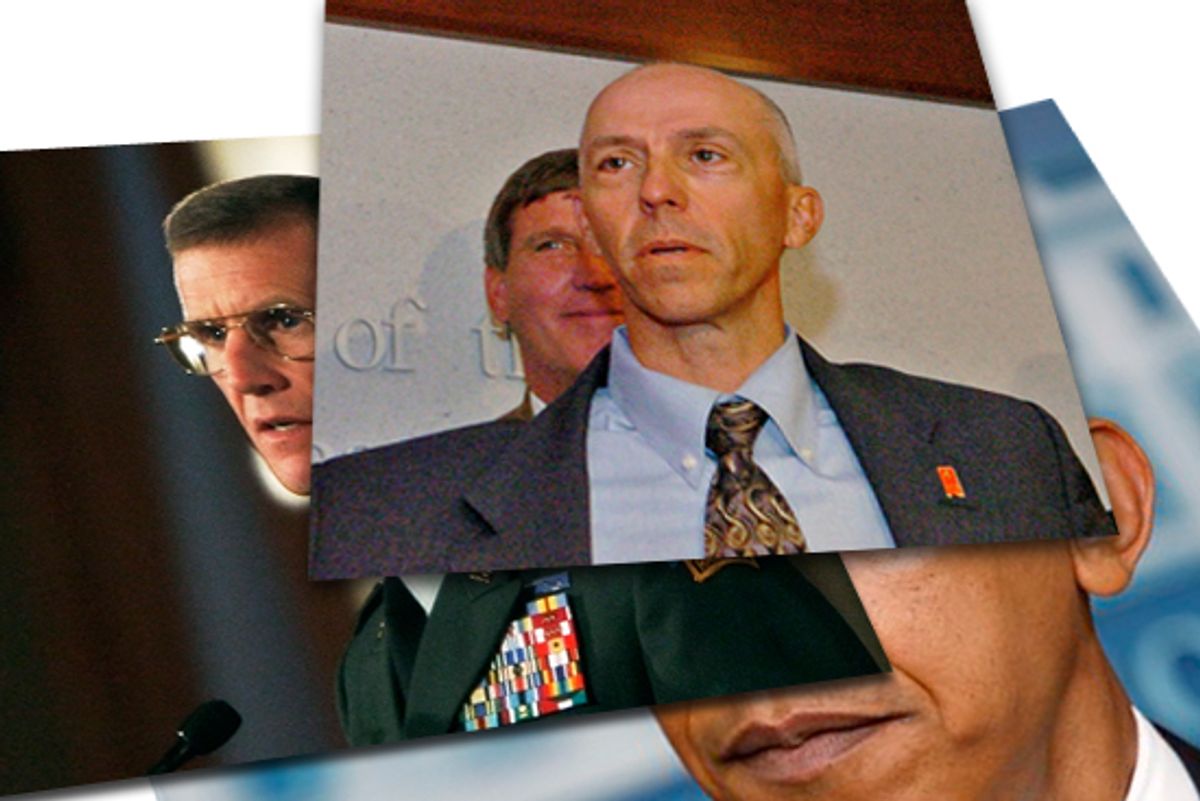
Left to right: Gen. Stanley McChrystal, DEA agent Jeffrey Sweetin, and President Obama. ”I am in control here in the White House.” — Secretary of State Alexander Haig, 1981
Ah, the good old days when even a big shot like Gen. Al Haig, who died early Saturday, could get in trouble for such mavericky declarations that defy basic constitutional precedents.
In the 21st century, that’s ancient history. We’ve so idealized cowboy-style rebellion in matters of war and law enforcement that “going Haig” is today honored as “going rogue.” Defiance, irreverence, contempt — these are the moment’s most venerated postures, no matter how destructive or lawless.
The Bush administration’s illegal wiretapping and torture sessions were the most obvious examples of the rogue sensibility on steroids. But then came McCain-Palin, a presidential ticket predicated almost singularly on the rogue brand. And now, even in the Obama era, that brand pervades.
It began reemerging in September with Gen. Stanley McChrystal’s Afghan escalation plan. McChrystal didn’t just ask President Obama for more troops — protocol-wise, that would have been completely appropriate. No, McChrystal went rogue, preemptively leaking his request to the media, then delivering a public address telling Obama to immediately follow his orders.
Incredibly, few politicians or pundits raised objections to McChrystal’s behavior. Worse, rather than firing McChrystal, Obama meekly agreed to his demands, letting Americans know that when it comes to foreign policy, the rogue general — not the popularly elected president — is in control in the White House.
Of course, while McChrystal’s insubordination was extra-constitutional in spirit, he at least made the effort to obtain the commander-in-chief’s rubber-stamp approval. The same cannot be said for the rogues inside Obama’s Drug Enforcement Agency (DEA).
Recall that one year ago, Obama instructed the DEA to follow his campaign pledge and respect local statutes legalizing medicinal marijuana. When the DEA kept raiding pot dispensaries in states that had passed such laws, Attorney General Eric Holder reiterated the cease and desist decree, stating that “What (Obama) said during the campaign is now American policy.”
As even more raids nonetheless continued, the Justice Department then issued an explicit memo ordering federal agents to refrain from prosecuting those who are in “compliance with existing state laws providing for the medical use of marijuana.”
And yet the DEA has recently intensified its crackdown. Here in Colorado — where voters enshrined medical marijuana’s legality in our state constitution — the feds not only raided two dispensaries, but did so in a way that deliberately humiliated their superiors.
In January, the DEA stormed a company that performs cannabis quality tests. The firm’s alleged infraction? Following protocol and formally applying for a federal equipment license. DEA rogues responded to the request not with thanks or — heaven forbid — approval, but instead with the gestapo.
This was topped last week when DEA agents arrested a medical marijuana grower who dared discuss his business with a local news outlet. Sensing a P.R. opportunity, DEA agent Jeffrey Sweetin used the spectacle to insist that he will not listen to stand-down directives from his bosses.
“The time is coming when we go into a dispensary, we find out what their profit is, we seize the building and we arrest everybody,” Sweetin menacingly intoned.
Once again, a rogue going wild and once again, tacit acceptance. Rather than personnel changes reining in the out-of-control agency, the president has nominated the acting Bush-appointed DEA administrator, Michele Leonhart, to a full term.
The message, then, should be clear: If you’re looking for who is “in control” of our military and police forces, don’t look to the established chain of command and don’t look to constitutional provisions that mandate civilian authority over the government bayonet. Look to the most reckless rogues — it’s a good bet they’re the ones running the show.
David Sirota is the author of the best-selling books “Hostile Takeover” and “The Uprising.” He hosts the morning show on AM760 in Colorado and blogs at OpenLeft.com. E-mail him at ds@davidsirota.com or follow him on Twitter @davidsirota.
© 2010 Creators.com
David Sirota is a best-selling author of the new book "Back to Our Future: How the 1980s Explain the World We Live In Now." He hosts the morning show on AM760 in Colorado. E-mail him at ds@davidsirota.com, follow him on Twitter @davidsirota or visit his website at www.davidsirota.com. More David Sirota.
Don’t ask, don’t tell 2.0
Conservatives in Congress are pushing for new ways to keep discriminating against gay and lesbian soldiers
(Credit: AP/David Lewis) People who thought the repeal of “don’t ask, don’t tell” was the final word on discrimination against gay and lesbian soldiers were mistaken. As the House of Representatives debates the National Defense Authorization Act this week, Republicans will push for two amendments to permit the military to discriminate against gay and lesbian service members, using “religious freedom” as a cover.
One amendment, offered by Mississippi Republican Steven Palazzo, would prohibit the use of military property to “officiate, solemnize, or perform a marriage or marriage-like ceremony, involving anything other than the union of one man with one woman,” even on bases in states in which same-sex marriage is legal. Rep. Todd Akin’s, R-Mo., amendment would require the military to “accommodate the conscience and sincerely held moral principles and religious beliefs of the members of the Armed Forces concerning the appropriate and inappropriate expression of human sexuality” and would prohibit “adverse personnel actions” against them.
Continue Reading CloseSarah Posner is the senior editor of Religion Dispatches, where she writes about politics. She is also the author of God's Profits: Faith, Fraud, and the Republican Crusade for Values Voters" (PoliPoint Press, 2008). More Sarah Posner.
America’s real Hunger Games
Young people are already being sacrificed at the whims of the 1%. Just look at Iraq and Afghanistan
U.S. Army soldiers respond after a suicide attack on the US..-led provincial reconstruction team (PRT) compound in the Behsood district of Jalalabad, east of Kabul Afghanistan, on Sunday, April 15, 15 2012. (Credit: AP Phot/Rahmat Gul) When I was growing up, I ate books for breakfast, lunch and dinner, and since I was constantly running out of reading material, I read everyone else’s — which for a girl with older brothers meant science fiction. The books were supposed to be about the future, but they always turned out to be very much about this very moment.
Some of them — Robert Heinlein’s “Stranger in a Strange Land” — were comically of their time: that novel’s vision of the good life seemed to owe an awful lot to the Playboy Mansion in its prime, only with telepathy and being nice added in. Frank Herbert’s “Dune” had similarly sixties social mores, but its vision of an intergalactic world of disciplined desert jihadis and a great game for the substance that made all long-distance transit possible is even more relevant now. Think: drug cartels meet the oil industry in the deep desert.
Continue Reading CloseRebecca Solnit grew up in California public libraries and is thrilled to be revisiting them all over the state as part of the Cal Humanities California Reads project, which is now featuring five books, including her A Paradise Built in Hell: The Extraordinary Communities That Arise in Disaster. More Rebecca Solnit.
Conservatives mad at liberal media, Obama over Afghanistan photos
Confused right-wing responses to a grisly scandal
U.S. Army soldiers from 4-73 Cavalry Regiment, 82nd Airborne Division walk during a mission in Zhary district of Kandahar province, southern Afghanistan April 17, 2012(Credit: REUTERS/Baz Ratner) The L.A. Times Wednesday published photos of American troops in Afghanistan posing and grinning with the body parts of dead Afghan insurgents. There are 18 photos in all of soldiers posing with human remains, all from 2010, and the Times published two of them. The newspaper received the photos from a soldier in the unit depicted, who, according to Times editors, sought to publicize “dysfunction in discipline and a breakdown in leadership that compromised the safety of the troops.”
Continue Reading Close
Alex Pareene writes about politics for Salon and is the author of "The Rude Guide to Mitt." Email him at apareene@salon.com and follow him on Twitter @pareene More Alex Pareene.
The army’s new photo scandal
Photos released by the LA Times show American troops posing with the corpses of Afghan suicide bombers
In a cropped version of a photo released by the LA Times, a soldier from the Army's 82nd Airborne Division with the body of an Afghan insurgent killed while trying to plant a roadside bomb (Credit: Los Angeles Times) The Los Angeles Times released photos on Wednesday showing American troops posing with the mangled corpses of Afghan suicide bombers, leading the Pentagon to issue a strongly worded statement condemning the actions in the pictures, which were taken in 2010.
The photos were provided to the newspaper by a soldier distressed about the actions of his division. He sent 18 photos saying they pointed “to a breakdown in leadership and discipline that he believed compromised the safety of the troops,” the newspaper wrote. The Army requested the newspaper withhold the images.
Tim Fitzsimons is a freelance print, photo and radio journalist based in Washington, D.C. More Tim Fitzsimons.
Afghanistan syndrome
Today's endless war has overtaken Vietnam in our collective consciousness as America's great military nightmare
Wounded U.S. soldiers lie on the ground at the scene of a suicide attack in Maimanah, the capital of Faryab province north of Kabul, Afghanistan on Wednesday, April 4, 2012 (Credit: AP Photo/Gul Buddin Elham) Take off your hat. Taps is playing. Almost four decades late, the Vietnam War and its post-war spawn, the Vietnam Syndrome, are finally heading for their American grave. It may qualify as the longest attempted burial in history. Last words — both eulogies and curses — have been offered too many times to mention, and yet no American administration found the silver bullet that would put that war away for keeps.
Richard Nixon tried to get rid of it while it was still going on by “Vietnamizing” it. Seven years after it ended, Ronald Reagan tried to praise it into the dustbin of history, hailing it as “a noble cause.” Instead, it morphed from a defeat in the imperium into a “syndrome,” an unhealthy aversion to war-making believed to afflict the American people to their core.
Continue Reading CloseTom Engelhardt, co-founder of the American Empire Project, runs the Nation Institute's TomDispatch.com. His latest book, "The United States of Fear" (Haymarket Books), has just been published. More Tom Engelhardt.
Page 1 of 74 in U.S. Military