Blanche L. Lincoln, D-Ark.

History says Reid, Specter and Lincoln are goners

Only two senators since 1984 have overcome the deficits that Harry Reid, Arlen Specter and Blanche Lincoln now face

  • more
    • All Share Services

Topics: , , ,

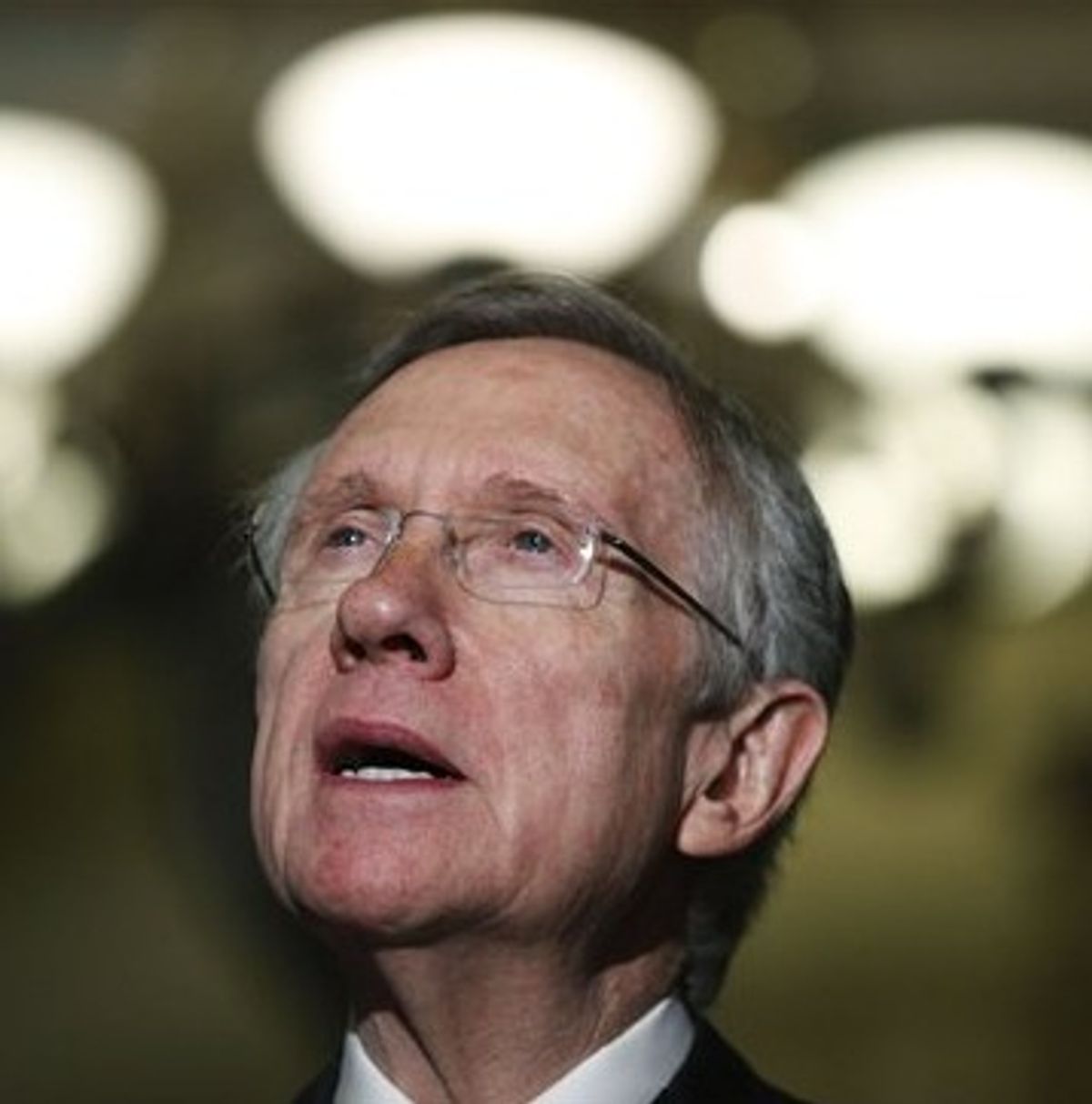
History says Reid, Specter and Lincoln are gonersSenate Majority Leader Sen. Harry Reid of Nev. speaks to the media on Capitol Hill in Washington, Thursday, Feb. 11, 20010, following a meeting with the Senate Democratic Caucus. (AP Photo/Manuel Balce Ceneta)(Credit: AP)

Asked about Harry Reid’s reelection prospects on MSNBC recently, a sympathetic Las Vegas newspaper columnist quipped that “we call him Landslide Harry, which basically is a term that recognizes that he never really wins races by very much. It’s not unusual that he’s being challenged and that the polls are where they are here.”

Actually, it is.

It’s true that Reid, the Senate majority leader, has had some close calls in the past — like when he edged out then-Rep. John Ensign by a scant 428 votes in 1998. But there was a big difference between that race and this one: Reid wasn’t running from behind.

At the end of February ’98, an independent poll actually put Reid 9 points ahead of Ensign, 45 to 36 percent. By contrast, the three most recent independent polls this year have shown Reid trailing the current GOP front-runner, Sue Lowden, by 6, 9 and 10 points. (Although there’s also a recent poll that showed the gap narrowing when a third party candidate from the tea party movement was included.)

When it comes to polling, Reid is actually in unique — and ominous — territory for an incumbent senator. A Salon review found that since 1984, 10 Senate incumbents have found themselves consistently trailing by significant margins at this stage of the campaign — and eight of them were defeated in November.

The only two survivors were Jesse Helms, who beat out then-North Carolina Gov. James Hunt in 1984, and New York’s Alfonse D’Amato, who battled back to defeat Robert Abrams in 1992. Some of the others managed to chip away at deep gaps, but all of them lost in the end. (By this point in 1984, Helms was running roughly even with Hunt, but polling in 1983 had placed him more than 20 points behind.)

This doesn’t portend well for Reid, or for the two other Democratic incumbents who are now facing similar (or worse) poll numbers: Pennsylvania’s Arlen Specter (who trailed Republican Pat Toomey by 10 points in a poll released this week) and Arkansas’ Blanche Lincoln (who is running about 20 points behind Rep. John Boozman).

Nor does the Helms example offer much of a survival model for them: The polarizing North Carolinian benefited from the coattails of Ronald Reagan, who carried his state with more than 60 percent on Election Day ’84. Reid, Specter and Lincoln will get no such help from the top-of-the-ticket this year.

The D’Amato case is slightly different. His campaign was saved by the combination of an ugly Democratic primary between Robert Abrams and Geraldine Ferraro and by Abrams’ self-destruction in the fall campaign (he called D’Amato a fascist at one point). Reid, Specter and Lincoln will need a break like that to survive this year. Because without one, history suggests there’s not much they can do.

Rozina Ali contributed to this story.

Embattled Senate Incumbents: 1984 – present


Continue Reading Close
Steve Kornacki

Steve Kornacki writes about politics for Salon. Reach him by email at SKornacki@salon.com and follow him on Twitter @SteveKornacki

Blanche Lincoln joins conservative lobby in fight against EPA

After the party and the White House failed to save her Senate seat, the ostensible Democrat aids polluters

  • more
    • All Share Services

Topics: , , ,

Blanche Lincoln joins conservative lobby in fight against EPAIn this photo taken May 25, 2010, Sen. Blanche Lincoln, D-Ark., is interviewed at her campaign headquarters in Little Rock, Ark. In the home state of former President Bill Clinton, and elsewhere, party leaders and structures are being bypassed _ undermined, in some cases _ by free-agent candidates who declare their independence from the political establishment while aligning themselves with special interests. "This is an election like no other," says Lt. Gov. Bill Halter, a union-backed candidate who has forced Democratic Sen. Blanche Lincoln into a June 8 runoff. (AP Photo/Danny Johnston)(Credit: AP)

Last year, then-Senator Blanche Lincoln (D-Walmart) was facing a tough primary fight from a more liberal Democrat. With labor and progressive groups aligned against her, the White House and the Democratic Party jumped in to defend Lincoln. Bill Clinton himself campaigned for Lincoln, and the effort paid off: She lost to a Republican in the general election. And then she joined a right-wing interest group. And now she’s fighting the EPA’s plan to regulate greenhouse gases.

The National Federation of Independent Business is generally treated in the press as the official practically apolitical voice of American small business (and the press treats the word of “small business” with almost as much reverence as that of military generals) but it is, in fact, a conservative lobbying organization that has spent decades fighting for anti-labor, anti-environmental and anti-consumer policies, all in the name of protecting our cherished “independent businesses.”

NFIB and Lincoln have teamed up to launch a campaign urging the EPA not to do anything about greenhouse gases, and she details her fight in an interview with Environment & Energy Publishing’s E&E TV. It’s not a very coherent interview, as Lincoln just repeats an endless flood of talking points (uninspired ones, too) and verbally treads water. She’s a politician, not an expert on policy, or anything else. The basic idea is that there are too many regulations, and regulations are bad.

Monica Trauzzi: EPA hasn’t yet sent its proposed rule of greenhouse gas emissions for utilities to OMB. The deadline is September 30. Do you take that as a sign that maybe there are some other regulations that they’re thinking of rolling back on?

Sen. Blanche Lincoln: I certainly hope so. I mean, that is definitely what we’ve been aiming for is to make sure — and you can go to our Website, www.sensiblereg.org, and that is where you can see these small businesses talking about what they face on a day-to-day basis, the cost of it, the time, how it is, you know, prohibitive towards them being able to reinvest their resources into their businesses to create new jobs. And it’s not just the new regs that come out, it is the uncertainty of what happens. You know, you’re exactly right, delaying that greenhouse gas emission rule is something that should be done if we don’t have all the facts, if we don’t have the appropriate cost-benefit analysis, if we don’t have the appropriate analysis of what, you know, is going to actually happen with that. OMB has got to have — I mean, sometimes it can take them two or three or four months, you know, to get that information out. And that is absolutely appropriate and it should not go forward until we have all that information. But when there are over 4200 new pending regulations out there, it just creates this unbelievable arena of uncertainty in businesses large and small, but particularly small, because they get hit harder. They’re not going to take their own money and spend $10,000 or $10 million, because they don’t know what those types of regs are going to cost them.

Uncertainty is bad, so the EPA must delay its new regulations as long as possible. 4,200 new regulations!

This is all fairly standard-issue Republican cant. Which isn’t surprising: The oil and gas industry were another of Lincoln’s major funders. (Lincoln also received more money than any other Democrat from ALEC, the organization that helps major industries write their own right-wing legislation in statehouses across the country.)

Blanche Lincoln’s loss proved that out-Republicaning the Republicans is an insane way to try to win an election, but Democrats never bother to learn that lesson.

Continue Reading Close
Alex Pareene

Alex Pareene writes about politics for Salon and is the author of "The Rude Guide to Mitt." Email him at apareene@salon.com and follow him on Twitter @pareene

GOP on Kagan: Will she fight for civil rights of rich, powerful?

Republicans worry that Justice Kagan might not always rule on the side of corporations and the military

  • more
    • All Share Services

Topics: , , , , , , , ,

GOP on Kagan: Will she fight for civil rights of rich, powerful?Supreme Court nominee Elena Kagan, foreground. listens to questions from Sen. Jeff Sessions, R-Ala., the ranking Republican on the Senate Judiciary Committee, on video screen, on Capitol Hill in Washington, Tuesday, June 29, 2010, during the committee's confirmation hearing for Kagan. (AP Photo/Susan Walsh)(Credit: Susan Walsh)

Yesterday, the Republican members of the Senate Judicial Committee opened the Elena Kagan confirmation hearings by, perhaps unwisely, putting Thurgood Marshall on trial. Today, they’re laying off Marshall, but they’re making it clear that they believe the court’s job is to always defend the rights of the powerful.

Republicans brought Marshall up 35 times yesterday, with unrepentant racist scumbag Jeff Sessions and Arizona’s Jon Kyl leading the charge against that terrible activist liberal judge who hated the Constitution. (Later, asked to name any single Marshall decision or opinion they disagreed with, Sessions and Orrin Hatch and Tom Coburn could not, really. Because that would’ve given away the game.)

And, for some reason, John Cornyn approvingly quoted a far-right secessionist novelist guy.

But while the Republicans hate Thurgood Marshall for extending those damn “special protections” (like regular protections, but for non-white people) to minorities, they want to make it clear that they expect any potential Supreme Court justice to always support the rights of their favorite put-upon minority groups: the United States military, incumbent senators, Republican presidential candidates, and corporations.

After Pat Leahy’s interminable opening questions about how much Kagan loved her parents and how nice and well-respected she is, Sessions began hammering her on the military recruiters thing. The issue was, the military was unable to sign Harvard’s nondiscrimination pledge, because it is, you know, a discriminatory employer. So it had to use the veterans’ organization instead of the Harvard Office of Career Services.

Sessions, in repeatedly asking why Kagan did not grant special treatment to the military, kept asking her why she discriminated against the military and treated our brave recruiters “in a second-class way.” Silly legal progressive — you’re only allowed to treat gay people in a second-class way.

(Kagan was asked if she thought Bush v. Gore was decided correctly. In 2003, she knew that it was not decided correctly. This morning she declined to answer.)

Orrin Hatch questioned Kagan on the Citizens United case. Kagan, obviously, argued that case, which would seem to make her position on the matter of the constitutionality of campaign finance laws known. But she told Hatch that as a judge, she would consider it “settled law.”

Hatch nearly got teary-eyed when discussing the poor corporations of Utah that were discriminated against by campaign finance laws. Why does Kagan hate Utah’s thousands of corporations that are made up of only one person? (Though theoretically this one-person corporation could conduct political speech as a one-person ,,, person.)

The conversation got weird when Hatch seemed to claim that restrictive campaign finance laws were somehow not bad for incumbents:

Kagan says campaign finance laws were “selfless” act of Congress, because all empirical evidence suggests union and corporate money protects incumbents.

“Tell that to Blanche Lincoln,” Hatch says. “Lincoln is one of the nicest people around here who had ten million spent against her by the unions, just because they disagreed with her.”

OK, but … Blanche won. And doesn’t Orrin think money is protected political speech? And if so, isn’t spending money to defeat her because you disagree with her policies … basically the entire point of politics? Unless Orrin wants Kagan to decide that unions aren’t allowed to be mean to his Senate friends, I guess.

Hatch was also outraged that the president criticized the Citizens ruling … while the Supreme Court was in the same room as him. The nerve! The court is very sensitive! Obama should’ve formed a one-man corporation in Utah and bought thousands of TV ads, if he wanted to exercise his right to express an opinion on the decision.

Kagan is expected to be easily confirmed because this whole thing is basically a fun way for the Senate to pass the time without having to pass legislation or anything.

Continue Reading Close
Alex Pareene

Alex Pareene writes about politics for Salon and is the author of "The Rude Guide to Mitt." Email him at apareene@salon.com and follow him on Twitter @pareene

National progressives are wrong about Blanche Lincoln

Lincoln's surprise win in last week's runoff looked a lot different in Arkansas than outside of it

  • more
    • All Share Services

Topics: , , ,

National progressives are wrong about Blanche LincolnSen. Blanche Lincoln (D-Ark.) on June 12.

Whether Arkansas Sen. Blanche Lincoln can survive a challenge from GOP Rep. John Boozman in November, her primary win over Lt. Gov. Bill Halter has surely set off a slanging match among Democrats. The pecking party was touched off by a morning-after comment by an anonymous White House official.

“Organized labor just flushed $10 million of their members’ money down the toilet on a pointless exercise,” the official told Politico. “If even half that total had been well-targeted and applied in key House races across this country, that could have made a real difference in November.”

“We are not an arm of the White House or the DNC or a political party,” an AFL-CIO spokesman huffed. “We work on issues. And if we feel like someone is standing up for working families, we support them, and if they don’t, we won’t.”

Halter’s out-of-state Internet backers reacted furiously. Salon’s indispensable Glenn Greenwald, co-founder of Accountability Now, which helped recruit Halter, argued that the “Democratic Party establishment” had abandoned its constituents.

Citing Lincoln’s “extreme unpopularity in Arkansas,” he argued that “most key progressive factions — grass-roots organizations, progressive blogs, civil liberties groups, and unions — would want to see Lincoln removed from the Senate.” Polls, he insisted, showed Lincoln has “virtually no chance of winning in November,” but that Halter did.

Presumably these would be the same polls that also showed Halter defeating the extremely unpopular Lincoln. Greenwald conceded that, “In an ideal world, we could have gotten behind a candidate who was really exciting … But we don’t live in that world, so Bill Halter is what we could get.”

Elsewhere, my favorite Democratic blogger Digby reacted sharply to the anonymous White House critic: “Is the ghost of Richard Nixon working in this administration or what?”

Inside Arkansas, Judge Wendell Griffin, “an unapologetic Halter supporter,” descried a racial insult. The White House, he wrote, “shouldn’t treat the people who supported Halter’s senatorial bid like field hands by talking and acting like plantation owners.”

Now that the dust and feathers have settled, here’s my view: If anybody’s acting like Republicans, it’s progressives determined to purge ideologically impure Democrats from Southern and Midwestern farm states whose views largely reflect their constituents’ extremely mixed feelings about the party’s agenda. A more self-defeating strategy would be hard to imagine. Nobody’s questioning anybody’s rights, only their political judgment.

Why did the White House back Blanche Lincoln? Probably because while she opposed the “public option” in President Obama’s healthcare bill, when push came to shove, she gave him a politically courageous 60th Senate vote putting the bill over the top. Courageous because “Obamacare” remains widely misunderstood and wildly unpopular in a state where the president earned 39 percent of the vote in 2008.

With that vote, Lincoln put her career on the line. Obama would have been an ingrate had he not supported her during the primary. That’s probably also why Blanche’s winning margin came almost entirely from Arkansas’ most reliably liberal precincts in Little Rock and Fayetteville. Women in particular appeared to think that they owed her too. Many Halter votes came from rural Democrats apt to lean Republican in November.

Simply and very broadly put, the race was viewed very differently inside than outside Arkansas. Pragmatism had a lot to do with it. For all the cultural conservatism of its largely rural and small town populace, the state hasn’t yet adopted Southern-style Republicanism. At present, Arkansas’ governor, both U.S. senators, and three of four congressmen are Democrats. Many would prefer keeping it that way.

I don’t believe I know a Democrat who hasn’t been put out with Sen. Lincoln over something or other. Her GOP-accented stance on estate taxes makes me crazy. But many also believed that nominating a candidate promoted by labor unions and left-wing advocacy groups like MoveOn.org would essentially concede the Senate seat to an Oklahoma-style, right-wing Republican who’d then prove extremely hard to dislodge.

Sen. Lincoln, President Obama can count on maybe 50 percent of the time; her Republican opponent, never.

Arkansas being Arkansas, personal issues also figured strongly in the result. As a retail politician, Blanche is seen as warm and charming, with a disarming smile. Halter’s neither; he’s widely mistrusted by most people in politics. Word got around. Even local pundits who favored Halter expressed personal reservations. He attracted no name-brand Arkansas endorsements.

Both camps’ incessant and dishonest TV ads and robo-calls offended almost everybody. “With the clarity of hindsight,” confided a colleague who strongly supported the challenger, “I see now that Halter’s main theme — he was not Blanche Lincoln — might not have been sufficient for voters who possess more sophistication than pundits often grant them.”

At the end, Blanche let Bill Clinton attack the “outside special interests” while she expressed down-home patriotism and her chairmanship of the Senate agriculture committee. She hopes for a replay come November.

Continue Reading Close

Arkansas Times columnist Gene Lyons is a National Magazine Award winner and co-author of "The Hunting of the President" (St. Martin's Press, 2000). You can e-mail Lyons at eugenelyons2@yahoo.com.

The unsinkable Blanche Lincoln

Despite endless whining from the lobbyists, the Arkansas senator's derivatives reform proposal keeps moving along

  • more
    • All Share Services

Topics: , ,

The unsinkable Blanche LincolnFILE - In this May 19, 2010 file photo, Sen. Blanche Lincoln, D-Ark. walks on Capitol Hill in Washington. Lawmakers will tackle sticking points and try to blend House and Senate bills into a single rewrite of banking regulations. A final measure, which President Barack Obama wants by July 4, is intended to prevent another financial crisis like the 2008 meltdown, which triggered a deep recession. (AP Photo/Harry Hamburg)(Credit: AP)

So what’s happening with Blanche Lincoln’s infamous derivatives regulatory proposal, popularly referred to among the cognoscenti as “Section 716,” adored by progressives (who never liked Lincoln), despised by Wall Street (who thought they could trust Lincoln to serve their interests), and supposedly opposed by the Treasury?

As originally described, Section 716 was supposed to force banks to “spin off” their derivatives trading operations. As the conferencing process reconciling the varying House and Senate versions of regulatory reform rumbles forward, the proposal is going through a process of “clarification.” Depending on who you trust, that means the proposal is either being weakened or made more sensible.

The key aspects of the clarification are that instead of spinning their derivatives operations off entirely, banks will be allowed to move them into subsidiary operations that are required to reserve significantly larger amounts of capital against potential trading losses than before. Community banks — defined as holding under $50 billion worth of assets — will be exempted from the requirement. And everyone will get two years of breathing room to implement the provisions.

FireDogLake’s David Dayen, a redoubtable blogging warrior for the left, concludes that the proposal is being gutted. But the Financial Times, citing Paul Volcker’s “softening of opposition to the provision,” reports that “banks are likely to lose a key lobbying battle.” Barbara Kiviat, writing at Time’s Curious Capitalist blog, argues that “whether or not banks wind up having to spin off their derivatives units … Blanche Lincoln has already come out ahead … because lobbyists …  have expended an incredible amount of time and energy trying to get rid of Lincoln’s provision,” which has distracted them from warding off other threats.

But perhaps the best ratification of the process, even if the proposal’s sharper edges are getting rounded off, is how distinctly unhappy the lobbyists and bankers sound.

From the Wall Street Journal:

James Mahoney, director of public policy for Bank of America Corp., said: “We are concerned that we won’t be able to provide our customers with financial products they need to manage risk and grow and that foreign banks will step in and take that business.”

From Bloomberg:

“The restrictions under the new proposal are not much different than complete divestment,” said Scott Talbott, senior vice president of government affairs for the Financial Services Roundtable, a Washington-based trade group.

We won’t know the final details until later next week. Meanwhile, neither the progressives nor Wall Street seems happy: standard operating procedure, for the Obama era.

Continue Reading Close
Andrew Leonard

Andrew Leonard is a staff writer at Salon. On Twitter, @koxinga21.

Lincoln scorns Clinton’s pleas to save planet

Rescued by Bill Clinton's support, the Arkansas Democrat votes with Big Oil against carbon regulation -- and him

  • more
    • All Share Services

Topics: , , ,

Lincoln scorns Clinton's pleas to save planetSen. Blanche Lincoln, D-Ark. is seen outside her office in the Dirksen Senate Office Building on Capitol Hill in Washington, Wednesday, June 9, 2010. (AP Photo/Susan Walsh)(Credit: AP)

Other than Al Gore – or perhaps Barack Obama – there are few major American politicians who speak out more passionately about global warming and the need to change our civilization’s energy economy than Bill Clinton. His concern dates back before the unanimous rejection of the first Kyoto treaty by the U.S. Senate – which he had endorsed as president — and he has devoted the  resources of the Clinton Foundation to reducing carbon emissions and saving forests around the world.

Which raises profound questions about Clinton’s  dogged campaigning for Blanche Lincoln, D-Ark., whose comeback victory in a bitter primary last Tuesday was attributed to his support. Today, Lincoln rewarded him by joining with Republicans in a landmark vote to block the Environmental Protection Agency from regulating greenhouse gases. Indeed, Lincoln was one of three conservative Democratic senators (along with Mary Landrieu of Louisiana and Ben Nelson of Nebraska) to co-sponsor the resolution authored by Sen. Lisa Murkowski, R-Alaska.

Widely regarded as a blatant and mindless political attack on science, the Murkowski-Lincoln resolution is also a rebuke to Clinton and everyone who shares his view that climate change is the most important challenge facing the world in this century. The former president has repeatedly urged Senate Democrats to pass serious cap-and-trade or carbon tax legislation by whatever means necessary, including the now-controversial method of reconciliation.  He often speaks in apocalyptic terms on the topic, as he did last year when he said that “Congress must pass, and the president must sign, legislation that puts a price on carbon and establishes a cap and trade system … properly pricing something that is otherwise going to destroy the planet.”

Whatever he and Lincoln discussed before he went into Arkansas on her behalf, she evidently has not gotten his fervent message on climate. While her assumption of the chairmanship of the Senate Agriculture Committee in 2009 was a victory for their home state, it was a debacle for environmental progress, especially on climate policy, because she simply doesn’t “get it” on energy, farming and climate. She is a mediocre senator overall, but on these critical issues she is a horror show.

Lincoln comes from a wealthy family whose fortune is based on rice farming, so she represents traditional agriculture interests that have joined with Big Oil and other corporate lobbies to fight environmental progress for many years. In Arkansas that is politically astute, because so many voters there tend to disdain the environmental movement as extreme and economically threatening.

Yet nobody is more eloquent than the president from Hope in explaining why sound environmental and energy policy would promote rapid economic growth and balanced budgets. And people in Arkansas apparently still listen to him. So maybe he should spend a little more time trying to persuade them that he knows what he’s talking about on climate — and a little more political capital pushing Democrats like Lincoln back toward the scientific consensus and the political center (which, as a new Washington Post-ABC News poll shows, strongly favors more, not less, regulation to forestall a climate disaster).


Continue Reading Close

Joe Conason blogs in Salon several times a week and writes a weekly column for the New York Observer. His latest book is "It Can Happen Here: Authoritarian Peril in the Age of Bush."

Page 1 of 7 in Blanche L. Lincoln, D-Ark.