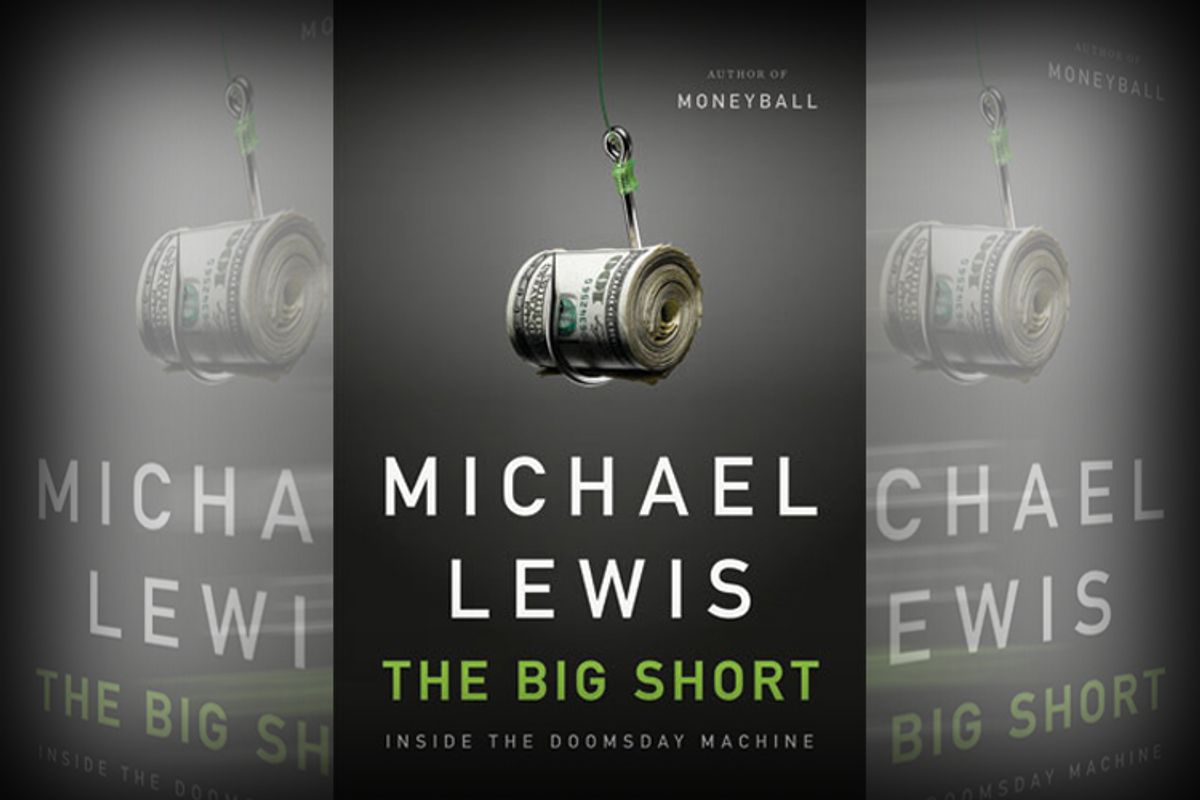
Near the end of "The Big Short," Michael Lewis' much-anticipated stab at explaining what just happened to the global economy, the author unloads a dump truck worth of jargon while describing a dilemma facing one of his protagonists.
"How do you explain to an innocent citizen of the free world the importance of a credit default swap on a double-A tranche of a subprime collateralized debt obligation?" writes Lewis.
I'm betting Lewis was grinning as he wrote that sentence, because if you wanted to summarize "The Big Short" in just one line, it might be: the most lucid explanation yet offered to readers as to the importance of a credit default swap on a double-A tranche of a subprime collateralized debt obligation. Which might not sound like a whole lot of fun, but turns out to be a blast. As someone who has struggled for years to penetrate the obtuse world of structured finance and the role it played in blowing up Wall Street, I must give credit where credit is due. "The Big Short" is superb: Michael Lewis doing what he does best, illuminating the idiocy, madness and greed of modern finance.
Even though I have long been a huge Lewis fan, dating all the way back to "Liar's Poker," his hilarious and enlightening account of life as a bond broker in the go-go '80s, I did not anticipate something this good, something capable of carrying its weight as a bookend to "Liar's Poker's" delights. My heart actually sank when the galleys of "The Big Short" arrived in the mail. A library of books exploring the financial crisis has already been published, with many, many more yet to come. My bedside table groans under the weight of their unfinished tomes. What could Lewis have to say that hadn't already been said a million times over?
But then I made the mistake of glancing at the first chapter and literally could not put "The Big Short" down. Lewis achieves what I previously imagined impossible: He makes subprime sexy all over again.
The secret to Lewis' success is a mixture of strategy and craft. Most books on the financial crisis find their locus inside the Wall Street firms at the heart of the action. The general theme: Hubristic banksters are oblivious to what they've wrought until it is too late. Chaos ensues. Lewis takes a different tack. "The Big Short" tells the stories of an odd collection of brilliant misfits who recognize that Wall Street is wearing no clothes, become convinced a massive calamity is nigh, and seek feverishly to profit off of their understanding. They are, in Wall Street parlance, the "shorts" -- speculators who bet that the price of a given stock or bond or commodity or any derivative thereof will fall, rather than rise. Most shorts pick on a single company, or have a dour view of the direction of the price of corn or pork bellies. "The Big Short" is a little more ambitious: It's a bet on financial sector collapse.
That's the strategy. Today you can find plenty of people who claim to have seen financial disaster looming, but in "The Big Short" Lewis captures protagonists who put their money on the line. That they did so by employing Wall Street's latest financial innovations against itself makes the story all the more fascinating. A typical Lewis "short" first figures out which mortgage lenders are making the absolutely crappiest loans, then determines which mortgage bonds (or collateralized debt obligations created out of slices of crappy mortgage bonds) are constructed from those loans, and then buys insurance, via credit default swaps, against the chance of those bonds or CDOs going bust.
In doing so these money managers have to war against their own self-doubt, the trepidation of their investors, the arrogance of Wall Street bankers, and the giddy momentum of financial markets that defy all logic for far longer than makes any rational sense. (There's also a good question as to whether what they are doing should even be legal -- the "shorts" are buying insurance on "properties" that they don't even own!) But the loner-against-the-crowd mentality delivers a dynamic sense of tension that propels "The Big Short" merrily along. We know, as readers, exactly what will happen at the end, and yet still the ride feels nail-biting.
But what truly sets Michael Lewis apart from other writers is his craft. Watch him describe Steve Eisman, a man whose desire to make money shorting subprime mortgage-backed concoctions is inseparable from his growing sense of rage that Wall Street is getting away with a rigged game.
The focal point of his soft, expressive, not unkind face was his mouth, mainly because it was usually at least half open, even while he ate. It was as if he feared that he might not be able to express whatever thought had just flitted through his mind quickly enough before the next one came, and so kept the channel perpetually clear. His other features all ranged themselves, almost dutifully, around the incipient thought. It was the opposite of a poker face.
When you combine an ability to evoke someone's essential character in a few spare sentences with an equal facility at deconstructing the financial engineering that goes into creation of a collateralized debt obligation, you are dealing with an exceptional talent. There are passages in "The Big Short" that get seriously wonky -- where most writers would be content to simply talk in generalities about "slicing and dicing up risk" -- but Lewis makes a game effort to communicate the nitty-gritty of how the structured finance con game actually worked. It can be intimidating, but if you stick with it the end result is devastating.
Lewis does not attempt to explicitly resolve some of the bigger questions as to how it was possible for Wall Street to run so far off the tracks. If you're looking to plug "The Big Short" neatly into a political narrative you may find it wanting. By now everyone has chosen their own favorite villain -- some blame the dismantling of regulatory oversight, others point at government efforts to boost lower-class home ownership. Everybody's mad at housing speculators and people who take out loans that they can't afford. The ratings agencies, regulators, mortgage lenders and banks all clearly failed us.
It's quite the toxic stew. But sitting at the center of the spider's web are the investment banks -- Goldman Sachs, Morgan Stanley, Merrill Lynch, Deutsche Bank, Bear Stearns, Lehman Brothers. These banks were not creating complex derivatives tied to subprime mortgages because of government policy pushing homeownership or because individual homeowners were irresponsibly prone to lying about their income. Far from it; these banks had discovered that billions of dollars could be made transforming lousy mortgage loans into securities supposedly safe enough that they could be sold to pension funds or anyone else. So they had a huge financial incentive to encourage the creation of even more crappy loans.
And even then, there wasn't enough raw product! The hunger for garbage that could be turned into gold was beyond anything the craziest real estate markets in California or Arizona or Florida or Nevada could provide. The smart brains at Goldman Sachs found many innovative ways to get around this obstacle, to the point of taking the collateralized debt obligations that already, uh, sliced and diced subprime bonds, and reslicing those into synthetic CDOs that were even further removed from actual humans living in real houses.
And even that wasn't enough, so they created a superstructure of credit default insurance swaps to buy and sell, ostensibly to protect against the possibility that their synthetic CDO or subprime mortgage bond might collapse, but really, just to have another way to make another speculative bet, in a world where there actually were physical limits to how many real mortgages could be created.
It all adds up to an extraordinary demonstration of how markets can fail disastrously. The tragedy, however, is that we appear, as a society, not to have learned anything lasting from this debacle. The most depressing part of "The Big Short" is realizing that now, more than a year into a new presidential administration, we have done nothing substantive to prevent a similar mess from occurring again in the future. The investment banks are minting money again, while millions of Americans have lost their jobs and their homes.
In the introduction to "The Big Short," Lewis observes that when he wrote "Liar's Poker" he thought he "was writing a period piece about the 1980s in America, when a great nation lost its financial mind." He "never imagined ... that the future reader might look back on this ... and say, 'How quaint.' How innocent." But he was wrong. The madness continued. "There was no scandal or reversal, I assumed, sufficiently great to sink the system."
And here we are, in 2010, shell-shocked after witnessing and living through the "most purely financial economic disaster in history" and absolutely nothing has changed.
Shares