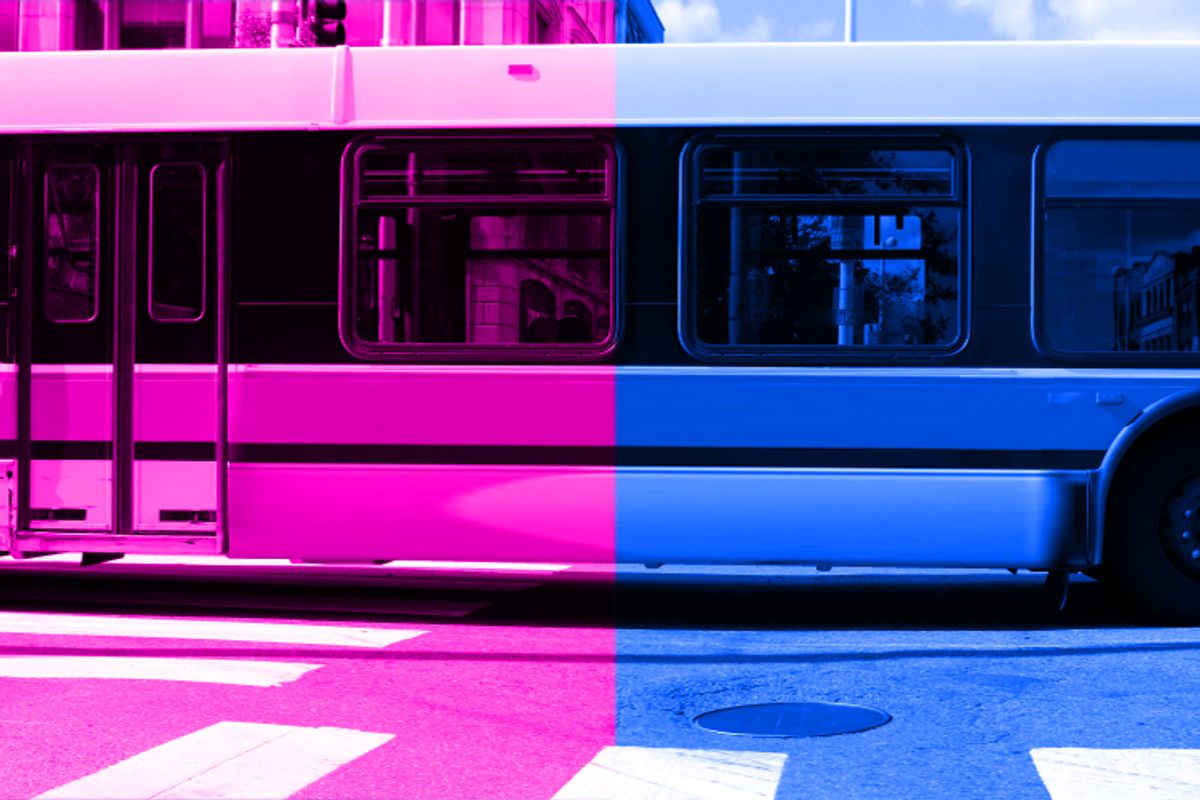
It was the sort of scene you'd expect to encounter on the streets of 1950s Alabama, not on a public square in modern Israel. But on the evening of Friday, March 13, around a thousand protesters marched outside the Prime Minister's residence in Jerusalem to protest segregated buses that are mainly (but not exclusively) used by the city's Haredi or "Ultra-Orthodox" community. Shouting "Jerusalem isn't Teheran," the protesters demanded an end to gender-based seating policies and called for the transport minister's resignation. Knesset member Nitzan Horowitz of the progressive New Movement-Meretz Party (PDF) told the crowd: "If the segregated buses continue to operate, we will board them and not follow the segregation rules."
The controversy over the mehadrin or "strictly kosher" bus lines through Haredi areas began a decade ago when the government-subsidized Egged bus company decided to compete with the private companies that were already servicing these parts of town. Not only are female passengers required to sit in the back third of the vehicle, they face withering looks and vocal insults from men if they board the buses wearing "immodest" clothing, particularly trousers.
Moving women to the back supposedly ensures the "purity" of the men in front, and women who ignore this masculine imperative do so at their own risk. In 2006, a woman claimed to have been "slapped, kicked, punched and pushed by a group of men who demanded that she sit in the back of the bus with the other women." In 2007, a group of five Haredi men beat an Ultra-Orthodox woman and a uniformed IDF soldier for sitting next to each other. When police cars arrived on the scene, a crowd of Haredi men punctured their tires, allowing the attackers to escape. In another typical story,
A pregnant woman got on the 318 midnight bus from B'nai Brak to Rehovot. She sat in the front because of motion sickness, explaining this to the other passengers. One Hareidi man stopped the bus by standing with one foot outside and one on the step up so the driver couldn't close the door. The woman finally fled into the street in the middle of the night. The other passengers went looking for her and found her under a tree, humiliated, hurt, and refusing to re-board.
Israel currently has as many as 63 segregated bus lines making 2,500 trips a day.
(Brooklyn residents may be reminded of a similar controversy last year concerning bike lanes through a Hasidic area of Williamsburg.)
In May 2008, Israel's High Court of Justice asked the Transport Ministry to establish a committee to investigate the legality and appropriateness of the segregated lines.Tensions have mounted in recent months, culminating in Transportation Minister Yisrael Katz's decision at the end of January to continue the segregated bus service on a "voluntary basis": "The public transportation operators should be allowed to put up 'conduct suggestion' signs that provide an explanation and a request from the passengers to sit separately -- while stressing that there is no obligation to do so." Apparently people will be allowed to enter at both the front and the back and then "choose for themselves" where they wish to sit without any input from government authorities.
The decision has split Israel along its familiar religious fault lines. Rebbetzin Yocheved Grossman from the Ultra-Orthodox Mea Shearim neighborhood, who heads a lobbying group calling itself the "World Women's Lobby for Halakhic transportation," welcomed the minister's decision, which she said respected "hundreds of thousands of women who wish to maintain a normative lifestyle." She went on to say that "This is not religious coercion, but our way of life -- from kindergarten to marriage --that should be respected. If the municipality considers the Haredi public and operates separate public parks -- there is no reason why public transportation should not be that way. We are coming only from a position of understanding. Even the gentiles in New York accept this." For Grossman and her supporters, segregation on the basis of sex is nothing less than a basic human right. In an interview last spring, she asked "Why can't you respect the Haredi person, who is essentially your brother? A smoker would not light a cigarette if he thinks this would disturb the people around him, so why not be considerate on this issue?"
Anat Hoffman of the Religious Action Center of Reform Judaism, who has publicly demonstrated against the bus policy herself, disagrees:
The suggestion that a voluntary arrangement can be enforced is very funny. … I think the countdown started today about segregation as a religious expression in the Jewish state. … It's a slippery slope. If signage makes it kosher, then next we are going to find segregated post offices, HMOs and sidewalks, all of which we already know examples of. Either the court will decide that this has no room in the public sphere and we will not go down the slippery slope, or the court says signage makes it all right and we're going to float with these signs down the slippery slope and become a very extreme variety of Judaism. God help us if that is the case.
The mehadrin buses have become a cause célèbre across the country. In January a number of organizations established a hotline where women could call and complain about discrimination. Two weeks ago, in a campaign called "A stop in time," young activists in Jerusalem, Raanana, Holon, Tel Aviv, Beersheba, and Tiberias plastered leaflets on bus stops and bus windows warning against a segregated future for Israel. "This bus stop is mehadrin kosher," the poster says. "Thus, men enter and sit down in the front; women and all the rest [i.e. blacks and minorities] -- to the back." The leaflet displays an ironic kashrut stamp showing that the bus line has been classified as kosher "with the oversight of the transportation minister and subsidized by the State."
Minister Katz does not have the last word in the matter. In February a three-member Supreme Court panel issued a restraining order on new mehadrin bus lines, stating that the term itself ("going beyond the letter of the law"), "might apply to Chanukah candles, kosher laws or an etrog, but apparently does not necessarily mean that whoever is mehader in the laws of modesty and inter-gender mingling is also mehader in the laws of respect to others."
But what has spawned this sudden obsession with segregated buses in the first place? According to a remarkable editorial in the Jerusalem Post by an Ultra-Orthodox Sanhedria resident last year, the demand for private kosher bus services, which the Egged company is now encroaching on, may have more to do with profit than with prophecy. "From outside, in the secular world, it seems as if it is all about these things you may call fundamentalism. This is indeed how it started. But today, inside the Haredi society, it is mainly a matter of earning a living. People here ask, 'Why should we renounce such an opportunity for profit, especially in these days of economic turmoil, and leave the profit to Egged?'"
And yet you might wonder why this story is such a big deal. It's true that the mehadrin buses represent only a fraction of transportation lines in Israel, and only around nine percent of Israeli Jews identify themselves as Haredi. And yet, in this increasingly fragmented country the "kosher bus" flap may indeed prove to be as divisive as the Old South's "separate but equal" policy. At stake are the future of Israel and Judaism itself. Opposition leader Tzipi Livni presented the progressive case in a letter to the street protesters on Saturday, saying: "This is not an internal issue for a certain segment of the population … I see this struggle not only about transportation but also as a struggle for the character of Israel as a free, Jewish and democratic nation. ... Those who push women to the back of the bus wish to prevent them from being seen and from taking an equal and central place."
Or, as Israeli blogger Miriam Woelke wrote last year,
Why do I have to sit in the back of a bus just because some men cannot behave themselves and get immodest thoughts into their minds? Is this my fault ? Such men don't need a bus with separate seats but a psychologist. … The whole discussion has two sides but I tend more to feeling like second-class or even garbage by being seated in the back. It is just like women have a disease and need to be separated and I wonder [how] our foremothers, Beruriah, Devorah, Rashi's daughters or other great women would respond to this.
Livni and Woelke can talk all they want, but it doesn't sound as if the other side is listening. Saturday's demonstrators were met by a group of Haredi counter-protesters, who were bused in from the Mea Shearim district for the occasion. Their message? "Separation is a blessing."
Shares