Food traditions

Competitive eating: The most American sport?

Amid the push toward healthier food, the popularity of eating contests continues to soar

  • more
    • All Share Services

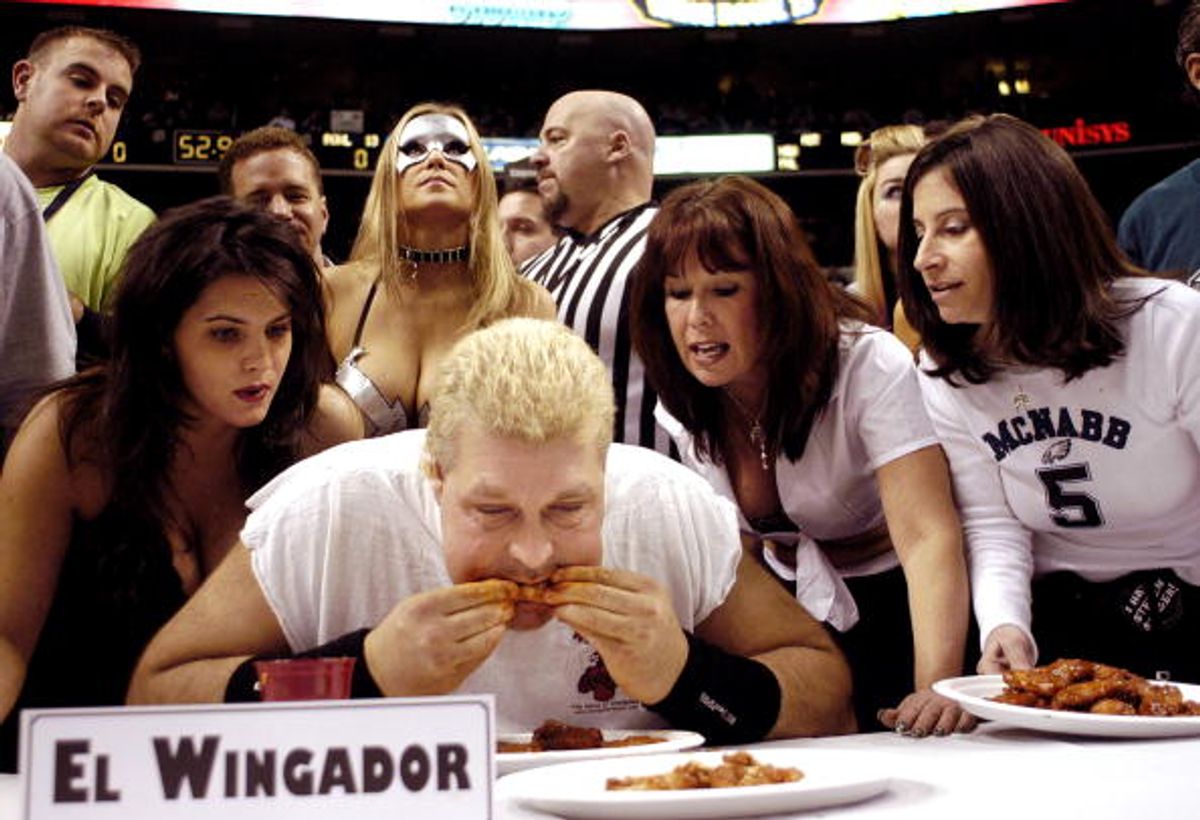
Competitive eating: The most American sport?PHILADELPHIA - FEBRUARY 4: Bill "El Wingador" Simmons is cheered on during Wing Bowl 13 at the Wachovia Center February 4, 2005 in Philadelphia, Pennsylvania. An estimated 20,000 spectators gathered to watch the buffalo wing eating contest. Wing Bowl started 13 years ago when a Philadelphia radio personality came up with the idea as an alternative to the Superbowl because he believed the Philadelphia Eagles would never again make it to the Superbowl. (Photo by William Thomas Cain/Getty Images)(Credit: Getty Images)

It’s crude, it’s rude, and it’s all about eating disturbing amounts of food. This week, the trailer for “Nacho Mountain,” the first fiction film about the world of competitive eating, has been circulating on food blogs. The low-budget independent film tells the story of Keefer, a man who loses his job and begins participating in underground eating competitions.

Unfortunately, based on the trailer, the gross-out comedy (which has yet to get distribution) isn’t all that much to get excited about (it appears to be an even less funny version of “I Hope They Serve Beer in Hell”). But it serves as a testament to the extent to which competitive eating has managed to insinuate itself into American culture over the past decade. In the past few years, the eating contest has turned from a fairground novelty into an organized circuit — with a supervising body, professional competitors, and hundreds of thousands of dollars in prize money.

It has managed to do this at a time when worries about obesity and overeating have prompted everything from salt-regulation legislation to Jamie Oliver anti-obesity reality shows. To find out why competitive eating continues to have such a hold over American culture — and what it says about Americans’ attitude toward food — we called Ryan Nerz, a competitive eating announcer and the author of “Eat This Book: A Year of Gorging and Glory on the Competitive Eating Circuit.”

The competitive eating world has grown dramatically over the past few years. Where did this widespread popularity come from?

The real start of this modern era of competitive eating was in 2001 when Takeru Kobayashi won the hot dog eating contest in Coney Island by doubling the record and eating 50 hot dogs in 12 minutes. It really started catching on in 2004, 2005, when the number of eating contests per year went from 30 or 40 to about 100. The International Federation of Competitive Eating (now known as Major League Eating) has done a fantastic job of relentlessly going after brands to sponsor these contests — casinos and food companies. Now there’s probably about $250,000 of prize money a year.

And there’s been lots of documentaries on the Travel Channel, Discovery, Spike TV; there’s this movie ["Nacho Mountain"]; all these guys have blogs, and Facebook pages and fans and, believe it or not, groupies. It’s not the Olympics yet, despite Major League Eating’s real intention of having it be in the Olympics. These days, Nathan’s famous contest gets as many viewers as some of the games in the Stanley Cup finals. If you consider how absurd many feel the contest of competitive eating is, it already has become a successful sport, but I feel like it’s plateauing, frankly. I’m shocked that it’s gotten where it is.

Why don’t you think it will get much more popular?

I just think it’s too redundant. They just keep eating. That’s all they do. For an announcer it becomes frustrating. Sometimes one person is eating faster than the other, or the person has some sort of technique to break apart a chicken wing, but after a certain point, I just want to be like, “They’re eating and they’re eating and you’re watching and I’m talking.” It’s just the same thing over and over again. There are no passes or dribbles or fouls. It’s just eating. There’s an inherent ceiling.

Why do so many people like watching people gorge themselves?

It’s this uniquely American spectacle that is half sport and half magic. People can’t wrap their heads around the idea of eating 69 hot dogs in 10 minutes, so it does have an element of magic. Though, if you want to be pessimistic about competitive eating, it’s also a kind of a freak show. It’s a little bit like watching a train wreck and you try to hide your eyes and peek through your fingers.

What makes it uniquely American?

Well, that’s not entirely accurate. Japan also embraces it and I’ve announced mince pie eating contests in England, a chicken satay contest in Singapore, and a dumpling one in the Czech Republic. But I think Americans are just insanely competitive people, and as such we want everything to become a competition. If you look at where new sports really stem and proliferate from, America is pretty up there — snowboarding and all these newfangled sports. In America we’re so inundated with different sports and media that we have an appetite for a new and esoteric sport that allow a small number of people to be experts in it.

I also think Americans have a slightly different attitude about food than many other countries. Americans often think of food in utilitarian terms — eating as fast as possible at Burger King. It’s not as much about taste and atmosphere as it is in many other countries.

I think there’s a degree of truth to that. Certainly if there’s any group of people that I’ve talked to who are confused, disturbed and outraged by competitive eating it’s the French and the Italians. We have fast food places where you eat by going through a drive-through and grabbing some fries and a burger — that’s a pretty utilitarian process. It’s not much of a leap of logic from eating in that way to timing yourself for 10 minutes and seeing how much you can eat.

In the past few years, there’s been an increasing move to regulate the way people eat — limiting trans fats and posting calorie counts on menus. Do you think the popularity of competitive eating is a backlash against that?

There’s a little bit of a working-class mentality where guys are like, “Fuck you, I’m going to eat a bacon double cheeseburger because I’m a man.” It shirks this new paternalism in the same way that New Yorkers, I think, cut back on smoking at first when it was banned indoors and it came back with some enthusiasm and now there are places where you know you can smoke after midnight. To me competitive eating is probably more of a curiosity [than a political statement].

What’s your favorite competitive eating event?

The best contest was probably a one-minute raw onion-eating contest in Maui, where they ate  sweet onions like apples. I like the deep-fried asparagus contest in Stockton, Calif. It happens in late April. There’s tens of thousands of people there to celebrate asparagus — they drink things like aspara-tea — and it’s just a really weird and oddly pure sort of event. The record I love the most is the mayonnaise record, 8 pounds in 8 minutes.

On the other end, there’s the Wing Bowl, in which 30,000 kids in Philadelphia’s Wachovia Center watch fat dudes eat wings while being flanked by naked women. I found it to be a version of hell on Earth. I needed to go home and take several showers to get the Wing Bowl out of me, but a lot of people think it’s a very American thing.

Thomas Rogers

Thomas Rogers is Salon's Arts Editor.

Today’s must-see viral videos

Watch: The contested winners of annual hot dog eating contest, robots as second-class citizens, and more

  • more
    • All Share Services

Today's must-see viral videosI am robot, hear me roar.

1. 365 days of makeup

 ”Natural Beauty” answers that burning question once and for all, “What would you look like if you put on a year’s worth of makeup all at once?”


2. “District 9″ … with robots

Kibwe Tavares’ short film “Robots of Brixton” imagines a world where sentient machines are given inhuman treatment by humans. An interesting memorial to the 1981 Brixton riots.


3. Joey Chestnuts, official winner of Nathan’s Famous hot dog eating contest

For the fifth year in a row, Joey “Jaws” Chestnuts won Nathan’s annual hot dog-scarfing contest in Coney Island. 


4. Actual winner of hot dog eating contest

Professional eater Takeru Kobayashi technically ate more ‘dogs on the Fourth than Joey (setting a world record with 69 buns and beef) , but was considered ineligible for the Coney Island event since he won’t sign an exclusive contract with Major League Eating. 


5. Twin infants sync laughter

Well, this is almost as creepy/adorable as those talking babies

Continue Reading Close

Drew Grant is a staff writer for Salon. Follow her on Twitter at @videodrew.

Our government’s terrifying food ads

New exhibit reveals the twisted logic of the Department of Agriculture's marketing department through the years

  • more
    • All Share Services

Our government's terrifying food adsGovernment's attempts to explain healthy pig diet through motivational poster goes awry.

There’s nothing more appetizing than giving human characteristics to the food you’re about to eat. That’s why we always see pictures of pigs with bibs on at rib houses; because for some horrible reason we feel better about eating Porky if we convince ourselves he’s a cannibal.

I always wondered where that strange impulse came from, and now thanks to a new exhibit, “What’s Cooking, Uncle Sam?” at the National Archives, I think I know. The New York Times ran a piece yesterday about the show, which focuses on posters, videos and other media from the Department of Agricultural, spanning all the way back to the revolutionary war.

The most fascinating of these photos is called “Pig Cafeteria”:

The caption reads:

“The Pig Cafeteria” was an exhibit produced by the Department of Agriculture to educate farmers about new methods of farming and raising livestock — specifically, what to feed pigs so that they would be healthy and profitable.

So maybe it’s just poor word choice, because when I see Wilbur here licking his lips and holding out his plate at a Pig Cafeteria, I assume that he will be in for a sad and delicious shock, smothered in barbeque sauce. But maybe Pig Cafeterias are just cafeterias for pigs, not serving them — the way we call where kids eat lunch “Human Cafeterias.”

Definitely check out the rest of the exhibit up in the Times, especially the poster demanding “Eat The Carp”:

Or the kind nurses that come to your home and tell you about the benefits of this “dairy product”:

Man, the past looks totally terrifying and not at all tasty. I’ll take Reagan’s “Catsup is a vegetable” decision* over carp demands or pushy milk women any day. 

*Yes, I know it didn’t actually go down quite like that.

Continue Reading Close

Drew Grant is a staff writer for Salon. Follow her on Twitter at @videodrew.

The five most ridiculous defenses of Ronald McDonald

A watchdog group is calling for the clown mascot's retirement, but is being creepy grounds for firing?

  • more
    • All Share Services

The five most ridiculous defenses of Ronald McDonaldWho wouldn't accept food from this guy?

McDonald’s is under attack again for force-feeding our nation’s children greasy, delicious fries. A group called Corporate Accountability International took out full-page ads today in several prominent newspapers, titled “Doctor’s Orders: Stop Marketing Junk Food to Children.

And while this grievance might not seem new, exactly, CAI is launching another campaign on Thursday against Ronald McDonald himself, whom the watchdog group called a “Deep Fried Joe Camel.” They claim Ronald’s the equivalent of a drug pusher for MSG-addicted kids.

But how “friendly” is Ronald? A new study done by outside marketing group Ace Metric found that in a survey group of 500, an overwhelming amount found a guy with big red lips and white greasepaint more creepy than cute.

McDonald’s refuses to give up on Ronald, though, and its defense on why it needs to keep a terrifying clown as its mascot would be charming if it weren’t so ridiculous and backward. Below, five of the responses McDonald’s has given for keeping Ronald on the payroll.

1. Complaint: “It’s really remarkable how often I saw the word ‘creepy’ [in regards to Ronald],” says the V.P. of a company that conducted the survey.

McDonald’s response: “For everyone who may feel that way, there are more who feel the opposite.”

2. Complaint: Ronald McDonald is an evil clown.

McDonald’s response: “He is a force for good,” says McD’s CEO, Jim Skinner.

3. Complaint: Too many damn clowns running around.

McDonald’s response: “There’s only one Ronald,” McDonald’s chief creative officer Marlena Peleo-Lazar said in response to several questions about how many actors portray the smiling clown.

4. Complaint: He is hurting a brand image that is trying to be more adult … like Starbucks.

McDonald’s response: He is the brand image. “It would be almost as if the Geico gecko disappeared, or the Aflac duck,” says one marketing strategist. God forbid.

5. Complaint: Ronald encourages childhood obesity.

McDonald’s response: Around 2004, McDonald’s christened Ronald as a “balanced, active lifestyles ambassador,” and stuck him in commercials where he trained for the Olympics. He got workout clothes. He got a tuxedo. He moved from McDonaldLand into the real world. 

You know who can also move into the real world after being trapped in a fantasy land? Freddy Krueger.

It’s actually in CAI’s favor to have a scary mascot act as a deterrent for children trying to buy fries. It should be thanking McDonald’s for keeping such a creepy figure right in front of the golden arches.

Continue Reading Close

Drew Grant is a staff writer for Salon. Follow her on Twitter at @videodrew.

Is it racist to ban shark’s fin soup?

All three West Coast states may eliminate the Chinese delicacy, but is it pro-environment, or anti-Asian?

  • more
    • All Share Services

Is it racist to ban shark's fin soup?Sandbar shark, one of the preferred species for fins

My Chinese grandfather was well into the latter part of his life when he made some money. He’d brought his children up on bowls of white rice with soy sauce and maybe a little pat of lard if he was feeling flush. And so, when it was time to feed his grandchildren, he loved that he could feed them the good stuff, the expensive stuff. I remember him being happy to see my grade school straight-A report cards, but the grins he showed me then were dwarfed by the supernova smiles he’d flash when I ate with him, precociously enjoying shark’s fin soup and other delicacies cousins my age were studiously avoiding at the kids’ table. And so I wonder what he’d think of the movement to ban shark’s fin.

Following in Hawaii’s footsteps, Washington, Oregon and, most significantly, California have introduced statewide legislation that would make it illegal — and highly fineable — to serve or even possess shark’s fin. (Hawaii’s law calls for fines of $5,000 to $15,000 for even first-time offenders.)

Ban supporters talk about the trade’s inhumane treatment of sharks and an outsize environmental impact. The “Ew-ick-how-can-you-do-that” argument is that fins are largely harvested by cutting them off of live sharks, then dumping the shark back in in the water to die. But the more big-picture concern is about the scale of finning: researchers estimate that 73 million sharks are killed every year to feed an exploding demand in fins by a huge, growing middle class in China. Some scientists estimate that ocean shark populations are just 10 percent of what they used to be, and there’s no telling what kind of impact that can have. As Dan Cartamil, a researcher at the Scripps Institution of Oceanography, said on the KPBS radio show “These Days,” “You take away the sharks, and, for example, many coral reef ecosystems become degraded. There are suddenly lots of stingrays, because now they have no natural predators, and then they may eat all the oysters, which is a commercial fishery.” And on and on. So the current scale of shark finning is a real problem.

But then I think, again, of my grandfather, and the night he took a teenage me to a nondescript, fluorescent-lit noodle shop in an undistinguished, vaguely smelly part of Macau. Walking past folding tables with diners on stools, going through an unmarked door behind a curtain, we found ourselves suddenly in a plush, one-table dining room, with relatively regal carpeting and a tablecloth of bright red, the color of celebration. I remember the dinner being wonderful, and that the strands of shark’s fin in the soup were thicker than spaghetti, a sign of quality … and extravagant expense. And it became clear that the room, the table, the whole dinner — so strange and luxurious amid such undistinguished circumstances — was built around the event of that soup; the metaphor of that soup was undeniable. It wouldn’t be too much of a stretch to say that much of my grandfather’s life was built around that soup, built around the idea that he could show the world and himself that he’d finally made it, that he could literally feed his family his success. For him, and tens of millions like him, that feeling of satisfaction must be unparalleled.

And so foes of the ban, including Chinese American California state Sen. Leland Yee, are tempted to say things like, “This is an attack on Asian culture.” And Jon Kauffman of SF Weekly sharply noted that it’s not hard to see “an anti-Chinese subtext in the ban,” with the language of the debate rife with “echoes of Americans’ fear of the rising Chinese middle class, and the persistent suspicion and disgust many Americans feel toward other cultures’ foods.”

But, Kauffman continues:

“Globally, we’ve reached the point at which the collapse of an ecosystem has to take precedence over one culture’s culinary heritage. No matter who the primary ‘market’ is, overconsumption is taking sharks — and bluefin tuna, and Atlantic cod, and hundreds of other species — away from all of us, and we all have a right to demand action. The situation is becoming drastic, and drastic, across-the-board bans are warranted.”

If the science is correct, I’d have to agree. (Sorry, grandpa. Really. I’m sorry.) I mean, the cultural import of the dish is, to be frank, as much about the demonstration of status as anything else, and there is no limit to the creativity of aspirational culture to come up with the next big status symbol. I mean, go ahead and buy another pair of Prada shoes instead of taking me out for shark’s fin. It’s fine. I don’t mind, and after a while, you’re not going to mind either. After all, the nature of status symbols is that the more they’re attained, the shallower their actual meaning, and the more attractive the next, other thing eventually becomes.

And cultures evolve. As Judy Ki, of a pro-ban group called Asian Pacific Americans Ocean Harmony Alliance, said, “I personally don’t think our culture is that fragile that it would fall apart without one little delicacy. My grandmother’s feet were bound. That was part of ‘our culture,’ and I’m very glad we’ve said that’s wrong.” (It’s worth noting that several California Chinese American legislators support the ban — and the bill was originally co-sponsored by a Chinese American assemblyman.)

But there is something disconcerting about this ban. A Chinese American chef, Jonathan Wu, noted, “It’s a tough call, but I support the ban. While we are at it, I’d also ban Caspian caviar and bluefin tuna [Caspian sturgeon and bluefin tuna are both considered endangered by many scientists] until their fisheries recover — no doubt, that would raise an uproar in certain other cultural communities.”

And that’s the thing: It’s not that this ban is “racist” as some have put it, it’s that it’s the kind of thing that smells a bit of cynical political posturing, scoring cheap environmental points because no politician is going to lose any votes that matter. Get rid of a grody-sounding food that only the Chinese are stupid enough to save up their money for? Easy! Try to take away the endangered tuna from voters’ Friday night sushi date, though, and there’ll be hell to pay. And don’t even think about doing anything about factory farming, the cheap-meat industry that is unequivocally ruining huge swaths of our ecology and our health. It’s not a good state of affairs when we can easily get up a head of steam behind laws that take away others’ pleasures, but refuse to even take a hard look at our own. 

Continue Reading Close

Francis Lam is Features Editor at Gilt Taste, provides color commentary for the Cooking Channel show Food(ography), and tweets at @francis_lam.

Toys that really cooked

Turns out you can create a whole dinner menu based on foods made by toys. So we did. Bon appetit!

  • more
    • All Share Services

Toys that really cooked

View the slide show

With the sad-making news last week that the Easy-Bake Oven as we know it will be going to the Great Incinerator in the Sky, we here at Salon Food started reminiscing over our own toy food memories. There were the Easy-Bake knockoff Chuck E. Cheese pizza ovens, there were the heartbreakingly dear Snoopy Sno Cones, there were the furiously lame Queasy-Bake Cookerator Dip n’ Drool Dog Bones.

It wasn’t long, then, before Aviva Shen, editorial fellow extraordinaire, realized that you could put together a whole menu of toy-made foods: “Basically,” she said, looking at dozens of Easy-Bake bootlegs, including one that grilled hamburgers, “if a child had to survive on toy oven food alone, they could do it … though they would quickly develop diabetes.”

Bah! A small price to pay for self-reliance! And probably no more dangerous than giving hormone-charged 17-year-olds keys to thousands of pounds of rocketing steel. (Probably.) So we scoured history to find the finest play-date victuals. Please, sit back and enjoy our menu of toy-made foods.

View the slide show

Francis Lam is Features Editor at Gilt Taste, provides color commentary for the Cooking Channel show Food(ography), and tweets at @francis_lam.

Page 1 of 10 in Food traditions