Salon Home
  • RSSfeed
  • Follow Writers and Writing
Topic

Writers and Writing

Wednesday, Mar 31, 2010 3:46 PM UTC2010-03-31T15:46:00Zl, M j, Y g:i A T

Frustrated writers save New England from flood

Who needs sandbags when you've got unpublished manuscripts to sop up the water?

Severe Weather

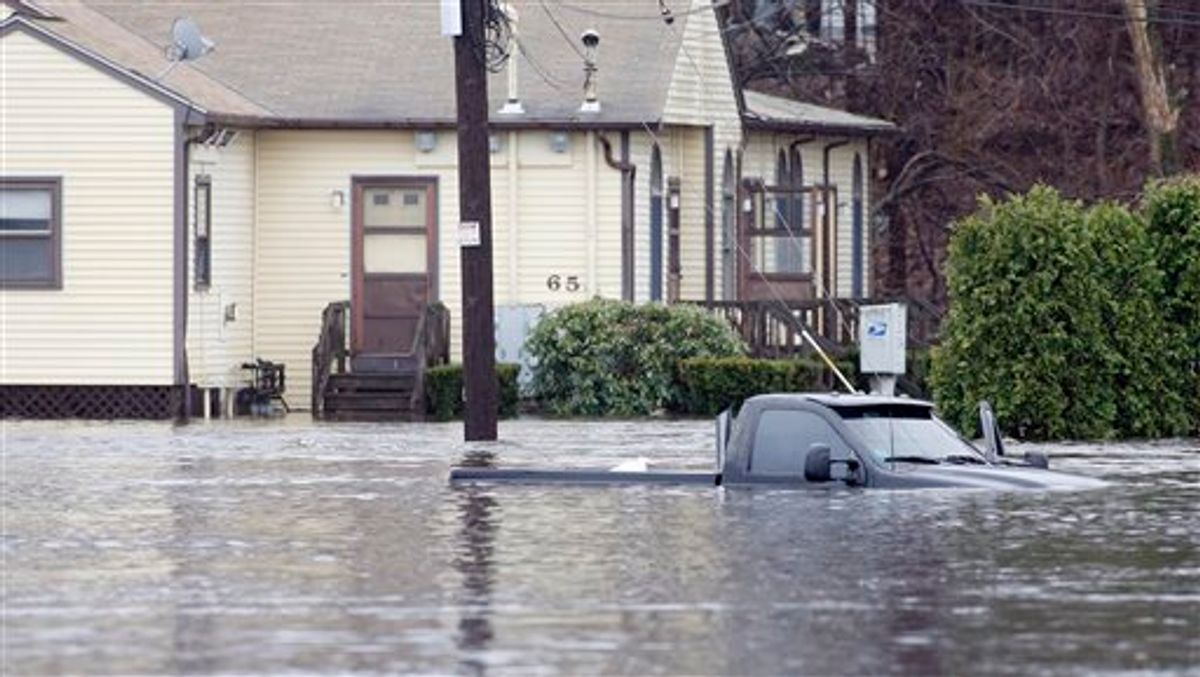
An abandoned truck sits in flood water on Industrial Lane in West Warwick, R.I.,Tuesday, March 30, 2010. The Pawtuxet River is predicted to hit a record stage of 17.5 feet, eight feet above floor stage. (AP Photo/Stew Milne) (Credit: AP)

SEEKONK, Mass. When Armand St. Stephen, a recent graduate of Tulane University, heard that New England had been inundated with unprecedented spring rains, the New Orleans native who survived Hurricane Katrina decided to do something about it. “It’s not enough to do a heckuva job,” he says, recalling former President Bush’s premature praise of FEMA Director Michael D. Brown. “You’ve got to do a helluva heckuva job.”

Brown:  “We can appease the weather gods if we give them Baton Rouge.”

So St. Stephen, who earned his degree in creative writing, called up the Army Corps of Engineers and suggested a new and unlikely source of raw material: unpublished manuscripts by writers across America.

“When you mix a 400-page coming-of-age novel with a little flour, water and glue, you get a substance that makes a pretty darn good flood prevention device,” said Chief Engineer Warren Lamont. “Of course, it looks like an elementary school science project, such as ‘How a Volcano Works’ or ‘When Dinosaurs Walked the Earth’, but we’re not in the landscape gardening business here.”

Federal Writers Project workers pretending to work

The idea of linking unpublished writers with reconstruction efforts has a Keynesian “multiplier” effect, according to David Simon, an economist at the University of Massachusetts-Seekonk. “If we can get underemployed writers — and believe me, they’re all underemployed — to crank out a short story collection at prevailing wages, then use it to fuel a waste-to-energy plant, we will ease unemployment and cut our dependence on foreign oil.”

Faulkner:  “Thanks to my Nobel Prize winnings, I can afford to maintain my savage tan.”

St. Stephen is currently working on a three-volume family saga in the manner of William Faulkner’s Yoknapatawpha County novels. “It’s a stream of consciousness novel told through the voice of Darrell Suggins, the feeble-minded product of inbreeding between the offspring of a morganatic marriage between a scion of the old Southern dynasty and a syphilitic prostitute,” he says. St. Stephens provided this reporter with a sample dependent clause from a sentence of his work-in-progress:

Yoo-Hoo Chocolate Soda Family Pack

. . . and it was not the knowingness or the beingness between the two who were the issue or the effluvium of their polar opposite forebears who yet shared the sameness and the oneness of the South yes the South with its crape myrtle and Yoo-Hoo Chocolate Soda and lightning bugs even though the drinking fountain yes the drinking fountain at Sonny Tufts Park in Atlanta had been shared yes shared by them illicitly and implictly even though serially and even though one was white and one black.

St. Stephen has been unable to find a publisher for the tome, and will ship his manuscript in three semi-trailer trucks to a processing plant in Shirley, Mass., where it will be mixed with uneaten fish sticks from the cafeteria at Bernie Carbo Junior High School to give it more substance.

Bernie Carbo

Other writers with specialized literary talents are excited about the program, and eager to participate. Dorothy Danville, an author of romantic novels disparagingly referred to as “bodice rippers” in the industry, has donated a 500-page draft of “Love’s Conquering Climax” to the cause, after trying for several years to sell it to Harlequin Books. “Ms. Danville’s works are very viscous, if I may use a 50-cent word,” said Dick Martin, Director of Public Works for New Bedford, Mass. “People are using them for caulking, tuckpointing brick structures and roof tar.”

Con Chapman, a Midwestern transplant to Boston, donated an unsold humor collection to Portland, Maine, which rejected the shipment when it failed to pass inspection. “Up here we like our humor dry,” said City Manager Floyd Oehrke. “Bounty, the Quicker Picker-upper, is more absorbent and frankly funnier than what this guy puts out.” 

On their way!

Chapman was undeterred, and said he would send a container-load of material from the Massport Marine Terminal in South Boston as soon as a ship large enough to carry it arrived in port. “And that,” he noted proudly, “will be just my rejection letters.”

  More Con Chapman

Sunday, Feb 12, 2012 2:00 PM UTC2012-02-12T14:00:00Zl, M j, Y g:i A T

Is gay literature over?

In an era of same-sex marriage and "Modern Family," the role of gay writers is changing. An expert explains how

Gore Vidal, Tony Kushner and James Baldwin

Gore Vidal, Tony Kushner and James Baldwin  (Credit: Library of Congress/Carl Van Vechten/Reuters/Phil McCarten/Miami Dade College)

Gay life in America has utterly transformed itself since World War II. In the 1950s, homosexuality was a crime. Now, openly gay people are everywhere in popular culture, gay kids are coming out as early as elementary school and we can get even get married in a half-dozen states (including, soon, Washington). One of the most crucial, but least-talked about, reasons for this change is gay literature. Starting in the 1940s, a coterie of bold writers — Gore Vidal, James Baldwin, Armistead Maupin and Tony Kushner, among many others — played a central role in creating what we now think of as gay life. Their words gave voice to a segment of the American population that, for much of its history, was hidden away.

Continue Reading

Thomas Rogers is Salon's deputy arts editor.   More Thomas Rogers

Thursday, Dec 29, 2011 9:00 PM UTC2011-12-29T21:00:00Zl, M j, Y g:i A T

Spoiler alert! What makes a great ending?

Books with terrific conclusions are hard to find, but they're even harder to talk about

the end final

The endings of novels are, in their own way, as crucial as the endings of years, but they are much less discussed. Any bibliophile can rattle off at least a handful of famous first lines (“It was the best of times, it was the worst of times…;” “It is a truth universally acknowledged…; ” “It was a bright cold day in April, and the clocks were striking thirteen,” and so on), but ask someone to quote a memorable closer and chances are all they can come up with is F. Scott Fitzgerald’s “So we beat on, boats against the current, borne back ceaselessly into the past” (from “The Great Gatsby”) or James Joyce’s rhapsodic “…and yes I said yes I will Yes.”

Continue Reading
Laura Miller

Laura Miller is a senior writer for Salon. She is the author of "The Magician's Book: A Skeptic's Adventures in Narnia" and has a Web site, magiciansbook.comMore Laura Miller

Thursday, Dec 15, 2011 1:00 AM UTC2011-12-15T01:00:00Zl, M j, Y g:i A T

Writing class from hell

As "Seminar" hits Broadway, novelist Ben Marcus judges the tyrannical writing teachers of stage and screen

Alan Rickman

Alan Rickman appears at the curtain call for the opening night performance of the Broadway play "Seminar," on Nov. 20, 2011.  (Credit: AP/Charles Sykes)

“Seminar,” a play starring Alan Rickman as a preening, acid-tongued teacher running roughshod over a group of tender aspiring writers, opened a few weeks ago on Broadway. Reviews have prompted all the usual observations about the difficulty of dramatizing both writing and reading, activities so internally momentous yet so physically inert. Why, then, do people keep doing it? And do the depictions of writing classes in stage, film and television — from “Wonder Boys” to “Bored to Death” — bear any relationship to real life?

Continue Reading
Laura Miller

Laura Miller is a senior writer for Salon. She is the author of "The Magician's Book: A Skeptic's Adventures in Narnia" and has a Web site, magiciansbook.comMore Laura Miller

Sunday, Nov 27, 2011 1:00 AM UTC2011-11-27T01:00:00Zl, M j, Y g:i A T

How my book became part of the “satanic sex stabbing”

My werewolf guide was found at the scene of a gruesome crime, but what chilled me was the media panic that followed

My book became part of a satanic sex stabbing

Left, Rebecca Chandler (left) and right, Raven "Scarlett" Larrabee  (Credit: thesmokinggun.com)

On the night I heard about my connection to a “satanic sex ritual stabbing,” I had just finished the dishes with my wife. It was about 10 p.m. on a Wednesday, my 2-year-old daughter was asleep in bed, and I was in the living room, casually catching up on email. “I assume you’ve seen this,” a friend wrote. The link took me to a headline on Gawker.com:

“Satanic Sex Ritual Threesome Not as Awesome as It Sounds.”

Continue Reading

Ritch Duncan is a writer and comedian living in New York City. Manageable samples of his vast body of work can be found at twitter.com/ritchiedMore Ritch Duncan

Wednesday, Nov 23, 2011 1:00 AM UTC2011-11-23T01:00:00Zl, M j, Y g:i A T

My Brilliant Second Career: The surprising leap from Viagra sales to journalism

After I was laid off from a Fortune 100 company, I gave up the corporate dream -- and began pursuing my own

My Brilliant 2nd Career

 (Credit: Maisei Raman via Shutterstock)

This is a series about people who stared down the Great Recession -- and reinvented themselves along the way. Do you have a great Plan B success story? Post it on Open Salon, tag it "My Brilliant Second Career," and we might publish it on Salon -- and pay you for it.

Jon Stewart was particularly pithy that Thursday night in January 2009. For weeks, my husband and I had been witnessing the economic roller coaster on television. But now, as we watched Stewart joke on “The Daily Show” about the Fortune 100 companies who’d laid off workers, it was horrifyingly personal. I was among them.

For nearly a decade, I had the mother of all sales jobs as a pharmaceutical sales representative; I sold Viagra and other medicines to urologists, family practice and internal medicine doctors. That Thursday morning, I’d been instructed to sit at home by my phone from 9 to 9:30 a.m. and wait for the call that would determine my professional future. The phone rang at 9 sharp; my district manager, awkward and stuttering, read a prepared text to inform me that I had been terminated. Later, I learned that he’d lost his own job the day before.

Continue Reading

Amy McVay Abbott is a freelance writer in southern Indiana. Her book "The Luxury of Daydreams" is available at all major online sites and for immediate download on Nook and Kindle.  More Amy McVay Abbott

Page 1 of 56 in Writers and Writing

Other News