Salon Home
Topic

Federal Reserve

Thursday, Apr 1, 2010 7:02 PM UTC2010-04-01T19:02:00Zl, M j, Y g:i A T

The trouble with the Fed’s secret bailout

The Federal Reserve has come clean about its covert actions. Now it's time to look at the worrisome consequences

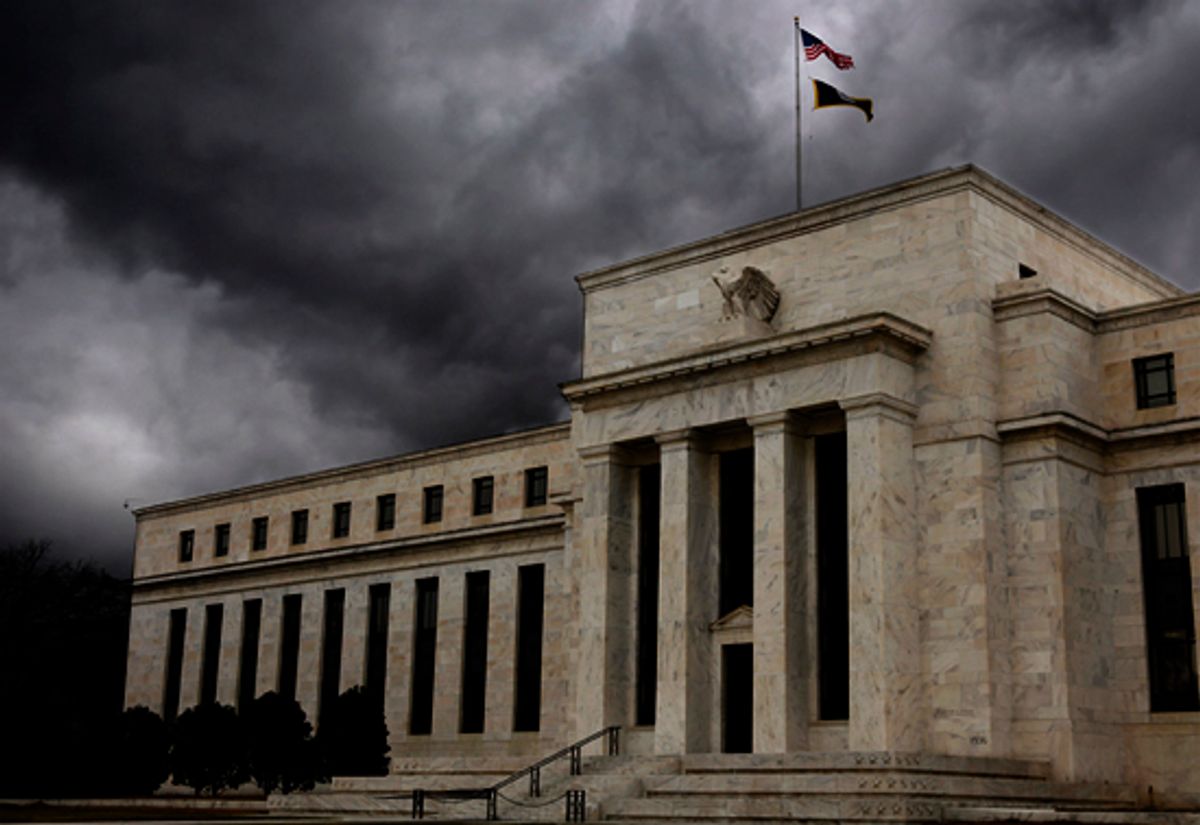
The Federal Reserve building is shown in Washington

The U.S. Federal Reserve Building is pictured in Washington, January 26, 2010. The U.S. Federal Reserve's Federal Open Market Committee began its two-day rate-setting meeting Tuesday, and while no change in interest rate conditions is expected, there is still plenty for investors to watch and worry about as the Senate debates Chairman Ben Bernanke's nomination for a second term as Fed chairman. REUTERS/Jason Reed (UNITED STATES - Tags: BUSINESS) (Credit: © Jason Reed / Reuters)

The Federal Reserve has finally came clean. It now admits it bailed out Bear Stearns — taking on tens of billions of dollars of the bank’s bad loans — in order to smooth Bear Stearns’ takeover by JPMorgan Chase. The secret Fed bailout came months before Congress authorized the government to spend up to $700 billion of taxpayer dollars bailing out the banks, even months before Lehman Brothers collapsed. The Fed also took on billions of dollars worth of AIG securities, also before the official government-sanctioned bailout.

The losses from those deals still total tens of billions, and taxpayers are ultimately on the hook. But the public never knew. There was no congressional oversight. It was all done behind closed doors. And the New York Fed — then run by Tim Geithner — was very much in the center of the action.

This raises three issues.

First, only Congress is supposed to risk taxpayer dollars. The Fed is not part of the legislative branch. Its secret deals, announced almost two years after they were done, violate the democratic process, if not the Constitution itself. Thomas Jefferson put a stop to Alexander Hamilton’s idea of a powerful central bank out of fear it would be unaccountable to the public. The Fed has just proven Jefferson’s point.

Continue Reading

Robert Reich, a professor of public policy at the University of California at Berkeley, was secretary of labor during the Clinton administration. He is also a blogger and the author of "Aftershock: The Next Economy and America's Future."  More Robert Reich

Thursday, Dec 22, 2011 12:45 PM UTC2011-12-22T12:45:00Zl, M j, Y g:i A T

Ron Paul’s wacky but influential Fed policy

Despite his crackpot theories about the central bank, his Republican rivals often echo his ideas

Republican presidential candidate Rep. Ron Paul

Republican presidential candidate Rep. Ron Paul (Credit: AP)

The Republican Party, falling deeper into the clutches of Ron Paul’s radical ideology, has a new item on its anti-populist agenda: Castrate the Federal Reserve so that it no longer can promote job growth.

In Fed-speak, this is known as cutting in half the Fed’s “dual mandate” to curb inflation and unemployment, by taking out the “unemployment” part — the nation’s persistently high jobless rates notwithstanding. The ranking Republican on the Joint Economic Committee, Kevin Brady, disclosed this week that he is drafting legislation that would turn the Fed’s long-standing “dual mandate” into a single mandate.

Continue Reading

Gary Weiss is a journalist and the author of "Ayn Rand Nation: The Hidden Struggle for America's Soul," to be published by St. Martin's Press on February 28, 2012. Follow him on Twitter @gary_weiss.  More Gary Weiss

Wednesday, Nov 30, 2011 2:00 PM UTC2011-11-30T14:00:00Zl, M j, Y g:i A T

Should the Fed save Europe?

A top think tank wants America's central bank to act as the EU's lender of last resort. Its director explains why

The Federal Reserve Building in Washington, D.C.

The Federal Reserve Building in Washington, D.C.  (Credit: Wikipedia)

This article originally appeared on GlobalPost.

BOSTON — Europe’s inability to devise a strategy for solving its debt crisis has become a dire threat.

Global Post

Economists say it could throw the world back into the kind of crisis that reached its nadir in 2008 and 2009, destroying trillions of dollars in wealth and causing millions to lose their jobs.

Continue Reading

David Case is a senior writer and editor at GlobalPost. Follow him @DavidCaseReport.  More David Case

Wednesday, Nov 2, 2011 7:00 PM UTC2011-11-02T19:00:00Zl, M j, Y g:i A T

Fed foresees far weaker growth than it had earlier

Prospects gloomy for driving down unemployment

Ben Bernanke

Federal Reserve Board Chairman Ben Bernanke testifies on Capitol Hill in Washington, Tuesday, Oct. 4, 2011, before the Joint Economic Committee hearing on the economic outlook.  (Credit: AP/Evan Vucci)

WASHINGTON (AP) — The Federal Reserve sketched a bleaker outlook Wednesday for the economy, which it thinks will grow much more slowly and face higher unemployment than it had estimated in June.

The Fed now predicts the economy will grow at a scant 1.6 percent to 1.7 percent for 2011. For 2012, it thinks growth will range between 2.5 percent and 2.9 percent. Both forecasts are roughly a full percentage point lower than its June forecast.

The Fed sees unemployment of between 8.5 percent and 8.7 percent next year. In June, it had predicted unemployment would drop next year to as low as 7.8 percent. The rate is now 9.1 percent.

Continue Reading

  More Martin Crutsinger

Thursday, Sep 22, 2011 5:01 PM UTC2011-09-22T17:01:00Zl, M j, Y g:i A T

Operation treason?

Why markets are tanking: The Fed's new plan admits the economy is in trouble but doesn't come close to fixing it

Federal Reserve Chairman Ben Bernanke testifies before the Senate Banking, Housing and Urban Affairs Committee

U.S. Federal Reserve Chairman Ben Bernanke testifies before the Senate Banking, Housing and Urban Affairs Committee hearing on Enhanced Oversight After the Financial Crisis: The Wall Street Reform Act at One Year on Capitol Hill in Washington, July 21, 2011. REUTERS/Yuri Gripas (UNITED STATES - Tags: POLITICS BUSINESS HEADSHOT) (Credit: © Yuri Gripas / Reuters)

If the stock market reaction is any indicator, the early reviews of Ben Bernanke’s latest scheme to juice the economy, “Operation Twist,” are negative. At 1 p.m. ET, the Dow Jones industrial average was down nearly 360 points.

Deciphering investor psychology is never straightforward, and particularly so recently, when there are so many potential reasons for fear and panic: our amazingly dysfunctional U.S. Congress, the ongoing European drama, and the steady drumbeat of negative economic indicators. But today’s tremors can be tied to the Fed’s announcements on Wednesday fairly easily.

Continue Reading
Andrew Leonard

Andrew Leonard is a staff writer at Salon. On Twitter, @koxinga21.  More Andrew Leonard

Wednesday, Sep 21, 2011 7:01 PM UTC2011-09-21T19:01:00Zl, M j, Y g:i A T

Fed to shift $400B in holdings to boost economy

Move to rebalance $2.87 trillion portfolio could help lower Treasury yields and reduce rates on loans

Ben Bernanke

FILE - In this Sept. 30, 2010 file photo, Federal Reserve Chairman Ben Bernanke testifies on Capitol Hill in Washington. The last time the Federal Reserve came up with a big plan to help the economy, it totaled $600 billion and touched off a 28 percent rally in the stock market. But if the Fed takes any new steps, as many people expect, it won’t look anything like that. Look for small ball, not a home run. “Operation Twist,” as Fed-watchers are already calling it, in a nod to economic history, probably will help the economy and the stock market. (AP Photo/Manuel Balce Ceneta, File) (Credit: AP)

The Federal Reserve says it will sell $400 billion of its shorter-term securities to buy longer-term holdings, its latest effort to boost a weak economy.

The Fed’s move to rebalance its $2.87 trillion portfolio could lower Treasury yields further. Ultimately, it might reduce rates on mortgages and other consumer and business loans.

The Fed also said it will reinvest its holdings of mortgage-backed securities, which would help keep mortgage rates at super-low levels. The Fed had previously reinvested the interest and principal into Treasury purchases.

Continue Reading

  More Martin Crutsinger

Page 1 of 13 in Federal Reserve

Other News