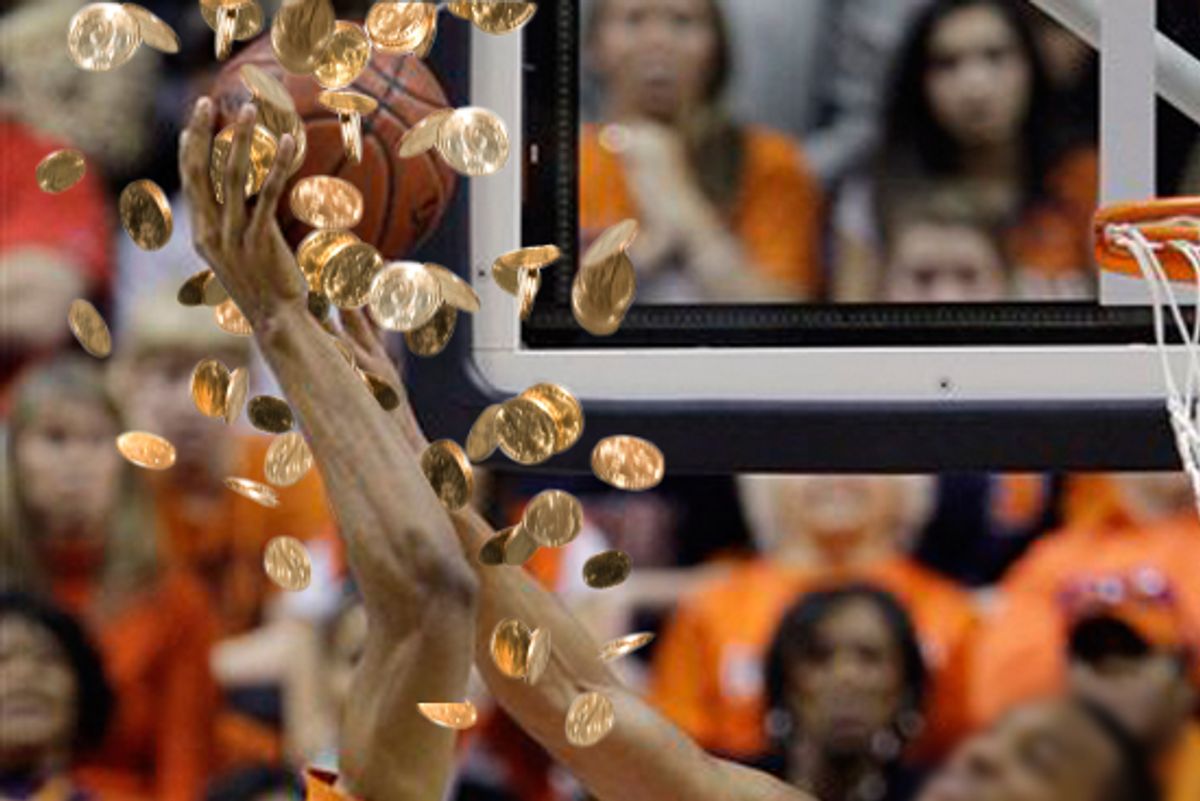
College basketball

The end of college basketball’s golden age is here

Enjoy this weekend's Final Four, because the NCAA is about to ruin March Madness forever

  • more
    • All Share Services

The end of college basketball's golden age is here

Beware the man who stares at perfection and proclaims, “I can improve this!” He most certainly can’t, and if you dare let him try, the only thing that’s certain is that he’ll end up ruining it.

And ruin, sadly enough, is the near-certain fate of what for a quarter-century has stood as one of the sports world’s last pillars of unspoiled perfection: the NCAA basketball tournament. As this year’s edition of March Madness climaxes in Indianapolis, it has become clear that the NCAA will junk the current tournament format and expand to a 96-team field starting next season.

A few days ago, the NCAA released a blueprint for its beefed-up bracket, laughably claiming that it was all theoretical and that no decisions had yet been made. Don’t be fooled. It was only the latest step in a tightly scripted rollout that began a year ago. Soon, the NCAA will sever its tournament contract with CBS and ratify the new postseason format. Then the bidding will begin.

And money, no matter what they claim, is what this is about. More than ever, television advertisers covet live events like the tournament, which still deliver the large, broad audiences that scripted sitcoms, dramas and movies-of-the-week delivered a generation ago. To accommodate 96 teams, 31 games– spaced out over two days — will be added to the tournament. A few years ago, ESPN (which can blow the broadcast networks out of the water, thanks to cable subscriber fees) bid more than $1 billion to air one NFL game a week. Imagine what it’ll pay for 95 do-or-die basketball games.

If you’re a casual fan, the kind that doesn’t know the difference between the Big Sky conference and the Big South, you probably won’t mind the new scheme. All you’ll know is that there are more games on the air in March, the only month you ever think about college basketball. You’ll fill out your bracket and dutifully tune it, just like you do now, while the NCAA and its new television bride sit back and drink to their own genius. Monster television ratings, after all, are built on the casual fan — not the critical-thinking die-hard.

But the more you know about and understand college basketball, the more tragic this looming expansion seems.

Like everything else in the world, the tournament is a product of evolution. It’s been around for decades, but it wasn’t until the 1970s that it cemented its status as the sport’s preeminent postseason event. And it wasn’t until the 1984-’85 season that it expanded to its current 64-team size. (Technically, it’s now 65 teams, with two schools matched in a play-in game two days before the start of the full tournament, but the basic 64-team bracket has been in place since ‘85.)

This has already emerged as a key NCAA talking point: We’ve expanded before and things have gotten better, so why not do it again? After all, they note, the number of schools playing Division I basketball has risen by about 50 since ’85, to the current total of 343. But what expansion advocates don’t appreciate (and what the NCAA willfully ignores) is that the growth of Division I over the last 25 years has not affected what kinds of teams do and don’t make the tournament field. 

Casual fans, the ones who only pay attention in March, like to complain that college basketball’s regular season is meaningless. It isn’t. Just ask Illinois, which posted a 19-14 regular season record this year (and a 10-8 mark in the Big Ten, one of the six power conferences), only to be left out of the field.

Right now, teams are forced to distinguish themselves in the regular season to qualify for the field. It’s true that the rules aren’t the same for everyone. A power conference team can (occasionally) get in with a .500 record in its league, while a small conference squad can go 28-6 and miss the field if it fails to win its league tournament (as happened to Coastal Carolina from the Big South this year). But while the quantitative standards may vary, every team that wants to make the tournament must distinguish itself qualitatively during the season. They have to earn their way in.

This is what makes CBS’s annual tournament selection show so fun. Watching the Minnesota Golden Gophers dancing around a hotel room after claiming one of this year’s final spots was a joyous sight. Whether they should have made it is a subjective matter, but with a 21-13 record (9-9 in the Big Ten), they clearly deserved to be under consideration. Their delirium was a fitting reward for hard work, steady improvement, and some achievement. Now, imagine that same scene under a 96-team model. It would have been the pitiful Texas Tech Red Raiders (17-15 overall, 4-12 in the Big 12) celebrating an invitation they’d done absolutely nothing to earn. When that starts happening, the regular season really will mean nothing.

Expansion supporters also claim that a 96-team field will create more opportunity for small conference teams. This misses the point. First, the NCAA’s motive is to clear more room for brand-name schools that will attract television audiences. It’s probably no coincidence that the current tournament is the first in memory not to include North Carolina, Connecticut or UCLA. With 96 teams, though, at least two of them would have been in.

Further, there just isn’t a need for the additional small conference teams that would also make it. No one loves the little schools more than me. (You can find my old Coastal Carolina sweatshirt hanging from the rafters of my local East Village sports bar, where I tearfully retired it after the Chanticleers choked in this year’s Big South title game.) But there’s good reason that the smallest leagues — like the Big South – only place one team in the NCAA field. Generally, the small league teams receive No. 15 and No. 16 seeds in the bracket. And since ’85, No. 16’s are a combined 0-104 in the tournament. No. 15’s are 4-100.

This doesn’t mean small conference teams shouldn’t qualify. They absolutely should; March wouldn’t be the same without them. But it does mean that their leagues don’t warrant more than one bid. It’s also worth noting that just about all of the expansion in Division I — the 50 or so new schools in the last 25 years — has taken place in these small conferences.

There’s also the Butler argument. Expansionists point to the success of this year’s Butler Bulldogs, a Final Four participant from a mid-major league (basically: bigger than the Big South, smaller than the ACC) as proof that the field should grow. But mid-major conferences already can — and often do — receive multiple tournament bids. Sometimes, worthy mid-major teams are left out, but it’s not very common. Just look at Butler’s own conference, the Horizon. This year, the Bulldogs went 18-0 in the league and 28-4 overall. The second-place team, Wright State, went 12-6 and 20-12 — which would barely be tournament-worthy for a major conference team. The Horizon got exactly what it deserved this year: one tournament bid.

For 25 years, making the tournament has meant that you achieved something substantial during the regular season. But starting next year, it’ll just mean that you finished in the top 10 of the Big 12.

Steve Kornacki

Steve Kornacki writes about politics for Salon. Reach him by email at SKornacki@salon.com and follow him on Twitter @SteveKornacki

NCAA accuses UConn men’s basketball of 8 violations

Staff led by Coach Jim Calhoun allegedly made improper phone calls and texts messages and gave benefits to recruits

  • more
    • All Share Services

The NCAA has accused the storied men’s basketball program at the University of Connecticut of eight major rules violations.

The school released the notice of allegation letter Friday following a 15-month investigation into the recruiting of former player Nate Miles. The eight alleged violations include improper phone calls and text messages to recruits, giving recruits improper benefits and improperly distributing free tickets to high school coaches and others. Coach Jim Calhoun was cited for failing to promote an atmosphere of compliance.

“It’s not exactly, certainly anywhere near the high point of my career, as a matter of fact it’s certainly one of the lowest points at any time that you are accused of doing something,” said Calhoun, who has led the Huskies since 1986 and twice guided them to national championships. “It’s a very serious matter.”

UConn is to appear before the governing body on Oct. 15 to respond. Attorney Rick Evrard, an outside counsel who advises UConn on NCAA-related matters, said the school likely will spend the next three months reviewing the allegations. He said if the school confirms them, it is obligated to impose its own sanctions. Penalties could vary widely, depending on what UConn finds in its review.

Among the allegations, is that assistants Beau Archibald and Patrick Sellers provided false and misleading information to NCAA investigators. Sellers and Archibald, who served as director of basketball have both resigned. Jeff Hathaway, the school’s athletic director says Archibald resigned last Thursday, and Sellers quit on Sunday.

Both released statements Friday saying they needed to devote their full attention to the allegations against them.

“Coaching is my passion and something I have spent many years of enjoyment doing,” Sellers said. “I want the record to reflect this and for the people to see the respect and integrity that I will show toward the process in the months ahead.”

The 68-year-old Calhoun recently signed a five-year, $13 million contract, though UConn was 18-16 last season and Calhoun took a medical leave of absence in January, missing seven games with an undisclosed medial condition.

UConn as an institution was cited for not adequately monitoring “the conduct and administration of the men’s basketball staff in the areas of: telephone records, representatives of the institution’s athletics interests; and, complimentary admissions or discretionary tickets.”

Calhoun and Hathaway declined to comment on the allegations, citing the ongoing investigation, but Calhoun said he won’t be defeated by the charges.

“I’m going to be educated by certain matters, if in fact we did make mistakes, which I think I said 15 months ago,” Calhoun said. “We’ll finalize some of that over the next 90 days and we will go forward.”

The NCAA and the school have been investigating the program since shortly after a report by Yahoo! Sports in March 2009 that former team manager Josh Nochimson helped guide basketball recruit Nate Miles to Connecticut, giving him lodging, transportation, meals and representation.

As a former team manager, Nochimson is considered a representative of UConn’s athletic interests by the NCAA and prohibited from having contact with Miles or giving him anything of value.

“The men’s basketball staff knew or should have known about the benefits provided by Nochimson due to their knowledge of Nochimson’s status as a professional basketball agent and his relationship and contact with (blacked out)….,” the NCAA wrote to UConn. The alleged infractions occurred between June 2005 and February 2009.

Documents released by the school showed pages and pages of phone and text message correspondence between Nochimson and UConn coaches Calhoun, Tom Moore, who is now head coach at Quinnipiac, and Sellers.

Messages seeking comment were left at Quinnipiac for Moore.

Miles was expelled from UConn in October 2008 without ever playing a game for the Huskies after he was charged with violating a restraining order in a case involving a woman who claimed he assaulted her. He played during the 2008-09 season for the College of Southern Idaho, and was cut last November by the NBA Development League’s Sioux Falls Skyforce.

The investigation of the men’s basketball program has no impact on UConn’s other sports programs, including its national champion women’s basketball team.

Continue Reading Close

March Madness live blog

A first set of games rife with overtimes. Can the second set beat it?

  • more
    • All Share Services

March Madness live blogRobert Morris' Mezie Nwigwe (2) drives past Villanova's Reggie Redding (15) during the first half of an NCAA first-round college basketball game in Providence, R.I., Thursday, March 18, 2010. (AP Photo/Winslow Townson)(Credit: AP)

Obama predicts Jayhawks will win national title

The President chooses Kansas to prevail in his annual Madness bracket

  • more
    • All Share Services

The First Fan is a big fan of basketball programs from Kansas.

President Barack Obama predicts Kansas and Kansas State to reach the men’s basketball Final Four this season, along with Kentucky and Villanova.

He’s picking the Jayhawks to defeat Kentucky for the title.

Obama filled out a bracket for ESPN for the second straight year Wednesday, along with one for the women’s tournament. He selected Connecticut, Notre Dame, Stanford and Tennessee to reach the Final Four in that tournament.

Last year, Obama correctly picked North Carolina to win the national championship. His bracket ranked 903,125th overall, just above the 80th percentile in the ESPN’s online contest.

NCAA Tournament, Day 1 — live!

If you want to understand America, you don't have to watch all this basketball. But it helps.

  • more
    • All Share Services

4:10 p.m. PDT Not much to recommend that Washington-Mississippi State game that just ended except a 10-point, 15-rebound, one-spectacular fall performance by Jon Brockman. The Huskies won by 13, which is about how much they led by for the entire second half.

Not much in the way of upsets so far. I refuse to consider a 9-over-8 an upset, so Texas A&M over BYU doesn’t count. Tenth-seed Maryland beat No. 7 Cal, which is officially an upset but didn’t much look like one, and 10-over-7 usually isn’t really one anyway.

I can drag out my well-worn theory here that a difference of three or four seeds in the middle of the bracket, a 7 vs. a 10 or an 8 vs. a 12, that sort of thing, is nothing. It has more to do with the biases of the Selection Committee and the small sample size of a season than the actual quality of the teams.

But I’m not going to do that.

The evening games offer some upset chances. A lot of people have Western Kentucky over Illinois in the South as their token 12-over-5 upset, and a few have No. 13 Akron, also in the South, over No. 4 Gonzaga.

While you’re waiting for the third set of games to get going, read this terrific post by my friend Jonah Keri, “The Legacy of Gonzaga, Adam Morrison, and Gus Johnson.” By way of reviewing Gonzaga’s decade-long run as a major Tournament player, he pays cockeyed tribute to my favorite announcer. With clips. Oh, baby!

I’ll take my leave of you for now. We’ll talk about the evening games later.

3:10 p.m. PDT I asked if it’s my imagination or if 1-vs.-16 games have become less competitive in recent years. After a quick look at the last 10 Tournaments, I have to say it’s not my imagination. In the last three years, those 1-16 games have been a lot more lopsided than they had been.

But they only had been less lopsided for two years, 2005 and 2006. What was a figment of my imagination was that the top seeds’ opening games had been fairly competitive for most of this decade. Not true. It’s been blowout city all along, except in ’05 and ’06.

Today’s 1-16 games had victory margins of 43 and 56 points. North Carolina’s 103-47 win over Chattanooga, by the way, was the first 50-point win by a No. 1 seed over a 16 since 1998, when Kansas beat Prairie View 110-52.

That means this will be the third straight year in which at least two of the 1-16 games had margins of 20 or more points, and it still could be the third straight year with 20-point margins in all four games. In both 2005 and ’06, only one of the four 1-16 games had a 20-point margin. Those were the only years since 1999 when fewer than two of these games were decided by 20 or more, and there was only one other year, 2002, when as few as two games were so lopsided.

The average margin of victory in 1-vs.-16 games from 1999 to 2003 was at least 24.25 points every year, and twice it was more than 30 points. In 2004 it fell to 22.5 points, then to 15.5 in 2005 and 16.5 in 2006. But it was back up to 31.25 in 2007 and 32 points last year. This year, it’ll be at least 30 points unless the total margin of victory in the remaining two games is fewer than 21 points. There have been 42 1-vs.-16 games played since 1999, and no two of them have a combined margin of victory fewer than 21 points.

The last time a No. 1 failed to win its opening game by at double figures was in 1997, when North Carolina beat Fairfield 82-74.

So what does all that mean?

It means that Mike Montgomery is part of a devious Stanford conspiracy against my Golden Bears.

In the only game going right now, Washington is pulling away from Mississippi State early in the second half. Washington’s a good team.

2:10 p.m. PDT So I’ve been off playing fanboy, watching my sturdy Golden Bears play the Terps, and it’s been a pretty dismal affair. That’s partly because Maryland just closed out a solid win and mostly because it was kind of a dreary ballgame.

Now here’s another way the NCAA Tournament is just like America: I’m looking around for someone to blame. Give me a few minutes here and I’ll have a conspiracy theory worked up that has to do with Cal’s coach, Mike Montgomery, still being loyal to his old employer, Stanford.

Chattanooga’s early surge against UConn didn’t exactly sustain itself. At this writing, the Huskies lead by 54. North Carolina struggled to a 101-58 win over Radford. That game was over so quickly I didn’t even have time to look up where Radford is. Virginia, is what I would have found.

Is it my imagination, or are 1-vs.-16 games becoming less competitive in recent years? I don’t remember so many 40- and 50-point games in the late ’90s and early ’00s, but lately they’ve become common.

Maybe I’ll do a little research on that question while I watch this West region game between No. 4 Washington, champs of my home conference, the Pac 10, and No. 13 Mississippi State.

See? We work even while we’re watching basketball, we Americans. That’s productivity.

12:15 p.m. PDT Thanks mostly to Roburt Sallie’s 35 points, Memphis held off Northridge State 81-70, so the big upset didn’t materialize in the first flight of games.

Butler over LSU in a 9-over-8 in the South wouldn’t have been an upset, but it always feels like one when a smaller conference team beats a BCS school, even when they’re evenly matched. That didn’t happen either, the Tigers hanging on for the 75-71 win. BYU never got its act together against Texas A&M and lost 79-66. That one was a BCS 9 over a smaller conference 8, but it felt a little more like an upset because who expected BYU to look so overmatched in that game?

So we soldier on to the next run of games, in search of our first upset. This is what we do during the first two days of the Tournament. We watch for upsets and any other close, exciting games. Upsets are almost always close and exciting.

We also watch our own team play, if we’re lucky, and this column’s lucky this year. The real alma mater, California, seeded seventh in the West, goes up against No. 10 Maryland in this set of games. The others are 5 Purdue vs. 12 Northern Iowa in the West, an upset pick for me but going the Boilermakers’ way early; and the first two 1-vs.-16 games of the Tourney, North Carolina-Radford in the South and UConn-Chattanooga in the West.

The Huskies announced shortly before game time that coach Jim Calhoun would miss this game because of a health issue. He’s reportedly at the team hotel, but the school isn’t saying exactly what’s wrong. He’s had some gastric issues for several years and sometimes misses games.

In 1954 an academic named Jacques Barzun famously wrote, “Whoever wants to know the heart and mind of America had better learn baseball,” and we baseball fans love to quote that, even though for all we know Barzun was a complete idiot and while this country’s heart and soul might or might not be a constant since 1954 its leisure interests have most certainly changed, and if baseball knowledge were necessary to know the heart and soul of America in 1954 — a dubious idea — it’s almost certainly not necessary today.

“American Idol” maybe. The NFL perhaps. But not baseball.

And maybe you can see where I’m going with this. Whoever wants to know the heart and mind of America had better pay attention to the NCAA Tournament.

Which is nonsense, of course. Complete doo-doo, as a favorite history professor of mine at Cal — there’s the tip! Go Bears! — used to say abouut some theory or other. But I wonder if there’s something to the idea that you can learn a little something, or a lot something, about our heart and soul, maybe even our liver, by cozying up to the NCAA Tournament, especially the first round.

We love our underdogs, of course. Have I mentioned Andrew Leonard’s great “National underdog days” in Salon in 2001? We love our underdogs, but we mostly bet on the favorites. And we don’t really squawk much when the deck is stacked in their favor, which the NCAA Tournament does by letting high seeds play early-round games close to home.

We bet a lot.

We become absolutely fascinated by something because it’s right in front of us. All of a sudden, we’re huge fans of … Cal State Northridge! We don’t know where it is! We mix it up with Fullerton, or is it San Luis Obispo! But we’re living and — oh! He fouled him! The refs are in the bag! — these guys for an hour or so if they get up in the grill of some high seed. We become experts on them. That No. 3 guy. He’s got to stop going to his left like that. He can’t go left! Why doesn’t he know that?

Of course we’ve never seen No. 3 before in our lives and for all we know his friends call him “Lefty” because he goes to his left so well. But we saw him go to his left twice and not score, and we know. He should listen to us.

And we’re going to forget No. 3′s name 10 minutes after this game’s over and never give him another thought. We don’t much care what you used to do. We care about what you’re doing right now.

We use the Tournament as an excuse to get together, to party, to sluff off at work. But we also work really hard. We work extra hours to make up for our — ahem — lost productivity. Maybe we check in on a few basketball games we shouldn’t on Thursday and Friday, but how many of us are trying to catch up on Saturday and Sunday, doing a little work on the side when, goshdarnit, we should be concentrating on basketball.?

Our hearts and our souls are a little too complicated to be boiled down to how you’d best get to know this or that game to understand them. But maybe you don’t get the full picture without knowing a little bit about baseball, about “American Idol” and the NFL, and certainly about the NCAA Tournament.

I could go further with this theory, but Cal has rallied from a bad start, Radford is hanging in against Carolina, and — Chattanooga! The Mocs! I didn’t even have to look that up! They’ve got the lead! It’s 6-4!

10:55 a.m. PDT Matadors! Northridge — my alma mater! OK, shut up — have pulled ahead of Memphis in the middle of the second half. Mark Hill’s 3-pointer put the Matadors on top 44-43. Following a Memphis timeout, a Hill assist led to a bucket that gave Northridge a 46-43 lead.

What would it do to your bracket if we got the first 15 over 2 since Hampton beat Iowa State in 2001?

10:30 a.m. Halftime times three. Why don’t they stagger those starts by more than five minutes? There are 16 games going on today. Why should there ever be down time?

Northridge is hanging in there against Memphis, though I’m not confident for my alma mater. They trail by three. BYU, outside my vision because I got tired of shielding my eyes, has semi-rallied to pull within 12 of Texas A&M. LSU leads Butler by six.

I should mention that I’m not going to try to fool you into thinking I have any expertise on the 2008-09 college basketball season. This season has largely passed me by. I was shocked to find out that UNLV didn’t make the Tournament. Don’t they win the championship every year?

Just kidding. But I’m approaching the Tournament the same way most people do — as a person suddenly paying a radical amount of attention to college basketball after having been no more than a casual fan all year.

This moment of full disclosure dispensed with, can we start those second halves please?

10 a.m. PDT Cal-State Northridge is giving Memphis hell in Kansas City. The No. 15 Matadors jumped off to a big lead but the No. 2 Tigers pulled even before I could even do any crowing: My alma mater!

That was a little personal in-joke anyway. I’m not a Northridge alum. I just like to say that because I went to a weekend journalism seminar there when I was in high school. But the joke’s on me: That seminar was at Cal State-Fullerton, not Northridge. Who can tell the difference?

Memphis has a 26-22 lead with about eight minutes to go after a big dunk by Matador Kenny Daniels — from St. Louis. Hey, he’s my homeboy, sort of. I’m just looking for connections wherever I can find them.

Butler has righted the ship somewhat but still trails LSU 22-18. BYU is getting blown out by Texas A&M, and it’s not looking flukey. The Cougars are playing terrible ball.

9:25 a.m. PDT Sweet Bud Light commercial there with the skier crashing down the slope, thanks to the tree that the Bud Light guy drew onto the mountainside with his finger.

It’s not like one of the biggest news stories in the country today is a famous actress having died after a ski accident or anything.

So one of my few “upset” picks — not that a 9 over an 8 is an upset — is off to a great start. LSU 9, Butler 0.

9:10 a.m. PDT This column is ready for duty, primed to watch Day 1 of the NCAA Tournament so you don’t have to, though let’s face it: You’re going to.

So let’s get a few things taken care of right off the bat. The most true thing ever written by anybody about anything, and yes I’m including all those old Greek dudes and Thomas Jefferson and whoever came up with that thing about beans being the magical fruit, was Andrew Leonard’s 2001 piece in Salon headlined “National underdog days,” in which Leonard argued that the first two days of the Tournament should be holidays in the United States. I link to it every year, so there you go.

“It’s an insult to working men and women to have one of the most exciting 48-hour stretches of sports off-limits to us poor sods who have to pay fealty to evil capitalist overlords,” Leonard wrote.

Put that man in charge of the Fed. Or at least make him president.

Another thing I like to do is point out the absurdity of the annual publicity-stunt claim by a Chicago consulting firm that the NCAA Tournament costs American business some tremendous and entirely fictional amount of money. Challenger Gray & Christmas gets its name in the paper — sorry, its name in the blogosphere nowdays — with this stuff every year, and good for Challenger Gray. I admire the ability to get mentioned and am happy to support it.

The main thing this publicity does for Challenger Gray is let potential clients know that the firm is comfortable with shoddy analysis based on faulty assumptions, and that’s giving the company the benefit of the doubt that it doesn’t just invent facts to lead to the conclusions it thinks will best benefit Challenger Gray.

Hire away, American corporations! These guys can really help.

The short version of what Challenger Gray does: It uses some old survey to guess at how many college basketball fans there are and how much time per Tournament day basketball fans say they devote to the Tournament. Then it multiplies that number by the number of days men’s and women’s Tournament games are played on, even though there are only two days in the whole thing when games are played during normal business hours. And then it multiplies that absurdly inflated number by the average hourly wage and, presto, a figure for the amount of money lost by American business.

Oh, by the way, this calculation assumes that no American worker ever wastes a single minute, all year, except on the NCAA Tournament.

OK, that wasn’t short. Challenger Gray’s lost productivity figure swung from $889.6 million to $3.8 billion and back down to $1.2 billion in the space of three consecutive years from 2005 to 2007. Just to give you an idea of the rigor here.

But never mind that. We’re ready for basketball. I’ve decided to go with a boring bracket this season. My son Buster, the coin-flippinest 6-year-old who ever thought he was a rock star, has a much more interesting bracket than mine, though we both come to the same conclusion: Pittsburgh over Louisville in the Championship Game.

Here’s what I have. In the Midwest, my only first-round upset is 11 Dayton over 6 West Virginia. In the second round I have all favorites except 7 Boston College over 2 Michigan State. Louisville over Kansas in the regional final.

In the West I have my token 12-5 upset, Northern Iowa over Purdue. I also have 11 Utah State over 6 Marquette, but then the bracket resolves to the top four teams making the Sweet 16. How could I resist the Huskies vs. the Huskies and the Tigers vs. the Tigers in the regional semis? I’ve got No. 2 Memphis beating the top seed, UConn, in the final.

In the East I’m taking 11 Virginia Commonwealth over 6 UCLA, only because I always pick against UCLA if a Bruins loss is plausible. I was born there. Paging Dr. Freud. I have 10 Minnesota beating 7 Texas. A minor upset in the second round, 5 Florida State over 4 Xavier, and then 3 Villanova over 2 Duke in the regional semi before Pitt takes the region.

In the South I’ve got 9 Butler over 8 LSU and 10 Michigan over 7 Clemson. I’m going with a 6-3 upset in the second round, Arizona State over Syracuse. And then North Carolina over Oklahoma in the final.

So my Final Four is Louisville over Memphis and Pitt over UNC, with Pitt winning the title. If I’m not entered in your pool, just send me the money.

Buster has Missouri, his home-state team, making a Final Four run out of the West, where he had them beating Cal in the Sweet 16. Dad has his own alma mater losing in the second round. Even better than that, though, he has Clemson making a shocker of a run out of the South, knocking off Gonzaga in the regional final.

Butler-LSU, Cal State Northridge-Memphis and Texas A&M-BYU are all bouncing balls around, about to tip off. Let’s go.

Continue Reading Close

King Kaufman is a senior writer for Salon. You can e-mail him at king at salon dot com. Facebook / Twitter / Tumblr

The year in sports: Believe the hype

2008 was a series of did you see thats that are destined to become do you remembers.

  • more
    • All Share Services

The year in sports: Believe the hype

Years from now, 2008 will probably be remembered as the year of an economic collapse so severe that even the usually recession-proof world of North American sports felt it. The NFL laid people off. That doesn’t happen most years.

But for most of 2008, living through it, even as housing prices fell and the recession gathered, the sports year didn’t feel like the Year of the Crash. Most of 2008 seemed to be about big sports stories actually living up to their hype.

It started with the New England Patriots chasing an undefeated season. They’d ended 2007 by winning an epic regular-season finale over the New York Giants, and a month later lined up as heavy favorites in the Super Bowl against the same team. Giants quarterback Eli Manning engineered a late touchdown drive that gave New York a stunning victory.

The highlight, Manning spinning away from the grasp of the Patriots pass rush, sprinting to the sideline and heaving the ball downfield, where David Tyree trapped the ball against his helmet and hung on while the great safety Rodney Harrison wrestled with him, was the signature football moment of the year and, so far, of the century. It might have been the single greatest play in Super Bowl history.

Like that, is how 2008 was. A series of breathtaking did you see thats destined to become do you remembers.

Swimmer Michael Phelps set out to win eight gold medals in the Beijing Olympics and succeeded. His seventh gold, tying Mark Spitz’s record for one Games, was in the 100-meter butterfly. Trailing badly at the turn and still behind Serbian Milorad Cavic one body length from the wall, he somehow made up the distance on the last stroke, touching one-hundredth of a second before Cavic.

And that wasn’t even the most electrifying moment of the Games. That honor belonged, pun and all, to Jamaican sprinter Usain Bolt, who didn’t just win the men’s 100- and 200-meter gold medals, the first to do so since Carl Lewis in 1984, he did it in cartoonish, world-record-setting fashion and with a sparkling personality — which drew fire from the International Olympic Committee’s idiotic chieftain, Jacques Rogge.

Bolt was so rattled by Rogge’s inanity that he went out and helped Jamaica win the four-by-100 gold, also in world-record time.

American Dara Torres became the first woman over 40 to swim in the Olympics and the first to swim in five of them, all the more remarkable because the five, dating to 1984, weren’t consecutive. She won two silver medals in relays and another in the 50-meter freestyle, losing to gold medal-winner Britta Steffen by a Phelpsian hundredth of a second. “I’m thinking,” she said afterward, “I shouldn’t have filed my nails last night.”

Overall the Olympics failed to live up to the hype in one good way. After a few American athletes were censured for arriving with masks on to filter out the pollution, fears of athletes being overcome by Beijing’s horrible air quality were not realized. American television viewers, however, were nearly suffocated by NBC’s ceaseless broadcasting of synchronized diving and beach volleyball.

In between, glimpses were caught of the U.S. men and women winning basketball gold, and the usual drama in the gymnastics arena. China dominated the men’s competition and won the women’s team all-around, but Americans Nastia Liukin and Shawn Johnson went gold-silver in the individual all-around, and Johnson, a darling of the pre-Games buildup, won gold on the balance beam.

The Euro 2008 soccer tournament lived up to its billing thanks in large part to a thrilling underdog run by Turkey, which staged dramatic comebacks against Switzerland, the Czech Republic and Croatia before falling to Germany in the semifinals. Spain, an exciting, attacking team — two concepts often lacking in international soccer — beat Germany for the cup.

Kansas guard Mario Chalmers hit a 3-pointer in the final seconds to cap a Jayhawks comeback against Memphis in the NCAA men’s basketball Tournament Championship Game, forcing an overtime, which Kansas dominated for the title.

That finished off a Tournament that was outstanding even by its own high standards, with just enough upsets to make it interesting and a deep run by an exciting — and underseeded — No. 10, Davidson, but the best teams were left standing at the end. The Final Four was the first ever to feature all four top seeds.

In the women’s Tournament, the sport’s colossus, Tennessee, won yet another title, led by Candace Parker, the game’s best player. Parker was taken first in the WNBA draft by the Los Angeles Sparks, scored 34 points in her first game, and went on to be named Rookie of the Year. Now that’s living up to the hype.

The Boston Celtics and Los Angeles Lakers spent the 2007-08 season threatening to renew their old NBA Finals rivalry, and sure enough, this being the year that anticipation paid off, they did. The offseason acquisition of Kevin Garnett was the centerpiece of the Celtics’ return to prominence. Boston started strong and never let up.

The Lakers had been fringe contenders for a while but became championship caliber when they made a one-sided trade for Memphis Grizzlies star Pao Gasol. Even without talented young center Andrew Bynum, who was injured during the season, the Lakers won the Western Conference behind Gasol and Kobe Bryant. But they proved too soft to be a match for the Celtics, who took the Finals in six games and won the title for the first time since 1986.

The Gasol trade sparked two answer trades in the West, longtime contenders trying to reload for another run by bringing in aging superstars. Shaquille O’Neal went to the Phoenix Suns, and Jason Kidd to the Dallas Mavericks. It didn’t work out in either place. Not everything in 2008 lived up to the hype.

It just felt like it. Baseball’s trading deadline, July 31, is usually a time of a million blockbuster rumors and a handful of minor deals. Oh, but this was 2008. In early July, C.C. Sabathia, the defending Cy Young Award winner, was dealt from the Cleveland Indians to the Milwaukee Brewers, and Rich Harden, who might have the best stuff in baseball when he’s healthy, which isn’t often, was sent from the Oakland A’s to the Chicago Cubs.

And then, supposedly within seconds of the deadline, colorful slugger Manny Ramirez went from the Boston Red Sox to the Los Angeles Dodgers.

Harden pitched brilliantly as the Cubs, already in first place when the deal was made, reached the postseason. But it was Sabathia and Ramirez who led their new teams to the playoffs by playing so spectacularly well that they got serious consideration for postseason awards in the National League for two months’ work.

A few weeks before those trades, Rafael Nadal and Roger Federer met in the Wimbledon men’s final for the third year in a row. That one lived up to its billing and how. In an epic, see-saw, rain-delayed match that people who are paid to know about such things have called the greatest ever played, Nadal ended Federer’s five-year run as Wimbledon champ.

The women’s final took a far backseat, but it was as glamorous a matchup as women’s tennis is capable of serving up: Venus Williams beat her younger sister Serena for her second straight Wimbledon title, her fifth overall.

The National Hockey League even lived up to its hype, kicking off the year with an outdoor game that easily overshadowed the now-meaningless New Year’s Day college football bowl games.

The game, between the Pittsburgh Penguins and Buffalo Sabres in front of 71,000 people in Buffalo, was the first outdoor contest in the league in four years, and it was a humdinger, the Penguins winning 2-1 on a shootout, though that result, and the sloppy, snowy hockey that led to it, was secondary to the spectacle, which was magnificent.

In a show of brainpower that’s often missing in the NHL, including five years ago, when the league failed to follow up on a similarly successful outdoor game in Edmonton, plans were made to do it again on New Year’s Day 2009. The Chicago Blackhawks were to host the Detroit Red Wings at Wrigley Field, though unseasonably warm weather was threatening to delay the game.

The Red Wings won their fourth Stanley Cup in 11 years in 2008, beating the Penguins and the league’s transcendent rising star, Sidney Crosby, in the Finals.

And then there was Tiger Woods. His legend would have been secure even if he’d bowed out of this year’s U.S. Open with what he later revealed was a torn ligament in his knee and a broken tibia. Instead, he played on that bum leg and beat game journeyman Rocco Mediate in 19-hole playoff. It was a moment so grand, Woods would have been a legend if he’d done that and nothing else in his career. As it is, that win was just one more case of Tiger being Tiger, just one in a series of the hype coming true in 2008.

Of course it wasn’t all greatness and wonder. It never is. While 2008 wasn’t weighed down with scandal, tragedy and misbehavior like most recent years, it didn’t escape those things either.

The year began in the shadow of the Mitchell Report, baseball’s December 2007 accounting of the steroid era, which by January had become the story of the fall of Roger Clemens. The great pitcher decided against the “disappear and hope it blows over” strategy of Mark McGwire and Rafael Palmeiro and fought back hard against accusations that he’d used steroids.

Clemens traded barbs and lawsuits with his former personal trainer, Brian McNamee, and eagerly faced a congressional subcommittee. But the more he spoke, the less believable he sounded. Then a small-time country singer went public with her story that she’d carried on a long affair with the married Clemens. His pal and teammate Andy Pettitte admitted that the parts of McNamee’s story that concerned Pettitte were true, which badly damaged Clemens’ credibility. When the dust settled, Clemens’ reputation was in ruins.

A lot of the year’s most depressing stories were like that, holdovers from previous years.

The New England Patriots “Spygate” game-taping scandal oozed into the new year before fizzling out in the spring when former Patriots video assistant Matt Walsh admitted to NFL commissioner Roger Goodell that an alleged tape of the St. Louis Rams’ pre-Super Bowl walkthrough from January 2002 did not exist.

Marion Jones was released from prison and went on Oprah Winfrey’s TV show to apologize for her “mistake,” the slight boo-boo of lying about her illegal activities to an admiring world for years. Indiana basketball coach Kelvin Sampson took a $750,000 buyout — a year and a half’s salary — as punishment for his illegal calling of recruits.

The year’s biggest controversy in sports wasn’t directly about sports. It was the worldwide protests over human rights violations in China in the run-up to the Beijing Olympics. The traditional celebratory globe-trot of the torch became a tense security gantlet as grim-faced Chinese military security forces squared off against protesters.

At times it became comical as officials head-faked demonstrators and sneaked the torch through streets filled not with cheering fans but with bemused commuters. Is a parade still a parade if no one knows it’s going on?

Once the Games began, a controversy broke out about Chinese officials lying about the age of some allegedly underaged female gymnasts. If it can be called a controversy when almost no one believed what China was saying.

As is usual with malfeasance and misbehavior committed not by relatively powerless individuals but by formidable entities, nothing came of it. That’s the way to bet on the shenanigans surrounding the new Yankee Stadium in New York.

The Yankees shut down their historic 85-year-old ballpark in the Bronx this season amid much hullabaloo and prepared to move next door to a new park, one with a reported price tag of nearly $2 billion, including more than a half-billion in taxpayer subsidies, according to various outlets, including the Village Voice.

The Yankees allegedly pulled a fast one on the real estate assessment, telling the IRS the parkland under the new stadium was worth more than $200 million in order to qualify for a massive tax break, and telling the state of New York the land was worth only $21 million in order to keep from having to replace it with more parkland.

The press and public are not nearly as outraged about this as they are about the Yankees working within the rules of baseball to improve the team on the field. So far, all of the big free-agent prizes of the offseason — Sabathia, pitcher A.J. Burnett and first baseman Mark Teixeira — have signed with the Yanks, who have literally outspent the other 29 major league teams combined. The remaining marquee name, Ramirez, who grew up in New York City, has been the subject of a few rumors involving the Yankees, which have been denied by all sides.

The New York Mets are also moving into new digs in 2009, and while they made the big splash of the 2007-08 offseason, trading for pitcher Johan Santana, their results were the same: They collapsed down the stretch and missed the playoffs.

The Yankees are hoping to spend their way back into the postseason, which they missed for the first time since 1993. This turned out to be a season of the underdog as the Tampa Bay Rays, a doormat of a franchise for a decade, went from their habitual last-place finish in 2007 to the World Series in ’08, where they lost to the Philadelphia Phillies, a doormat of much longer standing, having now won two championships in the last 29 seasons, and also two in the last 126.

The World Series ended with the completion of a suspended game, the first ever in Series history. Following two days of rain, the teams finally got together to play the last three innings of Game 5. It wasn’t a classic of a Series but it ended up as a heck of a way to decide a championship.

Almost any way of deciding a championship would beat college football’s Bowl Championship Series, which lunged through another year. LSU won the 2007 title in January by destroying Ohio State, and in the year between that game and the upcoming Florida-Oklahoma tilt for the ’08 championship, the president of the University of Georgia and the president-elect of the United States both joined the chorus calling for a playoff or tournament to decide the victor.

Fat chance. ESPN signed a deal to televise the BCS bowl games through 2015, making any revisions before then unlikely. And with the juggernaut of the sports industry having a vested interest in the status quo, expect calls for change to become fewer and farther between in the media.

2008 had its share of departures. Some major figures died, among them Sammy Baugh, Pete Newell, Gene Upshaw and Buzzie Bavasi. Sports lost several great chroniclers this year, most prominently W.C. Heinz, Jim McKay, Skip Caray and a pair of good players who became much-loved broadcasters, Herb Score and Bobby Murcer.

One of the year’s most poignant moments came at the end of the Kentucky Derby, when the filly Eight Belles collapsed with two broken ankles just after finishing second to Big Brown. The horse had to be euthanized. It was the second year in a row sports fans had to watch a popular American racehorse die. Barbaro, the 2006 Derby winner who was injured at the Preakness, died in January 2007.

There were calls for reform in the breeding and training of thoroughbreds in the wake of the Eight Belles incident, with industry critics saying the inbreeding of horses has led to equine physiology like that of Eight Belles, who, Sally Jenkins wrote in the Washington Post, “ran with the heart of a locomotive, on champagne-glass ankles for the pleasure of the crowd.”

There were other kinds of departures as well, many caused by the economic upheaval that climaxed late in the year. The Arena Football League, hailed just a few years ago as the next big thing on the North American sporting scene, shut down.

So did EliteXC, a mixed martial arts circuit that was second tier but notable because an EliteXC event was the first MMA card broadcast on U.S. prime time network television. CBS showed a lackluster EliteXC card in May, lying to viewers that what they were seeing was the sport’s big leagues.

Instead they were watching YouTube sensation Kimbo Slice, a Florida bouncer and street fighter, who beat a tomato can on cuts in the third round. A few months later, Slice was TKO’d in 14 seconds by a last-minute replacement fighter named Seth Petruzelli. EliteXC folded shortly after.

Not exactly dead but far more lamented are the Seattle SuperSonics, an NBA team that abandoned its home of 40 years for the — greener? — pastures of Oklahoma City, where the team now plays as the Thunder. Clay Bennett, an Oklahoma City businessman, and his partners bought the team in 2006 and immediately began lying about their intentions to move the team south.

Bennett and Co. dropped that charade fairly quickly, and it took them two years to escape their lease. The loss of the Sonics was the lowlight of a lousy year in the Emerald City. The baseball Mariners had their worst season in 25 years, finishing last in the American League. The football Seahawks had their worst season in 16 years, going 4-12 after a five-year run as NFC West champions.

And the Washington Huskies football team managed to do something that no other team in the NCAA’s Bowl Subdivision — formerly Division I-A — did: They went 0-12.

Women’s basketball fans in Houston lost their team and couldn’t even hate on the city that took it. The Houston Comets, the team that won the first four WNBA championships and was home for Sheryl Swoopes and Cynthia Cooper, among other stars, folded. The Comets were disbanded by the league when owner Hilton Koch couldn’t find a buyer.

That was the last in a series of blows for women’s sports this year, the most notable of which was the twin retirements, one day apart, of golfer Annika Sorenstam and tennis player Justine Henin, arguably the best in the world at their respective sports.

Sorenstam, 37 when she announced that she would quit the LPGA tour at the end of the year, had slipped some from her peak, when she was the best female golfer of her generation, the rare woman who transcended her sport, famous for owning the women’s tour and sometimes playing with the men. Back and neck problems had slowed her down, and she admitted to having lost some of the burning desire that had helped make her great. She has various business interests and has talked of starting a family.

In her last tournament, two weeks ago in Dubai, she led after two rounds before fading. She ended her career with a birdie, though she has said that might not be the end. She might return to competitive golf someday.

Henin’s withdrawal, a day later, was far more shocking. She was two weeks shy of her 26th birthday and a few days from opening her defense of three straight French Open titles when she announced the immediate end of her career. She asked the WTA to remove her name from the rankings, making her the first woman ever to quit while ranked No. 1 in the world.

Though she’d reportedly spoken excitedly about the French Open and other upcoming major events mere weeks before, she said she had had enough of tennis. This month she was named a goodwill ambassador for the joint bid of the Netherlands and her native Belgium to host the 2018 soccer World Cup.

Henin acknowledged that it’s hard to believe a 25-year-old superstar athlete at the top of her game would simply walk away, and she dropped the name of a 38-year-old superstar quarterback who then, and for months before, and for months after, was waffling about his own retirement.

Brett Favre, who had for years made an annoying habit of playing out the offseason will he or won’t he retire drama to the hilt, made a veritable career of it in 2008.

After his usual couple of months of indecision, he announced in early March that he would retire from the Green Bay Packers. There were rumors throughout the spring that he might return, and in early July he asked the Packers to release him so he could sign with another team. The Packers refused, leading to a standoff of sorts.

There was talk of a trade to the rival Minnesota Vikings, and then charges by the Packers that the Vikings had tampered with Favre. Eventually, Favre petitioned for and was granted reinstatement to the league and actually reported to the Packers training camp, though he never suited up and the team sent him home.

A weary nation begged for release from the long nightmare of wall-to-wall Favre coverage — one of the key moments in the summertime melodrama was an interview Favre gave to, of all people, Greta Van Susteren of Fox News — and at long last, in early August, he was traded to the New York Jets for a bag of kicking tees and two tickets to “South Pacific.”

It started well, with Favre showing flashes of his old self as the Jets won five straight at midseason to improve to 8-3. But since that eighth win, a thrashing of the then-undefeated Tennessee Titans, things have gone sour. The Jets lost four of their last five and missed the playoffs. Favre, complaining of a bum throwing shoulder, threw two touchdowns and nine interceptions down the stretch.

Thus as the NFL playoffs and a new calendar year begin, so begins another edition of will he or won’t he, starring Brett Favre. Favre was to undergo an MRI on Monday, and if the news was bad from that, the drama this time might be a short one. If not, stay tuned.

One small consolation: Anything that looks like 2008 can’t be all bad. It was a year that really lived up to the billing.

Continue Reading Close

King Kaufman is a senior writer for Salon. You can e-mail him at king at salon dot com. Facebook / Twitter / Tumblr

Page 1 of 7 in College basketball