Food Business
KFC’s freakish all-meat sandwich, explained
An industry expert dissects the fast food chain's baffling new high-fat item
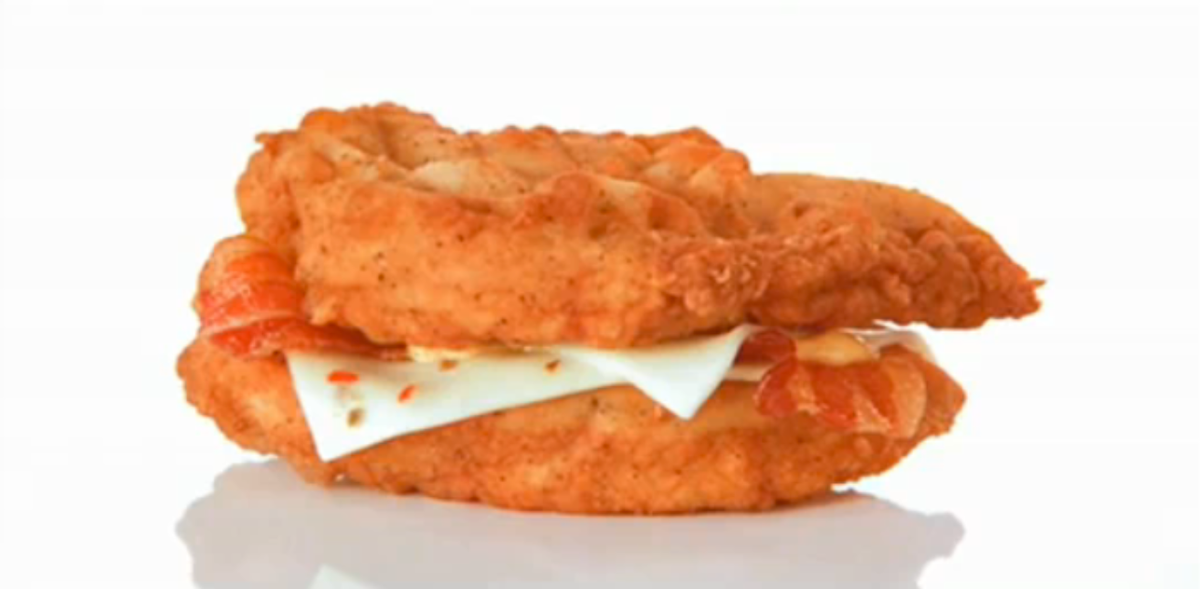
At first glance, KFC’s newest sandwich offering, the Double Down, sounds like a gag prop from a Mel Brooks movie: It is a sandwich made almost entirely of meat — two pieces of bacon and cheese sandwiched between two cuts of chicken. The company’s Web site (which includes an ominous countdown to the Double Down’s Monday launch) helpfully explains that the sandwich “is so meaty, there’s no room for a bun!” Or as the manly men in the KFC commercial put it, “So long, bun!”
Given America’s current obsession with fighting obesity, it seems like a strange time to be premiering an all-meat sandwich with 32 grams of fat, and so far most of those covering it have been somewhat, err, baffled. The A.V. Club’s Nathan Rabin taste-tested the sandwich earlier this week with disastrous results (“each bite became a grueling endurance test … the sandwich grew more revolting-looking with each bite”), and the folks at Eater have called it “the harbinger of the breadless apocalypse.”
To find out what KFC was thinking when it developed the Double Down we called Darren Tristano, executive vice president at Technomic, a food industry consulting firm.
Why, in God’s name, would KFC create something like the Double Down?
There are a few reasons: It’s unique, it’s shocking, it will appeal to younger generations, and people will talk about. But it’s also a product they can create without adding new elements to their restaurants — it can exist within the existing kitchen.
Who does KFC expect to buy this sandwich?
This isn’t going to be a kids meal. This would be too much food for a child younger than 11 years of age — this is for teenagers and older. They’re targeting working-class consumers that have less discretionary income and are looking for a very satisfying meal. It’s not necessarily about taste, but about quantity. The Double Down is a lot of food packed into a sandwich. Timing-wise, this is the start of the lawn-care season. We’re starting to see spring cleanups and more high-energy outdoor activities — so this could be fuel for that labor effort.
Isn’t this a stunt product?
I think it’s fair to say it is, but whether we like it or not, this product will appeal to a significant portion of the consumer base. Just think of “Jamie Oliver’s Food Revolution” — kids these days can recognize a McNugget but not a tomato.
There’s been a lot of talk lately about the splintering of food tastes. What kind of consumer does KFC generally go after?
Demographically, KFC is above a Church’s Chicken, maybe slightly above a Popeyes, and slightly below Chick-fil-A. It’s definitely a blue-collar, lower-income audience. There are enough fast food outlets with broad demographic appeal that it’s not unlikely you’ll see a higher-end person looking for a lower-end product. Those people who are eating at Morton’s Steakhouse are also still eating at McDonald’s. We are all hiding our packages of chips in our cabinets.
Given the growing concern about obesity, isn’t KFC risking a backlash by promoting this kind of product?
I don’t think so. The sodium and fat content for the Double Down is pretty high, but the calorie content is reasonable. I think the important role of an operator is to provide healthier alternatives. Regardless of what you do, consumers are going to make their choice. This product has broad appeal — I don’t think it’s going to damage their business or their image.
Most of the advance press about the sandwich has been about how disgusting it looks. Isn’t that going to hurt KFC?
From a marketing standpoint it appears to be achieving the goal they had set, which is to get people interested in the product and get them to try it. Freak shows are disgusting but everyone seems to want to go to them anyways. When there’s an accident on the highway everyone gapes. And, I’m sorry, but I’m really curious about it, and I’m probably going to try one next week.
Thomas Rogers is Salon's Arts Editor. More Thomas Rogers.
Walmart’s war on the American food system
It's hard to eat healthy in fast-food nation. A new book, reported undercover at Walmart and Applebee's, tells why
You may not be truly shocked by any single statistic in Tracie McMillan’s new book, “The American Way of Eating: Undercover at Walmart, Applebee’s, Farm Fields and the Dinner Table” — but by the time you finish reading, you’ll definitely feel the impact of her cumulative case.
McMillan spent months exploring the American food system from three different angles: picking produce in California fields, working in two Michigan Walmarts, and expediting (organizing the flow of food from the kitchen to the dining room) at a Brooklyn, N.Y., Applebee’s. By turns analytical and anecdotal, her book marshals first-person experience, history and current research to paint a picture of America’s 21st-century food reality.
Continue Reading CloseEmma Mustich is a Salon contributor. Follow her on Twitter: @emustich. More Emma Mustich.
The rise of Big Meat-bred super bugs
Despite the public health risk of antibiotic-resistant bacteria, the lobbyist-swayed FDA keeps easing regulations
(Credit: Reuters/Mike Cassese) So far, 2012 is bringing bad news for people who don’t want “free antibiotics” in their food.
Antibiotics are routinely given to livestock on factory farms to make them gain weight with less feed and keep them from getting sick in confinement conditions. But the daily dosing, at the same time it lowers feed needs, lowers drug effectiveness and produces antibiotic resistant bacteria or super bugs that can be deadly to people.
Martha Rosenberg frequently writes about the impact of the pharmaceutical, food and gun industries on public health. Her work has appeared in the Boston Globe, San Francisco Chronicle, Chicago Tribune and other outlets More Martha Rosenberg.
How to save small farms
By protecting farmland from development, land trusts are making small-scale agriculture more viable
(Credit: Courtesy of Maine Farmland Trust) You could say Penny Jordan saved the farm. A veteran of the insurance industry with a business degree, she came back to work at her Maine family farm at age 48. Since then, she’s revitalized her old farm stand business with a bus that delivers produce to senior centers. She’s opened a tiny restaurant on wheels, The Well, where a fine-dining chef turns out an ever-changing menu to be eaten at picnic tables by the parking lot—albeit one with a stunning view of Spurwink River. Jordan, a spunky, silvery blonde who favors fleece and Carhartts, has so much energy she almost bounces as she walks. Her creativity may spark new business models for other small farms, and why not? This is a woman who seems like she could do anything.
Continue Reading CloseWant a taste of Ben & Jerry’s Schweddy Balls?
The ice cream makers reveal their most unusual choice yet, named after a "Saturday Night Live" sketch
Ben & Jerry’s — much like the porn business — thrives on coming up with catchy titles first, and figuring out the details later. And like X-rated movies, the names of Ben & Jerry’s flavors are often the most satisfying things about them. But even fans with a genuine appetite for Jamaican Me Crazy and Karamel Sutra may have paused their spoons in midair Wednesday at the prospect of a big, sweet mouthful of Schweddy Balls.
The beloved Vermont confectioners, who have previously paid sly tribute to their favorite people and things via Cherry Garcia, Napoleon Dynamite, Phish Food, Bonnaroo Buzz, Magic Brownies and Hubby Hubby (celebrating same-sex marriage), are now rolling out a limited batch inspired by a classic, innuendo-riddled “Saturday Night Live” sketch.
Continue Reading Close
Mary Elizabeth Williams is a staff writer for Salon and the author of "Gimme Shelter: My Three Years Searching for the American Dream." Follow her on Twitter: @embeedub. More Mary Elizabeth Williams.
My mother, the Hamburger U. professor
Mom went from Finnish farm girl to McDonald's teacher. Only now do I realize how hard the transition must have been
The odd thing about my mother, who grew up in Finland drinking cream from the cows on her family’s farm and feeding herring out of the nets to the herding dog, is that she moved to America and worked for McDonald’s. In 1989, the company hired her as an interpreter at their corporate campus in Oak Brook, Illinois. And so, for the next 12 years, the Finns at Hamburger U. learning to run a fast food restaurant through a microphone in their ears were listening to my mother.
Finland and McDonald’s may seem an odd pairing to those who associate the former with forests and socialism, and the latter with obesity and corporate greed. Indeed, my mother hardly embodies the McDonald’s brand. She’s bone-thin, elegant, and has a vaguely European sophistication — her sweet tooth is satisfied with a nickel-sized morsel of dark chocolate and she’ll go three years without saying “like.” But she also has a specifically Finnish industriousness, a self-sufficiency Finns recognize as born of a long history of hostile borders and surviving off the land. She guts and skewers, pickles and preserves. A few days ago I watched her use the last embers of a bonfire to cook a whole pike, which she wrapped in seawater-soaked pages from the Helsinki newspaper before jamming it into the ashes. This woman — the only person I’ve ever seen to mill her own wheat berries for flour outside of an anthropology textbook — deeply admires a company that sells nuggets of L-shaped chicken for a dollar to people in cars. Now as a grown-up — and one who sees McDonald’s as a greedy peddler of fatty trash — I marvel at this paradox and try to account for her unshakable loyalty to the company.
Page 1 of 16 in Food Business

