
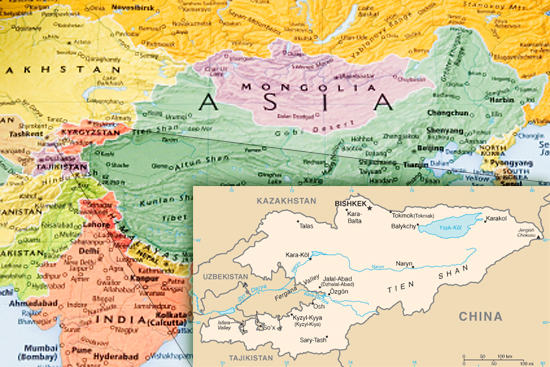

At a political fundraiser in the fall of 2008, a congressional candidate introduced me to Rahm Emanuel and explained that I was an expert on Kyrgyzstan. Emanuel quipped that if one of his daughters ever needed to do a book report on an exotic land, he’d give me a call.
Emanuel probably had no idea that, less than two years later, he and the White House would be confronting yet another major crisis in relations with this remote Central Asian nation: this week’s popular revolution, which endangers a critical American military base and also America’s long-range ties to a country in the strategically important borderlands between Russia, China and the Middle East.
The peril for America is compounded by one simple fact: While Washington backed Kyrgyzstan’s now-deposed dictator, Russia — American’s chief rival in the region — supported the triumphant forces of change. The fallout, in the months and years to come, could be considerable.
When small countries make the headlines, the media focus tightly on events of the day. But there is always a back story. This article provides that story, based on two decades of my conversations with leaders and ordinary people in Kyrgyzstan. It gives personal portraits of politicians, including those who make up Kyrgyzstan’s new interim government. It also explores the failure of American policy — policy that arose from our ignorance of, or our insensitivity to, this distant land.
– – – – – – – – – – – –
Rahm Emanuel faced his first major Kyrgyz crisis as President Obama’s chief of staff in February 2009. The president of Kyrgyzstan, Kurmanbek Bakiev, had just announced the expulsion of American forces from a Kyrgyz airbase that supported NATO operations in Afghanistan. The announcement came during Bakiev’s visit to Moscow, where President Medvedev promised to provide $2 billion in debt relief and $150 million in cash to an impoverished Kyrgyz government.
The announced expulsion was the latest disappointment in U.S. relations with a country that in the early 1990s had been touted as a model of democratic development for Central Asia. While neighboring countries moved from communist republics to personal dictatorships, Kyrgyzstan, under the leadership of a former physicist, Askar Akaev, embraced elements of the open society and competitive politics that Western governments were seeking to export to post-communist lands.
Kyrgyzstan’s distinct developmental path owed something to Kyrgyz culture itself. One opposition leader told me that the Kyrgyz are “the most insubordinate, rebellious, and mutinous nation” in Central Asia. Another insisted — in a slight toward their neighbors — that it’s harder to govern three Kyrgyz than 300 Uzbeks. But Kyrgyzstan’s status as the darling of the West in the 1990s also reflected the pragmatism of President Akaev. Without the energy resources of other Central Asian countries, such as Kazakhstan and Turkmenistan, the leader of this remote mountainous country of 5 million people peddled to the West an image of Kyrgyzstan as the Switzerland of Asia. In return, he received hundreds of millions of dollars in grants and loans from Western governments and private donors.
– – – – – – – – – – – –
As a scholar intent on understanding how this predominantly Muslim and Turkic land would make the transition from communism, I first arrived in Bishkek, the Kyrgyz capital, in May 1992, less than six months after the republic had gained its independence from the Soviet Union. It was a heady time, when everything seemed possible for politicians and researchers alike. I paid an unannounced visit to the country’s foreign minister and was ushered into her office within minutes; an hour later I was eating with cabinet members in the dining room of the Kyrgyz White House. The energy, openness, and salesmanship of Kyrgyzstan’s first foreign minister, Roza Otunbaeva, was emblematic of Akaev’s leadership team, which embraced Western ties at a time when post-Soviet Russia was struggling to define its role and identity.
Hearing that an American was in town, the deputy minister of tourism insisted on taking me to a resort on the shores of Issyk-Kul’, where some of Asia’s highest mountains ring a beautiful mile-high lake with sand beaches and shimmering turquoise waters. His goal was to attract well-heeled Western tourists to a site that had long been a retreat for cosmonauts, Communist Party leaders, and other members of the Soviet elite. Unfortunately, his understanding of what Western tourists expected of a mountain resort was no more informed than the Kyrgyz leadership’s ideas about Western democracies and markets. When I asked whether security would be a problem during the four-hour drive across the desolate landscape from the capital, he replied that escorts toting machine guns could accompany the tourists if desired. The alternative, he noted, was for tourists to make the journey in a fraction of the time in old Soviet army helicopters.

Eugene Huskey
Ala Too Square Bishkek, the epicenter of the April Revolution
The gap between Kyrgyz and Western views of economic and political development contributed to a souring of Akaev’s relations with the West by the mid-1990s. Although more liberal than the leaders of neighboring countries, Akaev could not brook the domestic criticism and constraints that came with democratic politics. The expanding business interests of his wife and family also butted up against the market reforms pushed by the West. And when the financial crisis hit Kyrgyzstan in 1998, the country found itself with debt of almost $1 billion and little ability to repay.
The failure of Akaev’s Western gambit led to a slide toward authoritarianism, which accelerated after Putin’s accession to the Russian presidency in 2000. Russia offered Kyrgyzstan an alternate developmental model that reserved maximum freedom of maneuver for Akaev in domestic affairs while integrating the country into several regional security organizations, most notably the Shanghai Cooperation Agreement, which united Russia, China, and several other Central Asian states. Immediately after the 9/11 attacks, Kyrgyzstan agreed to a temporary stationing of Western forces on its soil, but this arrangement led to tensions over the amount of rent for the base and over the alleged mistreatment of local employees by American forces.
Despite the relentless expansion of his powers of office as well as his family’s business empire, whose interests ranged from beverages and media to the jet fuel sold at the American air base, Akaev was never able to tame the country’s political opposition. One of the most potent sources of political opposition was the unequal distribution of appointments and resources between North and South. Separated by towering mountains that are impassable for part of the year, these two regions have developed somewhat different cultures, with the North more heavily influenced by Russia and the West and the South by Uzbekistan and the Islamic world. In a reference to Akaev’s northern district of Kemin, many complained that Kyrgyzstan had traded communism for “keminism.” Popular protests by southerners, which began in 2002, culminated in the Tulip Revolution of March 2005, which overthrew President Akaev and promised a turn away from the cronyism and self-dealing that had alienated the public and many members of the country’s elite.
– – – – – – – – – – – –
The latest in the parade of “color revolutions” that marched across post-communist lands, the Tulip Revolution resembled in some respects the earlier upheavals in Serbia, Georgia, and Ukraine. In each case, a flawed election triggered mass demonstrations, and the incumbent president refused to use force to silence the demonstrators. But the Tulip Revolution broke from the script of previous color revolutions. In Kyrgyzstan, the protests did not start in the capital but in the provinces, where protesters seized government buildings in two major southern cities and then marched across the mountains to Bishkek. Neither opposition leaders such as Roza Otunbaeva nor the heads of NGOs were able to control the crowds, who eventually resorted to violence. After storming the Kyrgyz White House, demonstrators ran amok in the capital, a northern city that was appalled by the influx of angry and “less cultured” southerners.
The Tulip Revolution also lacked an identifiable face. There was no Saakashvili, the leader of the Rose Revolution in Georgia, or Yushchenko, the hero of the Orange Revolution in Ukraine, to represent the Tulip Revolution to the world or to rally the population behind a common banner. Instead, the leadership of the revolution was a motley assortment of veteran oppositionists and opportunistic government officials who had broken with the Akaev regime in its final months. If the March events in 2005 had a charismatic figure, it was Felix Kulov, a former police official and Akaev loyalist who was languishing in prison on trumped-up charges. Kulov was the most visible Kyrgyz victim of the Russian aphorism “find me a man and I’ll find you an article in the criminal code to match.”
Freed from his Kyrgyz Bastille during the Tulip Revolution, Kulov moved decisively to bring the police and security forces under his command and to take control of the streets. Had he been a southerner, Kulov would have swept to power as president of post-revolutionary Kyrgyzstan, but his northern roots–and his inability to speak fluent Kyrgyz, a constitutional requirement for the office of president–forced him into a supporting role. With no clear successor to Akaev among the opposition, Kurmanbek Bakiev emerged as the leading contender for the presidency. Recommending Bakiev were not only his southern origins and his experience as a former prime minister but his reputation as an inoffensive politician.
To maintain peace between North and South, Bakiev and Kulov signed a power-sharing agreement in May 2005 that brought Bakiev to office as president and Kulov as prime minister. But Bakiev had little interest in ruling in tandem. Using the expansive powers of the presidency inherited from Akaev, Bakiev began to marginalize his northern prime minister, in part by appointing fellow southerners, including several members of his family, to key positions in the administration.
Following failed attempts to strengthen the prime minister’s office through constitutional amendment, Felix Kulov resigned in protest in December 2006, calculating that his departure would force Bakiev to compromise. Instead, it ended the political career of the president’s most serious rival. In a series of Machiavellian maneuvers in 2007, Bakiev emasculated the opposition. To retain his support in the North, he convinced a prominent northern member of the opposition, Almaz Atambaev, to serve as prime minister, and then fired him abruptly eight months later. Bakiev also launched a referendum that approved a new constitution confirming the dominance of the presidency. And, taking a page from his neighbors in Russia and Kazakhstan, Bakiev formed a new “party of power” that won an overwhelming majority of parliamentary seats in the elections of December 2007, whose official results bore no resemblance to the ballots cast. The Tulip Revolution had been betrayed.
– – – – – – – – – – – –
Like many countries in the developing world, Kyrgyzstan has not been governed as a modern state but as the personal domain of the ruler and his family. On a walk last spring down a mountain trail in the Ala-Archa National Park south of Bishkek, I came upon black-clad security personnel peering at the surrounding gorge through hand-held scopes. When shots rang out in the distance, I assumed they were on the trail of a poacher. They were instead part of the president’s security detail. Bakiev had come to the park from his residential compound a few miles away to enjoy an afternoon of hunting, a privilege denied to other Kyrgyz citizens in this nature sanctuary.
The reminders of Bakiev’s personalist rule were everywhere, from his smiling portraits that graced the streets of Kyrgyz cities to the troubling specter of his motorcade, which shuttled Bakiev between his compound and the Kyrgyz White House. With windows tinted to hide the leader from view, the President’s large black Mercedes sped behind a marked police car. Trailing them were two black Cadillac Escalades that swerved menacingly across each other’s paths. Looking more like attack dogs than professional security personnel, athletic young men with balaclava-covered faces and automatic weapons at the ready glared through the Escalades’ open windows. Alongside this cortege rides an ambulance, ready to tend to a president who had been taking lengthy trips to Germany for treatment of an undisclosed ailment.

Eugene Huskey
Sheep entrails dressed as a snake at traditional Kyrgyz feast
From his perch on the seventh floor of the White House, Bakiev tried to maintain the facade that he was governing the country through its formal institutions, which include the prime minister, the council of ministers, and parliament. But real power was exercised through intricate informal networks of relatives and associates operating in the presidential bureaucracy and beyond. As one opposition leader told me, the halls surrounding the offices of the prime minister and most ministers were empty; businesses seeking to lobby the government for licenses, tax breaks, and various forms of protection turned instead to the president’s staff. All pretence of a constitutional order was abandoned in early 2010 when Bakiev created new institutions in the presidency that downgraded the formal ministerial structure.
At the center of Bakiev’s informal government were his brother Janysh and his son Maxim. Another son worked for the security police and four other brothers are involved in foreign and trade relations and local government and business affairs in the South. Although Maxim focused on the media and the economy and Janysh on law enforcement, the division of labor did not prevented turf battles from erupting between factions in the President’s entourage. Politics in the public square gave way to court intrigue in Bakiev’s Kyrgyzstan.
Like Akaev and other Central Asian leaders, Bakiev and his family used state control of the economy as a source of political power and personal enrichment. Besides direct involvement in business ventures, the presidential team was at the top of a vast pyramid that sanctioned–and benefited from — the “sale” of government posts to occupants who then used the positions to collect what economists call “rents” from those in need of government permissions or largess. As one leader of the opposition explained to me, “everyone knows how much a post costs, and how much an official can generate from that position in a year….[in some cases] it’s millions of dollars.”
Because those in business had no recourse to an independent judiciary or autonomous media, their property rights were dependent on the beneficence of the country’s rulers. In such an environment, economic blackmail became a trump card against the opposition, many of whose members came from Kyrgyzstan’s entrepreneurial class. That so many successful business persons remained in the opposition is a measure of the reluctance of the Kyrgyz to sacrifice their recently acquired status as citizens for that of subjects. In his office in Bishkek last spring, a young businessman reaffirmed to me his commitment to the opposition cause even though he was embroiled in a lawsuit that threatened his popular new restaurant. The plaintiffs, who enjoyed close ties to the authorities, were seeking the forced sale of his property for well under market value.
But even for the most opposition-minded and financially successful Kyrgyz, political pressure at times became unbearable. When the Bakiev regime began threatening his wife and children as well as his extensive business holdings, Kubatbek Baibolov–a potential contender for the presidency–fled with most of his family to the United States in March of last year. In exchange for the government’s forbearance, family members left behind to run Baibolov’s remaining business ventures agreed to stay out of politics.
– – – – – – – – – – – –
Under Bakiev, personal safety became a rising concern for all citizens of Kyrgyzstan. Residents of the capital feared venturing outside after dark because of street crime, which resulted from a toxic blend of alcohol and unemployed youth, many of whom were recent migrants to Bishkek from the countryside. Opposition journalists and politicians lived with a special form of insecurity: the fear of targeted attacks that were sponsored or condoned by the state. Since the Tulip Revolution of 2005, over 30 journalists have been beaten or killed, and four deputies in the country’s 90-member parliament have been assassinated. Perhaps the most gruesome example of political intimidation occurred in March 2009, when the former chief of staff of President Bakiev, Medet Sadyrkulov, was found incinerated in a car along with a colleague. His “offense” was colluding with the opposition. A warning had been sent a year earlier, when Sadyrkulov’s wife received a package containing human body parts.
The concern for personal security was immediately evident when I met the longstanding leader of the Ata-Meken Party, Omurbek Tekebaev, at my guest house on the shores of Lake Issyk-Kul’ in the summer of 2008. After “casing” the guest house, he suggested that we talk instead at his cottage, a short drive away in a gated compound. Once inside his summer residence, this avuncular former parliamentary speaker pulled a pistol from his pocket and laid it on the table; he then pointed to a Kalashnikov in the corner. Unlike other, wealthier leaders of the opposition, he was reduced to providing his own security.
Tekebaev had every reason to be concerned about his safety and his reputation. He had been arrested on arrival in Warsaw in 2006 when customs agents found heroin in his suitcase. He was released only after surveillance tapes from the Bishkek airport revealed that an official from the Kyrgyz security services, which was headed at the time by President Bakiev’s brother, had placed an object in his bag. This married opposition politician from the South was also the subject of a video sting that caught him in a sex act with another woman. The video’s wide circulation on the internet was one of several factors that discouraged Tekebaev from challenging Bakiev in the July 2009 presidential elections.

Eugene Huskey
A young Dzhigit (a Turkic term for an able horseman) near the village of Arashan
Almaz Atambaev has been another prominent target of the authorities. Although his brief stint as Bakiev’s prime minister complicated his return to the ranks of the opposition, this northern politician emerged as the opposition’s unity candidate in this year’s campaign for the presidency. With no viable southern politician to carry the opposition banner into the election, Atambaev’s ability to finance his own campaign carried the day.
By Russian and Central Asian standards, Atambaev is from old money. He left his Soviet government post in 1989 to enter business in the newly liberalized environment of the Gorbachev era. He made his first millions in publishing in a country where bookstore shelves had been filled for decades with pulp propaganda. On the 8th of March, 1990, international women’s day, his company published the Soviet equivalent of the Joy of Cooking. He then turned to publishing Russian versions of popular foreign fiction, including The Godfather.
Unlike Tekebaev, he was able to afford a small army of bodyguards. In April 2009, the day before he announced his candidacy for president, I visited Atambaev at his office in a high-rise building on the outskirts of Bishkek. Like many buildings in the Kyrgyz capital, the structure screamed Soviet collapse, with pieces missing from the facade and design flaws everywhere. It was an aesthetic nightmare. A uniformed guard checked passes at the entrance and a number of large-necked men populated the stairs and the waiting room, where a television in the corner broadcast a soap opera. The “secretary” asked me to leave my cell phones on his desk.
The man and his office made very different impressions from the building. The office was modern and well-appointed, and Atambaev gracious and deferential, very much like Akaev, whose scholarly demeanor belied the harsh nature of his last years of rule. As a seasoned politician, Atambaev spoke in measured, purposeful phrases that never revealed more than he intended.
Despite his retinue of security personnel, Atambaev had been poisoned during his short tenure as prime minister. It was a fate he shared with numerous critics of post-communist regimes, including Ukraine’s Victor Yushchenko. When I met Atambaev, he was still recovering from surgery to combat the effects of the toxin, which had caused acute hepatitis. A few weeks after our meeting, he claimed that he was the subject of another attempt to poison him, this time while campaigning for the presidency in a small town in southern Kyrgyzstan. Video from the campaign stop, quickly placed on the internet by the Bakiev camp, showed the stricken opposition leader stumbling through a short speech as if in a drunken stupor. He would later seek treatment overseas for this poisoning. To use the Russian expression, this episode was part of a campaign of “black PR” that was designed to undermine support for Atambaev and the opposition. On election day itself, Bakiev supporters placed another video on the internet. This one suggested that Atambaev was having a liaison with a well-known Russian singer while his wife and children were waiting out the campaign in Turkey.
Atambaev’s presidential campaign had begun two months earlier on a more promising note. With the snow-capped Ala-Too Mountains as a backdrop, a thousand supporters from across the country gathered in a pasture in the village of Arashan, near Atambaev’s family home. It was the Kyrgyz version of a nominating convention, with delegates streaming onto a verdant field holding the red banners of Tekebaev’s Ata-Meken Party, the blue flags of Atambaev’s own Social Democratic Party, and a white banner symbolizing the unity of opposition forces. Stretching out in two wings from a central stage was a collection of yurts, each offering refreshments and refuge to a portion of the crowd: VIPs, the press, and delegates from each of the country’s seven regions. Beyond the yurts were boys and young men on horseback, preparing for the equestrian games that are obligatory at Kyrgyz celebrations.
On this unusually warm spring day, performers in national costumes took the stage to entertain the crowd. Nominating speeches followed from each regional delegation, with a seemingly endless stream of speakers claiming the microphone for their chance to praise the candidate and attack the evils of the Bakiev regime. Three hours later, when Almaz Atambaev rose to give his acceptance speech, the delegates greeted their candidate warmly but without particular enthusiasm. It was clear from the reactions of the crowd that what unified them was not the personality or ideas of Atambaev but their hatred of Bakiev.

Author at the April 2009 presidential nominating convention in the Kyrgyz countryside near Bishkek
Although this kurultai — a word for popular assembly handed down from the Mongols –brought together participants from diverse regions and parties, it highlighted the increasing ethnic and linguistic segregation in Kyrgyz politics. Only a single Russian spoke from the stage, and the only European faces in the crowd were from the media. Also absent were Central Asian minorities living in the country, such as Uzbeks. Although all ethnic groups are welcome at these events, the lack of minorities in party leadership roles and the use of Kyrgyz and not Russian as the language of the proceedings make such assemblies mono-ethnic affairs. Subject to russification for decades under Soviet rule, most Kyrgyz understandably revel in the opportunity to participate in a political gathering that openly celebrates their language and culture.
Following the kurultai, I joined a dozen top leaders of the opposition in a small yurt in a neighboring village for lunch. Over a meal of roasted horsemeat and other Kyrgyz delicacies, the politicians took turns proposing toasts to their newly nominated colleague. Assembled here in an atmosphere that had more in common with a family Thanksgiving than a political luncheon was an older generation of politicians who began their careers as Soviet functionaries and then embraced the challenge of leading a newly independent state. Over the years they had been political allies and adversaries, government officials and opposition leaders, and what united them at this moment was their fear of the Bakiev regime and the approaching end of their own political careers.
Missing from the equation were political ideas. In the rough-and-tumble of Kyrgyz politics, like politics in much of the developing world, personalities and not policies hold together most parties and political movements. But without a dominant personality or a consensus surrounding political values, it is difficult to assure the unity of the opposition and the support of the nation during an election. When I asked Almaz Atambaev about his political platform in the presidential campaign, he admitted that he didn’t have one. Instead of focusing on issues that could mobilize the population behind solutions to the country’s ills, he planned to frame the contest as a choice between a civilized democracy and a return to the cruelty of the Kokand Khanate, which controlled much of Central Asia before the tsars.
Unfortunately for the Kyrgyz opposition, in authoritarian regimes incumbents tend to frame the elections. They control not only the media and the lion’s share of campaign resources but also the election commissions that count the votes. Atambaev and other opposition leaders were all too aware of this reality. As they made clear to me at the beginning of the campaign, they had no illusions about winning the election through the ballot box. Like the oppositionists in Iran, their hope was to win the battle on the streets in the aftermath of the voting.
The script played out as expected on election day, July 23, 2009. The Central Election Commission declared President Bakiev the winner with more than 76 percent of the vote, to only 8.4 percent for Atambaev. International observers from the Organization of Security and Cooperation in Europe expressed their disquiet about the contest, noting that “election day was marred by many problems and irregularities, including ballot box stuffing, inaccuracies in the voter lists, and multiple voting.” Opposition supporters took to the streets, with as many as 1000 gathering in the small northern city of Balykchy before being dispersed by the police. Further demonstrations were planned for Bishkek and other cities.
But the massive uprising that opposition leaders had hoped for never occurred. Bakiev’s tougher hand had raised the cost of protest, and the failed promise of the Tulip Revolution made it more difficult to rally people to the barricades yet again. Regional divisions also played their role, as some anti-Bakiev southerners were reluctant to return power to a northern president. Finally, the opposition did not help itself during the campaign. Shortly after the nomination of Atambaev, a young, able, and ambitious opposition maverick named Temir Sariev announced his candidacy for the presidency, and thus diverted some support from Atambaev. Despite running a vigorous campaign, which adopted a slogan reminiscent of Obama’s–“Together we can!”–Atambaev did not explain convincingly how he would use the powers of the presidency to remake Kyrgyzstan. And in a risky move designed to de-legitimate the elections, both Atambaev and Sariev withdrew from the race on election day. In the end, the legitimacy and survivability of a regime are not just dependent on its methods of rule, or the underlying social and economic conditions, but also on the perceived alternatives to the status quo.
– – – – – – – – – – – –
For Bakiev, the most welcome international reaction to the deeply-flawed presidential election was the delayed and muted response of the United States. The country that once championed an open society in Kyrgyzstan had abandoned the critics of this authoritarian regime to their fate. In more than 35 interviews with Kyrgyz politicians and NGO leaders during the last two years, the one abiding refrain I heard concerned American disengagement from the internal forces for change in Kyrgyzstan. A year after her arrival in Bishkek, the American ambassador, Tatiana Gfoeller, had still not found time to meet Almaz Atambaev or other prominent opposition leaders. Leaders of NGOs who were sympathetic to Western values found themselves shunned by the American embassy. They were the subject instead of overtures from Russian diplomats, who had ignored them in the past.

Eugene Huskey
The New Leader of Kyrgyzstan, Roza Otunbaeva, in traditional dress at the April 2009 kurultai (presidential nominating meeting)
Bakiev’s “get out of jail free” card with the United States was the Western airbase near Bishkek. As the former Kyrgyz ambassador to the United States, Baktybek Abdrisaev, explained in a Washington Post op-ed piece in February, “…once the base was established, it became clear that while other concerns might be voiced from time to time, only one thing really mattered: the air base.” The”resetting” of relations with Russia at the beginning of the Obama administration also discouraged American advocacy of political and economic reform in Kyrgyzstan. With ties to Ukraine and Georgia already creating tensions with Moscow, Washington was reluctant to spend its political capital in a small post-Soviet country even further from the West geographically and politically.
American acquiescence to the consolidation of authoritarianism in Kyrgyzstan brought its desired reward a few weeks before the Kyrgyz presidential election. In an about-face, the government of Kyrgyzstan agreed to extend the lease on the NATO base for another year. But in exchange for this temporary staging point for operations in Afghanistan, it appeared that the Americans would pay handsomely. The annual fees for leasing rights were tripled, and the Russians, who already had a military base near the Kyrgyz capital, were promised a new facility, this one an “anti-terrorist center” near the southern city of Osh in the Ferghana Valley region. This center was to operate within the framework of the Shanghai Co-operation Agreement, to which Russia, China, Kyrgyzstan, and other Central Asian states were signatories.
The opening of a base in Osh had the potential to destabilize further the fertile Ferghana Valley, one of the world’s most densely populated and explosive regions. Divided among Uzbekistan, Tajikistan, and Kyrgyzstan, the Ferghana Valley has long been an incubator of political and religious radicalism, and it is now a breeding ground for clandestine organizations like the Islamic Movement of Uzbekistan (IMU) and Hizb ut-Tahrir (Party of Liberation). Where the IMU seeks to trigger a popular uprising through armed attacks directed at the government of Uzbekistan, Hizb ut-Tahrir has developed in southern Kyrgyzstan a mass underground party whose alleged commitment to non-violence does not square with its religious intolerance.
Bakiev seemed to believe that a base in the south would serve as a shield for Kyrgyzstan against these militant groups and against Kyrgyzstan’s larger neighbor, Uzbekistan, which had shown little respect for Kyrgyz sovereignty over the years. However, before negotiations with Russia could be finalized on the new base, the United States intervened to acquire its own “anti-terrorist center” in the Kyrgyz south. In early March 2010, Bishkek and Washington reached agreement on the opening of an American anti-terrorist facility in the south, near the city of Batken.
The president of one of Eurasia’s smallest countries was playing two of the world’s great powers off each other, and the costs of this game for Kyrgyzstan and Bakiev soon became apparent. On March 23, state-controlled Russian television broadcast a harsh attack on corruption and nepotism in Kyrgyzstan. This unprecedented Russian criticism of Bakiev clan served as a signal to the Kyrgyz that the Kremlin was abandoning its former ally. As Omurbek Tekebaev later noted, “the people took this as Russian support for the opposition.”
– – – – – – – – – – – –
For Rahm Emanuel and others in the American White House, Kyrgyzstan reappeared on the radar screen on the evening of April 6, 2010. Crowds hostile to the Bakiev regime seized the governor’s office in the western town of Talas. A small group of special forces sent in from the capital removed the occupiers a few hours later, but an even larger crowd, estimated at 3,000, retook the building during the night. The next morning, governor’s offices in several northern cities were in the hands of demonstrators, and large crowds were gathering in the center of Bishkek as an anti-Bakiev kurultai was set to open. At this point, the government intervened to behead the opposition by arresting its leading members. This step further outraged the gathering crowds, whose numbers and boldness appeared to grow by the minute. As the crowds sought to break through the iron gates of the presidential palace, the president’s brother, Janysh, reportedly gave troops the order to fire. Snipers located on rooftops surrounding Ala-Too Square began to pick off demonstrators, most of them young men who with few prospects in life.
Remarkably, the crowds did not disperse. As one colleague relayed to me, young Kyrgyz men simply stared down the bullets like zombies as others were killed and wounded around them. With the dead now numbering in the dozens and the wounded in the hundreds, the crowd seized the less well-defended parliament building north of the main square, and then, after commandeering trucks and armored personnel carriers, began a final assault on the Kyrgyz White House.
Apparently fearful of holding the leaders of the opposition as the battle for the country reached a tipping point, the police released them into the maelstrom that was sweeping through the capital. With the White House burning in the distance, opposition leaders met in the looted parliament building to form a new, interim government led by Roza Otunbaeva, Almaz Atambaev, Omurbek Tekebaev, Temir Sariev, and Azimbek Beknazarov.
The revolution was still not complete. The authorities had to convince the south that this northern-led revolt would benefit the entire country. But the Kyrgyz people had granted the opposition another chance at rule. The question was whether they would be worthy of the popular sacrifice made on their behalf.
– – – – – – – – – – – –
The full story of Russian involvement in the April Revolution in Kyrgyzstan is still to be told, but it appears that while the Kremlin backed the forces of change in Kyrgyzstan, Washington stood behind the forces of repression. In the wake of the revolution, Putin congratulated the new leadership; Obama remained silent.
Allowing basing rights to marginalize all other dimensions of American foreign policy in former Soviet Central Asia has seriously undermined the moral authority and political influence of the United States in the region. The triumph of wartime tactics over a broad and consistent strategy of engagement with governments and societies in Central Asia has disillusioned a generation of local reformers and left the United States ill-positioned to compete with the region’s rising hegemons, Russia and China.
Whether through design or neglect, the Obama administration has continued the cynical and short-sighted policies of the Bush years in Central Asia. The next time I meet Rahm Emanuel, I’ll ask him to remind his boss that in the long run, Faustian bargains carry a heavy price.
Eugene Huskey is William R. Kenan, Jr. Professor of Political Science and Director of Russian Studies at Stetson University in DeLand, Florida. The author of more than a dozen articles and book chapters on Kyrgyzstan, he spent five weeks during the last two years in Kyrgyzstan interviewing members of the opposition.
