Guest Chef

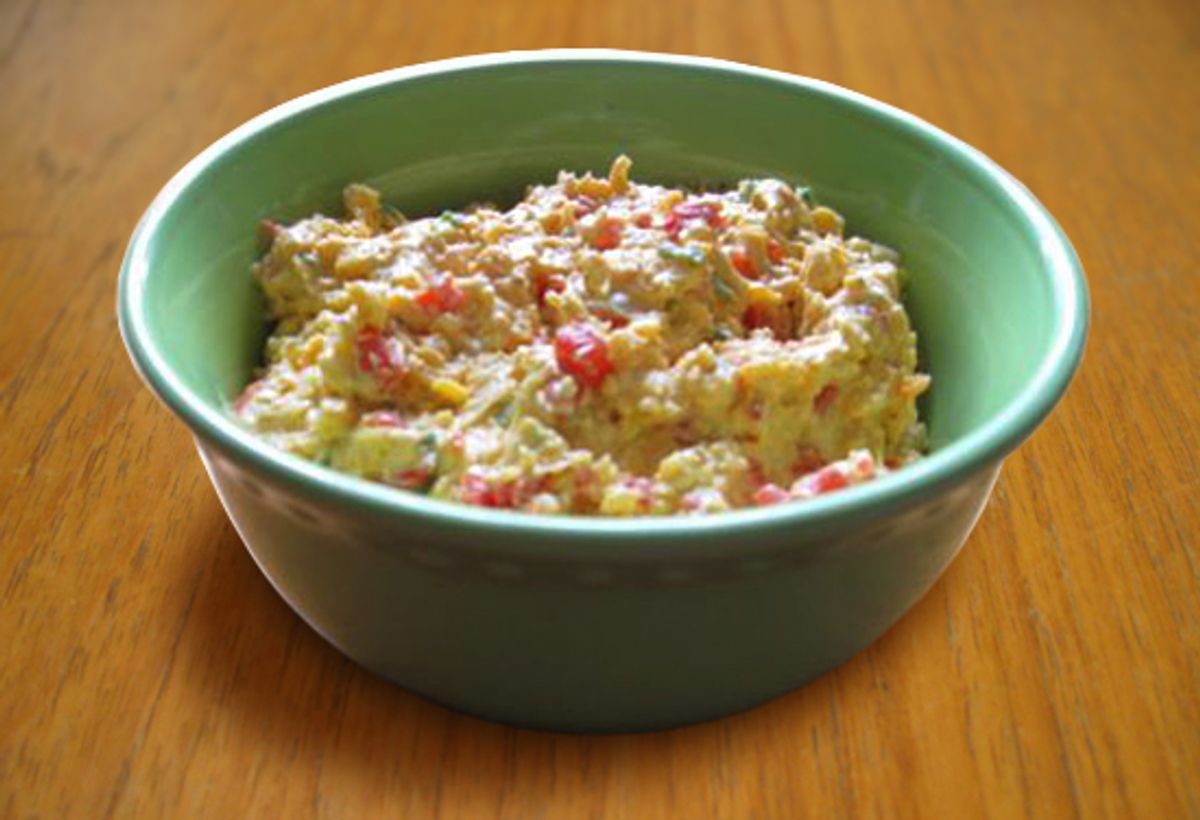
Pimento cheese is happy food

There are two kinds: Homemade and inedible. Here's a recipe, straight from the South

  • more
    • All Share Services

Pimento cheese is happy food

A version of this story originally appeared on Bellwether Vance’s Open Salon blog.

When my friend Mary Tom got married, her mama got into it with the caterer, who made the mistake of sniffing at serving pimento cheese sandwiches.

Mary Tom’s mama told the caterer lots of things: that he may have come to Mobile, Ala., lately by way of New York, but she knew his granny, and she was from Georgianna, so he shouldn’t be pretending he was too good for pimento cheese sandwiches; that she was paying for this whole shebang and there would be no mushrooms wrapped in “poof pastry” on the buffet line; that when she arrived on the day of the wedding she’d better see pimento cheese on bread or he’d be red-assed from her shoe and on the way back to Georgianna before the sun went down.

It was an empty threat, because Mary Tom’s mama liked to keep a Ball jar full of gin in her car, and long before sundown the gin would have dropped below the words “wide mouth” pressed into the glass, down toward the bottom, and she’s a rather lovely drunk. Still, the day came, it was a fine wedding despite my attire — a teal taffeta bridesmaid’s dress with a butt bow the size of a treasured carp — and the pimento cheese sandwiches were especially fine.

All across the South, pimento cheese sandwiches are de rigueur for showers (wedding and baby), receptions, dances, teas and other celebrations. Not funerals. Pimento cheese is happy food. Now, there are two kinds of pimento cheese: homemade pimento cheese and inedible pimento cheese. If you are ever called before God and asked to speak the truth, use that one.

Last year I sent my daughter off to college. She called me one day, not long into her exile.

“Mom! Quick question. I bought pimento cheese at the grocery store yesterday …”

“Let me get dressed,” I said.

“What? No. I bought pimento cheese at the grocery store and …”

“If I leave now, I’ll be there by 5. Splash some water on your face and don’t go to sleep!”

“What are you talking about?” she asked.

“Well, if you bought pimento cheese at the grocery store, you’ve obviously got a head injury. If you’re uninjured, I question your judgment.”

“Me too.” She sighed so heavily that I wondered about all the other ways her judgment might have recently failed her. “How do you make it? I’ve been telling all my friends how great pimento cheese is, and now I’ve lost credibility.”

I talked her through the recipe, and when I hung up I felt a little sad — thinking about my daughter in heathen lands, Mary Tom’s tragic marriage, and all that happened with Mary Tom’s mama. So I made myself a batch of pimento cheese, and before long I was happy again. Pimento cheese on bread can do that.

Bellwether’s Pimento Cheese

The daughter likes to use this as a dip for pretzels. I like it as a sandwich, on toasted wheat bread with a bit of dark mustard. It’s also good on a hamburger or veggie burger in place of sliced cheese. We almost always have a bowl of pimento cheese in our fridge.

8-ounce block of extra sharp cheddar cheese, grated (You must grate your own; the pre-grated product will not cream into a spread.)
4-ounce jar pimentos, drained very thoroughly and finely diced
3 tablespoons sour cream (or one large dollop)
2 green onions, mostly tops, finely minced
¼ teaspoon garlic powder
¼ teaspoon ground red pepper
About 2 tablespoons good mayonnaise (Hellmann’s please)
Freshly cracked black pepper to taste (You won’t need any salt, and I never say that.)

  1. In a medium-size bowl, mix together the sour cream, onions, cheese, garlic powder and ground red pepper until the cheese begins to break down into a spread. Stir in the pimentos. Add the mayonnaise a little bit at a time until you reach your desired consistency. It should spread easily, but it shouldn’t be gloppy. Add pepper to taste. Refrigerate for at least two hours.

Epilogue:

Mary Tom’s husband died suddenly of an undiagnosed heart condition, leaving her with two children under the age of 4. Mary Tom’s mama has dementia that her doctor swears is unrelated to the gin. My daughter is still in heathen lands, but now that she has the pimento cheese recipe, I don’t worry about her quite as much.

Making empanadas from scratch and memory

When my kids' caregiver moved away, she left a dear friend. But we celebrate each other every year by cooking

  • more
    • All Share Services

Making empanadas from scratch and memory

“I’ll make the dough this year,” I tell Nelly on the phone. I’m determined, though my talents flourish nowhere near the kitchen.

“I like Nelly’s empanadas,” my daughter Olivia says when I hang up.

“Don’t make them, Mom,” Sophia adds.

In the morning we will drive two hours to Nelly’s house for Empanada Day, a self-declared holiday we’ve been celebrating the Sunday before Thanksgiving for 12 years.

“Nelly always does everything. It’s time I took a turn,” I say, unsure about tampering with our tradition, but Nelly had a hard year, suffering with health issues, and I wanted to do this for her.

I start the dough making immediately. “Get the scrapbooks,” I tell Olivia. Flipping through pages of Empanada Days over the years, I look at the pictures of the girls smushing balls of dough in their highchairs. The note, scribbled beneath the step-by-step photos, says: about half a cup of shortening for every three or four cups of flour. I have no idea how much water to use, so I try to guess at the recipe that lives in Nelly’s heart, not a scrapbook. “We can do this, girls.”

Nelly and I met more than a decade ago; she was the first and last person to come into my kitchen when I interviewed for caregivers. Back to work, I was in need of childcare for Olivia and Sophia, now 12 and 13, then just babies. Nelly lived with us during the week; a few years after she came I had my son Johnny — Juanito as Nelly called him.

Johnny hung on my hip the morning I told Nelly I was getting divorced. I’d been up all night and the tears dropped into my cold coffee. Nelly, herself a single mother of three grown children, helped us through the custody battle, that excruciating year. Six years have passed since Nelly lived with us, and in that time Sophia and Olivia have been bridesmaids in Nelly’s daughter’s wedding, and I’m aunt to Nelly’s grandchildren. Even though we no longer share our day-to-days, Nelly is still our Nelly, and Empanada Day still stands.

One morning, after Nelly had been with us for a year, she came into the kitchen, put on her red apron, and set out three pounds of London broil. “I make empanadas today,” she said, and began dicing the meat. “It take time,” she said, adding the onions. Hours later, she brought Sophia and Olivia in, and they became a part of Nelly’s handiwork, folding and kneading small balls of the dough while seated in their highchairs. Nelly made more than a hundred empanadas that day; we took platefuls to each house in our neighborhood. We agreed thereafter to make them together once a year. I have few traditions or recipes passed down from my family, so I loved borrowing from Nelly and her Bolivian roots.

I scoop cups of flour into a mound on the counter. I make a well in the center, volcano style, just like in the old photo I use for guidance. “Is this right?” I ask as Olivia cracks eggs into the well. Sophia adds the shortening, I guess at the amount of water and attempt to knead the mixture into a ball. The dough is the size of a football, and it’s way off — mucky, sticky. I add more flour and the powder falls on the floor in fistfuls. I panic, add more flour, the ball grows. “You should have let Nelly do it,” the girls say, laughing now.

On the drive to Nelly’s house the next morning, I pull over and the girls and I run into the Stop ‘N Shop looking for the Goya aisle. I put the premade empanada dough in the cart. I’m stoic at the checkout line; the girls know not to say anything.

When we enter Nelly’s house, I blurt, “Mine didn’t work!” and pass her the plastic grocery bag with the store-bought stuff. She talks us into the kitchen of her tiny apartment with kisses. It’s as if Nelly expected this. “Come, my moneka,” she says to Sophia and Olivia and maybe me, too, her little dolls. “No importa. I do it,” she says, pulling the canister of flour from the cabinet. She is small, the same height as Sophia, her black hair cut into a bob at her chin, her dark skin smooth as a wine bottle.

Nelly is quick with her movements from sink to counter; she once again works too fast for me to transfer her spontaneous measurements to my head. She gives Olivia and Sophia each a rolling pin.

Nelly made the filling last night, a detailed mixture that includes meat with olives, hard-boiled egg and potatoes, all diced to the size of green peas. The girls and Nelly put a spoonful of meat in the center of each circle of dough, and set to work folding them into crescents, crimping the rounded side by hand, so the meat won’t ooze when Nelly fries the thin pouches. I have to crimp with a fork. I can’t pinch the edges the way they do.

As Nelly’s hands seal the dough, I think of her in the kitchen of my old house, making arroz con pollo, the girls playing with letter magnets, sticking them on the fridge. I remember those long days coming home from work late, running upstairs to see the children, bathed and smelling of baby powder, curled up on Nelly’s bed, watching Spanish soap operas. I remember the nights when Sophia was learning to read, and Nelly practiced her English alongside her. All those Frog and Toad books.

The kitchen smells of cumin and olives as Nelly fries the empanadas. She removes each pouch with a slotted spoon and places the crispy crowns on a paper towel.

I sip coffee, watching Nelly and Sophia and Olivia work. Maybe it’s just as well I wasn’t able to make the dough; the pleasure of seeing Nelly with my daughters, her hands over their hands as they roll, makes me as happy as I have ever been. And I know it will be my girls, not me, who will make the dough in the future, when Nelly and I are old, and we all gather for Empanada Day.

Nelly’s empanadas

Makes about 40 empanadas

Ingredients

Filling

  • 3 potatoes, cut in ½-inch cubes
  • 2 tomatoes, diced
  • 1 onion, diced
  • 1 green pepper, diced
  • 3 cloves of garlic, minced
  • ½ teaspoon cumin
  • 2 packets of Sazon Goya
  • 1½ pounds of flank steak, or other cut of beef, cut into ¼-inch cubes
  • ½ cup of parsley, chopped
  • 4 tablespoons vegetable oil and/or olive oil
  • salt and pepper, to taste

Dough

  • 3 pounds all-purpose flour
  • 2 large eggs
  • ½ cup warm milk
  • 1 tablespoon sugar
  • ¾ stick of butter, cut into little pieces
  • a few generous pinches of salt
  • 1 cup water, or as needed
  • vegetable oil, as needed, for frying

Directions

Filling (Prepare filling the day before)

  1. Boil potatoes with enough water to just cover until cooked. Drain and set aside.
  2. Sauté tomatoes, onion, green pepper and garlic in a pan with 1 tablespoon oil on medium-high heat. Add cumin and Goya Sazon and cook until all vegetables are tender (about 8 minutes). Add salt and pepper to taste. Set aside.
  3. In a large pot, heat 3 tablespoons of oil over high heat and sauté beef with a sprinkle of salt and pepper until cooked halfway. Then add the tomato/onion/pepper mixture into the meat and stir until evenly coated. Let cook for 10 minutes on medium heat. Stir in potatoes and let cook for 10 min. Turn off the heat and stir in parsley. Let cool and chill in refrigerator until cold, or overnight.

Dough and finishing

  1. On a clean countertop, place flour in a mound and create a center like a volcano. Beat together eggs and milk. Add egg/milk mixture, butter, salt and sugar in the middle of the mound. Begin to mix dry and wet ingredients with your hands. Add water little by little as you are kneading until the dough comes together and it is solid, but still pliable for rolling. If it is too sticky, add more flour.
  2. On a floured countertop and with a rolling pin, pinch off some dough and roll out into flat round disk 1/8-inch thick and about 3 inches in diameter. (Through trial and error, you’ll get the hang of how much dough that is.) Add a heaping teaspoon of the chilled meat mixture to the middle of the disk and fold over the dough into a half circle. Seal by pressing along the edge or with a fork or whatever creative technique you know.
  3. In a deep frying pan, fry the empanadas with vegetable oil on medium-high heat with just enough oil where you can fry one side at a time. Fry until each side is golden brown.
  4. Let cool slightly before serving.
Continue Reading Close

When the turkey took revenge, I took to vegetarian gravy

After a Thanksgiving of food poisoning, I swore off the bacteria-ridden beast and came up with this bird-free gravy

  • more
    • All Share Services

When the turkey took revenge, I took to vegetarian gravy

Early November 1999, I was driving down a rural highway on a sunny afternoon. As I rounded a corner, I was startled to see a wild turkey trotting across a cotton field — faster than you might imagine — heading toward the road. Math was not my best subject, but given my speed, the turkey’s speed and our projected paths, even I could calculate that we were a bloody word problem about to happen.

At the moment his body should have been hitting my windshield and exploding like a grotesque feather pillow, he flew back a few paces and I whizzed by without hitting him. “Stupid turkey!” I groused. “You almost got yourself killed!”

A few weeks later, on Thanksgiving Day, I did something almost as stupid. I wasn’t as careful as I should have been when handling the turkey (you know — wash your hands frequently, use a designated cutting board, disinfect surfaces …) and I spent the night singing whale songs into the deep, mysterious hole at the bottom of the toilet. The next morning, I was in the emergency room.

The CDC estimates that in the U.S. there are 76 million food-borne illnesses per year and over 5,000 deaths. Bacteria-laced poultry is the leading source of food poisoning. So there were others like me in the E.R. that morning, women and men with mint-green faces, wretchedly hunched over cramping bellies, clutching an assortment of decorative bathroom trash cans under their chins. One trash can had mockingly happy Disney characters on it. After a miserable, interminable wait, I was given IV fluids, Phenergan and another deliciously heady medicine that had me nattering on about how creepy it is that Mickey Mouse wears gloves but no shirt.

It was pretty easy to give up turkey after that. The next Thanksgiving, I brought a Tofurkey to the family gathering. It wasn’t bad, just a little eerie in its fleshy texture, and in general, if I look at a food product and envision the manufacturing process — a large vat, gelatinous slurry, an extruder — it’s an appetite turnoff. When it comes to the Thanksgiving feast, meat substitutes are unnecessary. There are always plenty of meat-free offerings among the casseroles and side dishes. I’ve never gone hungry.

The most difficult adjustment has been editing recipes to suit a less-than-adventurous crowd. When you remove meat from your diet you have to replace the flavor with other ingredients. Sometimes those ingredients are unconventional, even weird, and Thanksgiving seems to bring out the traditionalist in everyone. They want the same green bean casserole, the same sweet potato soufflé, the same stuffing. If I’m being honest, seeing the same spread year after year is reassuring, comforting. My mother and my mother-in-law are still with us, still healthy, and on Thanksgiving, the kitchen is still their domain.

This year, I’ll bring a bowl of vegetarian gravy and a big salad with homemade dressing and croutons. I’ll join the matriarchs in the kitchen, chop pecans for the stuffing,  set the table, make sure the bread doesn’t burn. I’ll wash my hands a lot, and remind them to do the same! And I’ll be oh-so-thankful I’ve had one more year as a “kid.” 

Bellwether’s Vegetarian Gravy

I promise you won’t miss the pan drippings! If you’ve ever had a vegetarian gravy or stew and the flavor was “thin,” lacking umami, the missing ingredient is nutritional yeast. It’s a staple in a vegetarian pantry. I add it to soups, stews, gravies, pot pie and shepherd’s pie fillings. You can buy it at any health food store, just be sure you don’t pick up brewer’s yeast by mistake.

Ingredients

  • 2 tablespoons olive oil
  • 1 tablespoon butter
  • ¼ cup sweet onion, finely minced
  • 3 tablespoons flour
  • 3 tablespoons nutritional yeast
  • 1¾ cups vegetable broth (or one 14.5 ounce can of Swanson’s Vegetable Broth)
  • 2 tablespoons low-sodium soy sauce
  • A small pinch each of sage, thyme and marjoram
  • Kosher salt and fresh black pepper to taste. 
  • ¼ cup heavy cream

Directions

  1. Measure the 3 tablespoons nutritional yeast into a small bowl and cover with a bit of very hot water. Stir until smooth and set aside.
  2. In a heavy skillet, heat the olive oil and the butter over medium heat. Sauté the minced onion until it is soft and slightly brown. Sprinkle the flour into the pan and stir to combine with the oil/butter/onion. Cook for a minute or two, stirring constantly. 
  3. Time to break out the whisk. Whisk in the nutritional yeast. At this point it will look dreadful (clumpy and oddly colored). Don’t worry! It will come together once the broth is added and whisked smooth.
  4. Slowly whisk in the vegetable broth. Whisk continuously until the mixture is bubbly and thick.
  5. Add the soy sauce, and the herbs. Be sure you taste the gravy before you add any salt. Both vegetable broth and soy sauce can be significantly salty. Add pepper liberally.
  6. Lastly, add the heavy cream and heat through.

Note: To make mushroom gravy, add a cup of chopped mushrooms to the oil when you add the onion. To make tomato gravy, add a large tomato, finely diced, to the pan once the onions are translucent, and cook until the tomato is softened before proceeding with the rest of the recipe.

Continue Reading Close

Italy’s ultimate answer to bacon: Guanciale

Imagine the flavor of prosciutto but in silky fat form. It's the soul of bucatini all'amatriciana, Rome's favorite

  • more
    • All Share Services

Italy's ultimate answer to bacon: GuancialeBucatini all'amatriciana

A recent year in Italy taught me that the pig is the king of its gastronomic jungle. Italians heart hogs. They prepare every imaginable part in every imaginable manner: cured and roasted and braised, even slow-poached in olive oil. One terrifying morning, in the back of a butcher shop, I ate it raw, slathered on a slice of rustic bread. Surviving the sushi-sausage experience would have been the most memorable encounter with the noble swine had it not been for an introduction to guanciale. At a sleepy trattoria, somewhere in the middle of Italy, I had a plate of pasta steeped in such succulence that I had to ask the owner the secret. “Semplice,” he said, pinching my face, “guancia.”

“Guancia” in Italian means pillow, which is synonymous with cheek. And it’s the facial aspect of the word, and the animal, that found its way into the kitchens of central Italy. Apparently pancetta, the familiar smoked and cured pork belly, simply wasn’t bold enough for rendering purposes, so they went to the face and found a far more profound flavor. To produce guanciale, the jowls of a hog are short-cured (three to four weeks) in salt and sugar and spices. The abbreviated process works well with the jowls’ combination of streaked meat and thick fat. And it’s that fat/meat quotient (as opposed to pancetta, which is meatier) that makes guanciale such a solid base. The fat melts in a hot pan, leaving the tender meat and a silky lipid of smoke and salt that informs but doesn’t overwhelm any soup or sauce.

Guanciale is best as the base of a pasta dish. And the most famous pasta using guanciale is the central Italian wonder known as amatriciana. Not surprisingly, there’s some controversy among the Italians as to the origins of amatriciana. Towns from regions of Abruzzo, Umbria and Lazio claim the superior preparation with appropriate noodle, but (with all due respect to the namesake Lazian town of Amatri) the king versions reign in the trattorias of Rome using the bucatini noodle — a thick spaghetti with a little hole (or “buco”) that runs through it. And, of course, within Rome, there are various versions, each the ultimo.

Regardless, a standard version begins with the guanciale, rendered slowly before taking in slow succession: thin red onions, a touch of red pepper flakes, plum tomatoes, torn basil leaves, and, for the finish, some grated pecorino with a swirl of olive oil and a confetti of basil. What you have is a broad balance of flavors with the guanciale holding it all together. Like most Italian dishes, this is simple to prepare. The challenge is coming up with the same quality of ingredients that are abundant in Italy.

For years, American cooks and chefs have used pancetta for dishes that traditionally call for guanciale, since it’s easier to find. But true, imported guanciale can be found in some big town specialty shops and major markets. The local butcher is always the best place to inquire. Guanciale can also be mail ordered from importers and a few national producers.

Bucatini all’amatriciana

There are a number of ways to use guanciale, but it seems appropriate to start with the classic

Serves 4 as a main course, 6-8 as a starter

Ingredients

  • 1 pound bucatini (a thick, dry spaghetti can be substituted)
  • ½ pound of guanciale sliced into long, thin strips (make matchsticks)
  • 1 medium red onion, halved and sliced ¼-inch thick
  • 1½ teaspoons of red pepper flakes
  • 1 large can of whole San Marzano tomatoes (crushed by hand)
  • ½ cup of torn basil leaves plus a handful julienned and reserved for garnish
  • ½ cup of grated Pecorino Romano plus ¼ cup for sprinkling
  • salt and sugar, to taste
  • Extra virgin olive oil, as needed

Directions

  1. Put a large pot of water on to boil.
  2. In a large saucepan with a thin coat of olive oil, render the guanciale over low heat, turning the cheeks occasionally until the fat has nearly dissolved and the meat slightly crisps.
  3. Add the onions and red pepper flakes to the pan and soften over medium heat until the onions are translucent.
  4. Raise the heat to medium-high and add the tomatoes. Season them with salt and a pinch of sugar. Bring to a boil and turn down to simmer while the pasta cooks.
  5. Salt the boiling water aggressively and add the bucatini. Stir until the boil returns and stir occasionally until two minutes short of package-instructed cooking time.
  6. Transfer the noodles to the saucepan. Raise the heat and coat the noodles with sauce, simmer until al dente (two minutes more).
  7. Off the heat, add ½ cup of Pecorino and toss.
  8. Plate the pasta and give each a swirl of extra virgin olive oil, a sprinkle of the remaining cheese, and top with the julienned basil. Enjoy with a simple red wine of central Italy, and say arrivederci to pancetta.
Continue Reading Close

I quit eating meat, but I still smoke … food

How to cure your bacon jones: Get a smoker, and smoke everything in sight

  • more
    • All Share Services

I quit eating meat, but I still smoke ... foodFour fresh trouts in smoker oven.(Credit: Patricia Hofmeester)

Like a lot of once-were carnivores, I miss a few meaty things. Fried chicken. Beef fillet, very rare. Bacon, of course, and smoked pig in piquant sauces. Dealing with these longings is all about rendering them down to individual flavors and textures. When I longed for fried chicken, what I really wanted was anything fried — fried okra or fried green tomatoes. Juicy beef fillet was a desire for salt, in brothy form — a miso-based soup.

Cravings for smoky pork products were harder to satisfy. Smoked paprika and smoked sun-dried tomatoes are great ingredients, fairly new to our grocery store, but they provide background smoke, not smoke smoke. Our only local health food store carried blocks of smoked tofu, and I used it to make quiche and breakfast burritos. Then the store went out of business, replaced by a Zaxby’s.

Frustrated, I took matters into my own hands and bought a small smoker. I’m afraid I’ve become something of an addict. The same way alcoholics look at cough syrup and see alcohol syrup, I look at food and see smoked food: peppers, garlic, tofu, tomatoes, corn, zucchini, okra, kale, eggplant, eggs and cold smoked cheeses. One day, as the fire died out, I had the bright idea of smoking a bowl of dog food, just briefly, to see if the dogs would be as seduced by the flavor of smoke as I had become. (They were. Seduced. When I carry the smoker from the shed they circle it like it’s a smoked kibble Pez dispenser.)

So here are some smoking tips, from someone who knows:

  • Before smoking blocks of super-firm tofu, press it, freeze it, thaw it, cut it in half lengthwise, and marinate it in soy sauce for a couple of hours. Smoke it for four hours, or until it’s the firmness of ham. Hickory gives it just the right amount of flavor and color. Mesquite smokes it to a burnt hue, although the flavor is fine.
  • Plum tomatoes are the easiest to smoke because they are fleshier than other varieties. Halve them and smoke them for four hours. Slip the skins off before using. If you want a drier tomato (more like a sun-dried tomato), slow-roast them in the oven first, and then smoke briefly.
  • Large portobello mushroom caps should be heavily oiled before they are smoked, otherwise they get very dry.
  • Roast and peel bell peppers before you smoke them.
  • Don’t hang your laundry anywhere near the smoker, unless you want to smell BBQ as things heat up during your morning walk.

Recently, my mom and dad went fishing and brought home five pounds of mullet fillets. For those unfamiliar with mullet, it’s what some might call a trash fish. It’s plentiful along the Gulf Coast. You see them running the bays and bayous in large schools, showoff jumping and landing with a splash. Anyone proficient with a net can scoop up a mess with one toss. Mullet has a strong, unique flavor and is typically fried or smoked. Roadside mullet smokers used to be common, but I haven’t seen one in the Panhandle for many years. My dad remembers large cans of salted mullet that they soaked before cooking, the way you’d soak salt cod. That was before my time.

I commandeered most of the mullet fillets for my smoker, because nobody needs five pounds of mullet lying around unless you’re running a booth at the Mullet Festival. I cut out the blood line (essential for fishy fish), dry-rubbed it with kosher salt, pepper and brown sugar, and smoked it for three hours. Since then, we’ve eaten smoked mullet with eggs and grits, smoked mullet tacos, smoked mullet bacalhau, smoked mullet hash, and smoked mullet straight, like a shot of vodka.

High on hickory smoke and bloated with salty fish, I needed to use up all of the smoked ingredients that were bursting from my refrigerator, so I threw a Halloween picnic for my daughter and her friends, who were visiting from college for the weekend. The menu featured everything smoky, including — yes! — the very last bit of smoked mullet.

Every mullet-loving Gulf Coast family has its own recipe for smoked mullet spread. Here’s our version.

Smoked mullet spread

Makes about 3 cups

Ingredients

  • 8 ounces cream cheese, softened
  • 3 green onions, mostly tops, finely diced
  • 2 tablespoons mayonnaise
  • 1 tablespoon Worcestershire sauce
  • Zest of one lemon
  • Juice of half a lemon
  • ½ teaspoon fresh ground pepper
  • ½ teaspoon Vietnamese garlic chili sauce or sriracha (or to taste) – we like lots.
  • 2 cups finely diced smoked mullet (use the thick, meaty portions, not the hard-smoked ends)

Directions

  1. Combine the cream cheese, onion, mayo, Worcestershire, lemon zest, lemon juice, pepper and garlic chili sauce. Add the smoked mullet.
  2. Taste and add additional heat or lemon juice as needed for balance, and add mayonnaise as needed for consistency. You may or may not need to add salt, depending on the saltiness of the smoked mullet. Our smoked mullet is on the salty side because we prefer to use a dry rub rather than a brine.
Continue Reading Close

Creating my own ethnic cuisine

A white Southerner, I seem to have no "ethnic" roots, but my immigrant neighbors' flavors are in my boiled peanuts

  • more
    • All Share Services

Creating my own ethnic cuisine

I have no ethnic heritage. My parents grew up poor and white in the rural South, born into families with no discoverable history prior to the early 1920s. No one remembers a homeland. Being “American” and “Southern” should be enough, and it is enough, but I long for connection to an Old Country, to know traditions and recipes that have been kept alive, lovingly tended, across geography and time. Denied that connection, I console myself by visiting the ethnic markets that have sprouted up in our modest-size town. 

Visitors to the Gulf Coast of Florida are often surprised by the diversity of our population. In the mid-1970s, thousands of Vietnamese refugees were relocated here. Military installations dot the coastline and the interior, and servicepeople returning home from foreign assignments often bring families from overseas. We have large Thai, Vietnamese, Korean and Filipino communities, and smaller groups from England, Turkey, Germany, Italy and Japan. Following the run of hurricanes a few years back, Mexican workers poured in to replace blue tarps with new roofs, and stayed for the construction boom. Once that passed, many moved on, but some have settled and opened restaurants and markets.

I like to browse the Mexican market, pick up bags of glossy dried peppers, inhale their smoky bitterness. I buy a new variety each time and experiment. The outrageously expressive man who runs the deli counter says, “Mamita linda! What do you want today?” If he has something new, he is insistent that I try it, and I oblige, always nodding my approval effusively enough to make him smile in satisfaction. In an invented familial history, he is my brother-in-law. One who delights everyone with his extravagant gestures and compliments, and who will surely — we all see it coming — break my sister’s heart.

The improbably blond, olive-skinned woman who owns the small Mediterranean market wears a permanent scowl. She has no patience for the Southern roundabout way of talking, the lack of urgency, the incessant smiling with intent to charm. She’s like a misanthropic aunt who visits once a year, very briefly, leaving behind hurt feelings and strange, miserly gifts. I’ve learned to suppress my need to win her over and get straight to the point. “What is this?” I ask, pointing to a  new cheese in the case. Or, “Is this bread fresh? Made today?” Questions that would be rude to anyone of Southern sensibilities, but which seem to please her, or to not displease her.

In the Thai market, the elderly man speaks little English. The elderly woman’s English is much better. I’m short, and she comes to my chin. Frail-boned with a grip that hurts my hand as she leads me through her store, pointing to the things I need, explaining how the ingredients must be used. Being led down the aisles, tightly packed with exotic ingredients, it’s easy to imagine I’m in Thailand, visiting relatives. I visit infrequently and, given her age, I won’t see her again; she has limited time to teach me all she knows. We had better hurry. It explains the clutched hand, the seriousness of her instruction.

At home I unload my purchases onto the counter. A bewildering, intimidating assortment of products. Panic rises. Then I recall the words of my new Thai relative. After all of her insistence, when she packs my grocery sacks, she grants me this: “I tell you how to make, but you make your own.” I relax, because nothing that tastes good is foreign.

Maybe a country’s culture and history, when borrowed and eaten, can in some small way create ethnicity. I hope one day I’ll visit the places of my favorite foods — Greece, Italy, Mexico, Thailand and Vietnam. When I step foot on the land, I might feel instantly at home. I might hear these words: I know you! You are one of mine! 

I created this dish to honor my homeland and one I’ve adopted, something familiar and something new. 

Boiled Peanuts, Thai Style

In the South, most people prefer their boiled peanuts cooked until they are very soft.  If you’ve tried boiled peanuts and found them mushy and unpalatable, try cooking up a batch that isn’t boiled completely soft. Despite the debate among my family and friends (some a’gin me, some with me), I hold firm in my opinion that they taste better when they are the texture of canned chickpeas rather than canned English peas! You can cook them however long you like.

Ingredients

  • 3 pounds unshelled green peanuts, thoroughly washed and sorted. Discard any with broken or discolored shells. (Green peanuts aren’t green in color; they are raw, fresh peanuts that haven’t been roasted or dried.)
  • 2-3  tablespoons chili garlic sauce (preferred) or sriracha 
  • Enough water to cover peanuts completely
  • Enough kosher salt that the water tastes distinctly salty, almost too salty
  • Juice of 2 limes
  • 2 tablespoons honey
  • 1 teaspoon fish sauce (Go easy on the fish sauce. It’s an acquired taste, but essential in small doses.)
  • ½ cup finely chopped cilantro

Directions

  1. In a large pot with a lid, cover the washed peanuts with water. Add the red chili garlic sauce and salt. As it heats up, taste the water for salt and heat. It should be quite salty, and quite zesty. Cook the peanuts at a slow boil with the lid on until they are done. It’s difficult to say how long done will take. It depends upon the size and age of the peanuts. They become drier as they age and need more cooking time. Start taste testing at about 2 hours and every half-hour after that. If you like them soft, it may take 4-6 hours. Be sure to taste several before you decide on their doneness. Let them cool in the cook pot until they are just cool enough to handle before proceeding to the next step.
  2. In a large bowl, mix the lime juice, honey, fish sauce and cilantro. Scoop the warm peanuts from the boiling pot. (Don’t worry about draining thoroughly — a little bit of the salty water is good.) Toss them in the cilantro lime mixture. Use your teeth to split the shells so that you taste plenty of the seasoning as you eat them.  We eat them on the back porch, sipping green tea with ginger or Singha beer. If the squirrels take off with the shells, you didn’t make them hot enough!
Continue Reading Close

Page 1 of 12 in Guest Chef