Food Business
The disappearance of Ronald McDonald
A new move to ban the fast food clown misses out on a crucial fact: His company has already left him behind
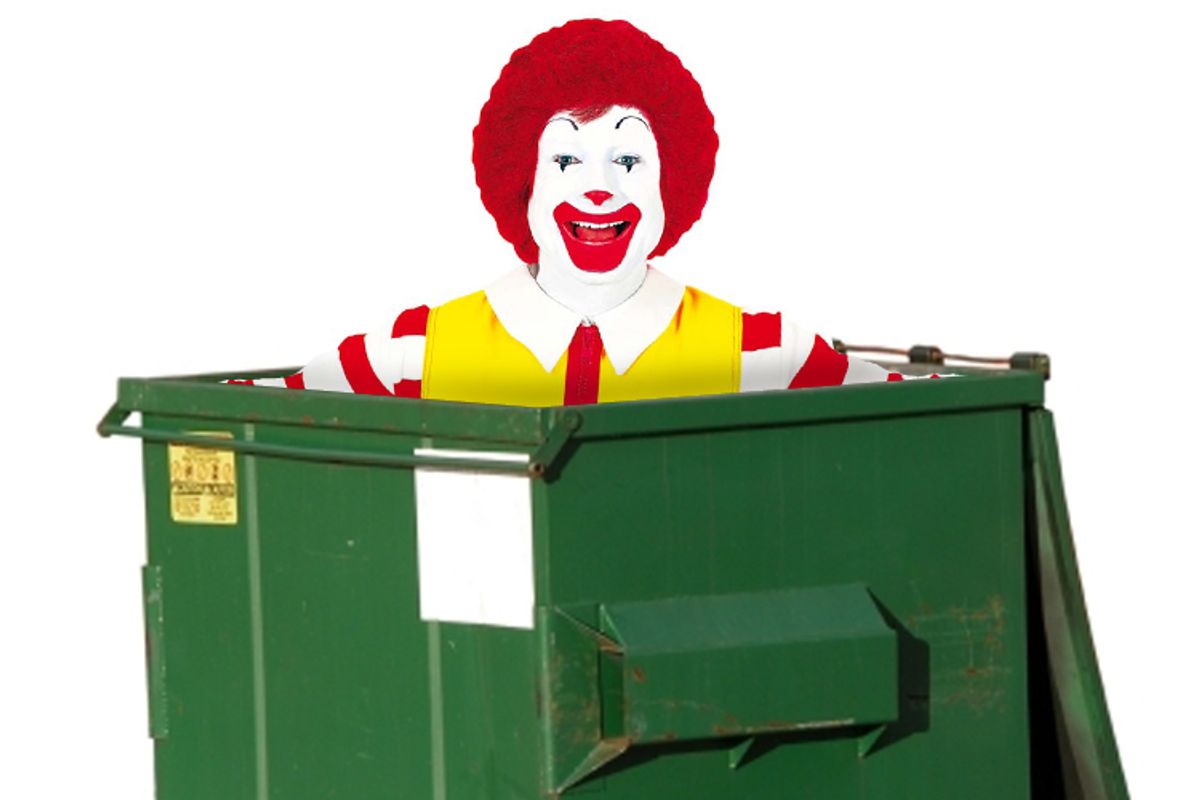
Life isn’t as jolly as it used to be for Ronald McDonald. The fast-food mascot, who has delighted and/or terrified generations of American children with his red and yellow jumpsuit and his relentless perkiness, has been in hot water recently. Two weeks ago, a Boston group called Corporate Accountability International (which previously helped force Joe Camel into retirement) launched a campaign to remove the brightly colored clown from McDonald’s restaurants and ad campaigns, claiming that he has too much influence on children’s eating habits, and promotes bad nutrition and the “fast food industry childhood obesity crisis.”
The story was picked up everywhere from CNN to ABC News. Academic Raj Patel cited a study on his blog claiming that more than half of parents want the clown to retire: “Ronald is more of a Hamburgler, dipping into our pockets with our children’s fingers, and leaving us with bills for long afterward.” The group staged “retirement parties” for the mascot in various McDonald’s restaurants. Others aren’t pleased: Marketing management consultant Gary Stible, whose company, the New England Consulting Group, helped develop Cheetos’ Chester mascot, told me over the phone that these attacks are petty and misguided: “This is about people who have too much time on their hands, and ought to be out doing good, like Ronald McDonald is.”
Ironically, this hubbub comes at a time when the world’s most famous clown has largely disappeared from McDonald’s ad campaigns. When, after all, is the last time you’ve seen Ronald McDonald in a TV ad? As the San Francisco Chronicle noted, his image is even tough to find on the McDonald’s Web site. In recent years, he’s mostly been relegated to the company’s charity operations — like the Ronald McDonald house — international ad campaigns, and as a spokesman for healthier eating choices. Instead, McDonald’s TV ads have centered around the company’s slogans, like “I’m loving it” or the delightfully tragic “I’d hit it,” and featured entertainers like the NSYNC and Britney Spears. It goes without saying that, in the age of Ke$ha, there’s something decidely uncool about hawking your food with a red-wigged clown.
“It’s very clear that McDonald’s has moved away from Ronald in their ads,” says Darren Tristano, executive vice president at Technomic, a fast-food consulting firm. “Over the last 10 years it’s become less about Ronald McDonald and more about the marketing of movies and toys to kids.” The Playland concept — the playgrounds located in McDonald’s outlets that were widespread in the ’70s and ’80s — has also been pushed to the wayside. “As younger generations have matured and become more sophisticated,” Tristano says, “there’s been less of an appeal to the circus theme and more of an appeal to contemporary figures, like athletes and celebrities.”
McDonald’s isn’t alone in downplaying its traditional mascot. KFC has all but phased out Colonel Sanders (Tristano: “After all, he’s dead!”) and Domino’s has long since gotten rid of the Noid (in favor of edgy ad campaigns that include fecal brownies and metaphorical self-immolation). Instead, fast-food chains are using more and more real people — like Subway’s Jared Fogle, who has “positive gender appeal on both sides” — and recognizable pop cultural figures to advertise their goods. Why? With the Internet shortening people’s attention spans, says Tristano, “we’re looking at cycles rather than a long-term appeal.” It takes a long time to get kids (and adults) to associate a cartoon figure with a brand, whereas sports and music stars already come with their built-in appeal and can quickly be trotted out for brief campaigns to spotlight particular items.
Today’s most successful fast-food mascots — Burger King’s creepy monarch, and Jack in the Box’s talking toy CEO — are hip, edgy and targeted more toward adults than children. The Burger King, after all, is a 7-foot plastic dude who hangs out in Russian saunas with scantily clad babes and steals recipes from competitors. The Jack in the Box is a hipster CEO whose ads are filled with carefully crafted irony and an overt stoner vibe. “We’re looking at rapidly changing consumer taste, and that’s paralleling what we appreciate in advertising. “
All of which means that the campaign to remove Ronald McDonald, even if it’s successful, isn’t going to have much of an impact on our country’s obesity rates — and we would be better off spending time at home with our children, teaching them to cook and choose foods wisely. Plus, if we actually did manage to get rid of that clown, we’d be denying Japanese ad-makers the inspiration for crazy things like this:
Thomas Rogers is Salon's Arts Editor. More Thomas Rogers.
Walmart’s war on the American food system
It's hard to eat healthy in fast-food nation. A new book, reported undercover at Walmart and Applebee's, tells why
You may not be truly shocked by any single statistic in Tracie McMillan’s new book, “The American Way of Eating: Undercover at Walmart, Applebee’s, Farm Fields and the Dinner Table” — but by the time you finish reading, you’ll definitely feel the impact of her cumulative case.
McMillan spent months exploring the American food system from three different angles: picking produce in California fields, working in two Michigan Walmarts, and expediting (organizing the flow of food from the kitchen to the dining room) at a Brooklyn, N.Y., Applebee’s. By turns analytical and anecdotal, her book marshals first-person experience, history and current research to paint a picture of America’s 21st-century food reality.
Continue Reading CloseEmma Mustich is a Salon contributor. Follow her on Twitter: @emustich. More Emma Mustich.
The rise of Big Meat-bred super bugs
Despite the public health risk of antibiotic-resistant bacteria, the lobbyist-swayed FDA keeps easing regulations
(Credit: Reuters/Mike Cassese) So far, 2012 is bringing bad news for people who don’t want “free antibiotics” in their food.
Antibiotics are routinely given to livestock on factory farms to make them gain weight with less feed and keep them from getting sick in confinement conditions. But the daily dosing, at the same time it lowers feed needs, lowers drug effectiveness and produces antibiotic resistant bacteria or super bugs that can be deadly to people.
Martha Rosenberg frequently writes about the impact of the pharmaceutical, food and gun industries on public health. Her work has appeared in the Boston Globe, San Francisco Chronicle, Chicago Tribune and other outlets More Martha Rosenberg.
How to save small farms
By protecting farmland from development, land trusts are making small-scale agriculture more viable
(Credit: Courtesy of Maine Farmland Trust) You could say Penny Jordan saved the farm. A veteran of the insurance industry with a business degree, she came back to work at her Maine family farm at age 48. Since then, she’s revitalized her old farm stand business with a bus that delivers produce to senior centers. She’s opened a tiny restaurant on wheels, The Well, where a fine-dining chef turns out an ever-changing menu to be eaten at picnic tables by the parking lot—albeit one with a stunning view of Spurwink River. Jordan, a spunky, silvery blonde who favors fleece and Carhartts, has so much energy she almost bounces as she walks. Her creativity may spark new business models for other small farms, and why not? This is a woman who seems like she could do anything.
Continue Reading CloseWant a taste of Ben & Jerry’s Schweddy Balls?
The ice cream makers reveal their most unusual choice yet, named after a "Saturday Night Live" sketch
Ben & Jerry’s — much like the porn business — thrives on coming up with catchy titles first, and figuring out the details later. And like X-rated movies, the names of Ben & Jerry’s flavors are often the most satisfying things about them. But even fans with a genuine appetite for Jamaican Me Crazy and Karamel Sutra may have paused their spoons in midair Wednesday at the prospect of a big, sweet mouthful of Schweddy Balls.
The beloved Vermont confectioners, who have previously paid sly tribute to their favorite people and things via Cherry Garcia, Napoleon Dynamite, Phish Food, Bonnaroo Buzz, Magic Brownies and Hubby Hubby (celebrating same-sex marriage), are now rolling out a limited batch inspired by a classic, innuendo-riddled “Saturday Night Live” sketch.
Continue Reading Close
Mary Elizabeth Williams is a staff writer for Salon and the author of "Gimme Shelter: My Three Years Searching for the American Dream." Follow her on Twitter: @embeedub. More Mary Elizabeth Williams.
My mother, the Hamburger U. professor
Mom went from Finnish farm girl to McDonald's teacher. Only now do I realize how hard the transition must have been
The odd thing about my mother, who grew up in Finland drinking cream from the cows on her family’s farm and feeding herring out of the nets to the herding dog, is that she moved to America and worked for McDonald’s. In 1989, the company hired her as an interpreter at their corporate campus in Oak Brook, Illinois. And so, for the next 12 years, the Finns at Hamburger U. learning to run a fast food restaurant through a microphone in their ears were listening to my mother.
Finland and McDonald’s may seem an odd pairing to those who associate the former with forests and socialism, and the latter with obesity and corporate greed. Indeed, my mother hardly embodies the McDonald’s brand. She’s bone-thin, elegant, and has a vaguely European sophistication — her sweet tooth is satisfied with a nickel-sized morsel of dark chocolate and she’ll go three years without saying “like.” But she also has a specifically Finnish industriousness, a self-sufficiency Finns recognize as born of a long history of hostile borders and surviving off the land. She guts and skewers, pickles and preserves. A few days ago I watched her use the last embers of a bonfire to cook a whole pike, which she wrapped in seawater-soaked pages from the Helsinki newspaper before jamming it into the ashes. This woman — the only person I’ve ever seen to mill her own wheat berries for flour outside of an anthropology textbook — deeply admires a company that sells nuggets of L-shaped chicken for a dollar to people in cars. Now as a grown-up — and one who sees McDonald’s as a greedy peddler of fatty trash — I marvel at this paradox and try to account for her unshakable loyalty to the company.
Page 1 of 16 in Food Business

