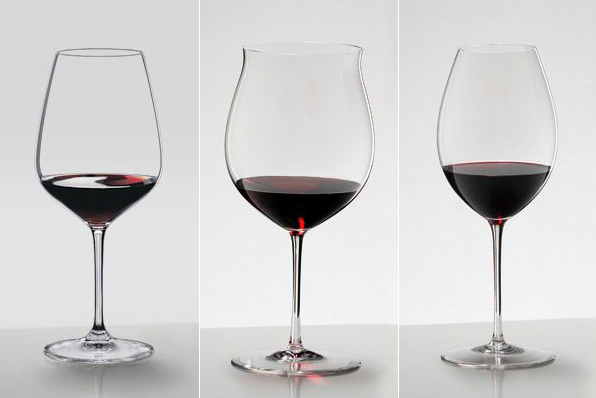

One of the happiest results of America’s enthusiastic embrace of wine is that wine snobbery, thankfully, has all but disappeared in the United States. But there’s a good wine’s worth of difference between snobbery and respect, and while I would never tell anyone what wine to enjoy — and certainly never why he or she should not enjoy a particular wine — I am not above gently recommending how to enhance enjoyment of wine. And one way is to drink from the right glass.
No, this is not going to be about those unbelievably expensive, hand-blown crystal wine glasses. (This isn’t about snobbery; everybody, including me, hates a wine snob.) It’s just that good, affordable wine glasses make a huge difference in the enjoyment of wine. (You’ll thank me later.)
Even among skeptics, you’ll find little disagreement that there’s a reason that white, red, and Champagne / sparkling wine glasses are different. The tall, thin flutes of the latter minimize the surface area of the wine exposed to the air, so those magical bubbles don’t all float their way out of the wine too quickly. Red wine glasses tend to have big, flat bowls for the opposite reason; giving the wine more exposure to the air and letting it “breathe,” allowing its rich, pent-up aromas to mix with air and develop in the glass. And white wines — which rarely need to breathe as much as reds — get glasses with narrower bowls that allow the wine to sit in a more compact shape, helping them keep cold longer.
So if we accept these general principals of wine glass design, it only follows that particular wine varietals (e.g., Chardonnay, Cabernet Sauvignon) can benefit from particular glasses designed to show off their character. For example, varying the shape of the rim — more opened or closed — will vary the degree the glass concentrates or dissipates aroma and bouquet, which is most of where the pleasure is. After all, we smell innumerable things and taste only five (sweet, sour, salty, bitter, and umami).
Speaking of taste, certain glasses are designed for wines to hit the parts of our palate that best highlight their characteristics. So a wine that’s a bit sweet may fall from the glass to the more sour-sensitive edges of our palates to better balance its overall effect. To be fair, there is some controversy around this, as scientists have disputed the “taste zone map” that those designs are based on, and I confess that I am a bit flummoxed by these findings. I tend to agree with the new research, but then I do these wine glass trials and there is no doubt that the wine ends up on a different part of the tongue, and it directly impacts the way we experience the wine. Also, being aware of the position of your head in tasting the wine (your head goes way back when you use a small tasting glass, but is almost straight with the some of these varietal-designed glasses) begins to tell you something’s up.
And in my daily life this holds true. Recently, I went to dinner at a good restaurant with several friends, and with the owner’s permission, I brought several very special wines with me, which the service staff took care of in a highly professional manner. But then they brought the wine glasses to the table, and they were crap – thick balloons that made each white wine taste sour and each red taste bitter. All the wines suffered from a short “finish,” the potentially lovely aftertaste that helps to define a great wine. I was bummed. These fine wines, served in crap glasses, tasted like crap. And crap wines did nothing to enhance the carefully prepared food, a lose/lose proposition for our table and the hard-working folks at the restaurant.
For days, I thought about the effect those glasses had. So I invited a couple of friends – Janet and Jerry – to join me for a blind tasting of wines served in different glasses. Jerry and Janet love wine and seemed intrigued, if a bit dubious, about the idea of matching a good wine to a good glass. I intentionally chose really good wines for the tasting, hoping to demonstrate that a great wine can taste like crap in a crap glass, and that the right glass will do that same wine organoleptic justice.
The two basic glasses for each wine were a) a jelly glass that sells for about $1 (more about this glass later), and b) a glass known as a “universal taster,” (about $3 each) a small, five-ounce wine glass, resembling a style you might use for port or sherry, and used widely in large wine tastings; I use hundreds of these glasses for the tastings I conduct daily in the classes I teach at the Culinary Institute of America.
The other glasses, matched to the grape varietals to the wines we tasted, were all produced by Riedel. The Riedel family has been making glassware for 11 generations, and it was Georg Riedel (the 10th generation), who realized that he could shape glasses to optimize the appearance, aromatics, and taste of particular wines, so a glass meant for Cabernet Sauvignon looks completely different from one meant for Pinot Noir. (Riedel, based in Austria, also produces machine-made Spiegelau wine glasses in Germany.)
Not that long ago, Riedel glasses were only found at upscale specialty stores, and the glasses were aimed solely at wealthy and/or aspiring wine connoisseurs. As wine drinking in the United States (at least 40% of Riedel’s worldwide market) has spread, Riedel made their glasses far more accessible, including a special line just for Target (the “Vivant” series; which sell for about $10 each). Riedel glasses, in all their forms, from the least to the most expensive, can be easily found online. Sold in sets, Riedel or Spiegelau glasses start at less than $10 per stem.
After an afternoon of tasting my friends marveled at how the finer, thinner glasses make the wine appear to “float” in the air, a beautiful effect, and it’s no secret that we “taste” with our eyes as well as our palates. But perhaps more importantly, as we moved from jelly glasses to the tasters to varietal-specific glasses, we found increased complexity and balance in the flavors and aromas, and not at all in a subtle way. There was an incredible difference: great wines tasted like plonk in the jelly glasses, and magnificent in the ideal ones. (The complete tasting notes, including the wines and glasses used, are below.)
The difference can be so striking, in fact, that in the course of professional tastings led by Georg Riedel I’ve seen people refuse to believe that they were tasting the same wine in different glasses.
Can the right glass, properly engineered to maximize certain characteristics and minimize others, make a lousy wine taste good? I do think that a good glass can improve any wine, from the humble to the extraordinary. But there’s a reason I chose the jelly glass for our tasting, even believing that they wouldn’t do the wine any sensory justice.
Robert Mondavi, who probably did more for wine in the United States than any other person in history, conducted a tasting about 20 years ago at the Culinary Institute of America. I had the honor of helping to coordinate it with him, and Robert taught me a few things that day. First, at age 73, he didn’t participate in the tasting. He told me his taste buds were shot, and he “didn’t want to fake it.” But he wanted to hear from the crowd of tasters, to listen to their opinions, and I understood the value of humility and learning from others in tasting, what is seemingly an internal exercise.
Robert was well-known for shipping hundreds, sometimes thousands of Riedel glasses in advance of any wine tasting he conducted. He explained to me that it was important to show his wines in the best possible light, including the best possible glass. I nodded and smiled, not fully realizing at the time just how correct, how smart he was in his thinking. But then he turned to me and, as an aside, offered me the other life-long lesson.
Robert Mondavi understood that wine, in the end, is always about more than just tasting notes and the senses. It’s about sharing and generosity, which means it should never be about snobbery. He said, “Just remember, Steven, that great wines need great glasses. But if someone offers you a great wine, even if it’s in a jelly glass, never say ‘no.’” And I never have.
Robert died at the age of 94 in May of 2008, and I dedicate this article to his memory.
. . . . . . . . . . . . . .
Tasting notes and results
Ist Flight: Chardonnay, Cakebread, Napa Valley, California 2005 (about $50/bottle)
Jelly Glass:
•Appearance: Cloudy, dull.
•Nose: grapey, undefined other fruits, one dimensional.
•Taste/Finish: Hot, full-bodied, bitter, alcoholic; short finish
•Opinion: Undrinkable.
Universal Taster:
•Appearance: Pale yellow/almost white peach.
•Nose: closed, some oak, some fruit.
•Taste/Finish: Hot, full-bodied, alcoholic; short finish.
•Opinion: Doesn’t taste like an expensive wine.
Riedel “Ouverture” White Wine Glass: $10-$12; machine blown, lead free; 10 oz.
•Appearance: Pale gold, rim begins to show more depth, and possible ageability.
•Nose: More apricot, a bit of oak/not much, balance as the flavors come together.
•Taste/Finish: Smooth, rich, slightly toasty, almost oily, elegant, long finish.
•Opinion: Pretty good.
Riedel “Flow” Viognier/Chardonnay Glass: $12-$15; machine blown, lead free; 22.5 oz.
•Appearance: Very pale. Shimmering, reflecting gold.
•Nose: Oak emerges, but in balance with fruits.
•Taste/Finish: Emphasis on complexity and acidity, with oak tannins in the finish, a bit of pleasant bitterness; extremely long and complex finish.
•Opinion: Excellent wine.
2nd Flight: Pinot Noir, Iron Horse, Green Valley of Russian River Valley, California 2004 (about $35/bottle)
Jelly Glass
•Appearance: Brownish, dull, brackish and muddy, no difference between rim of the wine and the center of the bowl.
•Nose: Smells like Manischewitz, nothing but grape and alcohol.
•Taste/Finish: Alcohol and tannin, with bitter fruits; blessedly short finish.
•Opinion: Lousy
Universal Taster
•Appearance: Medium black cherry, rim much darker than the center of the bowl.
•Nose: Earthy, mature red and black fruits, touch of leather.
•Taste/Finish: Red fruits ascendant, nice balance of tannin and acid, long finish.
•Opinion: The wine is beginning to strut its stuff.
Riedel “Vinum” Pinot Noir/Burgundy Glass: $30; machine made, 24% lead crystal; 25 oz.
•Appearance: Beautiful red-to-black cherry, with dark, almost black rim
•Nose: New and old oak, restrained wood aromatics; near-perfect balance of aromatics; red cherries, red and black currants, spice, a touch of black pepper.
•Taste/Finish: high but balanced acidity, red fruits, no harsh tannins; a truly fine example of the Pinot Noir varietal.
•Opinion: Really nice wine.
Riedel “Sommeliers” Burgundy Grand Cru Glass: $95-$120. 37 oz.; handmade, mouthblown; full lead crystal
•Appearance: Glass seems to disappear; rim of the wine goes to the sides of the glass, when looking down, you see the wine is still opaque; the wine can age quite a while.
•Nose: Overwhelmingly fragrant; roses, black currants, black cherries; as if the wine has been decanted for hours
•Taste/Finish: Extremely soft; balanced, voluptuous, silky, sexy.
•Opinion (in Janet’s words): “I want to dive in and swim in this wine.”
3rd Flight: Rubicon, Rubicon Estate, Rutherford, Napa Valley, California 2004 (about $125)
Jelly Glass:
•Appearance: Cloudy, opaque.
•Nose: Smells like grape jelly and alcohol.
•Taste/Finish: Horrible – all tannin and alcohol.
•Opinion: the worst.
Universal Taster
•Appearance: Almost black in color, totally opaque / looks quite young.
•Nose: Alcohol and leathery tannins.
•Taste/Finish: Blackberry – very full-bodied – moderate acidity – really hot alcohol.
•Opinion: I expect more – a lot more – from this wine.
Riedel “Ouverture” Red Wine Wine Glass: $10-$12; machine blown; lead free; 12.5 oz
•Appearance: Still dark in the center, but rim is much darker and “legs” (glycerol) dripping down the side of the glass are quite prominent.
•Nose: Black currant, oak, and vanilla.
•Taste/Finish: High acids. Sweet tannins, black fruits, very complex flavors; needs more time.
•Opinion: A fine example of a wine that, over time, should become extraordinary.
Riedel “Flow” Cabernet Glass: $12-$15; machine made; lead free crystal; 22.5 oz.
•Appearance: Ink black in the center with an even darker rim.
•Nose: Black fruits, olives, earthy, mint and eucalyptus.
•Taste/Finish: Mint, menthol, black fruits; balanced sweeter tannins; incredibly long finish.
•Opinion: Wow! What a difference. The wine seems to have achieved balance and tastes far more mature, and closer to ready to drink.
Riedel “Vinum” Bordeaux Glass: $24-30; machine made; 24% lead crystal; 21.5 oz.
•Appearance: Similar to above; even more opaque; glass seems to disappear.
•Nose: Much more black currant and mint.
•Taste/Finish: Beautifully balanced. Fruit acids jump out of the glass; tastes like fresh blackberries.
•Opinion: Tried this to see if there was much difference between Riedel “Flow” and Riedel “Vinum” (twice as expensive, but the same shape and size). Noticed the most difference in the appearance of the wine, as the “Vinum” is thinner, and the wine seems to “float” in mid-air.
These days many enjoy buying wine with labels that feature animals: kangaroos, penguins, fish, lizards, and loons. These “critter labels” don’t just happen by accident — research shows that American wine consumers are 40 percent more likely to buy a wine with a cute animal on the label when compared to a straightforward label that gives the standard information: the name of the producer, the name of the grape, the name of the place where the vineyards are located, and the year in which the grapes were picked.
But whether we choose our wines based on the cute factor or on the basic label facts, most wine labels give us minimal information; it’s up to the consumer to know about the vintage, the area where the grapes are grown, etc. Sometimes the back label of a wine is reserved for marketing the wine, and in the process of trying to hook the consumer with spinspiel, we learn a bit more about the origins of the wine and the philosophy of the producer.
But there is one wine producer in California whose unique labels actually give us important information (perhaps to the point of overkill), and that is the Calera Wine Company, owned by Josh Jensen. Jensen specializes in Pinot Noir, grown in single vineyards, and for the last 35 years his goal has been to create Burgundy in California, and the labels on his wine not only tell you about the wine, but, as you learn to read between the lines, they can also tell you much about the winemaker’s art — a sense of the level of detail that goes into how and where to plant, harvest, and make wine.
Let’s take a look. First, the front label:
So, it’s obviously straightforward: The producer is Calera; the vintage is 2005 (Calera’s 30th); the grapes were grown only in the Mills Vineyard; the varietal is Pinot Noir; the American Viticultural Area (AVA), or officially designated wine region is Mt. Harlan.
It’s the back label of this wine that really excites me, as it is filled with information about the pedigree of the wine (and why it is, in my opinion, absolutely worth $45 per bottle).
On the left hand side of the label we learn that the Mills Vineyard is 14.4 acres, and we see where the vineyard is located relative to the other Calera single vineyards. We also get some basic contact info for the Calera Wine Company (by the way, the website is terrific if you want to learn more about the winery, its vineyards, and its wines). But it is the right side of the label that makes this wine unique and provides a virtual tutorial in what it means to produce a true artisanal wine from vineyard to bottle. Let’s explore this label and see how it translates to what’s in the bottle.
American Viticultural Area (AVA): Mt. Harlan; Mountain Range: Gavilan Mountains
Where French and Italian wines often refer to their appellations and denominations, we Americans have a much-less well known system of geographic designations called American Viticultural Areas. Calera Wine Company is the only wine producer in this AVA, due to its extreme geographic isolation: Gavilan is Spanish for “hawk,” and red-tailed hawks are common to this mountain range, whose highest peaks are more than 3,000 feet.
County: San Benito; Region: California’s Central Coast
This wine is not produced in famous Napa or Sonoma counties, or even in Sideways territory, Pinot Noir-rich Santa Barbara and San Luis Obispo counties. San Benito County is not known for its wines, but it does have a few isolated wine regions, including Chalone and Calera’s Mt. Harlan AVAs.
Predominant geology: Limestone
After Josh Jensen returned from Burgundy in the early 1970s, he searched for limestone-rich soils for his Pinot Noir vineyards, convinced if he was going to make a Pinot Noir as fine as France’s best, he could not do it without the terroir-defining limestone soils. (Calera is Spanish for “limestone kiln.”) His search went on for years — limestone is a rare soil type in California, which is blessed with a lot of overtly fertile loam and clay soils.
Here is a photo of the Mills Vineyard. Note the limestone outcroppings easily visible in the upper-right sections of the photo:
Average Elevation: 2,200 feet above sea level
So these vineyards are close to a half-mile in the sky, and are accessible only by tough-terrain vehicles. At this elevation, all picking in the vineyard must be done by hand. High-elevation, cool-climate vineyards enjoy the morning and afternoon sun to ripen grapes, and also enjoy cool nights that produce high acid levels in those grapes. High acidity in the finished wine makes you want to take another sip of wine, another bite of food. There is nothing worse in the world of wine than low-acid Pinot Noir.
Owned by Calera Wine Company
This may seem like an obvious and unimportant fact, but it is actually quite important. What this means is that since the winery owns the Mills Vineyard, this wine was made without any purchased grapes. The wine is estate-bottled, meaning that Calera owns the land, grew the grapes, and made the wine. The majority of wines in California are produced at least in part from purchased grapes.
Number of vines: 10,575 (100% Pinot Noir); Vine Spacing: 6′x 10′; Vines per acre: 726
These numbers speak volumes about Josh Jensen’s approach to growing Pinot Noir. The total number of vines, the vine spacing, and the vines per acre indicate that Jensen believes in a more classic (Burgundian) planting regime, giving the vines plenty of room to grow, and plenty of room for vine roots to extend deep into the soil. By modern standards, which include close spacing of vines, 726 vines per acre is about one-third of what many growers might plant (about 2,000 vines per acre is the modern norm). The relatively small amount of vines, coupled with excellent vineyard management, will provide a low yield in the vineyard, which is what Jensen wants: fewer berries, but more concentrated minerals, flavors, and aromatics in each berry.
Exposure of slope: South/Southwest
Much like you want south-facing windows in your home for as much natural light as possible, these mountain vineyards are planted for maximum sun exposure throughout the day, helping to ensure steady and even ripening.
Year planted: 1984 Rootstock: Own-rooted (Pinot Noir)
Since the vintage of this wine is 2005, the vines were 21 years old at the time of harvest, meaning that the vines are mature, although they still have a long life ahead of them. Perhaps more important than their age is that these vines are planted on their own roots, not grafted onto a selected rootstock. Ever since the plant louse, phylloxera destroyed the vineyards of Europe and beyond at the turn of the 19thand 20th centuries, about 90% of the commercial vineyards in the world have been planted on phylloxera-resistant American rootstocks (Australia and Chile being notable exceptions). Jensen is taking a risk here, but he must believe it is important for the vines of the Mills vineyard to be planted on their own roots (the other four Pinot Noir single-vineyards are all planted on various American rootstocks).
The parentage of these vines is also an important issue for those of us who love great Pinot Noir. The vines are said to be propagated from cuttings of the Pinot Noir vines of the Domaine Romanée Conti (DRC), the most famous and revered vineyards in the Côte de Nuits region of Burgundy. Since smuggling these vine cuttings into California is technically a crime, Jensen will neither confirm nor deny the origins of his Pinot Noir vines, but those closest to him attest that the source of Calera Pinot Noir is, in fact, the DRC.
19-year average crop yield (1987 through 2005) 1.30 tons per care
I must have read this label entry more than a hundred times, and each time I wonder, “Could this be true?” Jensen’s yield per acre is, in the world of commercial grape growing and winemaking, infinitesimal. Growers whose yields are normally in the three to five tons per acre range produce high-quality wine; three tons per acre is considered an exceptionally low yield, especially in California. What this means is that each berry harvested in 2005 in the Mills Vineyard is precious for not only its varietal character but as a dramatic expression of its sense of place, its terroir.
2005 Mills Vineyard Harvest Data
Dates of harvest: September 17-25, October 7
Fruit, not being programmed machines, reach desirable ripeness levels at differing times, and so there is no single harvest date for the grapes in this wine, but rather harvest is a process that takes place over a range of dates.
Tons harvested: 20.05 Tons per acre: 1.3
Again, the emphasis is on low yields, both in total tonnage and tons per acre. 2005 was a textbook vintage for the Mills Vineyard, yielding exactly the 19-year average crop yield in that vintage. Incidentally, in 2004, the yield was 1.28 tons per acre, but in 2006, a very wet year, the yield was 3.16 tons per acre, still low by industry standards, but quite high by Mills Vineyard standards. Jensen “declassified” 44% of the finished wine that year, deciding it was not high enough quality for the Mills bottling. The wine found its way his into the 2006 Mt. Harlan Cuvée Pinot Noir, a blend of the single vineyard wines and wine made from younger vines.
2005 Mills Vineyard Winemaking Data
Fermentation: Native yeasts
This means that Jensen chose to ferment this wine with the yeasts present on the skins of the grape. While some producers choose to work only with native yeasts, many more choose to work with more predictable, less risky commercial yeasts. All of Jensen’s Pinot Noir wines are fermented on their own yeasts.
Barrel Aging: 16 months in 60-gallon French oak barrels (18% new)
Because of his love of Burgundy, Jensen uses French barriques to age his wine. French oak has a closer grain than American oak, and, in part due to that reduced surface area contact, imparts less powerful, more subtle oak flavors to the wine. By using only 18% new, more aromatic and tannic oak and the rest older barrels, Jensen is using the wood as a spice note in the wine, and not defining it as an “oaky” California Pinot Noir. The wine has great structure and the aroma and taste of oak is delicate, almost a whisper of wood.
Malo-lactic fermentation: 100%
Nothing unusual; this is a given in red wine making (a choice in white wines). Malo-lactic fermentation is a secondary fermentation that changes harsh malic acid (think green apples) to smooth lactic acid (think milk and yogurt), and in the process lowers overall acidity in the wine.
Filtration: None
The wine is unfiltered. Jensen is one of a cadre of serious winemakers who believes that filtering wine strips it of essential flavor, aromatics, and complexity. While the wine’s color may not achieve the brilliant luminescence so prized by so many consumers, the integrity in the wine is more than worth any slight haze in the color of the wine. Not all wines need to be unfiltered, but this wine benefits from Jensen’s non-interventionist approach.
Date of bottling, etc: Completing the picture, Jensen lets us know that this is a small production of a fine wine – the equivalent of about 1,350 twelve-bottle cases, more or less consistent with single-vineyard production in Burgundy.
Too much information? Maybe. But I find it refreshing that Josh Jensen is so proud of his wine that he wants to share his pride, his passion, and his obsession with the people who are going to drink that wine. I wish that other wine producers who share that pride and passion might follow his lead. And while it’s true that this information requires a little bit of context to understand the complexities it points to, it would seem to be easier for consumers to understand the effects of yield, sun exposure, etc. and be able to make educated guesses at the quality of the wine, rather than rote memorization of vintages, producers, areas, and grape types. That information becomes a great sell for the wine, and what better place to do that than on the wine label?
Continue Reading
Close
As if the majority of the American public didn’t already think that “wine professional” was another term for “buzzkill who can’t get a real job,” I have a dirty little secret about professional tasting that I want to share. When we taste, it is not for pleasure. The job of the professional wine taster is to find the faults with the wine, and it’s a bit like finding all the reasons not to award the Cub Scout his Webelos badge.
As if that wasn’t enough to endear ourselves to humanity, then there are the tasting panels like a recent one for a major wine competition who were unanimous in their opinion of one California Chardonnay over another. The wine they rejected retails for $65; the wine they embraced was Charles Shaw Chardonnay (commonly, and sometimes affectionately, sometimes derisively, called “Two Buck Chuck”) – it sells for $1.99-$2.99 at selected Trader Joe’s. This kind of thing happens more than you might imagine, and far more often than “professional tasters” care to admit. When I hear things like that, what can I do but weather the slings of friends who call my profession a collection of frauds and phonies and do the perp walk of crooked politicians and disgraced corporate executives?
It doesn’t have to be like this, people!
The real fun of tasting wine is tasting for pleasure, not for punishment. And the best place to do this is at home, with friends, in a relaxed atmosphere of conviviality and generosity. Tasting wine at home is fun, coupled with a bit of self-guided “education.” Don’t worry, in this case “education” is like the learning curve that began with the awkward pleasures of your first kiss and grew exponentially into sensual subtlety: the confident strut, the irresistible smile.
How to begin? What wines? How many wines? How expensive should the wines be? What glassware? What room? Outside or inside?
Wait! The most important question is “Who should I invite?” You can taste some of the most glorious wines in the world, but if you taste them with miserable people, guess what? The wines will taste miserable, too. You want to invite friends who enjoy the company of other people, have a sense of humor, don’t judge others harshly, don’t want to be the “expert” but do have something to say. Finally, invite friends who are moderate drinkers. Wine tastings are not for lushes, who can diminish or even ruin the experience for everyone else. “Tasting” is the operative word, not “quaffing.”
Once you’ve put together your guest list, then start to think about the wine. Some basics:
Think thematically about what wines to serve. New World Reds under $10; White Wines from the Loire Valley; Sparkling Wines of the World; American Wines Not From California; Zigging and Zagging With Zinfandel. Tastings are more interesting and fun if the theme gives a structure in which you and your friends can see the diversity and variety that exists in each category. Of course, if money is no object, then feel free to host a tasting of Opus One: 1995-2005 and so on.
Use wine glasses, not plastic cups that make the wine taste like plastic cups. You’ll need one glass per person per wine, since it’s no fun to have to wash and dry glasses between pours, and pouring into a used glass will mix whatever’s left in the glass with the new wine. Most people don’t have enough glasses, so here’s a hint: Rather than burdening your guests with bringing glasses from home, check out the local party rental folks. You’ll be surprised how inexpensive it is to rent two or three racks of glasses — not necessarily great ones, but all of them the same size and shape, and racked together for convenience and to avoid breakage.
Provide spit cups and napkins. Tasting involves four steps. In order: looking — taking in the color of the wine, best against a white background (hence the napkins); smelling — getting into the “nose” of the wine and seeing what aromas you’re picking up; tasting — sampling a small amount and swishing it around in the mouth, focusing on how your taste buds and nose are reacting to it; spitting — that’s right, part of tasting is spitting the wine into a spittoon or spit cup. Spitting allows you to taste more wine without feeling its effects — and having the alcohol cloud your judgment! Pick up a sleeve of 16 oz. disposable cups, and place one at every setting. You may not be able to enforce spitting at a home wine tasting, but especially if your friends are driving away from the tasting, you can certainly encourage it.
Bread and water. Bottled water, with and without bubbles, or pitchers of cold tap water, should be plentiful and available. A few bread baskets filled with crisp sliced baguettes, or individual plates with water crackers, should be available for cleansing the palate between wines. Make sure the bread or crackers are as neutral tasting as possible; no brioche, croissants or flavored crackers because these will have a dramatic impact on the wine’s taste.
Tasting mats/tasting sheets. On your home computer you can make a simple or an elaborate and creative tasting mat, basically a menu of the wines with space to write notes of your impressions. If you are tasting the wines “blind,” obviously the wines will be identified by number only. If you know what wines you are tasting, list them by name. It helps your guests to be consistent in how you list the wine. I recommend listing this way, which is commonly how they are presented on restaurant wine lists:
Product, Special Attribute*, Producer, Sub-Region*, Region*, State or Country, Vintage*.
(*if any: if non-vintage — like most sparkling wines — write “NV”)
Examples:
Pinot Noir, Reserve, Robert Sinskey, Carneros, Napa Valley, California 2007
Chianti Classico, Reserva, Banfi, Tuscany, Italy, 2006
Shiraz, Peter Lehmann, Barossa Valley, South Australia, 2003
Brut Cava, Reserva Heredad, Segura Viudas, Penedès, Spain NV
On the tasting mat — or if you are tasting more than five or six wines, probably on a separate sheet — allow each taster to make notes on each wine based on these criteria: color, nose, flavor, body, length of finish on the palate. You might ask “Did you like it?” and/or “What would be a good dish to pair with this wine?”
The tasting can be done indoors or outdoors — the more light the better to see the true color of the wine — in the afternoon or evening, as a prelude to dinner, or as its own little party. You should pour between one and two ounces per person per wine. Very important: make sure your guests stay for at least an hour or so after the tasting, and never let a friend drive drunk. If everybody is on the same page with the concept of the tasting, this should not be an issue.
At home, I prefer a tasting of accessible, affordable wines that my friends can appreciate and enjoy, and we can have some fun with, followed by a simple dinner or barbecue at home with the “partials,” the leftover wines. For an exotic and unexpected twist, have a tasting followed by a dinner at home of good Chinese takeout, the best pizza in town, or meze from that new Lebanese restaurant. You get the picture.
As for me, I’m busy planning my next blind tasting: $1.99 Chardonnays: World Class, Kick Ass, or I’ll Pass. See you there.
Continue Reading
Close
Traditionally, most Old World wines are named for their place: Bordeaux, Champagne, Rioja, etc. But today’s wine market is heavily tilted toward grape names, like Chardonnay or Pinot Noir, and the reason is easy to understand: Buying a 2005 Napa Valley Cabernet Sauvignon, for instance, is for most of us a much simpler exercise than buying a 2005 Château Smith-Haut-Lafitte from the Pessac-Leognan subregion of Bordeaux.
Great, we might say. Score one for transparency and straightforwardness! But there’s a lot to a name. Both of the wines in the above example are considered to be Cabernet Sauvignon wines, though they are both blended to some degree with wines made from Merlot, Cabernet Franc, and a few other varietals. In order to preserve the integrity of the Napa Valley Cab name, by law that wine must be a minimum of 75 percent Cabernet Sauvignon grapes, and 85 percent of those grapes had to be harvested from vineyards in the Napa Valley. But the Bordeaux wine, an explicit blend, can contain a varying percentage of Cabernet Sauvignon, depending on the year and the style the house is trying to produce. The 1,200 wine estates in Bordeaux, in fact, will all come up with different blends of grapes in their wines. More Cabernet in some, much more Merlot in others, depending on the customs and vintage conditions in their subregions. The blends will change from year to year, as the winemakers try to coax the best possible wines from their vines. The blending becomes an art in itself, one that stands proudly alongside the growing of the grapes.
Now say, back in the USA, that a winemaker wants to produce a wine that emulates a “Bordeaux Blend” — what is he or she going to call it? Since it’s not 75 percent of any particular grape varietal, the wine can’t be called by the name of a grape, and in fact U.S. wine laws dictate that it be called simply “Red Wine” or “Red Table Wine.” Not too sexy.
About 25 years ago, some frustrated Napa Valley winemakers who wanted to produce Bordeaux-style blended wines got together to address this issue. Agustin Huneeus of Franciscan Winery, Mitch Cosentino of Cosentino Winery, and Julie Garvey of Flora Springs Winery knew that they couldn’t call the wines “Bordeaux Blend,” as the French would go crazy and the U.S. government agency that approves labels wouldn’t go for it. Besides, these winemakers and others that they attracted wanted to create a uniquely American name for their Old World/New World winemaking concept. They formed a loosely knit alliance of about 20 members and in 1988 announced a contest to give their “concept” wines a name. The group received more than 6,000 entries, but chose one submitted by a young Californian, Neil Edgar, who came up with the name “Meritage.” The alliance trademarked the name, and awarded Neil a prize of two bottles of the first 10 vintages of each Meritage Alliance member’s wine.
The first Meritage wine was produced by Mitch Cosentino: the 1986 vintage of “The Poet.” Today, under the dynamic leadership of Kim Stare Wallace of Dry Creek Vineyard in Sonoma, there are more than 200 Meritage (rhymes with “heritage”) members, most of them in California, but with member wineries in 20 states, including New York, New Jersey, Arizona, Colorado, Michigan, New Mexico, and Virginia, and even members from Argentina, Australia, Canada, Mexico, and Israel (for a full list of Meritage Alliance members go to www.meritagewine.org).
So, what constitutes a Meritage wine? First of all, the wine must be made from a blend of at least two traditional Bordeaux grapes — Cabernet Sauvignon, Merlot, Cabernet Franc, Malbec, and Petit Verdot for reds, Sauvignon Blanc and Semillon for whites (more than 80 percent of Meritage wines are red). Second, no varietal can exceed 90 percent of the blend. This is probably why some of the most famous “Bordeaux blend” wines — Opus One, Rubicon, Insignia, etc., are not members of the Meritage group, as these wines often exceed 90 percent Cabernet Sauvignon.
I can’t make a blanket statement about what a “typical” Meritage wine tastes like, because there is no typical Meritage wine. A wine made from grapes grown in Colorado or Michigan is sure to taste different from a wine made from grapes grown in the Napa Valley. Also, some of the wines are more Merlot that Cabernet, some are more Cab than Merlot. Some wines are released in their youth, some are aged for years in barrel and bottle before release. What I can say about the red wines is that they are uniformly full-bodied wines, best served with hearty foods, and that all of the wines I tasted are capable of aging, some of them for a very long time. The whites, though they never really caught on, probably due to the lack of Chardonnay in the blend, are very attractive: medium-bodied, juicy but dry.
Red Meritage wines produced in states other than California tend to be a bit lighter than their Golden State counterparts, often lower in alcohol, and less oak-driven. Although their lack of drama might not blow away wine writers and critics who are tasting the wines on their own, these are attractive wines when paired with food.
Below are some fine Meritage wines to consider. Several of these will be easy to find in local wine shops — don’t hesitate to ask your wine merchant to order these wines if you don’t see them on store shelves — but for others, especially those made in states other than California and New York, you’ll probably have to order directly from the winery via the Internet. Note that many of these wines are quite expensive, but there are some good values in this category, too.
From New York State / Finger Lakes Region:
2007 Atwater Estate Vineyards Meritage Red (46% Cabernet Franc, 38 percent Merlot, 16 percent Cabernet Sauvignon): $21. www.atwatervineyards.com
2000 Casa Larga Vineyards Due Mille (50 percent Cabernet Sauvignon, 25 percent Merlot, 25 percent Cabernet Franc): $50. www.casalarga.com
2007 Fox Run Meritage Red (57 percent Merlot, 38 percent Cabernet Sauvignon, 5 percent Cabernet Franc): $45. www.foxrunvineyards.com
From Colorado:
2004 Grande Vineyards Meritage Red (40 percent Cabernet Sauvignon, 31 percent Cabernet Franc, 25 percent Merlot, 4 percent Petit Verdot): $19. and 2008 Meritage White (67 percent Sauvignon Blanc, 33 percent Semillon): $15. www.granderiverwines.com
From Virginia:
2007 Rappahannock Cellars Meritage Red (63 percent Cabernet Sauvignon, 33 percent Petit Verdot, 2 percent Merlot, 2 percent Malbec): $29. www.rappahannockcellars.com
From Michigan:
2005 St. Julian Bragannini Michigan Reserve Meritage Red (42 percent Merlot, 39 percent Cabernet Sauvignon, 19 percent Cabernet Franc):$30. www.stjulian.com
From California:
2007 Casa Nuestra Estate Bottled Meritage Red, Napa Valley (70 percent Merlot, 20 percent Cabernet Franc, 10 percent Cabernet Sauvignon): $45. www.casanuestra.com
2004 Dry Creek Vineyards “The Mariner” Meritage Red, Dry Creek Valley (46 percent Cabernet Sauvignon, 40 percent Merlot, 6 percent Petit Verdot, 5 percent Malbec, 3 percent Cabernet Franc): $40. www.drycreekvineyards.com
2006 Franciscan “Magnificat” Meritage Red, Napa Valley (56 percent Cabernet Sauvignon, 40 percent Merlot, 3 percent Malbec, 1 percent Petit Verdot): $50. www.franciscan.com
2007 Frog’s Tooth Meritage Red, Calaveras County (70 percent Cabernet Sauvignon, 10 percent Merlot, 10 percent Malbec, 10 percent Petit Verdot): $30. www.frogstooth.com
2003 Heller Estate “Celebration” Meritage Red, Carmel Valley (57 percent Cabernet Sauvignon, 23 percent Merlot, 17 percent Cabernet Franc, 3 percent Malbec): $100. and 2007 “Dancers” Meritage Red, Carmel Valley (76 percent Cabernet Sauvignon, 24 percent Merlot): $24 www.hellerestate.com
2006 Kendall-Jackson Vintner’s Reserve Meritage Red, California (66 percent Cabernet Sauvignon, 32 percent Merlot, 1 percent Cabernet Franc, 1 percent Petit Verdot) : $14 www.kj.com
2007 Murrieta’s Well Meritage Red, Livermore Valley (42 percent Cabernet Sauvignon, 24 percent Merlot, 22 percent Petit Verdot, 11 percent Cabernet Franc, 1 percent Malbec): $38, and 2007 Meritage White, Livermore Valley (52 percent Semillon, 48 percent Sauvignon Blanc): $24. www.murrietaswell.com
2006 South Coast Winery Meritage Red, Wild Horse Peak Mountain Vineyards (50 percent Merlot, 35 percent Cabernet Sauvignon, 10 percent Cabernet Franc, 5 percent Petit Verdot): $20. www.southcoastwinery.com
2005 St. Supéry “Élu” Meritage Red, Napa Valley (79 percent Cabernet Sauvignon, 14 percent Merlot, 4 percent Petit Verdot, 2 percent Cabernet Franc, 1 percent Malbec): $65. and 2006 “Virtú” Meritage White (52 percent Sauvignon Blanc, 48 percent Semillon): $28. www.stsupery.com
2005 Topel “Le Mariage” Meritage Red, Mendocino (60 percent Cabernet Sauvignon, 20 percent Merlot, 12 percent Petit Verdot, 8 percent Cabernet Franc): $32. www.topelwines.com
2008 Trinchero Meritage Red, Napa Valley (79 percent Cabernet Sauvignon, 13 percent Merlot, 7 percent Petit Verdot, 1 percent Cabernet Franc): $50. www.trincherowinery.com
Continue Reading
Close
A hundred years ago, Riesling wines from the Mosel and Rhine regions of Germany were the most expensive and sought-after wines in the world, and a great Riesling is honestly hard to stop talking about — fresh, flowery, flinty, and tart, redolent of peaches, apricots and green apples, with a sweet attack and a lengthy, complex, dry finish … I could go on. But while there are still magnificent German Rieslings, let me let you in on a no-longer well-kept secret: some of the finest — and finest value – Rieslings are from New York State, grown along the banks of the Finger Lakes, especially Keuka, Cayuga, and Seneca Lakes.
But this isn’t just the story of a great white wine, it’s the story of a visionary. Dr. Konstantin Frank was, in 1951 and at age 52, an immigrant from the Ukraine with $40 in his pocket. Though he held advanced degrees in viticulture and enology — and had taught these subjects in Russia — his first job in America was washing dishes at the Horn & Hardart Automat in New York City. He next secured a job upstate in Geneva, at the New York State Experiment Station, where he hoped to apply his knowledge of grapes and grape growing, but instead was given work as a menial laborer.
Nearly every wine grape you’ve ever heard of is of the species vitis vinifera, and when Frank arrived, he wondered why winemakers in the Finger Lakes were growing native grapes (vitis labrusca) such as Concord and Catawba, which are best for jams and jellies, or inferior hybrids of labrusca and vinifera. He argued that if New York was to develop a reputation for quality wines it must embrace the cultivation of vinifera, but was shot down by local “experts.” It was too cold, they said, ridiculing the naïve foreigner. For three hundred years, many had tried and failed to cultivate vinifera vines in New York State, and they left Frank to his mad dreams.
But Frank had grown Riesling, Chardonnay, and Pinot Noir in Odessa, where, he said, “the temperature goes to forty below; where when we spit, it froze before it hit the ground.” He remained undeterred, and, perhaps, emboldened.
Riesling is a grape that is difficult to cultivate successfully, but that, ironically, grows best along the banks of large rivers in the coldest regions of the wine world. Germany, for example, is the last outpost for grape growing in the Northern Hemisphere. The northern part of the country is just too cold to grow any wine grapes (though global warming is changing that), but Riesling shines in south central Germany, in the river valleys of the Mosel Saar Ruwer and the Rhine.
Cold-weather Riesling vines flower or “bud” late, which is good for avoiding spring frosts, but the vine also ripens late, leaving the fruit exposed to the possibility of late summer rains and early fall frosts. When nature cooperates, Riesling develops maximum fruit flavors and maintains its racy acidity.
To take advantage of those tendencies, Frank knew that he needed to find very hearty rootstock, and he discovered such roots in the garden of a convent in Québec, where he found Pinot Noir growing unexpectedly. Knowing it would be as cold there as in the Finger Lakes, Frank planted thousands of vines grafted with those roots over the next five years, and in 1957 a brutal winter tested his ideas. With February temperatures of 25 degrees below zero, both the labrusca and hybrid crops were decimated … but Dr. Frank’s Riesling and Chardonnay buds showed minimal damage, and when harvest came in late September, the vines produced healthy grapes at the rate of three to four tons per acre – a yield that is near-perfect for both quality and commercial viability.
Konstantin Frank, who worked everyday in his Keuka Lake vineyards and winery until he was 82, died in 1985 at the age of 86. His son, Willy, worked just as hard until his death at 80 years old. Willy’s son Fred, now operates Dr. Konstantin Frank’s Vinifera Wine Cellars and Château Frank, where he also makes excellent méthode champenoise sparkling wines.
Today, The Frank family is not alone in producing superior Riesling in the Finger Lakes. Consistently fine Riesling is produced by Red Newt, Anthony Lane, Heron Hill, LaFayette Reneau, Standing Stone, Lamoreaux Landing, Fox Run, Sheldrake Point, Atwater Estate, Hazlitt, Ravines, and Hermann Wiemer, who produces a very fine sparkling Riesling in addition to several luscious styles of still wines. Wiemer is especially notable because he is a true master of Riesling and a native of Bernkastel, a famous vineyard district in Germany’s Mosel Saar Ruwer region, where Riesling first gained its world-beating prominence. When he eventually moved to Dr. Frank’s little corner of the world to make his wines, you might say Frank’s mad project turned into a true international legacy.
Pairing Riesling with food
While Riesling is sometimes pigeonholed as a sweet wine, there is no more food-friendly white than a dry or semi-dry Riesling, the kind of pairing that can turn a light lunch into small feast. It’s almost unnecessary to even say what will be on the menu, because Riesling works with an enormous variety of foods, especially spicy food, and food with some acidity or a touch of natural sweetness. If you are going to have, say, a mild curry or ceviche, Riesling would be my first choice. But also if you’re having barbecued pork, or pan-fried brook trout, or fried chicken. Or, while we’re at it, grilled vegetables, or a tomato salad with goat cheese or especially smoked fish or smoked white meats. Riesling plays well with others.
One of my favorites is a $15 bottle: Dr. Konstantin Frank’s Vinifera Vineyards 2008 Dry Riesling, grown along the banks of Keuka Lake. The other day, it made my lunch of scallops marinated in lime with chilies and papayas taste sooooo good, and it made us smile with every refreshing sip.
Continue Reading
Close