I knew there would be partisans, but when I tweeted a question about which New Orleans sandwiches would belong in a theoretical Sandwich Hall of Fame, it took just minutes for my friend Pableaux to fire back: "Hall of Fame? The whole TOWN's a sandwich hall of fame!"
And, well, I can understand his righteous indignation. This is a hell of a sandwich town. The king, of course, is the once-humble po' boy, that torpedo of goodness barely contained by crisp, fluffy bread. Southern Italians invented the muffuletta, with its salamis and cheeses and chunky, lusciously oily olive salad. Then there are the oyster loaves, Vietnamese po' boys ... I mean, look: the typologies are strong.
So if you're going down to JazzFest this weekend -- or any other time – take some time to wander the halls of the New Orleans Sandwich Hall of Fame. Here's the first round of inductees, and a guide to where to eat them. And give us your nominees to the Sandwich Hall of Fame -- in New Orleans or elsewhere -- in the comments!
The Ur-Po' Boy: French Fry Po' Boy
First, a touch of history: Clovis and Bennie Martin owned a restaurant in the French Quarter when the city's streetcar conductors organized a strike in 1929, a violent and riotous affair that lasted months. Former streetcar conductors themselves, the Martin brothers offered to feed hungry strikers for free in heartbreakingly beautiful solidarity, and asked the baker John Gendusa to make massive, 40-inch loaves of bread for sandwiches. Every time a striker came by, the Martins would say, "Here comes another poor boy," and, in classic hilarious New Orleans fashion, the name stuck to the sandwiches.
All that is pretty much agreed upon. But the missing part of the story is what stuffed the original po' boys. One of the best, most common guesses is that, since they were free, they were filled with a humble pile of fried potatoes, sauced with drippings from the paying customers' roast beef, and thus our first inductee, the French Fry Po' Boy, the most unpretentious entry to any kind of Hall of Fame since John Madden.

R&O's restaurant keeps this tradition alive with a po' boy of soft, salty fries smothered in their beef gravy, chocolate-brown and humming with black pepper. Get it, like ALL OTHER PO' BOYS AT ALL OTHER TIMES, "dressed," which means topped with mayonnaise, iceberg lettuce, tomato slices, and, if it's a class operation, pickle slices.
The Baronial Roast Beef and Gravy Po' Boy
Let's not leave R&O's quite yet. In fact, let's take a look around. Hanging by the door, framed and faded to show only grays and pale blues, is the cover of a 2004 issue of Gourmet magazine that featured this red-sauce Italian joint. Around that frame wait droves of families, including, when I went last, one four generations deep and 20 members strong, from grannies to babies with the occasional tracksuit-wearing uncle in between. Groups waiting visibly hold their breaths whenever the host comes out with a stack of laminated menus, shouting the names of the fortunate.
The dining room looks like a particularly warm meeting hall of a VFW. You look at the recently vacated tables and wonder what the hell happened: tipped-over glasses and crumpled paper towels piled all over. This is a place where people come to eat raucously and well, on food that comes covered either in brown or red gravy. (That's beef or tomato sauce.)
Word on the street is that the pizza is pretty good, and I can attest to the superiority of the milk-crumb-soft meatball and fennelly sausage po' boys dripping with red gravy. (AND YES, STILL DRESSED.) But the reason to come here is for the magnificent Roast Beef Po' Boy, mellow with garlic and so much black pepper it warms your belly. These are not aristocratic slices of rare beef, but rather meat cooked to the falling-apart stage, impossible to divorce from its eternally brown sauce, forever menacing the crispness of the chewy, broiled bread. But it'll be gone before that ... and you will know it by the trail of crumpled paper towels.
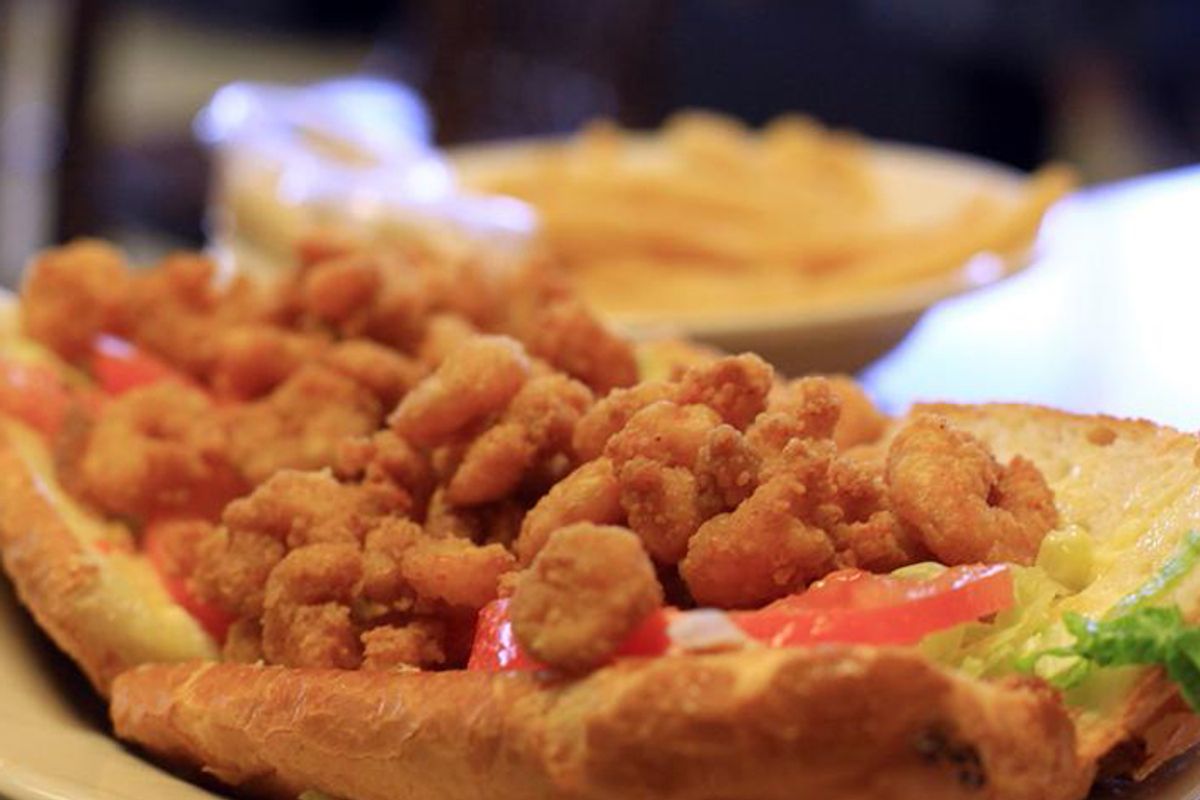
The Sandwich That Made Me Understand New Orleans: The Fried Shrimp Po' Boy
No, this is not going to be a po' boy-only Hall of Fame. But I have to get something off my chest. I was not always a fan of the po' boy.
It took me a long time to get over the mystique of the po' boy. I spent much of my New Jersey youth wondering what this exotic far-off thing was, knowing only that there was fried shrimp involved and that in itself made it seem like some magical fantasy food. So when I came to the Gulf Coast for the first time and ate them, po' boy after po' boy disappointed me. They were, after all, just sandwiches, served without singing unicorns and weeping angels, nor even exotic condiments or fancy breads. The bread, in particular, will have some scratching their heads. The local "French bread," which really is the only bread that matters in this city, is not like any bread in France. It's thin-crusted, crisp, but so light inside it's cottony. New Orleanians will not have it any other way, but the carbo-snob in me just couldn't get down.
Until, that is, I met Justin Kennedy, a young man who rocks the sandwich line at the Parkway Bakery and Tavern. Four months after Katrina, Justin left college and came home to help his uncle reopen this little corner po' boy shop -- shoveling the muck, hosing the walls, and when it came time to start thinking about food, teaching himself to cook. In a few years, he's made himself one of the prides of New Orleans, a po' boy man with panache, a head full of kooky sandwich specials and a fealty to the classics that came before. His shrimp come straight from the Gulf, fried crisp and tender and right, steaming with their faint local iodine tang, and he puts them on Leidenheimer's French bread, because it's the true New Orleans bread.
He did all this because he realized that there is something powerful about pride, pride in his work and pride in his home and in its history. And when I ate Justin's po' boys, I understood what it means to love New Orleans.
Oh, wait, this is a sandwich guide. Well: When (not if) you go to the Parkway, don't snooze on the Surf and Turf Po' Boy either – that's shrimp on top of their amazing roast beef, doused with gravy. But then you might have to think about skipping their custom cured corned beef, or whatever awesome special Justin's got crankin' that day, like amazing soft shell crabs in season.
There is another shrimp po' boy that deserves mention. Twenty years ago, Upperline restaurant shocked the Creole cuisine world by taking two classics -- fried green tomatoes and shrimp remoulade -- and stacking one on the other. Now, Mahoney's, another neo-traditionalist shop with a pedigreed chef at the helm, takes Grilled Shrimp Remoulade and Fried Green Tomatoes and stuffs them between bread. Believe me, in a city as obsessed with tradition as this, this is serious innovation. But aesthetic politics aside, it's a fantastic sandwich, the shrimp smarting from its sear on hot metal, the sauce mustardy and rich, the tomatoes crisp and tart. Let the revolution begin!
The Undeniable, Unspellable Muffuletta
Hang around New Orleans long enough, and you'll start talking with someone who sounds like a central casting version of a Brooklynite. And, as it turns out, the connection is southern Italian immigrants, who settled in New Orleans around the same time they showed up in New York. (Hence R&O's red gravy, and countless "Creole-Italian" restaurants.)
One of the great gifts of this community is the Muffuletta (pronounce it "moofalotta," and then try to spell it correctly. Impossible). A finger's-breadth of salami and other Italian-style cured meats and cheeses comes swaddled in focaccia-like bread, roughly the size of a Frisbee. But the key to the muffuletta is the olive salad, a rough chop of mixed vegetable garden pickles and olives bathing in olive oil. It's a salty, tart, slick, chunky, waterproof mess, and it kicks mad flavor.
My favorite version comes from the Central Grocery, a choice so uncontroversial it's controversial. It's in the most touristy quarter of the French Quarter. There are lines out the door of people with guidebooks waiting for one of the muffulettas. Some locals gripe that Central Grocery is run by cranks, that they don't even use olive oil in their olive salad, that their sandwiches sit pre-made, stacked in piles and oozing grease. But you know what? Of all the muffulettas I've had in New Orleans, Central Grocery's is still my favorite. I love its tart, so salty-its-hot olive salad, its store-bought meats and cheeses, the sturdy, soaked bread reminding me of deep-dish pizza.
For a more artisanal take, one where you can taste hours of loving work, knowledgeable locals will send you to Cochon Butcher, where they're making muffulettas with entirely house-cured meats and serving them warm. The meats are cured expertly and the sandwiches are made to order with care. It's great. But for me, some things are better appreciated for their more sleazy selves, and the Cochon Butcher boys are way too good for sleaze.
Consider the Oyster (Loaf)
Speaking of Cochon Butcher, let's go next door to its full restaurant, Cochon. Here, we will marvel at the Oyster and Bacon Sandwich. It's not entirely traditional, but we're talking about a classic in the making. They fry the oysters just crisp but still soft inside, a brackish ooze, making this quite literally an umami sandwich. The bacon, just a thin strip or two of house-cured stuff, adds a bit of crunch and a wisp of salt and smoke; it's a player, not a diva. Lime-tinged tartar sauce slicks it all up, spread on pullman bread, buttery and thin, just tough enough around the edges. This is a superlative sandwich, served with a fantastically tart, tender coleslaw. The problem, and this is a significant problem, is that there are so many good non-sandwich things to eat at Cochon that it feels almost incorrect to order the sandwich. I mean, if you're in the mood for oysters, it's hard to turn down the oyster pan roast, five babies covered in red pepper anchovy compound butter.
For a more old-school oyster sandwich with far less what-to-order anxiety, let's head to Casamento's. Someone pithier than me once said that eating here is like eating at the bottom of a swimming pool; the tile-covered walls and floors make you feel clean and wet just looking at them, a weird and wonderful experience. In the kitchen, which you walk through to get to the restrooms -- and which you absolutely should do to get the full-homey experience -- features not an industrial fryer but four pots sitting on a stove, wire baskets in them to fish out the oysters, shrimp and fish that get breaded and tickled in hot lard. A hugely muscled man, talking on his cellphone, tosses seafood in a bowl with seasoned flour, while older black ladies scurry about cooking and washing and tossing sawdust on the floor to keep their footing among the inevitable splashes of grease. The fried Oyster Loaf, served on enormously thick slabs of soft, chewy pan bread, is crunchy and briny. Dressed simply with lettuce, pickle-rich tartar sauce, and a few dashes of Crystal hot sauce, it feels unbelievably satisfying to hold in the hands, and better in the belly.
Newer New Orleanians: The Vietnamese Po' Boy
If you have never been introduced to the many pleasures of the banh mi, the Vietnamese sandwich tradition, New Orleans, with its vibrant community of Vietnamese immigrants, is as good a city as any in America in which to do so.
Banh mi bread, a legacy of French occupation, is baguette-like, but made with a bit of rice flour to give the crust a thin, shattering quality. Inside, you'll usually find a smear of garlic mayonnaise, crisp marinated carrots and daikon radish, maybe a slice of cucumber, and a few sprigs of cilantro for herbal freshness. From there on, it's a wild ride of combinations of grilled marinated pork; tender meatballs stewed in tomato sauce; slatherings of pâté; pleasingly chewy pork sausages; cold cuts of all manner; delicately spiced chicken ... the fillings span the breadth of Vietnamese cuisine.
I have two favorite spots. One, Tan Dinh, has a Thit Nuong (grilled pork strips) Banh Mi so good, so rich with the flavors of char, pork and its sweet garlicky marinade, it's still amazing cold from the fridge the next day, even after the cilantro's gotten a bit wilty and the bread limp.
The other is Dong Phuong, a wholesale bakery and restaurant sitting in the middle of what looks like nowhere: the Chef Menteur Highway that stretches from the core of the city to the arm called New Orleans East, the home of infamous post-Katrina garbage dumps, massive coffee and sugar plants, and the city's most vibrant Vietnamese community. You speed by all these broken-down places that you expect to be gas stations or weird leasing companies or strip clubs, but then you realize that they're all catering halls and restaurants. One of these restaurants, with a sign reading "NOW OPEN" in red, marks the otherwise nondescript Dong Phuong, whose main business is supplying much of the city -- white, black, and Vietnamese -- with its bread.
A Dong Phuong Banh Mi might seem underwhelming at first. The carrots and daikon are only lightly marinated, the cucumber seems overly watery. But two or three bites in, you warm up to it. You notice the crispness of the bread, crackling into shards that fall on your shirt. The cold cuts release their subtle aromas: warm spices and meat. When you realize that the mayonnaise tastes almost like butter, you're all in, and before you know it, you're ordering another one. My second was the Cha Tom Nuong (toasted shrimp patty) Banh Mi, and it did the same thing. After a minute of idle chitchat, we started to get acquainted, and where the shrimp patty seemed at first to just be chewy and rubbery, I marveled at how it contrasted with the bread's crust. It released its flavor, so deeply savory, the kind that stays with you for minutes after you eat it. It's the concentrated form of everything you've ever wanted fresh shrimp to taste like. And then you drive away, through the middle of nowhere, heading back into the city.
View NOLA Sandwich Crawl in a larger map
Shares