On May 9, 1950 -- a day henceforth celebrated as "Europe Day" -- French Foreign Minister Robert Schuman first set forth his plan for "deeper cooperation" on economic matters among the nations of Europe. Sixty years later, to the day, European leaders made a bold and desperate attempt to stay true to that vision, unveiling a $1 trillion bailout plan designed to shore up the stability of the eurozone and bring an end to the European financial crisis.
So far, the aggressive response must be deemed a smashing, stunning success, at least insofar as one can tell less than 24 hours after its debut. Stock markets across the globe surged -- the Dow retained its astonishing morning boost and finished up 400 points, its biggest one-day gain of the year. Bond yields for debt issued by the southern European nations viewed as most likely to default dropped sharply, indicating a greater willingness on the part of investors to accept risk. A worried world heaved a huge sigh of relief: the "wolf pack" of bond vigilantes that threatened to cull Europe's weaker members from the herd has been brought to bay.
Longer term, the outcome is anyone's guess. Nothing has been solved by the bailout plan. The most common framing of the bailout is to suggest that it has merely "bought some time" -- a year or perhaps two -- for countries like Greece and Portugal and Spain and Italy and Ireland to make real progress toward balancing their budgets, and for the eurozone as a whole to figure out how to evolve into a meaningful fiscal unit, rather than a hodgepodge of rich and poor nations straitjacketed together by a single currency.
But trouble looms. Ass the riots and protests last week in Greece proved, the citizens of bailed-out countries are unlikely to submit eagerly to the imposition of required austerity regimes, knowing full well the inevitable vicious recessions that will come in their wake. Nor will the citizens of countries that are paying the largest share of the bill -- Germany, France -- happily subsidize their ne'er-do-well neighbors. The potential for political upheaval is huge.
But it is the longest-term perspective that must have historians eagerly sharpening their pencils and outlining their next tomes. The significance of this past weekend's events cannot be overstated in the context of European history. The roots of the entire project of European economic integration can be traced back to an attempt to figure out a way for the Germans and the French to stop killing each other. The goal was to bind longtime antagonists so tightly together, economically, that war would simply not be feasible. In 1951, six European countries, Germany, France, Italy, the Netherlands, Belgium and Luxembourg, signed a treaty to run their heavy industries -- coal and steel -- under a supra-national management. "In this way, none can on its own make the weapons of war to turn against the other, as in the past," as proudly declared by the EU's own history of itself. Ever since, the linkages, both political and fiscal, have grown steadily.
Amazingly, so far, it's worked, beyond all expectations. Sixty-five years without a major war in Western Europe is a remarkable and unprecedented thing, historically speaking, with the one exception being the 40-year stretch of peace that followed the Congress of Vienna in 1815. Nations that have waged repeated bloody wars against each other for centuries have now lived in peace for decades. Sixteen nations even share a common currency -- the euro.
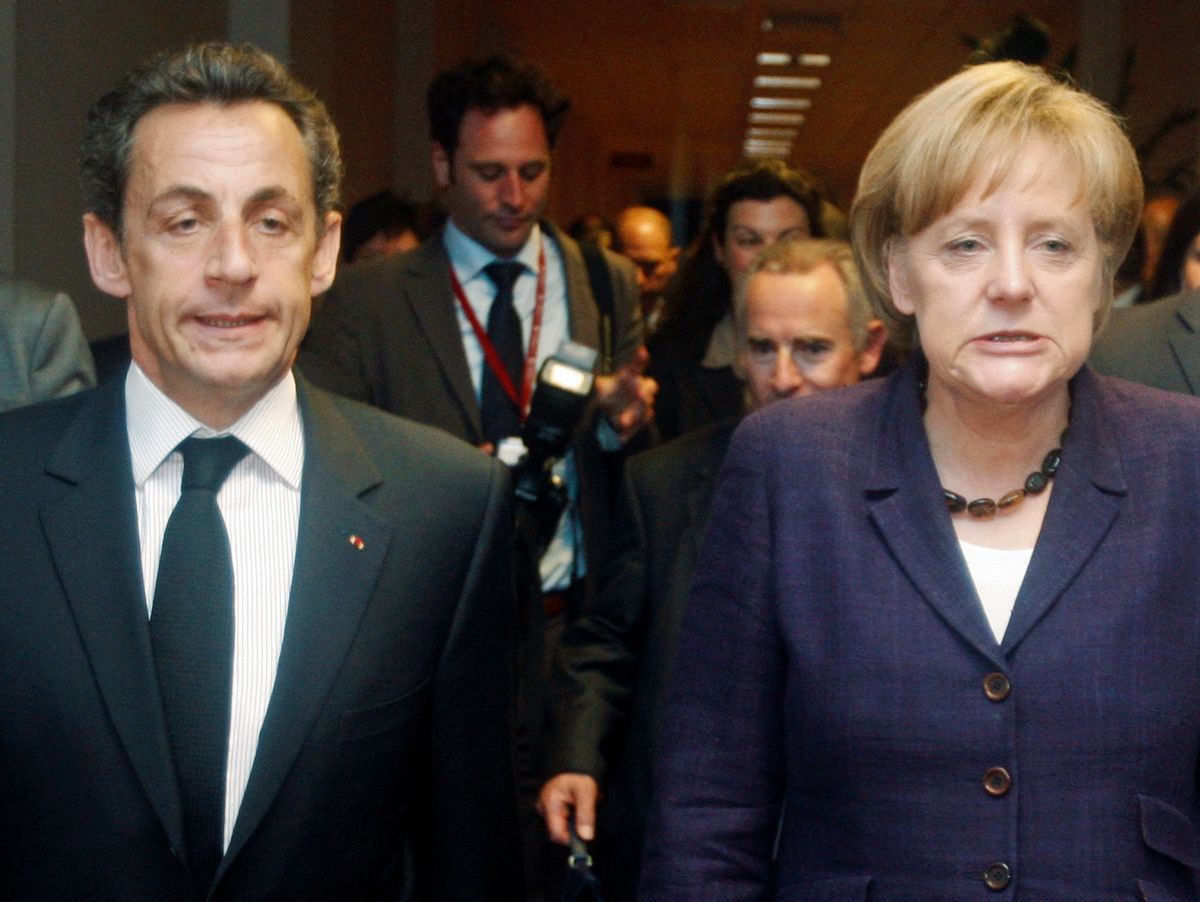
The bailout plan has been billed as an effort to "rescue the euro." But whether leaders like Germany's Angela Merkel or France's Nicolas Sarkozy know it or not, it's really a desperate, risky attempt to rescue the idea of a peaceful Europe. And there's a huge contradiction built into the project: The very things necessary to make the rescue work may end up tearing Europe apart.
Details are sketchy at the moment, but the loans that the European Commission and the IMF will offer to eurozone members in danger of defaulting on their obligations are contingent on those nations' making real progress on fixing their finances. How these contingencies will be enforced is a puzzler -- one theory is that it can only be achieved through tighter political integration, implying that a country like Greece or Portugal will lose some degree of control over their own finances to the New European Order. But however it is supposed to work, the process of managing this transition will be extremely difficult, for the very simple fact that in return for giving up sovereignty and getting bailed out, the countries at issue will have to make economic decisions that undoubtedly lower their citizenry's standard of living. Greece is looking at a potential 12 percent contraction of its economy. Spain already has 20 percent unemployment; for Spain to cut government spending in the face of such labor misery is to guarantee even more hardship. And so on. It seems unthinkable that voters will accept this bargain. It's certainly not hard to imagine grass-roots anti-EU Tea Party-style rebellions breaking out all over Europe, and, in the worst scenario, the accession to power of fiercely nationalist parties who base their appeal on their rejection of "European" priorities.
In that scenario, the prospect of government default, withdrawal from the eurozone, and the reintroduction and consequent radical devaluation of local currencies will lead to tremendous economic upheaval -- bank failures, surging unemployment, possibly another global depression. All of which combine to form a new recipe for war.
The roots of National Socialism's rise to power in Germany go back to the punitive economic conditions imposed by the victors in World War I via the Treaty of Versailles. What new horror gets born in Greece or Spain or Italy when a massive recession is catalyzed by government spending cuts necessary to appease foreign bond-holders? What does a German Tea Party -- fueled by the resentments of Germans who don't want to pay the bill for Greece to avoid default -- look like?
I have no idea how many of the finance ministers who huddled together working out their rescue plan Sunday night were thinking about the greater historical consequences of screwing up the march to European political and economic integration. By all accounts, they were more likely focused on the imminent opening of Asian stock markets.
Via Felix Salmon, Ultima Barbararum fears the worst -- that the current crop of European leaders just doesn't get the stakes at issue.
The euro is at more risk than it has ever been. And for the new generation of politicians in France and Germany the compromises of the 1990s may not mean so much. We don't know how much they are prepared to risk to defend the status quo. They don't have direct memories of firebombed cities, of fathers not returning home, of mothers and sisters raped by the Red Army. I don't think we'd have the same worry if Kohl and Mitterand were still around. We would trust them more not to fuck about.
Those words were published before news of the bailout broke -- and proved, at least for the moment, that Merkel and Sarkozy do have the will to meet the current challenge. For now. But pledging a willingness to bail out Europe's weaklings is the easy part. It will get a lot tougher, here on out.
Shares