Growers and Producers
The bold new faces of urban farming
It's not just kids and dirt. From indoor fish farms to business training for refugees, a slide show of 11 pioneers
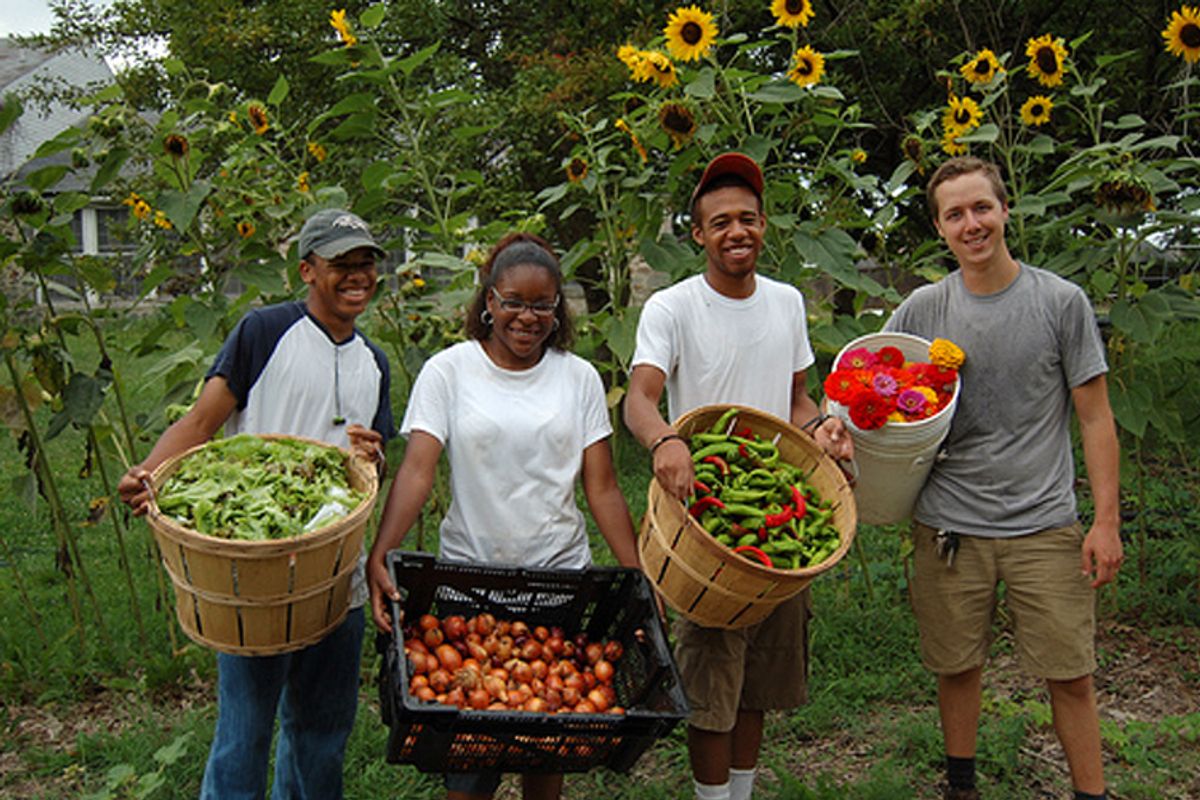
Urban farmers are coming to the rescue in dozens of city neighborhoods where you’re about as likely to find a fresh tomato as you are to find a unicorn on the sidewalk. But if “urban farmer” calls up visions of an old hippie hoeing a quaint little patch of sunflowers in the shadow of high-rises, think again. Modern urban farming is about block parties with DJs and cooking lessons. It’s raising fish in indoor tanks and getting outdoor education in city schools. It creates meaningful jobs for inner city youth who learn to plan food systems and cultivate crops. But most of all, it’s about ingenuity. Urban agriculturists see potential where others sees blight, seeking out vacant lots and neglected open spaces, looking at what they have within arm’s reach rather than thinking about what’s missing.
This slide show is a tour of some of the country’s most innovative approaches to urban agriculture. These are farms and gardens created in the service of education and activism. Whether they’re training entrepreneurs, teaching kids to grow organic kale, or producing food from plots no bigger than your living room, the urban approach to farming is about feeding, not being fed.
Sara Breselor is an Editorial Fellow with Salon Food. More Sara Breselor.
When eating organic was totally uncool
Before hipsters got rooftop gardens, my poor, refugee family ate that way because we had to. And we were ashamed
(Credit: Vic Valbuena Bareng) To me, the organic food movement has become dizzyingly, surreally chic. Farmers have become rock stars; the most exclusive restaurants name-check them so much you can almost see dirt on the menu. But before organic produce exploded into a $25 billion industry, before city gardening became cool, I grew up in a Hmong refugee community, living the urban organic lifestyle not because it was fashionable, but because we were poor. I couldn’t wait to leave it behind.
I grew up in Del Paso Heights, a mixed-race inner city of Sacramento, Calif. — the kind of neighborhood that had just two grocery stores between endless fast-food and liquor shops, and where we all paid for our groceries with food stamps. It was where we grew organic food and raised chickens in our backyards to survive. And where we did it in secrecy.
Continue Reading CloseFrancis Lam’s tales of the multicultural South
I'd love to tell you some stories of shrimpers, would-be mayors, bakers and market tenders: Folks dear to my heart
Andrew "FoFo" Gilich for mayor! A few weeks ago, I had the honor of addressing the august Southern Foodways Alliance Symposium, which would be the finest food conference in the country even if it didn’t dedicate a least one entire evening to various forms of fried catfish and booze.
The subject of my talk was the global influence on the South, as shown in the diverse people of Biloxi, Miss. — shrimpers and the children of shrimpers, bakers and market tenders. It’s a subject — and these are people — dear to my heart, and I found myself unexpectedly emotional as I told their rich stories: of FoFo Gilich who grew up working in a cannery and was nearly mayor of Biloxi; of Richard Gollott, who is the man literally responsible for the establishment of a vibrant Vietnamese community in this town; of Sue Nguyen, whose “Vietnamese bakery” became, over time, simply Biloxi’s bakery; and more.
Continue Reading CloseFrancis Lam is Features Editor at Gilt Taste, provides color commentary for the Cooking Channel show Food(ography), and tweets at @francis_lam. More Francis Lam.
The end of the greatest American fishery?
Threatened by mines, Bristol Bay, Alaska, is a place of beauty and heart, dependent on salmon. Plus: A slide show
If fish can be heroes, salmon have a heroic story — returning after years out in the world, they fight their way upriver back to where they were born, slipping past eagles and dodging bears to find a place for their children. But the natural order is both grislier and more beautiful than that. Those eagles and bears will stave off their hunger and snatch their fill of fish from the water. And the salmon that survive will spawn, wither and then die, their bodies nourishing the ecology with nutrients collected from the ocean.
Continue Reading CloseFrancis Lam is Features Editor at Gilt Taste, provides color commentary for the Cooking Channel show Food(ography), and tweets at @francis_lam. More Francis Lam.
Heirloom vegetables: $1,000
Sotheby's auctions high-priced vegetables to benefit local farms. But is that really an answer to agribusiness?
(Credit: Unknown) For some of us, shopping at Whole Foods, despite its inherent promise of establishing you as an esteemed member of the socially conscious, politically correct, seriously foodie upper middle class, can be a wholly unwholesome experience. You have to battle the snaking lines, the overly cutesy labels, and the overwhelming mass of organic-heirloom-tomato-toting liberals. Entirely too plebeian.
So, come Sept. 23, you can trade your brown-and-green paper bag for a designer gown and head over to Sotheby’s for a vegetable auction. You can also trade your rather ordinary orange pumpkin for one that almost sounds like a strip club — the pink banana pumpkin. Also on the auctioning block will be the Turkish orange eggplant, the Black Sea man tomato and the ridiculously diva-like Lady Godiva squash. The price of a crateful of these charmingly named veggies? A thousand bucks.
Continue Reading CloseRiddhi Shah is an editorial fellow at Salon. More Riddhi Shah.
A call for a new term beyond organic: “Authentic”
It's time to define quality in a way corporations can't co-opt
Elena Green, 3, helps her mother buy berries at the Westmoreland Berry Farm stand at the Arlington Farmers' Market in Arlington, Virginia in this picture taken June 28, 2008. While price hikes are rippling through farmers' markets across the United States, they are doing little to deter shoppers looking for local produce. Picture taken June 28. REUTERS/Jonathan Ernst (UNITED STATES) To match feature FOOD-USA/FARMERSMARKET(Credit: © Jonathan Ernst / Reuters) Some things — asparagus, summer turnips, green beans, peas, lettuce, plums, certain apples — taste obviously different when they are taken directly from the tree or soil rather than purchased in a supermarket. Yet very few of us know that from harvesting our own plants and trees. The closest we come is buying such produce at a farm stand or farmer’s market. The supporters of small-scale growers and farmers’ markets, which were once few and cheap and are now so much more plentiful and expensive, are sometimes accused of impracticality and elitism. But there’s no reason to deprive anyone of a choice between higher and lower quality. And small-scale producers sometimes show the way for mass-producers, as they did and continue do in the case of organic production.
Continue Reading ClosePage 1 of 3 in Growers and Producers
