This story first appeared on Felicia Lee's Open Salon blog.
Tortillas are sacred in the Zapotec village of San Lucas Quiaviní, Oaxaca. Devotees worship them by ripping them into little pieces and dunking them into soups, slathering them with spicy stews and sauces, wrapping them around little pieces of grilled meat, or otherwise laying waste to them in any number of thrifty and freakishly delicious ways, each field-tested and perfected by centuries of experimentation and practice.
The hellishly complicated Zapotec language spoken in San Lucas also venerates tortillas. The language has, among other things, a pronoun system that distinguishes referents according to the speaker's respect for them: animals and children are referred to with one set of pronouns; close friends and family with another. At the top of the linguistic pecking order are the reverential pronouns, used only to refer to God, saints, and a small number of culturally salient elements, such as the sun and moon -- and tortillas.
The presence of tortillas in the Zapotec pantheon finally made sense to me once I visited San Lucas to investigate that language: Tortillas appeared at every meal, without fail. Whenever I tried to get a Zapotec translation for a sentence such as "I already ate," what I invariably got back was "I already ate tortillas." The term for taking communion in the Catholic church translates literally as "eat the holy tortilla." If the dozens of missionaries trolling rural Oaxaca for lost souls had any sense at all, they'd translate the middle of the Lord's Prayer as "give us this day our daily tortilla."
And those tortillas are worthy of adoration. The most common variety in the village are big, thin corn tortillas -- about a foot across -- often faintly dusted with the ashes of the open fires over which they were cooked. I thought that I'd get tired of eating them three times a day over the two- or three-week duration of my trips down there, but I never did.
Over the course of several trips to San Lucas, I slowly figured out how to make those amazing tortillas. For reasons soon to become clear, I've never tried to make them this way myself -- and I hope I never have to.
Truly Old-School Oaxacan Corn Tortillas
Preparation time: about a year
Actual work time: a couple of months
Equipment needed: a grinding stone (metate) and a stone hand roller (mano), a fireproof flat skillet (comal), at least one adult male relative, one donkey, and at least two children or female relatives
Yield: Never quite enough
Ingredients:
seed corn (amount varies according to the size of your family and property holdings)
lime (ditto)
- A year before serving: Have your husband or other trusted male relative plant the seed corn. Ensure that they plow and weed the cornfield regularly.
- Once the corn crop has matured, allow the corn to dry on the stalk. Cut the dried cobs off the stalks, load them onto the donkey, bring them home and set them in an airy, covered area to dry further. Do not let your other animals get to them at this point.
- Remove the dried corn kernels from the cobs, using either your fingernails or better, an old, already denuded corncob. Better yet, have your kids do this. It will take a several hours.
- Save nine pesos for round-trip bus fare to Tlacolula. Go to Tlacolula and buy some lime (as in calcium oxide, quicklime, not as in the fruit) to process the corn. Bring along that bag of cactus fruit you picked while taking the sheep out to graze -- if you manage to sell it, you'll more than cover the expense of the bus fare and lime.
- If you haven't done so already, gather up enough firewood for about an hour of cooking. Once back home, light a fire, dissolve the lime in a large container of water, dump in the dried corn kernels, and cook gently over the fire until the skin of the kernels can be easily rubbed off. Let the corn sit in the cooking water overnight. Drain the corn, rub off any remaining skin from the kernels, and set aside.
- Grind the corn on a stone metate with the stone roller, using a firm forwards-and-backwards pushing/rolling motion and sprinkling water onto the corn as needed to keep it moist and pliable. The ground corn mixture must feel silky-smooth when rubbed between the fingers; there must be no sign of grittiness. (Gringos who buy "stone ground" tortillas that appear to have chunks of Corn Nuts in them are seriously deluded.) This stage will take a couple of hours. Transfer the silky mass to a large bowl.
- Light another fire and place a large comal (round earthenware griddle) on top of it to heat. Set up your tortilla press and your bowl of ground corn near the fire. Line the plates of the tortilla press with pieces of plastic cut from an old shopping bag.
- When the fire and the comal are hot, start shaping the tortillas: take a fistful of the ground corn mixture, roll it into a ball, put it into the press and push down hard to flatten it. (Note that tortilla presses in Oaxaca are the size of pizza pans, and so are the tortillas made in them.) The tortilla should be thin and perfectly round. Carefully remove it from the press and immediately place it on the hot comal. It will start to smoke and bubble within seconds. Once the bottom is set and lightly spotted with toasty brown dots, flip it over with your fingers, taking care not to burn yourself. Remove from the comal when the second side is cooked through.
- Place the tortilla in a linen-lined basket for storage. Repeat the shaping, pressing, and griddling process several dozen more times.
- Keep the tortillas covered to prevent them from drying out, gather up more firewood, and prepare the remaining dishes for the day's meals. Serve with breakfast, lunch, and dinner, at least 3 per person, per meal.
- Repeat steps 5-10 every day for the rest of your life. Repeat steps 1-4 as needed.
Interestingly, expat San Lucas natives now living in the States tell me that not all tortillas can be referred to with reverential pronouns. This privilege is reserved for homemade tortillas back home: anything store-bought (or, God forbid, that comes in a re-sealable bag with NO TRANS-FATS! printed on it) is referred to with a socially neutral third-person pronoun, if spoken of at all.
If you've tried to work through the recipe above, you won't need to wonder why.
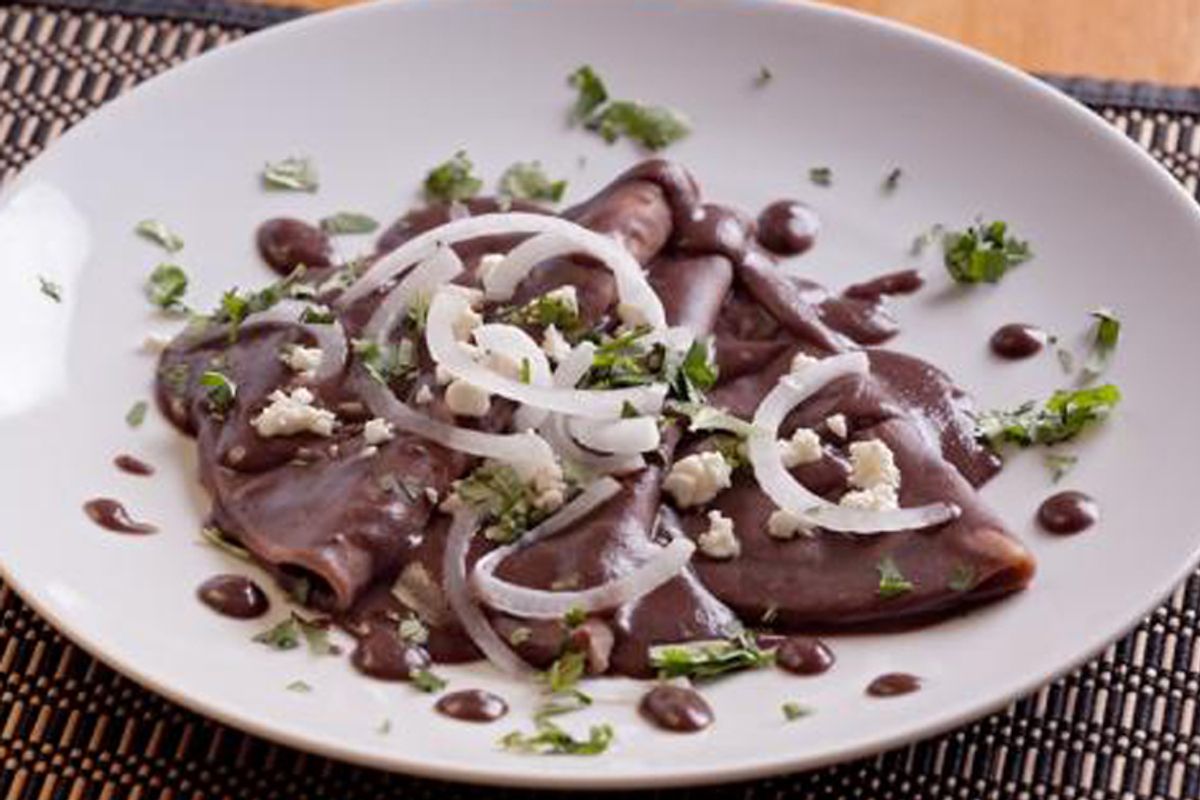
And here is my shortcut-filled take on a classically thrifty Oaxacan way to make tortillas the center of a hearty breakfast or simple supper, napped in a rich, savory sauce made from seasoned and pureed black beans. The sauce has startling blackish hue, but set aside any visions of the Deepwater Horizon: instead, think of that striking color as either evocatively earthy and primitive, or cutting-edge elegant. Either way, you'll have a stunning-looking plate, even if you must use unholy tortillas from the supermarket.
Enfrijoladas (corn tortillas with black bean sauce, Oaxacan style)
Preparation time: 45 minutes
Actual work time: 20 minutes
Yield: 2-3 servings
Ingredients:
1 15.5-oz. can black beans (unseasoned if possible)
1 clove garlic, crushed
1/8 c. white onion, roughly chopped
½ tsp. dried epazote, crumbled (Epazote is a Mexican herb that is almost inseparable from black beans in Oaxacan cooking, and well worth procuring)
8 or 9 corn tortillas
1/8 c. neutral oil, such as canola
Salt to taste
- For garnishes: thinly sliced white onion, crumbled or shredded white Mexican cheese (such as cotija or quesillo), chopped cilantro, avocado slices (optional)
- Heat the beans, garlic, onion, and epazote together in a saucepan over medium heat until the garlic and onion are soft, about fifteen minutes.
- Transfer bean mixture to a blender or food processor, blend until smooth.
- Return bean mixture to saucepan. Cook over medium heat, adding enough water or broth to form a thick but pourable sauce. (It should have the consistency of a thickish bean soup, but not be gloppy.) Taste and add salt if needed. Transfer the sauce to a wide skillet and keep it warm while you prep the tortillas.
- Now it's time to assemble the enfrijoladas: Heat the oil in a saute pan over medium-high heat. Fry each tortilla for a couple of seconds on each side to soften it. As each tortilla becomes soft and pliable, remove it from the oil, allow all excess oil to drip off, then dip the tortilla in the bean sauce and fold it in half. The tortilla should be completely coated in sauce. (In Oaxaca, where the tortillas are ginormous, they are folded into quarters, like crepes.)
- You can either arrange the dipped tortillas decoratively on individual serving plates (allowing three or four per serving as a main course) or put them all in a common serving dish. Either way, nap them with any extra sauce, top with any of the garnishes listed above, and serve immediately.
Shares