
Israel

Israel attacks aid ship, kills at least 10 civilians

Israel attacks aid ship, kills at least 10 civilians -- international outrage grows

  • more
    • All Share Services

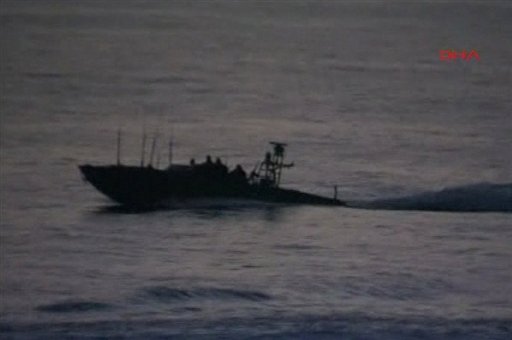
Israel attacks aid ship, kills at least 10 civiliansThis video image released by the Turkish Aid group IHH Monday May 31, 2010 purports to show Israeli military vessel at sea in international waters off the Gaza coast near a ship convey carrying aid to Gaza. Israeli commandos on Monday stormed six ships carrying hundreds of pro-Palestinian activists on an aid mission to the blockaded Gaza Strip, killing at least 10 people and wounding dozens after encountering unexpected resistance as the forces boarded the vessels. AP Photo/IHH via APTN) ** TURKEY OUT **(Credit: AP)

(Updated belowUpdate IIUpdate IIIUpdate IVUpdate VUpdate VIUpdate VII)

Late last night, Israel attacked a flotilla of ships in international waters carrying food, medicine and other aid to Gaza, killing at least 10 civilians on board and injuring at least 30 more (many reports now put the numbers at 19 dead and 60 injured).  The Israeli Defense Forces is claiming that its soldiers were attacked with clubs,  knives and “handguns” when they boarded the ship without permission, but none of the Israeli soldiers were killed while two are reported injured.  Those on the ships emphatically state that the IDF came on board shooting (though see this video and discussion here, as well as this).  An IDF spokesman said:  ”Our initial findings show that at least 10 convoy participants were killed.”  

The six-ship flotilla was carrying 10,000 tons of humanitarian aid along with 600 people, all civilians, which included 1976 Nobel Peace Prize laureate Mairead Corrigan Maguire of Northern Ireland and European legislators; an elderly Holocaust survivor, Hedy Epstein, 85, was scheduled to be among those on the ship but remained in Cyprus.  In December, 2008, Israel, citing rocket attacks from Hamas, launched a 22-day, barbaric attack on Gaza, bombarding a trapped population, killing hundreds of innocent civilians (1,400 Palestinians and 13 Israelis were killed), and devastating Gazan society.  A U.N. report released earlier this month documented that, as a result of the blockade imposed on Gaza by Israel and Egypt (the two largest recipients of U.S. aid), “[m]ost of the property and infrastructure damaged . . .  was still unrepaired 12 months later.”  

The flotilla attacked by Israel last night was carrying materials such as cement, water purifiers, and other building materials, much of which Israel refuses to let pass into Gaza.  At the end of 2009, a U.N. report found that “insufficient food and medicine is reaching Gazans, producing a further deterioration of the mental and physical health of the entire civilian population since Israel launched Operation Cast Lead against the territory,” and also “blamed the blockade for continued breakdowns of the electricity and sanitation systems due to the Israeli refusal to let spare parts needed for repair get through the crossings.”

It hardly seemed possible for Israel — after its brutal devastation of Gaza and its ongoing blockade — to engage in more heinous and repugnant crimes.  But by attacking a flotilla in international waters carrying humanitarian aid, and slaughtering at least 10 people, Israel has managed to do exactly that.  If Israel’s goal were to provoke as much disgust and contempt for it as possible, it’s hard to imagine how it could be doing a better job.

It is appropriate that Israeli Prime Minister Benjamin Netanyahu is scheduled to meet with President Obama on Tuesday in Washington, because — as always — it is only American protection of Israel that permits the Israelis to engage in conduct like this.  Initial reports speculate that Netanyahu would cancel that meeting in order to return to Israel in light of this attack.  But there would be something quite symbolically appropriate about having the U.S. stand at the side of Israel in the aftermath of this latest massacre, because it is only the massive amounts of U.S. financial and military aid, and endless diplomatic protection, that enables Israel to act with impunity as a rogue and inhumane state.  So complete is the devotion of the U.S. Congress to the mission of serving and protecting Israel that it even overwhelmingly condemned the Goldstone report, which found that Israel and Hamas had both commited war crimes and possibly crimes against humanity during the Israeli attack on Gaza (the U.S. Congress, of course, never condemned the Israeli war crimes themselves — only the Report which documented those crimes).  Israeli actions are a direction reflection on, and by-product of, the U.S. Government, because it is the U.S. which enables and protects the behavior.

The one silver lining from these incidents is that the real face of Israel becomes increasingly revealed and undeniable.  Not even the most intense propaganda systems can prettify a lethal military attack on ships carrying civilians and humanitarian aid to people living in some of the most wretched and tragic conditions anywhere in the world.  It is crystal clear to anyone who looks what Israel has become, and the only question left is how will the rest of the world — beginning with their American patrons — will react. 

As Americans suffer extreme cuts in education for their own children and a further deterioration in basic economic security (including Social Security), will they continue to acquiesce to the transfer of billions of dollars every year to the Israelis, who — unlike Americans — enjoy full, universal health care coverage?  How is the revulsion justifiably provoked by this latest Israeli crime going to impact American efforts in the Muslim world (as but one of many examples to come, Al Jazeera reports that “Moqtada al-Sadr has called for a large anti-Israel rally across from the Green Zone in Baghdad”)?  How much longer will Americans be willing to pay the extreme prices for its endlessly entangled “alliance” with its prime Middle Eastern client state, whose capacity for criminal and inhumane acts appears limitless?  

* * * * * 

On a day when the meaning of “heroism” is often discussed, the people on these ships who tried to deliver aid to Gazans, knowing that they could easily find themselves in a confrontation with the Israeli Navy but doing it anyway in order to bring attention to the extraordinary injustice and cruelty of the blockade, are pure, unadulterated heroes.


UPDATE: Regarding the blockade of Gaza itself — about which “Dov Weisglass, an adviser to Ehud Olmert, the Israeli Prime Minister [said when it was first imposed]: ‘The idea is to put the Palestinians on a diet, but not to make them die of hunger’” — this post documents just some of the effects, with ample links to U.N. reports, including:

* since the intensification of the siege in June 2007, “the formal economy in Gaza has collapsed” (More than 80 UN and aid agencies [.pdf])

* ”61% of people in the Gaza Strip are … food insecure,” of which “65% are children under 18 years” (UN FAO)

 * since June 2007, “the number of Palestine refugees unable to access food and lacking the means to purchase even the most basic items, such as soap, school stationery and safe drinking water, has tripled” (UNRWA)

 * ”in February 2009, the level of anemia in babies (9-12 months) was as high as 65.5%” (UN FAO)

The Washington Post‘s Jackson Diehl, whose entire political world view is shaped by his devotion to Israel, today criticizes President Obama for rejecting ”Bush’s conclusion that the promotion of democracy and human rights is inseparable from the tasks of defeating al-Qaeda and establishing a workable international order.”  That’s ironic, because if “human rights” played any role whatsoever in American foreign policy, the massive American aid and other protection for Israel which Diehl cherishes above all else would instantaneously disappear.


UPDATE II: Just ponder what we’d be hearing if Iran had raided a humanitarian ship in international waters and killed 15 or so civilians aboard.


UPDATE III: One of the ships attacked by Israel belonged to a Turkish aid organization, and it’s been reported that among the dead are at least two Turks.  Turkey today “warned that further supply vessels will be sent to Gaza, escorted by the Turkish Navy.” Among other things, Turkey is a NATO member with increasing tensions with Israel.  Its Prime Minister today condemned the Israeli action as “state terrorism.”  Amidst worldwide protests aimed at Israel, along with possible internal unrest if (as has been reported) an Israeli Arab leader was among the wounded or dead, it’s possible that this incident could produce some serious unforeseen consequences for the Israelis.


UPDATE IV: So, to recap what seems thus far to be the central claim of Israel apologists:   Israel is the official Owner of international waters (which is where the flotilla was when it was attacked).  As such, they have the right to issue orders to ships in international waters, and everyone on board those ships is required to obey and submit.  Anyone who fails to do so, or anyone in the vicinity of those who fail to do so, can be shot and killed and get what they deserve. 

What’s so odd about that is that the U.S. has been spending a fair amount of time recently condemning exactly such acts as “piracy” and demanding ”that those who commit acts of piracy are held accountable for their crimes.”  When exactly did Israel acquire the right not only to rule over Gaza and the West Bank, but international waters as well?  Their rights as sovereign are expanding faster than the BP oil spill.


UPDATE V: Israel’s foreign minister is now actually claiming that attempts to deliver humanitarian aid to Gaza are “an attack on Israel’s sovereignty.”  Is that supposed to be some kind of a joke?  The only claim that I can recall that’s remotely comparable is when the U.S. General serving as Commander of Guantanamo condemned suicides by three detainees there as an “act of asymmetric warfare waged against us.”  The U.S. and Israel are very adept at claiming victimhood:  even when they’re killing large numbers of civilians and locking people up in cages with no charges, they’re the ones who are the suffering, wronged parties.  

Thus, there are at least 10-20 dead passengers and 50-60 wounded on those ships — compared to no Israeli fatalities and virtually no wounded — but it’s the passengers, delivering humanitarian aid in international waters when Israel seized their ships, who are the aggressors and were “attacking Israeli sovereignty.”  The only thing worse than this claim is how many apologists for Israel will start parroting it (see Andrew Sullivan for more refutation of the claim that it was the passengers who were somehow the “aggressors”).


UPDATE VI: Among the countries condemning Israel for its attack are Russia, Turkey, India, China, Brazil, France, Spain and many more.  By stark contrast, the White House issued a statement which conspicuously refused to condemn the Israelis (Obama “expressed deep regret at the loss of life in today’s incident, and concern for the wounded”), while the U.S. State Department actually hinted at condemning the civilians delivering the aid (“we support expanding the flow of goods to the people of Gaza.  But this must be done in a spirit of cooperation, not confrontation”).  

Obama’s call for “learning all the facts and circumstances” is reasonable enough, but all these other countries made clear that this attack could never be justified based on what is already indisputably known:   namely, that the ship attacked by Israel was in international waters and it resulted in the deaths and injuries to dozens of civilians, but no Israeli soldiers were killed and a tiny handful injured.  In any event, Obama’s neutrality will have to give way to a definitive statement one way or the other, and soon.


UPDATE VII: The formal statement submitted to the U.N. by the U.S. Ambassador today rather clearly seeks to blame everyone — from Hamas to those attempting to deliver the aid — for what happened:  everyone, that is, except for the party which actually did the illegal seizing of the ship and the killing (Israel):

As I stated in the Chamber in December 2008, when we were confronted by a similar situation, mechanisms exist for the transfer of humanitarian assistance to Gaza by member states and groups that want to do so. These non-provocative and non-confrontational mechanisms should be the ones used for the benefit of all those in Gaza.  Direct delivery by sea is neither appropriate nor responsible, and certainly not effective, under the circumstances. . . . We will continue to engage the Israelis on a daily basis to expand the scope and type of goods allowed into Gaza to address the full range of the population’s humanitarian and recovery needs. Hamas’ interference with international assistance shipments and the work of nongovernmental organizations complicates efforts in Gaza. Its continued arms smuggling and commitment to terrorism undermines security and prosperity for Palestinians and Israelis alike.

Given that the Israelis refuse to allow anything other than the most minimal “necessities” to enter Gaza, I’d love to know what “non-provocative and non-confrontational mechanisms” exist to deliver humanitarian assistance?  And it’s extraordinary that we refuse to condemn a blockade that, as classic “collective punishment,” is a clear violation of the Geneva Conventions, and even refuse to condemn today’s violent seizure of ships in international water.  But, of course, the central rule of American politics is that Israel cannot be criticized, even as the rest of the world condemns it.  How do you think the rest of the world will perceive the U.S.’s extreme, out-of-step protection of the Israelis, while subtly (or not-so-subtly) heaping the blame on the victims of its aggression?

Glenn Greenwald

Follow Glenn Greenwald on Twitter: @ggreenwald.

Selling Zionism in the 1920s

The Palestine Poster Project reveals attempts to entice settlers into what is now Israel

  • more
    • All Share Services

Selling Zionism in the 1920s
This article originally appeared on Imprint.

ImprintDan Walsh’s incredibly rich Palestine Poster Project Archives includes much in the way of protest, but it also contains a trove of rare Zionist/Israeli posters from the 1920s through the ’50s, largely before partition. The ones excerpted here are from the Mahmoud Darwish Memorial Gallery, which includes a collection of Zionist Worker agency posters calling for increased development of Palestine.

The affairs of the workers of Eretz Israel should be in the hands of the workers of Eretz Israel, 1935.

To experience the role of posters in the birth, growing pains, and ultimate conflict, this is perhaps the best online resource. Here’s what Walsh collects: 1) international artists and agencies; 2) Zionist and Israeli artists and agencies; 3) Palestinian nationalist artists and agencies; 4) Arab and Muslim artists and agencies. And here is what he says about his collection of over 6,700 posters:

I first began collecting Palestine posters when I was a Peace Corps volunteer in Morocco in the mid-1970s. By 1980 I had acquired about 300 Palestine posters. A small grant awarded with the support of the late Dr. Edward Said allowed me to organize them into an educational slideshow to further the “third goal” of the Peace Corps: to promote a better understanding of other peoples on the part of Americans. Over the ensuing years, while running my design company, Liberation Graphics, the number of internationally published Palestine posters I acquired steadily grew. Today the archives include some 3,000 Palestine posters from myriad sources making it what many library science specialists say is the largest such archives in the world.

To fortify our home - use Hebrew cement, 1937.

Come and See the Palestine Exhibition - Vienna, 1925.

Text in logo in upper left hand corner - The Worker, 1937.

Build Industries In Palestine!, 1927

Continue Reading Close

Israel’s drone dominance

If you want to know how drones will change America, look to the Jewish State -- where they're already widespread

  • more
    • All Share Services

Israel's drone dominance (Credit: Benjamin Wheelock)

Stark Aerospace of Mississippi is perhaps the only foreign-owned company with FAA permission to fly a drone in U.S. airspace. Based in the town of Columbus, not far from Mississippi State University, Stark is a subsidiary of the state-owned Israel Aerospace Industries — not that you could tell from looking at the company’s website, executive leadership or affiliations. You have to go to the Mississippi secretary of state website to learn that two of Stark’s three directors are Israelis.

So too with the America’s drone industry. The Israeli influence is not visible but it is real, documented and extremely relevant to the future of drones in America. If you want to know how drones may change American airspace in coming years, just look to Israel, where the unmanned aerial vehicle market is thriving and drones are considered a reliable instrument of “homeland security.”

“There are three explanations for Israel’s success in becoming a world leader in development and production of UAVs,” a top Israeli official explained to the Jerusalem Post last year. “We have unbelievable people and innovation, combat experience that helps us understand what we need and immediate operational use since we are always in a conflict which allows us to perfect our systems.”

Israel’s drone expertise goes back to at least 1970, according to the UAV page of the Israeli Air Force. Mark Daly, an expert on unmanned aircraft at Jane’s Defense in London, notes the Israelis were the first to make widespread use of drones in Israel’s 1982 invasion of Lebanon, when the aircraft were used to monitor troop movements.

Now, as the Arab media and Western reporters such as Scott Wilson of the Washington Post have reported, the Israeli Defense Force uses fleets of constantly hovering drones to intimidate and control the Arab population in the Gaza Strip.  (The residents call these drones “zenana,” which both sounds like the aircraft’s distinctive buzz and is Arabic slang for a nagging wife.) The IDF regularly uses drones for targeted assassinations of suspected militants, saying the drones enable them to use “precision strikes” to avoid hurting civilians. Yet as Human Rights Watch has documented, the drone strikes during the Gaza War killed scores of children who were nowhere near armed combatants.

Israel markets its expertise in defense to the rest of the world. Israeli academic Neve Gordon cites a glossy government brochure on drones titled “Israel Homeland Security: Opportunities for Industrial Cooperation,” which boasts, “no other advanced technology country has such a large proportion of citizens with real time experience in the army, security and police forces.” The chapter called “Learning from Israel’s Experience” notes that “many of these professionals continue to work as international consultants and experts after leaving the Israel Defense Forces, police or other defense and security organizations.”

The work has paid off when it comes to drones: The Jewish state is the single largest exporter of drones in the world, responsible for 41 percent of all UAVs exported between 2001 and 2011, according to a database compiled by the Stockholm International Peace Research Institute. Israeli companies export drone technology to at least 24 countries, including the United States.

In addition to exports, Israeli companies also create subsidiaries in consumer countries. “To increase sales outside Israel, Israel’s defense companies have to set up subsidiaries in target markets, rather than expand local manufacturing,” Haaretz reported  in 2009. The Israelis “set up Stark in 2006 to drum up business in America,” according to Haaretz, because the U.S. prefers “to buy armaments and other defense gear from local companies.” In 2007, Stark  “inaugurated its first production outfit, which makes Hunter unmanned vehicles that it sells through Northrop Grumman. In fact, the U.S. armed forces have been using [Israeli-made] Hunter drones since the early 1990s.”

As for domestic drone uses, the Israeli example is perhaps most instructive at the U.S. border. The 5 million Palestinian Arabs living in and around Israel, like the 11 undocumented resident aliens in the United States, are ineligible for citizenship in the land they call home. Both groups are subject to monitoring, barriers to entry and rapid expulsion. Not surprisingly one of the first uses of drones by the Department of Homeland Security was to monitor the U.S.-Mexico border, where it now flies Israeli-made Hermes 450 drones.

And the Israeli example is instructive not just at the border, but also south of it, where the Mexican government has allowed the U.S. to fly drone missions as part of the drug war. Mexico has, apparently, learned a thing or two from its northern neighbor about the best country for buying drones. In March, when it allegedly purchased two new drones of its own, it knew where to go: Israel.

Continue Reading Close
Jefferson Morley

Jefferson Morley is a staff writer for Salon in Washington and author of the forthcoming book, Snow-Storm in August: Washington City, Francis Scott Key, and the Forgotten Race Riot of 1835 (Nan Talese/Doubleday).

“The Aleppo Codex”: The bizarre history of a precious book

A reporter traces the shadowy fate of the definitive version of the Hebrew Bible

  • more
    • All Share Services

Matti Friedman

An ancient and priceless book, a murky history of evasions and coverups, an underground of sinister and possibly violent dealers, a former spy who drops tantalizing hints and a wily 84-year-old millionaire who says stuff like, “The problem with this story is that it could damage your health”: Are these the ingredients for a cheesy, improbable historical thriller? Yet “The Aleppo Codex,” Matti Friedman’s account of his attempts to learn the history of one of the world’s most precious books, sports all of these assets, and it’s nonfiction. If reporting this story damaged Friedman’s health, it probably happened when he realized what he’d stumbled into and his reporter’s heart started beating in doubletime.

The Aleppo Codex is the most authoritative version of the Hebrew Bible, produced in the 10th century by the great rabbi Aaron Ben-Asher and the scribe Shlomo ben Buya. Friedman, who lives in Israel and has covered the Mideast and the Caucasus for the Associated Press and other publications, explains that the codex’s significance to Jewish faith and identity is more than symbolic. As a people scattered across the globe, “instead of being bound by a king, a temple, or geography, [Jews] needed to be bound by something else, something portable. What emerged was the idea that a people could be held together by words.” Yet in the centuries before printing, when words were transmitted orally and by copyists, it was all too easy for mistakes and variations to creep in, and “Jews could not be held together by a book if they were not reading precisely the same one.”

The codex was the perfect version of the Bible, a sort of atomic clock of Judaism, and intended to be the model for all subsequent copies. Its early history was fraught: captured by Crusaders in the fall of Jerusalem, ransomed by the Jewish community in Cairo and consulted by the fabled sage Maimonides, it was eventually taken to the Syrian city of Aleppo. There, it resided for half a century. Although it was well-cared-for by Aleppo’s Jewish community, it had come to be revered as a relic or treasure; few were allowed to see it and no one was allowed to copy it.

All that changed in 1947, when the establishment of the state of Israel by a United Nations resolution led to unrest in the Arab world and the harassment and persecution of Jewish communities in Muslim nations. In Aleppo, this took the form of riots and the sacking of the synagogue. The codex — commonly referred to as the Crown — was supposed to have been consumed in a fire set by the mob.

It was not, and in 1958, the Crown was smuggled into Jerusalem by a cheese merchant who was one of the few Syrian Jews to receive official permission to emigrate to Israel. Friedman became interested in this “lonely treasure and millennium-old traveler” in 2008, when he decided to write an article about it. He imagined the piece would be “an uplifting and uncomplicated account of the rescue of a cultural artifact,” but what he discovered instead was a thicket of conflicting reports, missing records, puzzling omissions, stonewalling officials and obsessed amateur sleuths.

The mysteries surround not the ancient history of the book, but what happened to it between 1947 and the mid-1970s, although even establishing where things got dodgy proved to be a challenge. Friedman relates each piece of the story as he untangled it himself, and part of the pleasure of “The Aleppo Codex” is getting to tag along on the heels of a real-life investigative journalist as he does his detective work. Those years spent writing wire copy have not eroded the author’s eloquence, either, as the book’s headier touches attest: “Down in those streets, the stores now shuttered, the women of the manzul were receiving clients, and the men were submerged in cafe smoke like deep-sea divers, tubes between their lips, inhaling the rose-scented oxygen of water pipes.”

While the official story simply states that the Crown was presented to the president of Israel, Itzhak Ben-Zvi, upon its arrival in Jerusalem in 1958, Friedman unearthed evidence that this was no simple handoff. Most of the Jewish community of Aleppo had immigrated to Israel, and their rabbis insisted that the Crown was supposed to have been delivered to them. The cheese merchant maintained that the rabbis still living in Aleppo, the ones who had passed him the book, told him no more than to give it to “a religious man.” (The Syrian government prevented communication with the Jews in Aleppo, so his story could not be confirmed or disproved.) The Aleppo rabbis decided to take their complaint to court.

This dispute embodied major tensions within the newly formed state. The Aleppo rabbis had presided over what was, as Friedman writes, “an old community by the time Roman legions destroyed the Jewish temple in Jerusalem in AD 70.” The Israeli leadership, “largely secular European socialists,” did not strike the Aleppo Jews as “representing the entire Jewish people.” Why should these interlopers be allowed to appropriate a book that had been the focal point of Aleppo’s venerable Jewish community for half a millennium?

The codex lawsuit was also a dramatic example of what Friedman describes as a “largely untold story” concerning the migration of the Jewish Diaspora to Israel after the formation of the state. Along with the movement of people, there was also a “great migration of books.” Jews from all over the Muslim world were forced to leave neighborhoods their families had inhabited for centuries. Not only did distinctive local cultures vanish overnight, but so did many of their treasured texts, left at docks and airstrips with the promise that they would be forwarded on to their owners in Israel, and then never seen again. Well, not exactly never: Some of these books and scrolls turned up later in state archives and even in booksellers’ shops.

If that were all there was to the story of the Aleppo Codex, it would be fascinating (and dismaying) enough, but after wrestling with the shadowy story of how the Crown got to Jerusalem, Friedman turns to a second and even more disturbing question: Where is the rest of it? About 200 pages, some 40 percent of the Crown, are missing. These are the most important parts of all: the first five books of the Bible, also known as the Pentateuch and the Torah. Again, the official story holds that portions of the Crown were burned in the 1947 fire, but this has since been disproved. A couple of single pages have been found in places as far-flung as Brooklyn, N.Y., where they were carried around by Aleppo old-timers as good-luck charms. The bulk of the Torah, however, remains MIA.

This is where Friedman’s investigation gets especially lively, as he consults with a former Mossad case officer and secretly records an impromptu interview with one of the dozen or so men rich enough to have bought the missing pages. Supposedly, this collector and his daughter were approached by two dealers with a briefcase at a Jerusalem book fair in the 1980s. They were shown an old codex identified as part of the Crown, but the collector says he refused to buy it because the price was too high. One of the dealers later turned up dead in a Tel Aviv hotel room registered to a man who didn’t exist.

Friedman has his suspicions about the collector’s story: Would this man really consider $1 million too much to pay for a supposedly priceless text? He devotes most of his energy, however, to getting to the bottom of who is responsible for ripping out the heart of the Crown and selling it on the black market. As he settles on three likely culprits, “The Aleppo Codex” builds to a moral crescendo more impressive than the climactic fight scene in any thriller. “A volume that survived one thousand years of turbulent history was betrayed in our times by the people charged with guarding it,” Friedman writes. “We might file this tale between Cain and Abel and the golden calf, parables about the many ways we fail.”

Continue Reading Close
Laura Miller

Laura Miller is a senior writer for Salon. She is the author of "The Magician's Book: A Skeptic's Adventures in Narnia" and has a Web site, magiciansbook.com.

For Israel, Iran attack back on table

Prime Minister Benjamin Netanyahu's political maneuvering over the past week strengthens his position on an attack

  • more
    • All Share Services

For Israel, Iran attack back on tableIsrael's Prime Minister Benjamin Netanyahu delivers a speech to his Likud party members during the party convention in Tel Aviv, Israel, Sunday, May 6, 2012. (AP Photo/Ariel Schalit) (Credit: AP)
This article originally appeared on GlobalPost.

JERUSALEM — Israeli Prime Minister Benjamin Netanyahu’s frenetic politicking over the last week appears aimed at one thing: strengthening his ability to take on Iran.

Only days after announcing the surprise dissolution of his government and early elections, on Tuesday Netanyahu presented his compatriots with a second shocker: He cancelled elections and announced a strengthened parliamentary coalition, bolstered by unification with the opposition Kadima party.

Global PostThis new union means Netanyahu will control more than 90 seats in Israel’s 120-seat parliament, known as the Knesset. The new majority is unprecedented in modern times. Former army chief of staff and Kadima’s newly-elected leader, Shaul Mofaz, will join as deputy prime minister. The center-right Kadima party adds heft to Netanyahu’s mandate at a time of urgently polemical debate in Israel over Iran’s nuclear program.

Netanyahu’s political jockeying provoked an immediate and strong reaction in Israel.

Labor Party leader Shelly Yachimovitch, who will benefit politically if, as expected, she is now named opposition leader, said: “This ugly maneuver is going to be taught in universities for a long, long time.”

Israel’s Occupy-style protest movement, meanwhile, announced a series of demonstrations to call for political reform this coming weekend. The main question occupying Israel’s punditry even after this second twist remains the same: Is Netanyahu acting to strengthen his hand if he decides to strike Iran before the American elections in November?

Ari Shavit, a top political analyst at the Israeli daily Ha’aretz, who is known for his contacts in circles close to Netanyahu, told GlobalPost that the prime minister has been intent on early elections for at least a few months, for one principal reason that will not please Washington.

“Netanyahu designed to have early elections in Israel so they preempt the American elections in November and give him time to bring the Iranian nuclear crisis to a climax in autumn, in the two months between the Israeli elections and the Americans’,” he said.

Netanyahu’s decision to then abandon early elections in favor of a broader coalition appears aimed at that same result. “Netanyahu suddenly understood that the Likud” — Netanyahu’s party — “could easily split to the right, in which case, even if re-elected, he would not have the mandate he needs,” Shavit said. “Instead of an election preparing the ground for a confrontation, now he has unity preparing the ground for confrontation.”

The Israeli leader has long argued that a pre-emptive strike on Iranian facilities may be the only way to prevent Iran from developing nuclear-weapons capability.

But opposition from European leaders and US President Barack Obama, who supports a diplomatic approach, and from a growing chorus of former Israeli military commanders who argue that a unilateral strike would only delay, not halt, Iranian ambitions, have weakened the prime minister’s position.

Netanyahu’s logic seems to hold that if Obama is re-elected in November, he will no longer have to worry about domestic politics and will be able to press Netanyahu on Iran and the question of peace talks with the Palestinians — an area Netanyahu is eager to keep out of the international spotlight.

“The Iranian reason remains Netanyahu’s motivation,” Shavit said. “The difference is that now the season is shortened. He does not have to wait until the election on Sept. 4 before bringing the Iranian issue to a head. He can act now.”

Chanan Kristal, a political analyst for Israel Radio, had a somewhat different take. He said that two possibilities exist that can explain Netanyahu’s actions — but agreed that the move was driven by Iran.

“Either [Netanyahu] needs [new Deputy Prime Minister] Mofaz in his government in order to justify postponing any action against Iran, or he needs Mofaz inside so as to provide legitimacy for when he does attack Iran. Mofaz has so far come out against an attack, but it remains clear that those making the decision will be Netanyahu and Defense Minister [Ehud] Barak. For now, all bets are off.”

Shavit warned that anyone interested in preventing a conflict with Iran, such as the United States, will need to act swiftly to find a political solution.

“Otherwise there is a risk by the end of summer, we’ll find ourselves in a dire situation,” he said.

At the joint press conference announcing his union with Kadima and Mofaz, Netanyahu appeared to be peeved at much of the sniping he has recently faced by a growing list of former military and intelligence leaders expressing doubts about his Iran policy. He seemed especially put off by Yuval Diskin, the former head of Israel’s internal security agency and an apolitical figure respected across the board, who last week took the criticism farther than most.

“My major problem is that I have no faith in the current leadership, which must lead us in an event on the scale of war with Iran or a regional war,” he said. “I don’t believe in either the prime minister or the defense minister. I don’t believe in a leadership that makes decisions based on messianic feelings.”

The implication that Netanyahu and Barak are not competent to make decisions on matters of national security, specifically regarding Iran, ricocheted loudly across the political universe and clearly remained on Netanyahu’s mind today as he repeatedly stressed the “sanity” of his government and said: “I have even been referred to as messianic. Yes, messianic.”

Continue Reading Close

Iran’s gift to Netanyahu

The Israeli prime minister's hawkish position on the Islamic republic is the ideal way to shore up his base

  • more
    • All Share Services

Iran's gift to Netanyahu Israeli Prime Minister Benjamin Netanyahu (Credit: AP Photo/Uriel Sinai, Pool)
This article originally appeared on GlobalPost.

JERUSALEM, Israel — As negotiations proceed in Istanbul over Iran’s nuclear program, Israeli Prime Minister Benjamin Netanyahu can’t seem to stop harping about the threat posed by the Islamic republic.

Global PostFollowing the conclusion of last week’s talks between Iran and Western powers, for instance, Netanyahu publicly complained that the five-week gap between each summit amounted to no more than “a freebie” for Iran to continue developing its nuclear capacity unimpeded.

A growing cadre of Israeli political analysts view Netanyahu’s posturing on Iran as part of a long-term pre-electoral strategy — he faces mounting threats against the stability of his coalition.

Alon Liel, a 30-year veteran of the country’s foreign ministry, where he once served as director general, told GlobalPost he believes the Iranian issue is expedient for Netanyahu both internationally and domestically. Abroad, he is vulnerable to accusations that he is not moving toward peace talks with the Palestinians. Internally, he needs to shore up his right flank ahead of elections.

“In Netanyahu’s political circles, and even beyond that, it is very comfortable for him to lift the issue of Iran to high decibels. He needs to address internal political realities and consolidate an Israeli consensus, and also, internally and externally, to postpone the Palestinian issue,” he said. “He is much more comfortable talking about the Iranian danger than he is addressing the crisis with the Palestinians.”

Leil said that Netanyahu is “earnestly” concerned by the possibility of Iran developing into an existential threat to Israel, but thinks most of the rhetoric is aimed to serve his re-election campaign.

“I personally am much more frightened by the silence of the Palestinians than by the verbal back and forth between Obama and Netanyahu,” he said.

U.S. President Barack Obama responded swiftly to Netanyahu’s outburst over the five-week gaps.

“Now, the clock is ticking. And I’ve been very clear to Iran and to our negotiating partners that we’re not going to have these talks just drag out in a stalling process. But so far, at least, we haven’t given away anything — other than the opportunity for us to negotiate and see if Iran comes to the table in good faith,” Obama said. ”And the notion that somehow we’ve given something away — or a ‘freebie’ — would indicate that Iran has gotten something. In fact, they’ve got some of the toughest sanctions that they’re going to be facing coming up in just a few months if they don’t take advantage of these talks.”

Alon Pinkas, a former Israeli consul general in New York and chief of staff to four foreign ministers, told GlobalPost that Netanyahu’s outburst was irresponsible.

“The promptness and resoluteness of the U.S. response suggests that [if] Israel had reservations, [they] should have been conveyed through quieter channels. Mr. Netanyahu’s reaction gave the impression of a major divergence in U.S. and Israeli positions where one may not really exist,” he said.

American officials went out of their way to assure the Israeli public that their prime minister had been informed of every facet of the Istanbul talks ahead of time, while they were under way, and after their conclusion.

Netanyahu is juggling a number of challenges ahead of elections next year. Like many in the international Occupy movement, the organizers of last summer’s massive wave of social protests in Israel are gearing up for a renewed effort this season.

Also, senior political allies such as Deputy Prime Minister and former Chief of Staff Moshe Ya’alon are growling at Netanyahu from the right, threatening to bolt from his government if he complies with a Supreme Court order to evacuate illegal Jewish settlements in the West Bank.

Many Israeli ministers say they are resigned to the government’s collapse well before the scheduled date for elections, in late 2013.

Amos Yadlin, a former chief of military intelligence, took the unusual step last week to calm any talk of a possible Israeli strike against Iran, telling Israel Army Radio that “even if Iran achieves the capacity to make a bomb, I don’t think the first thing they’ll do is launch a bomb against Tel Aviv.”

Many Israeli analysts dismiss the squabble on Iran as mere posturing for the benefit of the media, positing that, behind the scenes, Netanyahu and Obama are coordinating a united front — or that Netanyahu is simply playing for local votes.

“Five weeks is not the end of the world,” Iran expert Meir Javedanfahr told the Israeli website Times of Israel, dismissing Netanyahu’s complaint about the time between negotiations.

Liel said Netanyahu “is a spin master with a genius for PR, a real master. The last thing he wants, for example, is for the UN to take up Palestinian demands, or the ticking time bomb of the settlements. He wants quiet on that front. And the best way to get that silence is to raise the tone of the Iranian issue.”

The Israeli blogger Anshell Pfeffer said naked electoral calculations explain Netanyahu’s impertinence.

“He needs to present the Israeli public with an achievement on the Iranian issue and he needs it soon. The prime minister hears not only the ticking of the Iranian atomic clock; last summer’s clamor from Tel-Aviv’s Rothschild Boulevard also echoes in his ears. It was the lowest point of his second term, with his ratings plummeting and Likud ministers talking openly about losing the next elections.”

Continue Reading Close

Page 1 of 50 in Israel