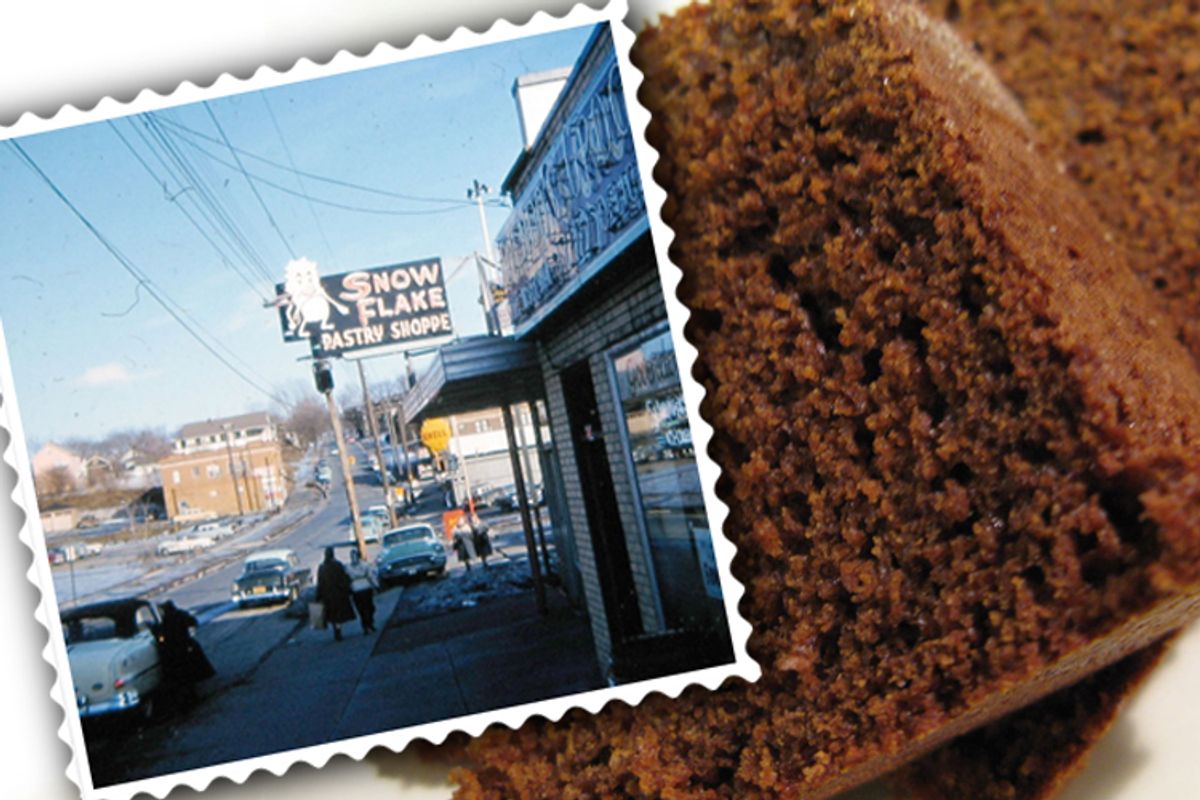
Every year at Rosh Hashana I make honey cake. Inevitably heavy and almost inedible, I imagine all kinds of ways to repair the recipe, but promptly forget about it until the next year, when tradition compels me to make another one. We never eat it, but the leftover cake, wrapped in foil, is great: As a doorstop, paperweight and, in a pinch, a substitute brick to flatten pan-roasted chicken.
It took my new Uncle Milt to fix my honey cake wrecks, but it's not often adults get to adopt new uncles. Months ago, I wrote a story featured in Salon's Food section about our family tradition of making half-moon (aka black-and-white) cookies, and I reminisced about being a kindergartner going to the Snowflake Pastry Shop in Syracuse, N.Y., to buy them. I was extra-tall then, standing in the bustle of the morning rush, lucky enough to see all the goodies in the cases without having to jump. The ladies in the white uniforms and hairnets would give me a cookie for not leaving fingerprints on the glass. I'm sure I saw owner Milt Zeigler there, but back then I didn't know him, too distracted by the cookies in the case.
Someone in Milt's family saw the article I wrote and sent it along to him, Milt's son e-mailed me, and I found myself one day on the telephone talking with Milt Zeigler, learning all about those Snowflake Pastry Shop days from the other side of the counter.
He told me about the early days at Snowflake, how it began as a family bakery in the Bronx. How his dad, Isidore Zeigler, went to Hungary at the turn of the last century to learn baking and make his own mark. How the family ran the shop for about 80 years, and how in heady times, their black rye bread was so famous that a restaurant in Alaska had it shipped and a patron recognized it just from the look and smell alone. The lines at Snowflake were always out the door early in the morning when people still went to the bakery to buy their daily bread and morning pastries.
But before long, our phone calls turned from a chance connection and stories about the old days into something else. We became friends. I started converting some of Milt's old recipes to home-kitchen proportions. He'll call without hesitation: He says hello and begins talking in the middle of a thought. Fortunately, I am pretty good at catching up. We talk about the neighborhood, about life decades ago in Syracuse, about friends and family and doctor's visits and various ailments of the day, and his wife chimes in from the background. But mostly we talk about the bakery.
As I was getting ready to work on the black-and-white cookie recipe, Milt called me out of the blue, saying immediately that I need to add five more pounds of flour to the recipe. "OK. I'll use five pounds of flour," I said. To which he replied, "No, dear. Add five more pounds of flour!" The light bulb went on. "Add five pounds to the nine pounds already in the recipe? I'm going to be making cookies for the entire city, Milt!"
He laughed. "That you are!"
And making cookies for the entire city, of course, is what Milt used to do. But the family sold the bakery in the '80s, and the sad news is that bakeries like Snowflake all over the world are vanishing one by one. Snowflake's original building has been razed. Gertel's on Hester Street in NYC is now condos. In Paris, on Rue des Rosiers, the heart of the local Jewish community for centuries, Sacha Finkelsztajn, a lone Jewish patisserie, hangs on.
I am a very lucky to have Milt just a phone call away. To be able to make authentic Snowflake half-moon cookies and feather-light honey cake? Awesome. I only hope I make him proud.
Uncle Milt's Honey Cake
½ cup white sugar
1/3 cup veggie oil
1 cup of your favorite honey
2 large eggs
1 teaspoon cinnamon
Pinch of ground clove
Pinch of freshly ground nutmeg
2½ cups plus 3 tablespoons light rye flour
4 fluid ounces water
3 teaspoons baking soda
- Preheat oven to 325 degrees. Butter and flour a large loaf pan.
- Pour the sugar in the bowl of a stand mixer. In a smaller bowl, mix together oil, honey, eggs and spices with a whisk. Add that to the sugar and mix on medium-high for a minute. In a measuring cup dissolve baking soda in water. Set aside. With the mixer on low, blend in flour. Turn mixer on high for a minute. Switching mixer to low once again, add the water and baking soda mix. Once incorporated, turn the mixer on high for about 30 seconds.
- Immediately pour into prepared loaf pan. Set cake in oven. Leave the oven door ajar on the first stop (yes, open!). Once the cake reaches a good height, close the oven door and continue baking for about 40-50 minutes more or until a toothpick comes out clean. Cool 5 minutes. Invert on a rack. Tastes best as it ages — wrap tightly and store in the refrigerator. Serve at room temperature.
To make gluten free: Use gluten-free flour instead of rye. Add ½ teaspoon xanthan gum. Add 2 tablespoons molasses to the honey-egg-oil mix.
Shares