Beer

The misogynist drinking game sweeping the nation

The ridiculous "Bros Icing Bros" frat-boy phenomenon goes viral

  • more
    • All Share Services

The misogynist drinking game sweeping the nation

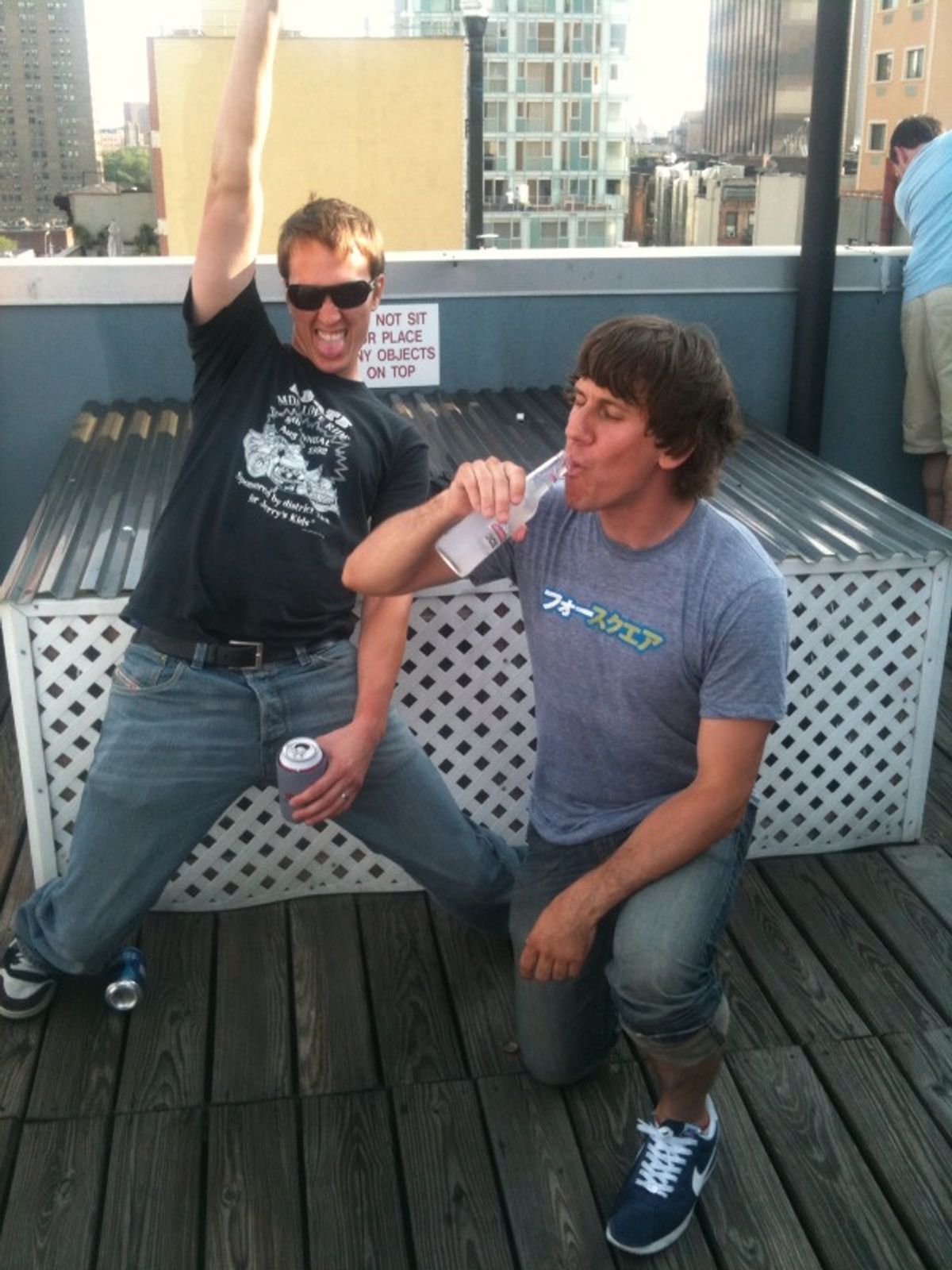
A new sport has emerged from that hothouse of juvenile drinking games known as the fraternity. It’s called Bros Icing Bros, and it’s slowly taking over the nation — well, Facebook anyway. The rules are simple: Buy a few fruit-flavored Smirnoff Ices. Present one to a “bro” in an unexpected location (handing it to him at work, say, or hiding one in the mailbox). Laugh as the “iced” bro goes down on one knee and chugs the entire 24-ounce bottle.

The game’s origins are shrouded in mystery – some say it started at fraternities in South Carolina, others say it all began at Saint Lawrence University. In two short months, though, the game has gone viral. Bros Icing Bros’ Facebook page has more than 19,000 fans, it’s been written about by major media outlets and has even spread to Wall Street, including firms like Goldman Sachs, Raymond James and D.E. Shaw

What hasn’t been remarked on in all that press, however, is the misogyny inherent in the game. Women aren’t allowed to play. It’s a strictly “bro” game. “No … anything with a vagina may not be included in icing,” says one comment on the website brosicingbros.com. The game’s premise — the thing that is cracking up all those men with popped collars — is the assumption that Smirnoff Ice is a “pussy” drink. “Thats the whole fucking point bro. No one wants to chug a fucking smirnoff ice because its for fags. It’s like getting shamed. You have to chug a fag drink in front of all your bro’s… ultimate humiliation. Any bro would want to chug a beer, but chugging a smirnoff ice is the ultimate slap in the face,” says another commenter (reminding us that misogyny and homophobia are often bedfellows). Add to this the fact that a bro must go down on one knee while drinking an Ice, and the stage is set for an avalanche of sexist catcalls every time someone gets iced. “BOOM! YOU JUST GOT ICED TAKE A KNEE AND SUCK IT DOWN YOU DIRTY GIRL,” says yet another comment.

Sure, some women have been iced. Others are mere accoutrements. “My friend has really big boobs … we iced one of our other friends by putting the ice under her boobs and she walked out of the bathroom and put her boobs in his face,” says an enthusiastic participant on brosicingbros.com. Some Ices get nestled between the breasts of strippers, whole bachelorette parties have been mobilized; surely there’s a twin fantasy in there somewhere, etc.

Of course, college fraternities inventing a ridiculous game that smacks of misogyny is hardly surprising. But it’s a shame to watch a generation of males latch on to it like the next beer pong. I guess bros will be bros.  

Exhibit A.

Riddhi Shah is an editorial fellow at Salon.

A new low for Wisconsin politics: Beer wars

Targeting public sector unions is bad enough -- but craft brewers? Does the state have no shame?

  • more
    • All Share Services

A new low for Wisconsin politics: Beer warsBeer being poured during a tour of Sprecher Brewery in Glendale, Wis.

Could Wisconsin Gov. Scott Walker really be waging war against craft brewers? According to a group of highly vocal small brewers in Wisconsin, a piece of legislation backed by the mega-brewer MillerCoors and approved last week by the state Legislature’s Joint Finance Committee will unfairly restrict the ability of small craft breweries to operate their own businesses. Walker, say the critics, is selling out the little guy in favor of an out-of-state corporation that contributed $22,750 to his election campaign.

Walker’s list of legislative priorities is famous for its radical realization of a utopian hard right agenda — lower taxes for the corporate sector, a crackdown on public sector unions, tighter limits on voting eligibility, easier privatization of state-owned assets, school vouchers, looser gun control, and tighter restrictions on abortion. So if you happen to be a beer-loving liberal hooked on microbrews, I’m sure it wouldn’t be a stretch to believe that Gov. Walker has a plan to force you to drink Coors Light until you puke.

But it also seems like a highly risky strategy. Forget about Wisconsin’s glorious labor history. Wisconsin’s love affair with beer dates back to the 1830s, when German immigrants brought their lager-loving tastes with them and ended up making Milwaukee into the beer capital of the United States. You simply do not mess with Wisconsin and beer. The entire beer-drinking United States owes Wisconsin a huge debt of gratitude: A Wisconsin senator, John Blaine, introduced the amendment that repealed Prohibition!

So what’s happening here?

According to a summary provided by ThinkProgress on Friday, the big players in Wisconsin’s beer industry, which includes MillerCoors, the Wisconsin Beer Distributors Association, the Tavern League of Wisconsin and the Wisconsin Grocers Association, are claiming that the law, which will prevent any brewer from owning a wholesale distributor, is intended to prevent another monolithic producer of watery pap, Anheuser Bush InBev, from swooping into Wisconsin and buying up distributors and creating its own local monopoly. But the law also restricts brewers from having more than one retail license to sell beer, which seems to mean a small micro-brewer would not be allowed to run more than one brew-pub to market and sell its own product.

ThinkProgress went even further, declaring that “Under the provision, it would be illegal, for instance, for a small brewer located near a restaurant to walk next door to deliver a case of beer. They’ll have to hire a middle man to do it instead.”

But that doesn’t seem to be true. Under the law, brewers who produce under 300,000 barrels are allowed to self-distribute.

What is true, however, is that nationally, the craft beer segment of the beer industry is continuing to register strong year-on-year sales growth even as the overall market shrinks — down 1 percent in 2010 after an even larger drop in 2009. Right now, craft beers only add up to about 5 percent of the Wisconsin beer market, but in the long run, taste and diversity seem sure to threaten an ever bigger chunk of the dollars currently spent on Bud Light and Miller Lite. If a group of small Wisconsin brewers wanted to get together and run their own wholesale distributor in order to compete more effectively with the big boys, the new law would prevent them from doing so.

The craft brewers are angry because they say they were not consulted before the law was sneaked through the Legislature. And it does seem odd that a governor who makes such a big deal of supporting small businesses would back legislation that restricts them from getting bigger, and potentially restricts Wisconsin beer drinkers from full access to the best brews available. What ever happened to the free market?  But blaming this particular piece of legislative maneuvering solely on Walker seems misplaced. The Joint Finance Committee voted 14-2 to approve the legislation — only one Democrat and one Republican opposed it. Apparently, in Wisconsin, when MillerCoors talks, everybody listens. 

Continue Reading Close
Andrew Leonard

Andrew Leonard is a staff writer at Salon. On Twitter, @koxinga21.

How to enjoy your beer

Experts teach us ways to savor the drink that too often gets mindlessly chugged

  • more
    • All Share Services

How to enjoy your beer

Most of us know you’re supposed to swirl and sniff a big California Cabernet in a giant wine glass, or linger over a smoky Scotch in a snifter. But when it comes to our beer, we’re clueless: We chug our bottles ice cold and let our suds sit around in a plastic pitcher. “With beer it’s often drinking without thinking,” bemoans Ray Daniels, a former Chicago home-brewer expert who runs Cicerone, one of the country’s only beer sommelier certification programs. “We turn our analytical minds off when we drink it. But every beer tells a story,” he adds. “It has a beginning and a middle and an end.”

Daniels is not talking about cheap six-packs, of course, but craft beer, the modern term for brews designed to be delicious. Daniels’ job is training beer professionals how to taste those suds, and how to tell their stories. And step No. 1 for us amateurs, he’d likely tell you, is to take that bottle or can out of the ice-crammed cooler, and pour it into a glass.

What’s That Smell

That’s because 85 percent of what we describe as “flavor” is actually aroma, says Daniels, and if your beer is too cold or trapped inside a bottle, most of what you perceive as taste isn’t free to float into your nose. That all-important organ can process hundreds of chemical compounds in beer from the malt, hops, yeast and spices, he says, while our mouths can handle just five: sour, sweet, salty, bitter and the newly discovered umami. (Or maybe it’s actually eight: Modern scientists, says Daniels, are starting to think fat, carbonation and metallic should get added to that list one day, too.)

Smelling is so important to beer professionals that Daniels can define different approaches to the technique. One colleague does the Drive-By, swirling her beer to first release aromatic properties like piney or toasty or nutty, then waving it under her nose in one swift move. Daniels sticks his nose deep into the glass and take many short sniffs, an approach he’s christened the Bloodhound. “Beer judges,” he admits, “always have little specks of foam on their noses.”

Think Deeply

As an ordinary drinker, you might not end up with foam on your face if you sit through one of Greg Engert’s tasting dinners, but you will be encouraged to sniff and think, if only because it forces you to enjoy your beer more fully.

Engert is the beer sommelier at the two-story Birch & Barley in Washington, D.C., which has a 120-page manual for staff, stocks 50 draught lines and 500 bottles, including some aged in-house. (Yep, they do that for beer, too.)

At Birch & Barley beers are held at three distinct temperatures designed on what works best for enjoying the beer, all of which are served in glassware designed to accentuate their charms. The crisper, lighter and less aromatic in general — e.g., an-all American lager like Budweiser — the colder you should serve it, and in a tall straight-sided glass. (You can find a list of proper glassware at BeerAdvocate.com and a discussion of beer temperatures are RateBeer.com.)

At Engert’s tastings, budding beer aficionados are taught to swirl, sniff, sip and swish the brews around their mouths, breathing back in as they swallow. That’s to get what Engert and Daniels call retronasal smelling, the technical term for the aromas that you can only pick up at the back of your nose and throat.

But beyond all that facial exercise, what Engert really wants you to do is pay attention to what you’re smelling and tasting and feeling. To help you parse your palate, he hands out scorecards and talks you through characteristics from beer color (“is it brick or tawny brown?”); to flavor (“is it tart and crisp?”); to characteristics of malt (toasty, caramelly) and hops (pine, oregano) to mouthfeel (silky, oily, airy, hollow).

Go Back to Grade School

Of course it’s one thing for a beer sommelier to prompt you with a cheat sheet of possibilities; learning how to describe what you’re experiencing on your own is ultimately the hardest part of tasting. That’s why one of the key components of the sensory training program at Colorado’s New Belgium Brewing Co. is building vocabulary

Designed by head brewer Lauren Salazar, the program consists of a 45-minute session each week that in part teaches staffers how to talk about beer from a professional standpoint. When they start out, says Salazar, invariably they just want to say a beer is “good,” or “yummy.” But what she needs to know is does that mean caramel-toasted malt, black jellybean or green apple?

“I’m not your mother,” jokes Salazar. “I don’t care if you like it. I want you to tell me what it tastes like.”

One way Salazar helps trainees do just that is to isolate one flavor characteristic at a time. Trainees taste it over and over again, while simultaneously talking about what compound — freshly cut grass, resin or orange peel — they are experiencing, just like when you were memorizing colors and letters as a grade schooler.

“Aroma is on one side of your brain, and lingual is on the other side,” she says, “and we’re just not really wired to talk about these attributes, so you have to learn them, talk about them, say them again and again and make these long-term memories. It sounds like you’re in second grade,” Salazar admits, “cause you kind of are.”

(Note that for professionals, not all of these flavors are good ones. Some are downright awful, like sulfur or wet cardboard. In the beer geek world, these are known as defects, and they’re critical to detect before a beer is served; in fact the majority of Ray Daniels’ coursework is training tasters how to spot them.)

Drink Beer, a Lot

Tasting and talking and talking and tasting is pretty much how Mary Izett, a member of the New York City Homebrewers Guild, mastered her own certification through the Beer Judge Certification Program (BJCP), except she did it mostly by talking to herself.

Similar to Cicerone, BJCP is focused on training judges for home brew competitions. When Izett started out in the program in 2002, she went out for beers nearly every day, toting around the 50-page BJCP complete guide to the beverage. That mammoth printout listed beer styles from IPA to Pale Ale, to Belgian to English brown and Baltic porter, as well as how to describe the characteristics of hops, malt and yeast you’d find in each one.

“I carried that thing around with me every day,” sighs Izett, “and I compared every beer I drank to it for months.”

These days, not surprisingly, she has a version on her iPhone available for free from bjcp.org. So yes, when it comes to learning how to taste beer, there is now an app for that.

Continue Reading Close

Do we need a gender-neutral beer?

Carlsberg introduces a sleek new line of brew to appeal to both sexes -- because regular beer was just too manly?

  • more
    • All Share Services

Do we need a gender-neutral beer?Carlsberg Copenhagen: a beer that won't get your panties in a bunch.

Everyone knows that men drink beer for its fine texture, its smooth, deep complexion, and a third thing. Meanwhile, us women drink beer when the bottle matches our dresses and brings out our eyes, or when they run out of kamikaze shots at the sports bar we’re sitting in, trying to meet men.

That was actually supposed to be a joke, but then I read the thought process that went into designing the new Carlsberg Copenhagen, a beer designed to appeal to both men and the little ladies:

“We can see that there are a number of consumers, especially women, who are very aware of design when they choose beverage products,” Jeanette Elgaard Carlsson, international innovation director at Carlsberg, says on the brewer’s website. “There may be situations where they are standing in a bar and want their drinks to match their style. In this case, they may well reject a beer if the design does not appeal to them.”

Strangely, Carlsberg designers forgot the most important part when creating a beer for the fairer sex, which is that it must have zero calories and taste like carbonated strawberries.

To get both men and women on board, the Denmark company created a drink that looks half like a Corona (currently the only beer enjoyed by by women, besides Miller High Life), and half like something fancy you’d drink in Europe. (Women love Europe!) Then throw a bunch of vague adjectives that men think make the beer sound “sexy,” and women will think applies to them while drinking the beer. Voila! Gender neutral suds!

See, ladies, in this scenario, you are what you drink. Easy to embrace. A natural beauty that needs no makeup. Blond is the new black (sorry, brunettes!). This beer is speaking to your style, girlfriends!

Guys, you can continue to drink whatever is cheapest or tastes best.

Continue Reading Close

Drew Grant is a staff writer for Salon. Follow her on Twitter at @videodrew.

Beer-braised sausage and kale pasta

Best served hot, maybe after a snowy trek through German forests

  • more
    • All Share Services

Beer-braised sausage and kale pasta

This entry to the Salon Kitchen Challenge comes to us courtesy of Dave Copeland. We haven’t had a chance to try this recipe yet, but would love to hear about it if you do! 

This is a play on Gruenkohl und Pinkel (kale and sausage), a North German specialty traditionally served after “Gruenkohlfahrt,” which is a brisk hike accompanied by schnapps and followed by a meal with a dish similar to this one as a way to celebrate winter.

I’ve combined it with another kale and sausage recipe that uses pasta that I like to have on nights before winter days when I know I’ll be spending a lot of time outside being active.

Beer-braised sausage and kale pasta

Serves 4-6

Ingredients

  • 1 pound spaghetti
  • 1 white onion, chopped
  • 4 sausages, flavor of your choosing (except breakfast sausage), meat removed from casings, if applicable. Otherwise, slice into bite-size chunks
  • 5 cloves garlic, minced
  • 1 pound kale leaves, washed, center ribs removed, loosely chopped
  • 1 12-ounce bottle dark beer (porter, stout or dark ale)
  • 1 tablespoon mustard
  • 1 cup freshly grated Parmesan
  • Olive oil, as needed
  • Salt and pepper to taste

Directions

  1. Heat olive oil in a Dutch oven over medium-high heat and brown sausage meat, breaking up with a wooden spoon.
  2. Remove sausage and add onions and sauté until soft, about 5 minutes.
  3. Toss in garlic and heat until aromatic (do not let garlic burn).
  4. Add kale; it will fill up the entire pot but will wilt quickly and significantly as you stir. Drizzle in a little more olive oil if necessary.
  5. Add sausage back to pot, add beer, bring to a boil and turn down heat to medium-low. Cover and cook for 20 minutes or until kale is tender.
  6. Meanwhile, prepare spaghetti according to package directions until al dente.
  7. Stir salt, pepper and mustard into kale.
  8. Stir in freshly grated Parmesan to thicken sauce.
  9. Toss in pasta and allow it to finish cooking in the sauce. Serve in warmed bowls, garnished with parmesan, salt and pepper and a drizzle of olive oil.
Continue Reading Close

San Diego to consider banning offshore boozing

The City Council will look into closing a loophole in ban on beach drinking. People on boats exempted

  • more
    • All Share Services

The City Council will consider letting the air out of “floatopia” parties that involve thousands of people boozing it up on inner tubes just offshore.

The council was scheduled to meet Monday to consider closing a loophole in the city ban on drinking at the beach.

An amended version would ban seagoing boozing by floaters, swimmers, waders and bodysurfers up to three nautical miles offshore. People on boats would be exempted.

The council could pass the measure on an emergency basis, allowing it to take immediate effect.

Since the alcohol ban took effect on Jan. 1, 2009, people have skirted the law a handful of times by gathering a few feet offshore in Mission Bay on inner tubes, surfboards, rafts and other floating devices.

Parties advertised online through Facebook and other social network sites have drawn thousands of mainly college-aged revelers. One event in March drew as many as 6,000 people.

There haven’t been any drownings but police and lifeguards said they have made dozens of rescues and spent more than $20,000 policing the floatopias. Lifeguards said several people had to be taken to the hospital, and in one instance a man almost drowned because he was so drunk he couldn’t stand up in shallow water.

Councilman Tony Young, who didn’t support the original alcohol ban, said he isn’t surprised the crowds found a way to circumvent the law. He supports the latest proposal but wants to be careful about over-regulating the public.

“In some ways, we’re responsible for this because we have created a situation where individuals felt that they had to do this,” Young said last month at a council public safety committee hearing.

Councilwoman Marti Emerald said the council had to act because the parties are a public safety risk.

Continue Reading Close

Page 1 of 5 in Beer