TMI

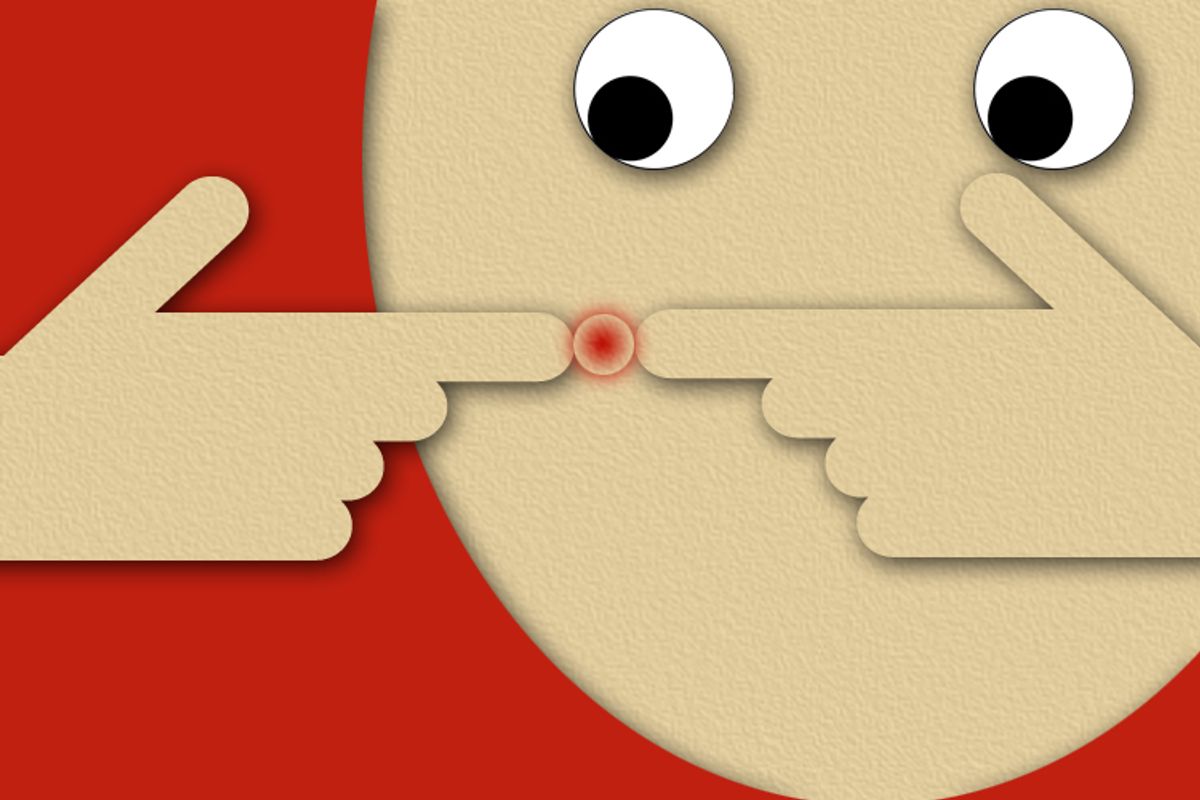
The secret life of pimple poppers

It's a social taboo -- but why is it all that different from blowing your nose? Salon investigates

  • more
    • All Share Services

The secret life of pimple poppers

I have a friend with whom I often discuss things I don’t discuss with anyone else. Bowel movements, infections, bodily fungi — it’s all fair game with him. But just the other day, I mentioned that I’d popped a large pimple on my back. A back-juicer, I called it. “Dude,” my friend said to me, “that’s gross.”

On one hand, I understood. On the other, who hasn’t popped a pimple? Who doesn’t get a painful little prick of satisfaction from doing so? I didn’t see why my revelation deserved such a disgusted reaction. In our current gross-out moment, when Lady Gaga’s labia can become water cooler fodder, when Tiger Woods’ golden shower-related texts are read by millions, and when there are popular websites — and best-selling books — devoted to excrement, pimples reside firmly in the socially radioactive TMI zone. Discuss at your own peril.

For most of us, that is. Just below the mainstream lies a thriving pimple-popping culture. On YouTube, graphic videos of people squeezing impressive pimples (or sometimes having the zits squeezed for them) earn hundreds of thousands of views. These clips have no narrative or context. If they were pornos, they’d be all money shots. Facebook groups are devoted to the topic (check out “Feeling Satisfied After Popping the Biggest Pimple“).

Outside the fetish cornucopia that is the Internet, though, pimple popping hides in plain sight. We see the effort put into pimple popping all the time: The dude in the next cubicle with the scabby blemish on his face; the sunbathers at the beach with acne scars dappling their shoulders. Yet we never bring up the subject the way we do with other similarly icky biological matters. Why is it socially acceptable, if indelicate, for someone to sit beside you on the bus and blow thick streams of snot into a thin tissue but verboten to pop a pimple in public?

“Trying to determine why we have such a negative view of pimple popping is almost an existential question,” says Mark Bowers, a pediatric psychologist based in Ann Arbor, Mich., who has written about acne-related pathologies. “I think it has to do with societal norms, and who’s to say why those are what they are? Why is it OK if I raise my ring finger at you, but not my middle finger? Similarly, blowing one’s nose in public is acceptable, but there’s no place for pimple popping. I don’t know that there’s a ‘good’ explanation for why that is.”

The virtuous killjoys on the Mayflower could surely hazard a guess: Pimple popping arouses our puritan streak. We’ve all heard the old wives’ tales about where pimples come from: eating too much candy, touching one’s face with greasy hands, not washing enough — all the habits of an individual with a weak, decadent will.

If acne-sufferers are bad, poppers are even worse. They can’t keep their hands off themselves long enough to heal. Instead, they feverishly work at a sensitive part of their bodies, usually when no one’s around, increasing the tension until it’s resolved in explosive fashion. (Remind you of anything? In his 2007 novel “The Flawless Skin of Ugly People,” author Doug Crandell created a protagonist who could not leave his pimples alone, a sign of his own self-destructive impulses.)

There’s also a contradictory element of self-improvement and unintended defacement to pimple-squelching. We scan our faces in the mirror looking for blemishes, and then try to fix the ones we find — only to create scabs and swelling. The pursuit of satisfaction is at the root of both motivations.

“I feel like I’m doing my body a justice when I do it,” says Liam Buckley, an 18-year-old from Edinburgh, Scotland, and longtime acne sufferer. “I enjoy it — not in a disgusting way, mind you. In my experience my acne heals faster when I do it. Popping is fun because it makes you feel like you are beating the acne. I’m almost 100 percent clear now.”

“Pimple popping offers instant gratification,” seconds Laura Cooksey, who “pops pimples all day long” as an aesthetician at the Face Reality acne clinic in San Leandro, Calif. “People find it pleasurable the way that having your legs waxed is pleasurable. It can be uncomfortable and sort of nasty — we’ve all been grossed out when the pus hits the mirror — but you’re doing something that can help you toward your goal of clearer skin.”

For Cooksey, prowess at pimple popping, which in the dainty parlance of her trade is called “extraction,” is also a matter of professional pride. “Any aesthetician worth his or her salt likes to do it.” Certainly there are some parents, amateur aestheticians of the world that they are, who understand.

Despite what you may have heard, pimple popping isn’t necessarily bad for you. “It can definitely be helpful, you just have to know the right way to do it,” says Dr. James Fulton, a fellow at the American Academy of Dermatology. “The problem is that people get neurotic about it and pick and pop before the pimples are ready. You have to have the patience to wait until you can see the whites of the pimple’s eyes. If everyone followed that advice, we would see less acne scarring. But not enough people have been properly educated.”

To help spread the gospel, Daniel Krebs of Acne.org, which draws 1.2 million unique visitors a month, has posted a “how to” guide. “Look,” he says, “if people have a big pimple staring at them in the mirror, they’re going to pop it. That’s the reality of the situation. So I think it’s only right that they have the opportunity to learn the most gentle and effective way of doing it. If you happen to enjoy it, more power to you.”

There’s nothing to be ashamed of. Surely, even the most easily queasy among us can admit that as an activity, pimple popping (when not done neurotically) is not that different from, say, cleaning one’s ears.

“Pimple popping is only troublesome if it becomes pathological,” says Bowers. “That is, if it’s disrupting your day-to-day functioning. Otherwise, it’s not something that has to be understood as problematic or off-putting.”

“And anyway,” he continues, “there’s way grosser stuff out there.” 

David Marchese is associate music editor at Salon.

Why I turned down the threesome

My freewheeling wife wanted a tryst with a hot European woman, but I couldn't do it. Was I just being a coward?

  • more
    • All Share Services

Why I turned down the threesome

In 2009, I had a fight with my wife, Raquel. It was “Lord of the Rings” epic. Like most fights between couples, it was complicated and scary and boring in its details. Unlike most fights between couples, it was about a ménage à trois. Raquel wanted to have one. I did not.

Raquel is bi in a big way. (Raquel is not her real name, by the way.) We’re monogamous in our marriage, but before we met, she’d made hot tub love to another girl, made out with girls onstage at Anal Blast concerts, had her own “Bound” experience with her girlfriend and said girlfriend’s husband. She currently does ample work as a fetish model and performs as a scream queen, doing “B” movies with titles like “Bad Girls Burn in Hell.”

I, on the other hand, am a bit of a prude. I grew up square in the Bible Belt and didn’t even know what fellatio was until I was 22. I lost my virginity at 26 and married the girl I lost it with. Even now, after being with Raquel for four years, I stand in the bedroom doorway, shyly toe the carpet and ask her if she wants to “experience sexualities.” And yet, our relationship has worked, ever since we first met in 2006 on a writing website by bonding over “Titus Andronicus” and Harry Potter. I’ve grown accustomed to Raquel’s freewheeling lifestyle. Not long ago, I found myself backstage at a lingerie show, surrounded by naked lovelies and a drag queen named “Bitch Flowers” performing as MC, when I realized just how far I’d come from my fundamentalist roots.

Still, I have my limits. When my wife informed me a gorgeous European girl named Yasmin (also not her real name) was going to be crashing with us for a week, right around my 29th birthday, I worried that she had ulterior motives.

“Do you think Yasmin is hot?” I asked Raquel.

She nodded. “Do you think Yasmin is hot?” she asked me.

I nodded. (Hey! I may be embarrassed by my penis, but I still have one.) Yasmin had a body that was pure Botticelli and a temperament like a tidal wave. There was no resisting her. This was the dream girl for every Yank who’s ever traveled through Europe, hoping to run into Julie Delpy. Yasmin is also bisexual.

“Would you like to have sex with Yasmin?” I asked.

Raquel nodded eagerly.

“Would you like to have sex with me and Yasmin at the same time?”

Another eager nod of the head. 

I know this is the stuff of movie fantasy, but I wasn’t turned on. I was furious. I was deeply hurt. I sputtered my defense: When you’re in love with someone, it’s not just sex, it’s a communion of souls. It’s intimacy of the purest kind. You’re not just baring your privates. You’re baring everything. Why would Raquel want to share that with someone else?

Now, before you tell me I’m some sentimental wimp, or some puritanical zealot, I am well aware that it is healthy for people in love to have fantasies about other, often far more famous, people. I get that. Raquel has a thing for Ewan McGregor, James Franco and Leonardo DiCaprio. Good for her! I have a thing for Jenny Agutter and Jenny Wright (and maybe for Leo, too). But things get messy when a raunchy fantasy becomes reality. It’s one of the messages of “Chasing Amy”: Threesomes are a bad idea. And this is from the guy who gave us ex-porn-star Traci Lords blowing bubbles out her who-who place.

But my anger about the ménage à trois surprised me. I took a hard look at myself in the bathroom mirror: What was wrong with me? Was I just too uptight? Was I too paranoid of losing the love I never thought I’d have or deserve?

My views on sexuality, of course, were forged by a conservative upbringing. And while I don’t believe in God anymore, I am still a big believer in C.S. Lewis’ book, “Four Loves.” For Lewis, romantic love is divided into two categories, Eros and Venus. Eros is that feeling of being cosmically attuned to another person, while Venus is the urge to get into their pants. I can feel Venus for any woman, but Eros is something special, something I can only feel for Raquel. But feeling Eros for her, I don’t want to experience Venus with anyone else.

The other thing that’s shaped my definition of love is my mental illness. I have intense OCD, and it makes socializing difficult. Being around other people freaks me out. An obsessive-compulsive’s life is defined by rituals and routines designed to prevent anxiety. I check to make sure the front door’s locked 52 times before I go to bed, so I can sleep in relative peace. But socializing is made up of hundreds of rituals and routines and they all cause anxiety. Hell, the number of rituals I had to go through to overcome the anxiety of just one socializing ritual — it really wasn’t worth it.

Like most obsessive-compulsives, I am terrified of touch. The only other woman I’ve been with besides Raquel I kissed a grand total of three times in two years. Just holding this poor woman’s hand was agony for me.

I’d lie awake in bed every night, dreaming of that perfect girl who would change everything for me. I didn’t really believe this dream would ever come true, but then I met Raquel. I’ll never forget the first time I made love to her on the linoleum floor of her Minneapolis home. It was the most natural thing in the world. I have never flinched from Raquel’s touch. I truly believe our relationship is the greatest argument for kismet. We shouldn’t be, but here we are.

So Raquel is my Eros and my Venus. She’s the answer to all those pathetic, sleepless nights of longing. With her by my side, I doze peacefully. I sweetly, simply love her. Only for her would I move 2,000 miles away from everything and everyone I’ve ever known to live in Los Angeles. Only for her would I write a love ballad and sing it to her at our wedding in front of 200 people.

Which is why I was so hurt when she wanted to have a ménage à trois with another woman. After all I’d been through to find her, I couldn’t believe she wanted to share me with some hottie she met on Facebook.

But Raquel isn’t me. She understands my pain, but she’s not burdened by it. She loves me. Sweetly, simply. In fact, she feels Eros for me so much that Venus doesn’t really matter to her all that much. For her, having some threesome with a Facebook friend would never endanger what we have because her love for me is so huge; sex with a stranger means nothing. It’s like worrying about a speck of space dust altering the orbit of a planet.

The next day at work, I couldn’t get the dilemma off my mind. I finally sought counsel from one of my female co-workers, a mother of three working toward her R.N. When I showed her one of Yasmin’s modeling photos, her eyes grew wide. “Hell, I’d do her if I were you.”

What the hell? As we continued to talk, I discovered that not only had my “staunchly heterosexual” co-worker dabbled in lesbianism, but she’d carried on an affair with a female co-worker. A manager, no less! I went home feeling more dejected than ever. How did everyone get so naughty, while I stayed such a prude? Was my fixation on having this pure and perfect love keeping me from having some fantastic experience with the woman I love? Was I a true romantic — or a total coward?

My birthday came. I turned 29. Raquel “sprang” her gift on me. Yasmin cornered me in the kitchen, asked me if I wanted to have a threesome. I ignored the question. When they asked again, I stalled and said let’s do it in the morning. When they came in to ambush me the next morning, I pretended to be so deeply asleep, I couldn’t be roused. I didn’t say yes and I didn’t say no. I just let the opportunity pass me by.

I can imagine envious males reading this and shouting at their computers, “Are you insane? This is every guy’s dream!” Maybe it is. But I’m not every guy, and I don’t ever want to be.

And this is the only truth that matters: I am loved. I am lucky that I have someone who would share me with another girl and think nothing of it, because no matter what happens, she knows I’m hers. Would a threesome have been fun? Maybe. But there will be other risks, other thrills. Every day is full of discoveries with Raquel. And love is constant.

Joshua LeSuer is currently working on a memoir.

Continue Reading Close

Joshua LeSuer is working on a memoir about overcoming OCD.

My life cruising online

As a gay man, my dating world evolved on the Internet -- from the innocence of AOL to the desperation of Manhunt

  • more
    • All Share Services

My life cruising online(Credit: Jon Schulte)

Pointiest logo ever; every element ends in a sharp edge, even the cursive; also, eerily reminiscent of the Eye of Providence symbol (i.e., God) on the dollar bill

I. To preserve my sanity between sophomore and junior year of high school (defining “sanity” loosely here), I moved out. Out of the small back bedroom where I shared a bunk bed with my brother, to a futon in the sun room of our house — a converted porch, actually. Privacy was my main concern, but an added bonus was the old family computer gathering dust in the corner of my new room. Unbearably slow as it was, late at night after I closed the French doors (ooh la la!) to the living room and drew the curtains to the backyard, I could go online, muffling the sound of the 56K modem with a pillow, and surf the Web unmolested and unafraid.

The thing is, I never really got to the Web, proper. I never left AOL, heading right for the chat rooms night after night. Men4men was my go-to room. Guys would send their stats or whatever they were looking for into the public window in sporadic blasts, and the real exchanges would follow in one-on-one sessions. “17yo closeted student in Texas here,” I’d post, and the replies would trickle in. “Where in TX?” and “What are you wearing?” popped up a lot. I’d settle in with the most enticing, least pompous screen name, and my messages went like, “I just want so badly to feel another guy’s skin,” or “I wonder what it’s like to kiss and hold someone I like.” Just articulating what was in my teenage head. I had to get up for school the next morning, so it never went much further than that.

“Fun,” friendly logo; huge fad to have no spaces between words; notice the P and the O in the shape of a weirdly elongated ringed planet? I did, at 17.

II. Once I got to college in New York, I didn’t fear (as much) a wrathful backlash if someone from real life found me out online. Planet Out seemed the most trustworthy mainstream portal, so I posted a profile. No picture yet, just “College guy new to the city, looking for chat, friends, maybe more.” I was nervous about that last bit, an enticement to I didn’t know what. I soon found that no one, or only the crazies and desperates, respond to pictureless profiles, so I posted one with my face cropped out. That got me only crotch shots in return, so after a week I added a grainy obscure portrait.

This led to my first date — really just a hookup without sex or even much kissing (does that still count?). One lonely Friday night a guy who lived not far (my ZIP code was in my profile) posted a “like” to my page. We chatted maybe 20 minutes before exchanging more photos via e-mail. “Yr cute,” he wrote. “I’m Bored.” “Me too,” I typed. “Wanna come over and hang out?” I walked the seven blocks to his walk-up apartment. A photographer in a tiny studio crash pad. We sat on the edge of his bed (no couch), he offered a beer, and I talked, knees shaking, about not really being out yet.

The groping and kissing was awkward, me wanting both everything and nothing to happen. Not a button or zipper was undone. I started backing away when his hand ventured too far, and his tongue pushing in deeper made me feel weird about what I was doing. Giving some awkward excuse, I walked quickly back to the dorm.

“Straight” from the all-lowercase logo craze; spaces between words still a big no-no, they couldn’t even live with the space of a period — had to close it up even more, with the overlap on the C.

III. Later in college, gay.com released a revamped messaging service, which made it easier to “preview” guys and weed out bad matches ahead of time. I should also say at this point: This was it for me in the dating department. There was no meeting guys around campus, no striking up a conversation with someone in the cafeteria, no clicking with a friend of a friend at a party. School was all work, all study, all the time, and my budding (stunted?) sexuality only came out at night, back home in the dark, in front of the glowing computer screen.

With gay.com messenger, I could swiftly click on guys who popped up to see their photos, profile and stats, and decide off the bat whether I was aroused. Meeting guys in real life if the chat went well now felt more possible, so sometimes these messenger exchanges turned into hours-long sagas as I figured out whether I really wanted to meet up, and how in the world I would ask.

One guy — another college student — I met at a coffee shop where we nursed cappuccinos and smiled, blushing, into our mugs. We walked back to his place and sat awkwardly with five inches between us, looking up the walls, until he made the first move. I ended up sleeping over. We never got out of our underwear, and our hands never reached past our belly buttons.

Can you count the number of outline effects applied to those letters? Jeez.

IV. After college I dated more — nothing too serious, but a couple of months at a stretch here and there. In between times — being a young, broke, entry-level employee — I started doing the math: Going out to a club and paying the cover charge in order to meet guys in the crowded darkness, or buying enough drinks at a bar to where my inhibitions would be sufficiently lowered to actually uncross my arms and speak up, versus logging onto the Internet for free, with the same goal in mind.

The dating profiles and message boards felt stale by now — hard to get excited about anyone after so many misfires — so I cut to the chase and logged onto Manhunt. No pretense here about just wanting to chat, or find a nice date, maybe an LTR (long-term relationship), or not being hell-bent on getting laid by the end of the night. At sign-up you filled out fields for interests (1-on-1, group sex, PNP [party and play, meaning get high and fool around]), availability (right now, later tonight), and preferred ambience (your place or mine).

Turns out, the efficiency of this setup killed it for me. Even when guys were remotely attractive, with everything spelled out ahead of time, hookups felt mechanical, like shooting fish in a barrel. Everything prearranged. Seeing all the goods upfront meant that there were no surprises later. Nothing was more of a turnoff. Wait — I take that back. More of a turnoff was seeing a college professor on Manhunt, and being propositioned by said professor. (Please, God, tell me he didn’t recognize me, and reach out for that very reason.) Whether scoring or just jerking off by the end of the Manhunt sessions, I inevitably felt dirty afterward.

We’re not even going to talk about the spelling on this one, but what in the world is that gay flower about over the i!? Wait — I may have just answered my own question.

V. A couple of years after college I moved to Helsinki for work for six months and was back to square one, dating-wise. Not a gay friend to speak of, three lame gay bars in the entire country, and none of my go-to Web sites were of any use there. Oh, and I didn’t speak the language. After an exhaustive search, a profile site called Qruiser seemed the most popular in the Scandinavian/Baltic region, and I listed myself as “American Dude in Finland.” What impression did this give a local? Sexy foreigner? Lame outsider? I have no idea. Though a handful of message exchanges lasted a few days (rarely getting past “Hello, what are you doing here?”), the best match was a pilot out of the Netherlands who regularly flew to Helsinki, and wouldn’t mind getting together at the hotel near the airport on his next stopover. It never happened. I fared better (barely) in Helsinki’s gay bars.

I don’t understand the star at all. And the D? Were A- B- and C-list.com already taken?

VI. Back stateside, the online scene had evolved while I was away. I happened upon a sort of Facebook for homos: D-List. So much about the site seemed asexual, trying to keep up the pretense that this was a “social network,” not a hookup site. I never came across a real-life friend on D-List — no one was searchable by their actual name — but the site had a surprising number of good-looking guys not listing their size in inches, and far fewer erect cocks ramming into the camera in photo galleries (as seen constantly on Manhunt).

One D-List meet-up went better than I had expected. We agreed to meet at a local gay bar/dance spot on a Saturday night. He was with a group of friends, I was alone. We passed each other a couple of times among the crowd and on trips to and from the bar, but didn’t stop to speak. I’d recognized him at first glance. I figured he either didn’t recognize me from my photos, or recognized me and wasn’t interested in person, so was ignoring me and getting on with his night. At last we came up against each other on the edge of the dance floor and started up a conversation. He thought I was giving him the same treatment — the not-recognizing/not interested thing. At last call, we walked back to my place.

When that relationship went south a couple months later, I didn’t go back online. I felt over it. Better, I thought, to try more seriously meeting guys for real — in real life — for a change.

Erich Nagler is a designer and writer based in New York City. He can be found at www.designmeans.com.

Continue Reading Close

Erich Nagler is a designer and writer based in New York City. He can be found at www.designmeans.com.

I’m done writing about my sex life

It was a great way for a young woman like me to get published. But the cost of sharing sordid tales became too high

  • more
    • All Share Services

I'm done writing about my sex life(Credit: Alex Timaios Photography)

When I lost my virginity my freshman year of college to a 24-year-old alum who still lived in his parents’ house, I remember staring at the portrait of the Virgin Mary hanging on his folks’ bedroom wall, the slight ache between my legs, the gasping breath of the guy lying next to me, and realizing: I am going to write about this.

And four years later, in a teen magazine, I did. It was my first published piece, and it confirmed what I’d always suspected about writing: Sometimes, in order to be successful, it helps to get a little slutty.

Publishers have long been partial to young women willing to open up about their private lives in memoir or thinly veiled fiction, from Erica Jong’s “Fear of Flying” to Elizabeth Wurtzel’s “Prozac Nation” to Emily Gould’s “And the Heart Says Whatever.” After Jezebel ran an item that detailed a Duke graduate who created a PowerPoint detailing all the men she slept with, agents and editors pounced, comparing her to a female Tucker Max and praising her self-empowerment. The woman in question may be humiliated now, but trumpeting her sexual conquests opened doors that would have otherwise remained closed — should she take advantage of it? For that matter: Should I have?

I graduated from Barnard in 2005, steeped in the era of “Sex and the City’s'” do-me feminism. Sex wasn’t just material for liveblogs and anonymous erotica, it was fodder for book deals and professional attention. From the highly sensational romans à clef like Jessica Cutler’s “The Washingtonienne” to a “literate smut” website like Nerve.com to the fact that “sex columnist” was a viable career path many friends aspired toward. We got the message: Sleep around, write about it, become someone. I spent every creative writing workshop chronicling the conquests I’d made at the dive bar down the block and wrote an American studies paper about the observations I’d made at a swingers club. I was quite literally embedding myself in self-exploration, hoping that coupling up would lead less to romantic connection than to crafting a cool, confident girl-about-town persona that would help me stand out in a city of strivers.

After college, I dated around, but I wasn’t looking for love, I was looking for experiences. I’d do anything — or anyone — if that could somehow translate into a moment of transcendence worthy of writing about. In writing and in dating, I felt like I was cute-ish, talented-ish, smart-ish. This wasn’t low self-esteem so much as reality in an exceptional town like New York. And I needed to find some way to stand out. I guess mine is an old tale of being just another young girl who comes to the city, willing to do whatever it takes to get noticed, giving whatever she needs to give of herself to succeed; I just didn’t think that was a career path that would affect writers.

But in an economy where nearly all creative types are struggling, highly confessional essays about sex by young people — in particular women — are one of the few reliable markets for a newcomer like me. Websites like lemondrop.com, YourTango.com, TheFrisky.com, and HappenMag.com traffic daily in tell-all, highly confessional essays by barely adult writers. Meanwhile, traditional magazines like Marie Claire, Elle, Self and GQ often run revealing essays about love and lust. And then, of course, there’s the New York Times “Modern Love” column, perhaps the apotheosis of romantic oversharing. I wrote for a bunch of these outlets (sometimes under my real name, sometimes using a pseudonym), including a piece about a casual encounter gone awry (“Modern Love”), my tendency to Google-stalk dates (TheFrisky.com) and even an essay for Salon about how I think weddings are prime hunting grounds for finding a no-strings-attached fling. And reading other people’s work in these outlets, I feel a kinship with the writers, whose best work did what great writing should: make sense of the baffling world, help me feel less alone. The essays are navel-gazing, sure, but they’re also earnest and yearning. And sometimes, they’re simply a plea to the universe to be recognized as a writer, even if it does mean your audience knows how many people you slept with and whether you shave or wax.

As a writer, I was adventurous, with a flair for drama and an eye for detail, three qualities that made it easy to write about sex. Sometimes, I felt like I wasn’t living my life so much as directing it, especially on a Friday night when I zeroed in on a guy at the opposite end of the bar. Following a new acquaintance up the stairs to his apartment, holding his hand and feeling the rush of too many drinks in my brain, sentences would already begin to form in my mind — as calm, detached and sober-sounding as the narration in a public television documentary.

“Do you remember how you kept stopping me to ask how things felt? I’ve never been asked to do color commentary on sex before,” a man said the next morning as he walked me from his apartment to the subway stop.

“I’m a writer,” I said with a shrug. I was embarrassed at how obvious I’d been, as if I were spoon-feeding him lines I could later use, carefully constructing the scene. Which, of course, was exactly what I was doing.

And the comments I got from editors — “good, but needs to be dirtier,” “more details!” “really make the power dynamics stand out” — started to seep into my dating life, where I began suggesting sex in bar bathrooms or sex while his roommate watched. The promise of publication was like a drug, and the more attention I got, the more I wanted.

“You’re not Carrie Bradshaw,” a therapist told me one time, when I told her about the man I’d met at a downtown party whom I’d accompanied home. He asked if I’d mind if he hit me in the face while we had sex, and I declined, mainly because I was interviewing for jobs and wouldn’t know how to explain the mark.

“I know,” I said. Carrie Bradshaw never would have done that anyway. I was more extreme than she was. And I had no intention of stopping. For one, the occasional paycheck that came from a published piece went toward my credit card debt, allowed me to buy more beer that would lead to more alcohol-infused encounters, gave me the money I needed to buy a triathlon bike. Some of my friends sold plasma or donated their eggs or surreptitiously took hardcover books from their publishing house jobs to sell at a used bookstore, and my sneaky way of padding my income was more responsible, less painful, and it boosted my résumé. Was I being “self-objectifying” (as one former boss put it, in an “I’m just looking out for you” lecture after she read a story I’d written online about a threesome)? Did I hate hearing my mother tell me how disappointed she was when she read one of my essays (even though I’d told her not to read it)? Hey, at least I was getting published.

Around that time, I had my first-ever in-person meeting with an agent who’d read some of my pieces and wanted to talk about ideas. I wore earrings and called in sick to work for the occasion. The night before, I’d been at a book party, where the guest of honor was a bestselling author whose success had absolutely nothing to do with her sexual history. I drank too much champagne and went home with the author’s cousin. We’d made out in the elevator of his hotel, and when I woke up the next morning, I was dry-mouthed and confused, and as I stumbled out the door of the building, I had to ask the doorman what part of the city we were in. I’d only figured out the guy’s name, and his relation to the guest of honor, in the cab ride home, when I fished his business card out of my purse.

It was all the ingredients for a solid personal essay about what I’d learned from party hookups. It would be cynical and jaded with just enough humor to slide over the fact that I’d been blackout drunk, couldn’t remember whether we’d had sex, and that colleagues from work had seen me falling all over him.

By the time I met with the agent that afternoon, my head was still pounding and the smell of coffee made me nauseous. A small woman waved me over to a table.

“I bet you have so many great stories,” she said, leaning toward me. “You’re just not afraid to put everything out there, are you?”

“I guess not.” Memories of the night before — the endless alcohol, the clumsy making out in the cab, the waking up naked next to an unfamiliar man, the fact that he’d pinned me down to the bed and I just knew a bruise was blooming on my upper arm as we spoke — flashed through my mind.

“Like what?” She pressed.

“I can’t think of any recent ones.” It was much easier to create a story in front of my laptop, but talking about everything face to face seemed cheap. For the first time, I saw myself as other people saw me. Young, dumb, déclassé. They definitely didn’t see me as a serious writer. And there were only so many times I could tell the same story, could find giddy adventure in a one-night stand. In the first few years after college, thinking of myself as a writer made those wandering hands in sticky bars and those hungover mornings in unfamiliar apartments bearable. Like so many other young women in New York, I was trying to find a moment of connection in a city of confusion. Being the easy party girl gave me an identity, but it wasn’t admirable — or sustainable. For one, I was lonely. After all, telling all meant missing out on the opportunity to ever share my life with just one person who really mattered to me. It was becoming embarrassing that the majority of my clips were about hookups, that essays about wild nights out were the first things future employers (or boyfriends) found on a Google search.

In a way, tossing off pithy, 500-word pieces about sex for $100 a pop was beginning to feel a little bit like a one-night stand. It gave me what I craved in the moment — attention, excitement — without sustaining satisfaction. But still, at the end of the day, I was left with no book deal and no boyfriend. Hardly a tragedy, but at age 28, I was wondering what, exactly, I’d been doing for the past 10 years, both in my personal and professional life. If I wanted to be a real writer — and, hell, find a real relationship, I needed to stop pole dancing for dollar bills and quietly figure out who I was. I’m not claiming that I’ll never write about sex again, or even that I regret all that I’ve written so far. I needed those essays. They got my name out there, they made me feel like a writer, and they helped me parse the complicated feelings I was experiencing during my turbulent early 20s. But I do want a break from the cheapened feeling that it’s all I have to offer. It was a crutch I used while I was still scrambling to figure out who I was and what I wanted to say. And maybe, if I stop performing for a while, I’ll finally figure that out.

Anna Davies has written for the New York Times, Marie Claire, Nerve.com and others. She lives in Brooklyn, N.Y.

Continue Reading Close

Anna Davies has written for The New York Times, Marie Claire, Nerve.com and others. She lives in Brooklyn.

On the wrong side of a Craigslist ad

When the website shut down its erotic services, I was relieved. I knew firsthand how dark that life could be

  • more
    • All Share Services

On the wrong side of a Craigslist ad

I sipped vodka and orange juice for courage as I drove along the 405 freeway toward a beach city near Los Angeles. I felt like vomiting. I felt like turning around and going home. Drinking and driving is something I would normally never, ever do, especially early on a Saturday morning. But none of this was anything I would normally do.

I was about to embark on a career as an escort.

The week before — with $75 in my bank account, no more unemployment checks and hundreds of résumés and carefully crafted cover letters sent and ignored in a rotten economy — I bypassed the typical job ads on Craigslist and went straight to the “adult gigs” section, just out of curiosity.

What I found was an eye-popping number of help wanted ads. These ads weren’t looking for how fast you could type or if you knew PowerPoint, but they were also discreet about what skill set, exactly, was required. One posting caught my eye: “Make up to $2,000 a week!”

Maybe it was the desperation and anxiety of my empty bank account, maybe it was the normalcy of the website I was using, but I wasn’t as repulsed as I expected to be. The ad described a female-run agency, the potential to make a lot of cash in a short amount of time and a safe, friendly work environment. The ad encouraged hopeful applicants to forward along two recent photos via e-mail. No phone number. No contact or company name. It was nothing more than a couple of lines of poorly written ad text and a Craigslist-generated e-mail address to reply to, but it would change the course of my life for the next six weeks.

Recently, Craigslist replaced its erotic services section with a “censored” non-link and removed its “adult gigs” section completely, wiping the American version of the website clean of this dirty little problem (international Craigslist pages continue to run ads for both). It’s the latest in an ongoing debate about the website, which has been accused of acting as a haven for sex traffickers and underage prostitution. Honestly, I don’t know anything about that. (I was carded by my employers. I was never forced to do something I didn’t want.) What I do know is that ads on Craigslist made it easy — yes, too easy — for a naive woman like me to slide into a dark and illegal lifestyle. In the world of escorting, essentially straight-up prostitution, Craigslist was the Walmart. Everybody said that.

That afternoon, I sent an e-mail with two attached photos, thinking I’d never get a response. In 20 minutes, I got a call from a blocked phone number. The woman on the other end of the line was very straightforward. She asked my age, height and weight. “Have you done this before?” she asked.

“Sex? Well, yeah.”

“No, I mean shows. It’s an industry term. It means meeting with the clients,” she said.

“Oh, um, no,” I said. “But I’m a quick learner.” I cringed to hear myself fall into interview mode.

She quickly explained how the agency worked, and then asked if I could meet in person. It was a whirlwind of information to take in, so I simply replied: “Yes.”

“You’ll be meeting with Mario. Be sure to wear something cute, bring your makeup bag, and take a shower before you come.”

I wondered: Who doesn’t take showers? That should have been my first clue that I had no idea what I was getting myself into.

As I drove to the meet-up location to meet my “driver” for a “training” — like “meeting with clients” and “shows,” all the words were comically bland and imprecise — voices in my head began to scream: “My parents will disown me.” “What if my friends find out what I’m doing?” “You have a college degree. Why are you doing this?”

I chugged on the vodka, thought about pocketing $2,000 in cash a week and plowed ahead.

Mario was a big African-American man. He was the type of guy you’d see in L.A. body-guarding young starlets or working as a bouncer at some Sunset Strip nightclub. Mario isn’t his real name (I’ve changed all the names to protect the privacy of individuals), but I’m pretty sure the name he gave me wasn’t his real name to begin with. Not much is actually the “truth” in the escorting world.

I met Mario at a park bench just outside a strip mall restaurant. There was another girl doing the in-person interview who introduced herself as Rose. She looked as scared as I felt. Later, I found out she left and never came back.

We drove to a seedy motel on a busy street, where Mario handed me a wad of cash and simply said: “Go get a room.”

It was surreal. On TV and in movies, upscale escorts always have a somewhat charmed life. I remember watching Diane Sawyer interview Ashley Dupré a few years ago and thinking that, aside from the whole illegal issue, being an escort seemed almost … nice. Didn’t escorts stay at the Four Seasons, or the W? This dump wasn’t even the Days Inn.

I had stupidly assumed that there was a difference between being an escort and being a prostitute. Turns out it’s just all semantics. While everyone in that world used the term “escorting” — and the P-word was completely forbidden — I would soon learn there really was no difference.

I booked a room down a dark hallway in the very back of the complex. It reeked of Pine-Sol, as if the carpet and bedspreads had been soaked in the stuff. Ant traps peppered the bathroom and bed area. I was a little scared just to sit on the bed. It was disgusting. I was disgusted with myself.

“Suck it up,” I thought. Like it or hate it, I had run out of options.

Mario told me to take off my clothes and show him what I could do. He sat on the bed, naked and waiting.

Someone way more erotic than my usual self must have taken over my body at that moment, because I suddenly didn’t have a single worry about stripping down to my lacy bra and thong in front of a complete stranger, though Mario had to nudge me to go further.

“I thought guys liked it when women played coy,” I said, clearly stalling for time.

“Not when they’re paying for it!” Mario said, laughing.

When we finally had sex — aka “the training” — I felt very little. I wasn’t happy or sad, I just felt numb.

The woman who initially called me turned out to be Lisa, the booker. Lisa answered all the client phone calls and e-mails and placed all the ads on Craigslist, Backpage.com and other websites. She and Mario were in constant contact. Every time one of his three cellphones alerted him of a new text message I became more and more nervous. A text message potentially meant a client was on the way. As I waited in the hotel, my anxiety flared.

In the meantime, Mario had plenty of free time to critique me.

“Your dress is way, way too long,” he said, giving me an up-and-down look that I would soon become way too familiar with. “Plus, you don’t look all that sexy.”

“What’s wrong with my dress?” I asked. I thought my dress was cute.

“You need shorter dresses, or booty shorts. Do you have anything like that?”

“No” was my very curt reply.

“Well, OK,” Mario said hesitantly. “We’ll see how this goes.”

I got lucky and unlucky that day: Four men showed up at the door that afternoon, and they all left within minutes, if not seconds. Money made = $0.

“I think they all thought you were a cop,” Mario said. “You just don’t look like an escort in that outfit. And, seriously, you need to work on upping your makeup. You need to look like the fantasy girl they can’t get in real life. You look like the girl next door.”

So they wanted a naked Kim Kardashian; I was more of a fully clothed version of “Blossom’s” Mayim Bialik. There was no question this gig didn’t come naturally to me. I was used to eight-hour days at a desk job. I’d spent my life not wanting to look like a prostitute; was it weird that I took a certain pride in being told I’d succeeded?

But that wouldn’t help my bank account. I went home that night without a cent earned. Before I even got to my apartment, Lisa had sent me e-mails directing me to makeup application YouTube videos and links to an online shop called Yandy.com where I could buy the “type” of clothes I suddenly needed to invest my last measly dollars in. It was like Forever 21 for aspiring call girls.

The following week, we drove to the same seedy motel. I was again handed a wad of cash and repeated the check-in routine. Over the next six weeks, this is the part of the transactions I would dread the most. There was a reason to be nervous, too. Eventually, Mario and I were banned from at least three motels, and others were so sketchy that Mario said we would not be going back. As my “driver,” Mario was part bodyguard, part therapist and, in a strange way, part confidante.

The first time a client stayed and paid, it was so much different than I’d expected. In fact, it was almost easy. Granted, I’d run through so many worst-case scenarios — in my nightmare, the “client” turned out to be an undercover cop and I landed in jail — that it was relief to see an average 30-something guy simply looking to get some action on his way home from work. He handed me the prearranged amount of cash, $150 for a 30-minute “show,” and took off his clothes. I pulled the bedspread down, counted the money, and hid it away in a drawer.

There was something about that money hitting my hands that changed my idea of what escorting really was: It was simply a transaction. I’d been so cooked up about the shame and the indignity of it all. But it almost felt more like my high school job at a mall clothing shop than a taboo, illegal act. He handed me the payment, and I provided the service.

That first encounter was a blur of nakedness. I was so nervous, I’m sure I was visibly shaking. Of course, none of that mattered to the client. He didn’t know if he was my first client or my hundredth. He was there for just one thing, and — like bing, bang, boom — it was all over.

From the knock at the door to the client leaving, it lasted less than15 minutes. He seemed happy, and I had some money. I was also, finally, initiated as an escort.

I would quickly learn that there are three types of clients: The good ones (85 percent), the bad ones (10 percent) and the crazy, stalker, awful ones (5 percent). For the most part the work itself wasn’t hard. The good clients showed up, paid the right amount (or even more), and left satisfied. The bad clients tried to renegotiate the “donation” or were just a little too forceful. The terrible clients were an entirely different story. Several of the worst clients I saw were doctors, like the guy who insisted I dominate him and creeped me out so much I had to ask him to leave; so much for that amazing “marriage material” you always hear about.

By the end of my run as an escort, I had wrangled about a half-dozen regular clients, and I had begun getting to know them and their lives. In fact, each of those guys became sort of like a friend. Not a real-life friend, but someone I could keep a running dialogue with — about seeing a certain movie the week prior or my plans for the weekend — and I might even look forward to seeing them. These were also the men who usually had a higher starting “donation” fee and often tipped really, really well.

But regular clients were tricky. I had to keep in mind what I wore the last time I saw them. I had to remember which of the many false names I’d used with them. Because Lisa communicated with them by phone and text, I never knew which made-up stories she would tell them if I wasn’t available.

I often had to quickly dodge bullets like, “Was your weekend away fun?” when I hadn’t been out of Los Angeles in months. Or the worst one: “Is your mom feeling better?” Um, yep, she’s fine.

These are the guys who made the rest of my day seem doable. But I can honestly say there was not a single client I would have wanted to see outside of work. Not one I would consider giving my phone number to. Not one I would want to know my real name.

Eventually, work began taking a toll. I started agreeing to work longer hours, then more days each week. My days off were spent in bed, not wanting to face the real world. I’d end a shift at midnight, get home by 1 a.m., then stay awake till the sun was out, sipping cheap red wine. I withdrew from the people in my life that I loved, none of whom knew what I did for a living. Mario and Lisa became, in a weird way, my closest friends, and that was a mistake; I was a money-making venture for them.

I started drinking a lot. Actually, I started drinking too much.

Despite the $2,000 a week that Lisa had suggested, I never made more in a week than I’d made in any other job I’d had — often a lot less. It was a total myth that this was easy money. On my most successful day, I pocketed only about $350. On the worst days, we’d only just cover the cost of the motel room and leave with $40 to split 50/50. Nothing was more depressing that driving home with $20.

The day I quit was the first day I felt my life might be normal again. There was no replacement job lined up, but I was just tired: Tired of the lies, tired of opening up the door of some miserable motel room, just praying the horny man on the other side wasn’t a freak or a cop. I was tired of my body being judged. I was tired of smiling and playing pretty for clients I couldn’t care less about. Most of all, I was tired of rationalizing this whole business.

The breaking point came earlier that day. I’d never met a client who had cheated me out of the “donation,” so maybe I’d let my guard down a little. A charming and very overweight guy showed up, immediately got naked and handed me a stack of cash. I gave it a quick glance, didn’t count it like I should have. It was late; I just wanted to go home.

After he left, I went to the dresser drawer and discovered it was short by half. I wanted to cry. Also, I wanted to throw a chair across the room. As per agency rules, I was going to be docked the lost money. I went home with nothing for that show. I knew I was done.

When Mario dropped me off at my car that night, I gave him a hug. I hated that job, but I still felt affection toward him. The next day I sent a text message to Lisa and Mario explaining that I was done. Lisa was mad and wanted me to reconsider. Mario told me he understood, that he knew it was coming.

I’ve thought about that job a lot since I quit. No, not about going back, but about the business itself. I think there’s a common assumption — at least it was an assumption I had made — that women in the sex-work industry are there by choice or because they like it. Maybe that’s true for some women, but I can’t imagine enduring the whole thing unless I really had run out of options. Yes, it got me through a rough patch. And I don’t regret those six weeks, exactly — more like, I wish I had never been that desperate. But this is a brutal economy, and I’m sure I’m not the only one getting morally creative. I’m sure I’m not the only young woman on Craigslist dazzled by the false promises of the adult-services gigs.

When I heard Craigslist had shut down its erotic service ads, I’ll be honest: I was relieved. It won’t stop Internet ads offering sex for money — a simple Google search proves that. And it won’t mean much to employers like mine. A while ago, when I asked Mario what he thought about the Craigslist debate, he told me they’d just advertise elsewhere. But I know it would prevent someone like me from going down this path. The Craigslist ads were just right there in front of my face each day; one simple click took me from legitimate job ads into the escort work.

I know I’m lucky to have gotten out of this relatively unscathed. But I also know that plenty of other women aren’t so lucky.

Phoebe Kay is the pen name of a real person who did not want to disclose her identity.

Continue Reading Close

On tonight’s menu: Placenta

Most women's afterbirth winds up in the trash. I fried mine with a little soy, garlic and ginger

  • more
    • All Share Services

On tonight's menu: Placenta

Before getting pregnant, the idea of eating my placenta had never occurred to me. My hippie aunt had buried hers under a tree. That sounded nice. But a month before my son was born, my doula (a birth assistant I hired to coach me during labor) asked, “Do you know what you want to do with your placenta? I have a great recipe.”

My husband, who had been hesitant to hire what sounded like a New Age-y junior doctor, shot me a skeptical look across our kitchen table. I knew he was thinking, “Of course the doula has a great placenta recipe.” But after a year’s immersion in the halls of modern medicine, I was ready to absorb all the earthy wisdom I could. The world of science no longer held the answers it had promised, so I was open to a new perspective. Trying to conceive had been an anxiously deliberate process, involving ovulation thermometers, injections, surgery and a scheduled date with a test tube; in vitro fertilization loomed on the horizon. Our doctor told us we had a .0001 percent chance of getting pregnant on our own, so we had almost — almost — given up trying.

When two blue bars dawned across the pregnancy test stick, I burst into tears, a mixture of sweet relief and anguish that it could be a false positive. Six sticks later, I had enough proof to convince me I was actually, naturally pregnant, and we could cancel my rendezvous with the test tube.

“I really can’t explain this,” our fertility doctor told us when she saw my blood test. For weeks, I was flooded with humble awe. We had worked hard (overplanned, overanxious sex really does feel like work) and wished harder, but I knew there was more to be grateful for than our own perseverance. We’re not religious people, but we felt as if we had slipped through some kind of cosmic loophole and couldn’t take full credit for the mystery unfolding in my womb. The placenta was ground zero, and I wanted to get to know it better.

As my body calmly and quietly created a new human, I felt as if I were in the back seat while a mysterious driver piloted my organs. I was possessed by new appetites, pumped up with new fluids, and with no conscious instruction, my body had spun a miraculous pod for my baby, providing nourishment, shielding him from toxins, ferrying his waste and cushioning his body for the nine months that he lived inside me.

In the West, the majority of placentas are dumped in the trash. But the placenta is considered sacred by some cultures. And virtually all mammals, including herbivorous ones, eat their afterbirth. Placentophagy, as it’s called, may be inspired by a new mother’s need for extra nutrients or her desire to erase the trace of her birth in order to throw off predators; there is also a theory that the placenta contains a pain-deadening molecule. Most people are repulsed by the idea of eating their own flesh, particularly an excretion from the vagina. But one person’s gross is another person’s delicious, as we know from the fact that fresh monkey brains, fried roaches and dog scrotum are delicacies in various parts of the world. As anthropologists know, “yuck” is culturally constructed.

Esther, our doula, told me about the energy-restoring properties of the placenta, and how consuming it is an ancient practice, especially beneficial for warding off postpartum depression. She mentioned the growing movement in the natural birth community to encapsulate dehydrated placentas into pills, reputed to bestow mental and physical benefits to the mother over time. “But eating it is more fun,” she said with a wink. Esther knew that I was vegetarian and hadn’t sampled more than a tentative bite of flesh in 20 years. This was a rare chance to enjoy meat. Not just any meat: my meat.

I cringed to think what my mother and sister, both doctors, would think if they knew we were considering eating so-called medical waste. Intuitively, the idea of dumping my placenta in the trash was an unceremonious fate for the sophisticated nest that had protected my baby before I knew how. The word “placenta” comes from the Latin word for “cake” — in German, the word is Mutterkuchen, meaning “mother cake” — and I started to realize that consuming this architectural feat could be a symbolic tribute. I had spent nine months feeding the baby through this extraordinary two-way filter, and now it would feed me, completing a kind of nourishing cycle.

A week after my son’s birth, Esther visited our house. I held our baby while she pulled a Pyrex dish from our fridge and tipped it onto a cutting board. The crimson mass flopped out like a fish. “This was the side that faced you,” she said, gently lifting the meat to show me a honeycomb of thin white branches. “And this side faced the baby,” as she lifted a thin membrane and turned the sac inside out. The slab was thick and juicy looking, about the size of a dinner plate. Esther used a paring knife to separate the fibrous, outer membranes from the dense interior. It was surprisingly porous, like a sea sponge squeezed tightly, crowded with passages. As I looked at the tiny channels, I thought about my pregnancy cravings for black beans and salsa, grapefruit and chocolate, and pictured little nutrient nuggets careening down the branches into my baby, wondering whether he had taken particular pleasure from the chocolate morsels, or begrudged the grapefruit. It seemed amazing that my body could produce meat — and was meat — even when it had been sustained on vegetables, grains and legumes, amazing in the same way that an infant can be sustained on breast milk alone, or a 1,000-pound horse on grass.

Esther marinated the placenta in a soy, sesame, garlic and ginger sauce. Then, she left us to do the rest. Following her recipe, we fried the steaks with mushrooms for five minutes on each side, turning when the flesh had browned. My kitchen filled with the heavy, primal scent of organ meat, a first in the five years we had lived there. We debated over the appropriate beverage. (Breast milk?) We finally chose a shiraz, following a lyrical logic that only a full-bodied wine could match the fruits of my full body’s harvest. Finally, we plated the steaks with wild rice and vegetables and dug in. My husband and I traded our single steak knife back and forth. The meat was both porous and dense, with a texture like spongy volcanic rock, a compact network of cells permeated by thousands of tiny holes. “It’s a lot like liver,” my husband observed. He is an enthusiastic meat eater, but I noticed he was proceeding with caution. Apparently, I’m an acquired taste.

The meat felt heavy and chewy in my mouth, part sponge, part brick. I ate slowly and deliberately, taking deep breaths between bites.

“This is, um, challenging,” I said, gulping my wine.

“You taste gooood, darling,” my husband said, picking up speed.

“I do?” I tried to find a me-ness in the flavor, the way I look for myself in my son’s face. Did I taste different from a carnivore? Did I need to eat animals’ meat in order to enjoy my own meat? Would my future placentas taste different than this one? Was there a hint of chocolate?

I cut a large bite so that I’d finish sooner.

“Three bites down! Six more to go!” I celebrated, willing myself onward.

“Just leave it — I’ll finish it!” my husband volunteered, devouring his portion. But I was committed, eating it to love it. As a vegetarian, this was the closest I would get to carnivore-ism, let alone cannibalism. Perhaps the fact that my mother cake was an acquired taste proved that my body had better things to do — growing a life — than delighting my taste buds. It was a multifunctional organ; too smart to taste like pastry, too mysterious to taste like fruit.

I stacked an onion and a pepper on my fork, sandwiching the chunk of meat. “It’s largely organic and free range,” my husband said, all mock salesman. It occurred to me that this meat of mine was truly sustainable, a renewable resource created without killing. In a way, our culinary experiment was the ultimate act of consumption: eating life without taking life.

“Would you eat another woman’s mother cake?” I asked my husband.

He paused and raised his fork. “Depends.”

“Depends on what?”

“On how attractive she is.”

I took that as a compliment.

Holly Kretschmar is a writer, mother and innovation consultant based in Los Angeles. She is birthing a second placenta (and a child) in September.

Continue Reading Close

Page 1 of 3 in TMI