Afghanistan
War for resources: From slander to clarion call
Suddenly, the Pentagon wants us to know about all the resources the U.S. can acquire by invading countries
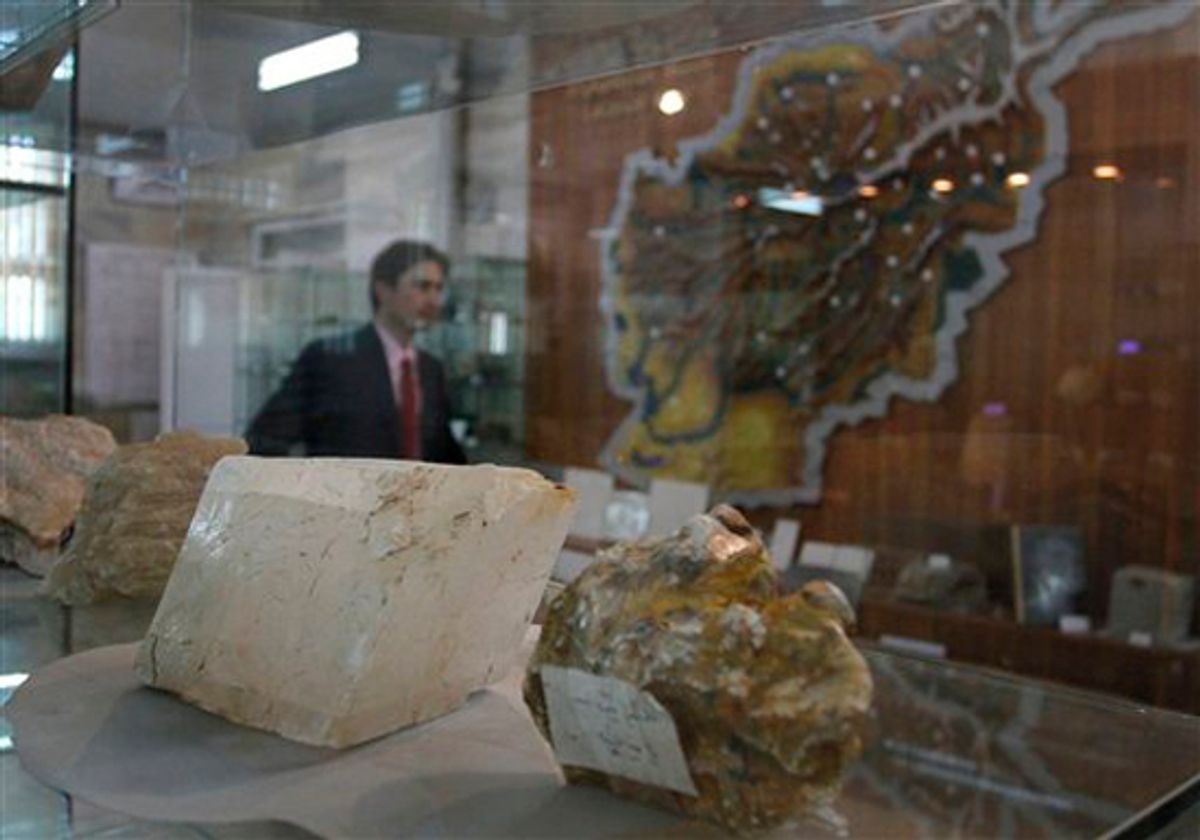
An Afghan journalist walks by precious stones on display as he attends a press conference of Afghan Minister of Mines Wahidullah Shahrani in Kabul, Afghanistan on Thursday, June 17, 2010. An Afghan mining official says the untapped minerals in the war-torn country are worth at least $3 trillion, triple a U.S. estimate. (AP Photo/Musadeq Sadeq)(Credit: Musadeq Sadeq) Reading this week’s New York Times headline — “U.S. Identifies Vast Riches of Minerals in Afghanistan” — many probably wondered why this information was being presented as “news” in 2010. After all, humanity has long been aware of the country’s vast natural resources. As Mother Jones magazine’s James Ridgeway said after recalling previous public accounts of the ore deposits, “This ‘discovery’ in fact is ancient history tracing back to the times of Marco Polo.”
The intrigue in the Times’ dispatch, then, is not Afghanistan’s “huge veins of iron, copper, cobalt, gold and critical industrial metals” that the paper quotes Pentagon officials gushing about — it is the gushing itself. Indeed, the real question is: What would prompt the government to portray well-known geology as some sort of blockbuster revelation?
The Atlantic’s Marc Ambinder proffers a convincing answer. Noting the military’s coordinated quotes in the Times piece, he writes that the Pentagon is probably trying to bolster Americans’ support for the flagging Afghanistan campaign by “publicizing or re-publicizing valid but already public information about the region’s potential wealth.”
This assertion, mind you, is not coming from some antiwar ideologue in a “No War for Oil!” T-shirt. On the contrary, Ambinder is a quintessential buttoned-down establishmentarian far more interested in covering political process than in pushing a pet cause — which means his charge (later echoed by other Washington journalists) is a particularly powerful one. And if he’s correct, we may be witnessing the final spasm of a radical shift.
The accusation that the U.S. invades countries to pilfer their natural resources was once written off as an inflammatory insult or an unsubstantiated conspiracy theory, irrespective of corroborating facts (like, say, pre-9/11 Pentagon plans to divvy up Iraqi petroleum, State Department proposals to privatize Iraq’s oil fields, and top government officials insisting that Saddam Hussein’s overthrow was “essential” to protect oil supplies). The assumption, of course, was that the public opposed resource conflicts and that therefore labeling wars as such was nothing but disreputable slander designed only to harm a political opponent.
This manufactured construct, though, began eroding as soon as George W. Bush started turning the “war for oil” aspersion into a proud clarion call.
In 2005, the Associated Press reported that the president “answered growing antiwar protests with a fresh reason for U.S. troops to continue fighting in Iraq: protection of the country’s vast oil fields.” During a press conference a year later, Bush three times pitched petroleum as a rationale for war, criticizing “extreme elements” who “want to control oil resources,” insisting that “we can’t tolerate a new terrorist state in the heart of the Middle East with large oil reserves” and warning that we must stop insurgents from gaining “the capacity to use oil as an economic weapon.”
Now, under President Barack Obama, we get leaked Pentagon memos cheerily promising that Afghanistan will become “the Saudi Arabia of lithium” and generals touting the minerals’ “stunning potential” — the implication being that America is morally obligated to exploit such potential through armed occupation.
The theater of battle is different, but the paradigm is the same: Whereas it was previously considered uncouth for anyone to even suggest that economic hegemony might motivate U.S. military action, our leaders are now boldly selling wars as commendable instruments of such profit-focused imperialism.
Importantly, this revised message relies on the new assumption that the public now sees resource conflicts not as detestable, but as worthy and even admirable. And should that assumption prove true, it would mean that this latest exercise in martial propaganda represents more than mere marketing innovation. It would signal a disturbing change in what the population thinks is — and is not — a just reason for war.
David Sirota is the author of the bestselling books “Hostile Takeover” and “The Uprising.” He hosts the morning show on AM760 in Colorado and blogs at OpenLeft.com. E-mail him at ds@davidsirota.com or follow him on Twitter @davidsirota.
David Sirota is a best-selling author of the new book "Back to Our Future: How the 1980s Explain the World We Live In Now." He hosts the morning show on AM760 in Colorado. E-mail him at ds@davidsirota.com, follow him on Twitter @davidsirota or visit his website at www.davidsirota.com. More David Sirota.
Memorial Day’s lessons in amnesia
If nothing else, the holiday allows us to reflect on our commitment to forgetting bloody conflicts
(Credit: Carly Rose Hennigan via Shutterstock) It’s the saddest reading around: the little announcements that dribble out of the Pentagon every day or two — those terse, relatively uninformative death notices: rank; name; age; small town, suburb, or second-level city of origin; means of death (“small arms fire,” “improvised explosive device,” “the result of gunshot wounds inflicted by an individual wearing an Afghan National Army uniform,” or sometimes something vaguer like “while conducting combat operations,” “supporting Operation Enduring Freedom,” or simply no explanation at all); and the unit the dead soldier belonged to. They are seldom 100 words, even with the usual opening line: “The Department of Defense announced today the death of a soldier who was supporting Operation Enduring Freedom.” Sometimes they include more than one death.
Continue Reading CloseTom Engelhardt, co-founder of the American Empire Project, runs the Nation Institute's TomDispatch.com. His latest book, "The United States of Fear" (Haymarket Books), has just been published. More Tom Engelhardt.
Where the wounded are
Wars don't just cause casualties among soldiers, they drain medical staff. I traveled to see the costs firsthand
A soldier is prepared for an operation at Landstuhl Regional Medical Center. (Credit: Reuters/Kai Pfaffenbach) The weather’s getting warmer in Afghanistan and the war there is heating up again. That means – as it has meant every year for more than a decade — that the pace will quicken at the Landstuhl Regional Medical Center in Germany. More casualties will be brought to this largest American military hospital outside the United States. The Critical Care Air Transport teams and their C-17 Globemasters will fly in from “downrange,” as they call the Afghan battleground, and the injured will be brought by ambulance bus from nearby Ramstein Air Force Base to the hospital front door.
Continue Reading CloseMichael Winship is senior writing fellow at Demos and a senior writer of the new series, Moyers & Company, airing on public television. More Michael Winship.
NATO invites Pakistan to summit
A sign that Islamabad is ready to reopen its western border to NATO troops on their way to Afghanistan
Oil tankers, which were used to transport NATO fuel supplies to Afghanistan, are parked at a compound in Karachi, Pakistan, Tuesday, May 15, 2012. NATO on Tuesday invited Pakistani President Asif Ali Zardari to the alliance's summit in Chicago, after signs that the country could be moving to reopen its Afghan border to NATO military supplies. (AP Photo/Shakil Adil)(Credit: AP) ISLAMABAD (AP) — NATO on Tuesday invited Pakistan’s president to the upcoming Chicago summit on Afghanistan, the strongest sign yet that Islamabad is ready to reopen its western border to U.S. and NATO military supplies heading to the war in the neighboring country.
Pakistan blocked the routes in November after American airstrikes killed 24 of its troops on the Afghan border. The attack sent ties between Washington and Islamabad to new lows, threatening regional cooperation needed for negotiating an end to the Afghan war.
Continue Reading CloseAfghanistan, I can’t quit you
My mom pushed me to join the Marines. Now that she's gone, I'm still drawn to war zones
A child flies a kite in Kabul on Tuesday Mar. 27, 2012. (Credit: Geoffrey Ingersoll) The heat. That’s what I remember most. Shimmery and bright. Blinding. Stifling. Heeee-eeaat.
The kind that’s not just on you, wrapped around you, but balled up and pulsing inside you — a desert blanket with teeth. It’s a type of heat that makes your skin cry and your eyeballs sweat, even in the shade; heat like a predator you can’t run away from.
I notice it right as I get off the plane — not just the degrees but also the dust. Dust you can smell, kicked up by a thousand years of struggle. In a region this old, I’m sure each breath carries a dose of unintended history: Inhale, Alexander the Great; exhale, the Ottoman Empire; inhale, the USSR; exhale, the Taliban.
Continue Reading CloseGeoffrey Ingersoll is a freelance journalist, documentarian, writer, photographer, and veteran of Operation Iraqi Freedom. He is the recipient of the Sam Stavisky Award for Combat Reporting. More Geoffrey Ingersoll.
What Obama didn’t mention in Kabul
Just outside the Afghan capital, the Taliban is in control and preparing for a wider war
President Barack Obama addresses troops at Bagram Air Field, Afghanistan, Wednesday, May 2, 2012. (AP Photo/Charles Dharapak)(Credit: AP) MAHMUD RAQI, Afghanistan — The office of Kapisa’s governor sits high on a hilltop overlooking the provincial capital, Mahmud Raqi. It has a beautiful view of the river below and the mountains, trees and fields that stretch into the distance.
Beneath the tranquil surface, however, lies a grim truth. Just outside town roadside bombs are planted to target NATO convoys.
Page 1 of 122 in Afghanistan