Food
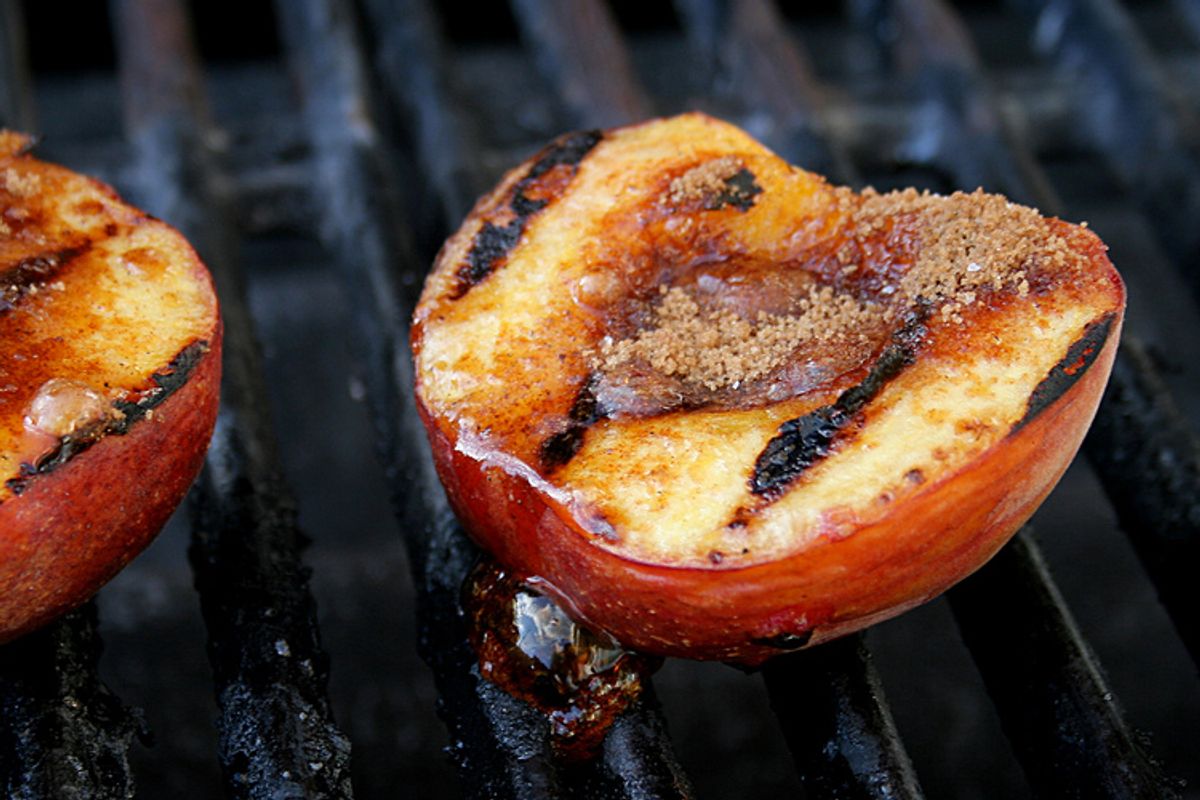
Grilled peaches: A lazy dessert chef’s dream
Your favorite summer fruit deserves a turn on the barbecue. It's sweet, smoky -- and a lot easier than pie
Topics: Food
Over the years, I’ve equated summer with Slip ‘N Slides, outdoor concerts and then rooftop bars. But now, warmer months really just remind me of barbecues at my parents’ house. Often just one or two family friends would join us, but once in a while these dinners turned into actual parties, with a couple dozen baby boomers and their kids crammed into our tiny backyard, beers in hand, waiting for the next round of flank steak to be done.
It was at one of these parties that I first discovered what I now regard as the quintessential finale to a good barbecue: the grilled peach. When summer fruit first starts showing up at the market, my mother usually goes into a crisp- or tart-making frenzy. On this particular evening, however, after one of those rare Bay Area summer days where the temperature actually climbs higher than 75 degrees — and a day when we had already spent hours in a hot, stuffy kitchen — and neither of us wanted to go back inside for even the 15 minutes it would have taken to throw a dessert in the oven. But we had peaches. We had ice cream. And we had a still-hot barbecue.
Continue Reading CloseEmma Silvers in an editorial fellow at Salon.com. More Emma Silvers.
Trust me on this: Wine
The Mario Batali partner behind some of New York's best restaurants hopes his kids share his passion for vineyards
Topics: Food, Parenting, Trust Me On This
(Credit: Draw via Shutterstock/Benjamin Wheelock) How I make my living — and how I live my life — is for food and wine. You know, I make wine and I make food. That’s what I do. I have vineyards in Italy, and one of them is from the area where my family is from. And wine-making is one of those incredibly personal, passionate things that tells the story of who we are, who our family is and where we come from. So having my kids be involved in the tradition of wine-making would be incredible.
I have two boys, one 11 and one 13, and a daughter who’s 15. And they spend their summers at the winery in Italy. They work in the vineyards, they taste wine. They bottle the wine, they make it. So they live it. I don’t want to shove anything down anyone’s throats, but I hope at least one them becomes passionate about it and wants to be involved in it.
Continue Reading CloseJoe Bastianich and partner Mario Batali own some of America's most acclaimed restaurants, including New York's Babbo, Lupa, Otto and Del Posto; Osteria Mozza and Pizzeria Mozza in Los Angeles; and Las Vegas' B&B Ristorante, Enoteca San Marco and Carnevino. He is the author of the memoir "Restaurant Man" and a judge on Fox's "MasterChef." More Joe Bastianich.
The making of the term ‘pink slime’
A simple nickname that forever changed an entire industry
Topics: Food, From the Wires
FILE - In this March 29, 2012 file photo, the beef product known as lean finely textured beef, or "pink slime," is displayed during a plant tour of Beef Products Inc. in South Sioux City, Neb., where the product is made. Gerald Zirnstein, the microbiologist who coined the term "pink slime," says it came to him in the spur of the moment as he was composing an email to a coworker at the U.S. Department of Agriculture a decade ago. Although it's been used as a filler for decades, the product became the center of controversy only after Zirnstein's vivid moniker for it was quoted in a 2009 New York Times article on the safety of meat processing methods. (AP Photo/Nati Harnik, File)(Credit: AP) NEW YORK (AP) — “Pink slime” was almost “pink paste” or “pink goo.”
The microbiologist who coined the term for lean finely textured beef ran through a few iterations in his head before pressing send on an email to a co-worker at the U.S. Department of Agriculture a decade ago. Then, the name hit him like heartburn after a juicy burger.
“It’s pink. It’s pasty. And it’s slimy looking. So I called it pink slime,” said Gerald Zirnstein, the former meat inspector at the USDA. “It resonates, doesn’t it?”
Continue Reading CloseDid slaves catch your seafood?
Thailand, a major source of fish imported to the US, depends on forced labor for its product
Topics: Food, GlobalPost, Thailand
(Credit: Alena Brozova via Shutterstock) PREY VENG, Cambodia, and SAMUT SAKHON, Thailand — In the sun-baked flatlands of Cambodia, where dust stings the eyes and chokes the pores, there is a tiny clapboard house on cement stilts. It is home to three generations of runaway slaves.
The man of the house, Sokha, recently returned after nearly two years in captivity. His home is just as he left it: barren with a few dirty pillows passing for furniture. Slivers of daylight glow through cracks in the walls. The family’s most valuable possession, a sow, waddles and snorts beneath the elevated floorboards.
Horrors we hide
From slaughterhouses to sweatshops, modern society is constructed to let us ignore atrocities
Workers at a Seagate Wuxi factory in China (Credit: Robert Scoble / CC BY 2.0) Would Americans eat less meat, and would animals be treated more humanely, if slaughterhouses were made with glass walls and we all could see the monstrous killing apparatus at work? This is the query at the heart of Timothy Pachirat’s new book, “Every Twelve Seconds” — the title a reference to the typical slaughterhouse’s cattle-killing rate.
Continue Reading Close
David Sirota is a best-selling author of the new book "Back to Our Future: How the 1980s Explain the World We Live In Now." He hosts the morning show on AM760 in Colorado. E-mail him at ds@davidsirota.com, follow him on Twitter @davidsirota or visit his website at www.davidsirota.com. More David Sirota.
Lessons of a reluctant hunter
A transplant to Oregon teaches me about growing up in rural Mexico, killing iguanas and grilling chicken
Jazmin Rudin with her mother, Esperanza Jazmin is 27 years old and beautiful. She has the fierce, dark beauty of a Mexican Indian, but she’s tall, and when you see her move, you think Masai warrior or maybe ninja. And it’s true: She does have ninja skills. When I first met Jazmin, she’d just killed a pheasant. She was sitting on the deck talking with a friend when she spotted the bird at the edge of the yard, 20 feet away. She casually picked up a two-by-four and hurled it. The missile hit the pheasant in the head, a neat kill. Jazmin walked over and picked it up. “Dinner,” she said.
Continue Reading CloseFelisa Rogers studied history and nonfiction writing at the Evergreen State College and went on to teach writing to kids for five years. She lives in Oregon’s coast range, where she works as a freelance writer and editor. More Felisa Rogers.
Page 1 of 238 in Food