Salon Reading Club

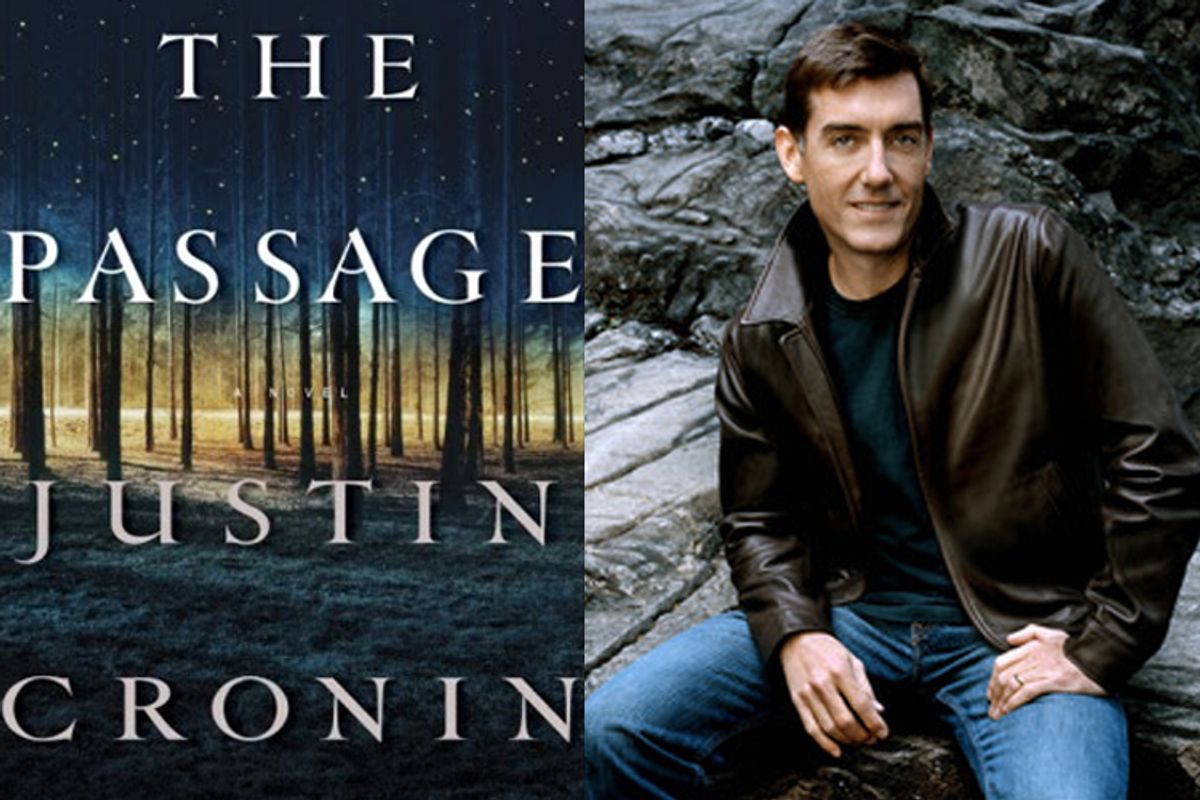
Salon Reading Club: “The Passage” author answers your questions

Justin Cronin discusses our grim zeitgeist, and why we can't stop reading about the apocalypse

  • more
    • All Share Services

Salon Reading Club:

As most Salon readers are already aware, we really love Justin Cronin’s “The Passage.” That’s why we selected Cronin’s epic book, about vampires and a post-apocalyptic America, as the subject of the first-ever Salon Reading Club. Over the past month, Laura Miller and Salon readers have been discussing everything from the book’s take on mortality to its similarities to Cormac McCarthy’s “The Road.” (Check out more of the Salon Reading Club here.)

Over the course of the past month, we’ve also been collecting your questions for Cronin — about, among other things, his fascination with the end of the world, President Obama and the meaning of the word “wicking.” Here are his answers.

As I’m sure you know, you’re certainly not alone in setting a novel in a period after a great die-off of human life. What do you think is the American novelist’s fascination with the apocalypse at this particular historical moment?

I think stories of this kind grow out of uncertainty, and these are very uncertain times, to say the least. I grew up during the Cold War, when everything seemed very tenuous. For many years, right up until the fall of the Berlin Wall, I had vivid nightmares of nuclear apocalypse. But the good thing about the Cold War — and it was the only good thing — was that we knew what to be frightened of. There was one danger so overwhelming that it pretty much pushed all other worries off the table.

I think we’re even more anxious now because we don’t know exactly what to be afraid of. The collective national trauma of 9/11 was profound, not least of all because its images made no sense. Planes flying into buildings: Who ever expected such a thing? The character Richards is the voice of this state of mind — he pretty much articulates it chapter and verse. The things we fear now have a shadowy quality, moving at the edge of our vision  — like the virals, who “move at night, in the trees.”

About landscape, which itself seems to become a character in the second part: What is it about the West — especially the desert West — that invites so many writers to make it the setting for the post-apocalypse?

In part this solves a practical problem. In a dry climate, the ruins of the old world would be better preserved and hence provide a more vivid and detailed backdrop. Houston, where I live, would turn to gelatin in just a couple of decades. Las Vegas, on the other hand, would stand intact, like the pyramids. There’s also something about the West that invites epic storytelling. One of the great themes in American literature is the individual’s confrontation with the vast open spaces of the continent. In this sense, “The Passage” is also a western.

I’m curious which parts of the book grew out of your daughter’s contribution. I’m also curious, of course, if she’s read it. She’s 13 now, from what I understand, so she’d be old enough.

My daughter and I worked up a basic outline for the whole story. A few specific items were her own creation. For instance, the character Michael was pretty much someone she demanded. (She’s always preferred brainy boys.) The Sunspot was also hers. She wanted one character to have red hair (Alicia). She also named a lot of the characters. But these details are the least of it. She’s everywhere in these pages, especially in the Wolgast-Amy relationship. And yes, she’s read it; she actually read it twice, the highest compliment a 13-year-old reader can pay.

The America you show, even pre-virals, is pretty grim, with curtailments on civil liberties and constant war abroad. Did the recent change in administration and in the tenor, if not the substance, of our foreign policy, affect how you depicted America in the near future? Why so pessimistic?

I began the book in the fall of 2005. This explains a lot. The war in Iraq seemed to be grinding on with no exit in sight; Katrina had just drowned New Orleans; the revelations about Abu Ghraib had badly stained America’s reputation. My mood was pretty dark. It has brightened somewhat since then, but the jury is still out.

What do you see vampirism standing in for? Is it a virus that we already know about [HIV]? Or is it about our human desires to ostracize those who are different?

To my mind the virals of “The Passage” are a kind of cultural Rorschach, the dark presence in the trees that makes us all afraid. The reader gets to decide what that is for herself. Environmental catastrophe? Scientific malfeasance? Anthrax in the morning mail? And the virals also are what they are: people trapped in the moment just before death, their individual humanity all but eradicated, waiting to make their passage.

What books influenced your writing here, other than apocalypse and vampire literature?

Behind every writer stands a very large bookshelf. You learn to write by reading, and my experiences and tastes as a reader are pretty wide. “The Passage” was certainly colored by a number of post-apocalyptic and horror stories, but I learned a great deal from writers like Dickens. One book that definitely stood over my shoulder was Larry McMurtry’s “Lonesome Dove.” I think it’s the perfect example of a novel that speaks to a popular sensibility through its great characters and rousing plot while it also achieves the status of great literature. It’s also a wonderful road story, which “The Passage” hopes to be.

Could you talk a bit about “The Passage’s” intertextuality? How would you describe your novel’s relationship to the texts it references through the epigraphs and the allusive character names?

I think it’s disingenuous for any writer to pretend they’re inventing the wheel, and that their book isn’t a comment on and grappling with other books — especially when they’re writing within an established storytelling tradition, such as vampire narrative. I decided to throw my arms around this basic truth of writing and openly invoke other novels, stories, plays and poems. Some of these references are subtle, little Easter eggs tucked in the grass, and some are overt, such as the works referenced in the epigraphs (especially “King Lear,” “The Tempest” and “Twelfth Night”). The list of referenced works is actually so long I don’t have space here to name them all, and no doubt there are more I’m not even aware of. They’re absolutely part of the novel and my sense of it, but the reader doesn’t need to be consciously aware of their presence to experience the story.

In the world you have created, how do you envision people telling Amy’s story? As scripture? As fairy tale? As a Greek-style epic? Or as scientific text, as if she were our Lucy?

A combination of all of these. The story of “The Passage” and Amy’s journey is, for a society a thousand years in the future, the reality behind a legend, both the subject of scholarly study and something rather like the basis for a new gospel (hence “The Book of Auntie” and “The Book of Sara”).

Lacey states that Lear could have nuked the facility at the beginning of the outbreak, but he held off because Amy was still there. Does this mean that the billions of deaths and the virtual destruction of terrestrial mammalian life was due to Lear’s affection for Amy? Lear must have known what the release of the virals would mean, but did he make a conscious decision to sacrifice the world in order to save Amy?

I think the question assumes that Lear was more deliberate in this choice than he was. By the time the virals broke out, he was a completely broken man, having watched his noble intentions to “solve the mystery of death itsel” perverted by the military and men like Richards. He has come to see the unfolding catastrophe as inevitable. But you’re right to note that in his final conversation with Wolgast, he suggests that Amy was a conscious attempt on his part to subvert the dark intentions of Project NOAH, so choosing not to blow the bomb would follow.

What’s with the word “wicking”? It keeps cropping up. Just wondering …

You got me there. I never noticed this.

I do have one trivial question for Justin Cronin — what are the rules of “go to”? — I may find myself with a deck of cards after the end of the world, and little diversion would be welcome.

I confess I don’t know all the rules. I imagine it as some combination of hearts and crazy-eights. If somebody wants to write the rules, I’ll gladly abide by them in future volumes.

Reading Club interview: Jonathan Franzen answers your questions

The "Freedom" author discusses "Franzenfreude," Obama's reading choice and the criticism that really hits home

  • more
    • All Share Services

Reading Club interview: Jonathan Franzen answers your questionsJonathan Franzen

As you know, we really liked Jonathan Franzen’s “Freedom.” Over the past month, as part of the second edition of the Salon Reading Club, Laura Miller and Salon readers have been discussing everything about the book, from the characters we loved — or loved to hate — to our favorite sentences or the most memorable moments. Over the past month, we’ve also collected your questions for Jonathan Franzen (in the letters section and via e-mail) about everything from the “Franzenfreude” backlash to his own personal writing process.

What do you think of the phrase “Franzenfreude”?

I think in German it literally means “joy in Franzen.” But I’m no stranger to literary envy and am in no position to deplore it in others.

There’s been discussion in the Salon Reading Club about which character in “Freedom” most represents you. Which one is it?

All four characters draw equally on my experience of life, though I admit to having a particular fondness for the youngest of them.

The characters in “Freedom” appear to make decisions, but they’re all rooted in their experience and biology. It’s striking, for example, how much like Patty’s father Walter turns out to be, and her relationships with both Walter and Richard make all sorts of sense on the basis of her upbringing. Where do you come down, ultimately, on the question of free will?

This is exactly the kind of question I want to leave to the reader. The novelist is responsible for creating an experience, not for interpreting it.

The book has received a tremendous amount of publicity. Is there another book that you really liked that has recently come out, that you think might have been overshadowed by your own?

I’ve been so busy with publicity that I haven’t been able to read any recent releases, but reliable friends have told me that Jennifer Egan‘s and Gary Shteyngart‘s new books are very good.

Of the criticisms you’ve read of the book, which hits home the hardest?

Well, I don’t read reviews, so I’m not familiar with the criticisms. But I’m sad when I do a public event and somebody tells me — as if an author would want to hear this! — that my characters are unlikable. I feel like I’m being told that I myself am unlikable.

A lot of writers really suffer through the experience of writing. Do you have fun when you write?

I have fun when I finally crack a problem that’s been dogging me for months or years, and there were about a hundred such problems between the start and the finish of the project of writing “Freedom.” When I’ve solved an especially knotty problem, I stride around the office smacking my hands together in excitement. I wouldn’t describe making pages as “fun,” but during a year when pages are being made I’m conscious in a larger way of being genuinely happy.

Obama famously was photographed with a copy of “Freedom.” If he read it, what do you hope he took away?

I hope he was so preoccupied with urgent national affairs that he wasn’t able to take away much more than a general enjoyment of the experience. I didn’t vote for him in expectation of his mooning around pondering literary novels.

In a way, the book is about watching flawed humans during the downturn of an empire using their glorious “freedom” to do damage to those they love, to animals, to other countries. In writing the book, were you thinking of George W. Bush’s use and misuse of the word “freedom”?

I was indeed.

Continue Reading Close

Why Jonathan Franzen is the wrong face for “Franzenfreude”

Yes, white male writers are too dominant in highbrow literature, but the "Freedom" author is one of the good guys

  • more
    • All Share Services

Why Jonathan Franzen is the wrong face for

Having finally released three books back into the wild of the Brooklyn Public Library system — “Freedom,” “Catching Fire” and “The Passage” — I feel the time is right to weigh in on the literary meme of the moment, “Franzenfreude,” a term that, loosely defined, indicates that author Jonathan Franzen represents all that is wrong with the contemporary highbrow book world.

Is that stupid? Quite! Except there’s a caveat. The phenomenon referred to by “Franzenfreude” — the idea that the highbrow book world reserves its highest praise and most fawning attention for the works of men — is absolutely true. It just happens that Jonathan Franzen is a terrible poster boy for that problem.

Franzen writes gorgeous women. Fleshed-out, interesting, three-dimensional, vivid women, women with brains. He writes for them, too, and perhaps most important of all, he reads them. When, at a Brooklyn Book Festival panel, someone asked him what he was reading, he replied, “Edith Wharton.” To the follow-up question of what should we, his audience, be reading, he listed several books, all by female authors, including the “Ms. Hempel Chronicles,” of which, up to that point, I hadn’t even heard. (Then I read it. It was good!)

A friend and I cornered him after the panel to ask whether he’d realized he’d been promoting work by ladies. He blinked for a moment, then laughed and said it honestly hadn’t occurred to him.

Thus, “Franzenfreude” is the wrong label for this particular can of worms. (As a language nerd points out, it’s also stupid for other reasons.)

That said, let’s address the can of worms itself. Yes! Fiction by women is customarily and routinely dismissed by the intelligentsia in favor of fiction by men. Because why should fiction be any different than anything else? The most exalted spaces in any pantheon are reserved for men. So it has been, so it will be. This is because women can have babies, whereas men can only have egos, and also testicles, or something.

However! The less important the pantheon, the more likely it is that you can find a woman at the top of it.

The highbrow book world also dismisses almost all genre fiction. Genre fiction is where women reign supreme or, at the very least, hold their own: romance, mystery, young adult, sci fi, fantasy. Having just ingested the “Hunger Games” trilogy, a sci-fi Y.A. extravaganza that took not just me but America by storm, I feel particularly drawn to this point right now.

Even in most genre fiction, there remains an idea that boys won’t read books about girls. Hence the sad-but-true fact that J.K. Rowling couldn’t publish under the name “Joanne” for fear of frightening off huge numbers of young male readers. But this to me feels wrong. Step on the NYC subway right now and look around — I guarantee you that someone on that car is reading not “Freedom” but “The Girl With the Dragon Tattoo.” That book is about, as you’ve perhaps heard, Lisbeth Salander, one of the most kick-ass female characters in any book of any genre. The “Golden Compass” books didn’t suffer for focusing on Lyra, another quite impressive young woman. Even Dan Brown’s idiot bestseller “The Da Vinci Code” was a feminist conspiracy theory.

Best of all, perhaps, is Suzanne Collins, whose hugely popular “Hunger Games” books center around Katniss, who doesn’t want to get married and doesn’t understand why having leg hair is bad. Written by a lady! Starring a lady! Yet everyone’s reading them. Hopefully the next J.K. Rowling can be inspired by this and publish under her full name.

This doesn’t, of course, solve the problem of the white male tastemakers — and the sufficient numbers of female tastemakers who concur — giving all the plaudits that matter to white male authors. As Adam Gopnik, a New Yorker author I admire, put it just this year in his tribute to J.D. Salinger: “In American writing, there are three perfect books, which seem to speak to every reader and condition: ‘Huckleberry Finn,’ ‘The Great Gatsby,’ and ‘The Catcher in the Rye.’”

What Gopnik meant to say, no doubt, was, “Here are three books I really dig!” He’s hardly the first intellectual to fall into the tar pit of generalizing from his own experiences. But it’s a disturbingly prevalent trend among white male tastemakers: assuming that what they relate to and find meaning in, the rest of us must as well, and that those books must be “the best.”

It’s crap, and I’m glad people are finally beginning to realize that. But leave Jonathan Franzen out of it, would you? He’s one of the good ones.

Continue Reading Close

Ester Bloom's writing has appeared in the Apple Valley Review, Conte: A Journal of Narrative Poetry, The Morning News, PANK, Bundle, Nerve.com, and Salon.com, and is collected on her website, esterbloom.com. She is currently at work on a book of comic essays entitled "Never Marry a Short Woman."

“Freedom”: Which character is Jonathan Franzen?

Richard isn't a stand-in for the author, but the character's irresistible negativity is what makes the novel work

  • more
    • All Share Services

“There had always been something not quite right about the Berglunds.” This is the general consensus among the Berglunds’ former neighbors when, long after they’ve moved, Walter Berglunds’ name suddenly resurfaces in an unfavorable New York Times feature. “Freedom” is Jonathan Franzen’s 500-page exploration of just what that “not quite right” something is; and how it is that Walter went from left-wing ideologue “greener than Greenpeace” to lackey for a West Virginia coal mining company and figure of national media contempt.

This is not, however, as much Walter’s story as it is his wife Patty’s. One of the great ironies of the Oprah Book Club scandal of 2001 is how devoted Franzen actually is to creating complex female characters. “Freedom,” I would argue, is written very much for women readers, much more than “The Corrections” ever was (so I’m not surprised that  Oprah has picked it for the her next Book Club), and much more for those readers than it is for the critics who are falling all over themselves to praise it (and I’m not bucking that trend). 

But there’s also plenty in here to like for readers who hate Oprah and/or mistrust critics. Curmudgeons will love the character of Richard Katz, former alt-rock star and perennial post-punk girl magnet. He is best friend to Walter, but ultimately lover to Patty. In a world teeming with lifestyle missionaries, Richard is a grounding reminder of a brief moment in the ’90s when cynicism had a certain integrity. As Richard explains, “I don’t do belief. I don’t do vision.”

Yesterday, Curtis Sittenfeld argued in The Observer that Richard was something of a stand-in for Franzen who, like Richard, toiled in obscurity for decades until achieving commercial success in 2001.  Franzen, however, does “do” belief and vision. It might seem like depressive realism isn’t actually a vision, but it’s the one that’s been keeping psychiatry going for over a century. I don’t think Franzen is Richard, but this book would be nothing without the balancing force of Richard’s irresistible negativity. He, Walter and Patty are the love triangle that keeps this novel as philosophically balanced as a geodesic dome.

Patty seems apolitical. But she is really only in a rigid state of rebellion against an intensely liberal family. She is a gentrification pioneer, and daughter of a famous public defender and feminist politician. Patty pushes strollers though “broken beer bottles and barfed-upon old snow.” She cooks from “The Silver Palate Cookbook” and uses cloth diapers. “She was already fully that thing that was just starting to happen to the rest of the street.” So much so that the people who end up emulating her seem to have always disliked her.

There’s a hashtag popular on Twitter right now, #franzenfreude, that is unfortunately being used by women writers envious of Franzen’s current literary success. But franzenfreude is also a perfect description of just exactly what it is Franzen is so good at. He creates characters that you can’t help wanting bad things for. Only to turn around and make you love them as though they were part of the same tangle of rage and affection that people often usually only feel for members of their own family.  

Bad things do happen to the Berglunds. Terrible things. And at a certain level they are undeniably, and often, terrible people. Patty loves her son, Joey, to a point creepily close to incest. Joey, barely a teenager, starts sleeping with the girl next door, and then moves in with her trashy cougar mom and her redneck boyfriend, because unlike his parents, they let him do whatever he wants. It’s easy to write him off as your garden-variety teenage sociopath. But gradually, using satire like paint stripper, Franzen patiently exposes the humanity that is almost always there if you get to know people well enough to let it emerge.

At one point Richard looks at Walter and sees exactly how Walter has “snapped under the pressure of thinking in too much detail about the fuckedness of the world.” Franzen writes like someone who has snapped like that countless times, but then, every time, beaten the path back to sanity a little wider.

Continue Reading Close

Road trips, political rage and catnapping

The Salon Reading Club concludes its discussion of Jonathan Franzen's "Freedom"

  • more
    • All Share Services

Road trips, political rage and catnapping

Welcome to the third and final session of the Salon Reading Club for Jonathan Franzen’s novel “Freedom.” Last week, we took the discussion up through Page 382, and now it’s time to consider the book’s conclusion. If you haven’t finished yet and are spoiler phobic, read no further. (See the sidebar to the right for more information on the Salon Reading Club)

As always, I’ll toss a few topics out in this introduction, but please feel free to take the conversation wherever you like in the comments. Now’s your last chance to get in any questions you may have for Jonathan Franzen. He’ll being answering them next week.

I’m a little ambivalent about the ending of “Freedom.” While it was definitely satisfying to see Walter and Patty reunited, part of me thinks it’s not very realistic. But perhaps that’s the point; if those characters had done what most divorced couples do and kept moving on to new lives, they’d be exercising the American-style freedom about which Franzen is clearly so ambivalent. He doesn’t really show us how they manage to patch things up, which I find a bit mysterious, but I assume that it has something to do with both of them (but especially Patty) wanting to make right what they’d gotten so terribly wrong. Walter got the chance to fall apart (formerly Patty’s job) and Patty got to rescue him. (And poor Lalitha got a bird sanctuary named after her.)

What did you think of the way Franzen depicts the political climate of the mid-2000s? Walter’s road trip with Lalitha to promote Free Space is a Magical Hysteria Tour of the endemic rage of the period, which Walter regards as “loony,” even though it is, in a fashion, a reflection of the repressed anger he’s been nursing since his boyhood in the motel. There’s a strong sense that Americans have been making their politics carry an emotional load displaced from their personal lives — it’s a lot less destabilizing to rant on the Internet about Dick Cheney or Bill Clinton than to get into it with your spouse and parents, let alone your own messed-up self — to the detriment of public life.

Among the many delightful touches that I savored in this last part of the book was the way Jessica keeps flinging the authority of her youth in Lalitha’s face — “Did Lalitha not understand anything about young people’s new relationship with music?” — although the age difference is, what, seven years? A much less sympathetic character in the very last chapter, Linda, deploys a not dissimilar rhetorical tic whenever she thinks she’s losing the moral high ground in a conflict: She starts talking about her children, whom she clearly regards as a free pass for every selfish and vindictive thing she does. I’m sure some readers will call Linda a caricature, and I wish it were so. Alas, I have met people exactly like her.

In fact, the whole little neighborhood drama about the cats and the songbirds at the end deftly encapsulates the themes of the book: Walter is right, but in the wrong way. Linda is a monster, but taking her cat to the pound only makes him one, too. But, again, I’m not sure I’m optimistic enough to believe in Patty’s solution — even if I’d like to.

What do you think?

Continue Reading Close
Laura Miller

Laura Miller is a senior writer for Salon. She is the author of "The Magician's Book: A Skeptic's Adventures in Narnia" and has a Web site, magiciansbook.com.

Reading Club: America’s prudish literary morality

Why are so many writers, including Jonathan Franzen, so obsessed with creating "likable" characters?

  • more
    • All Share Services

Reading Club: America's prudish literary morality

Likability is indeed just another word for “morality.” A huge section of the American reading public does not want art for art’s sake, or even realistic characters; it wants the books we read and the movies we see to be clever public service announcements, meant to uphold public morality.

Naturally, these unrealistic modern Achilles types must have some “likable” flaw, which is almost worse. It leads to the aesthetic of “quirkiness,” which has brought such success to Jonathan Safran Foer and Wes Anderson (probably the two masters of the modern safe-quirk genre).

I might point out that “The Corrections” was in some sense a morality tale, the classic American story of trying to get all the kids home for one last Christmas with the family. Well, not all literature has to be dangerous or extremely challenging, but frankly when I think of most modern American “literary” books, the epithet “cowardly” comes to mind. Paul Auster is a good example of an obviously talented (or even very talented) writer who simply can’t break free of certain strictures. All of his books have good sections and the prose overall is enviable, but the end result is unsatisfying.

It all reminds me of a classic defense mechanism, “You’re weird!” This epithet is used by many young people whenever they are confronted with a challenging person or a person with a challenging thesis. Having read many literary reviews on Amazon in order to get an idea of what the average person thinks about fiction, I’ve come to believe that half of the negative literary reviews can be broiled down to those two words: “You’re weird.”

The sad truth is that most American writers are professionals first, artists second. We need a Mark Twain to make all these Horatio Algers look ridiculous. The case of Nirvana and ’80s rock is also instructive.

Continue Reading Close

Page 1 of 4 in Salon Reading Club