California
Is this the latest anti-government police shooting?
A heavily-armed man who was angry at liberals in Congress allegedly opened fire on police in Oakland
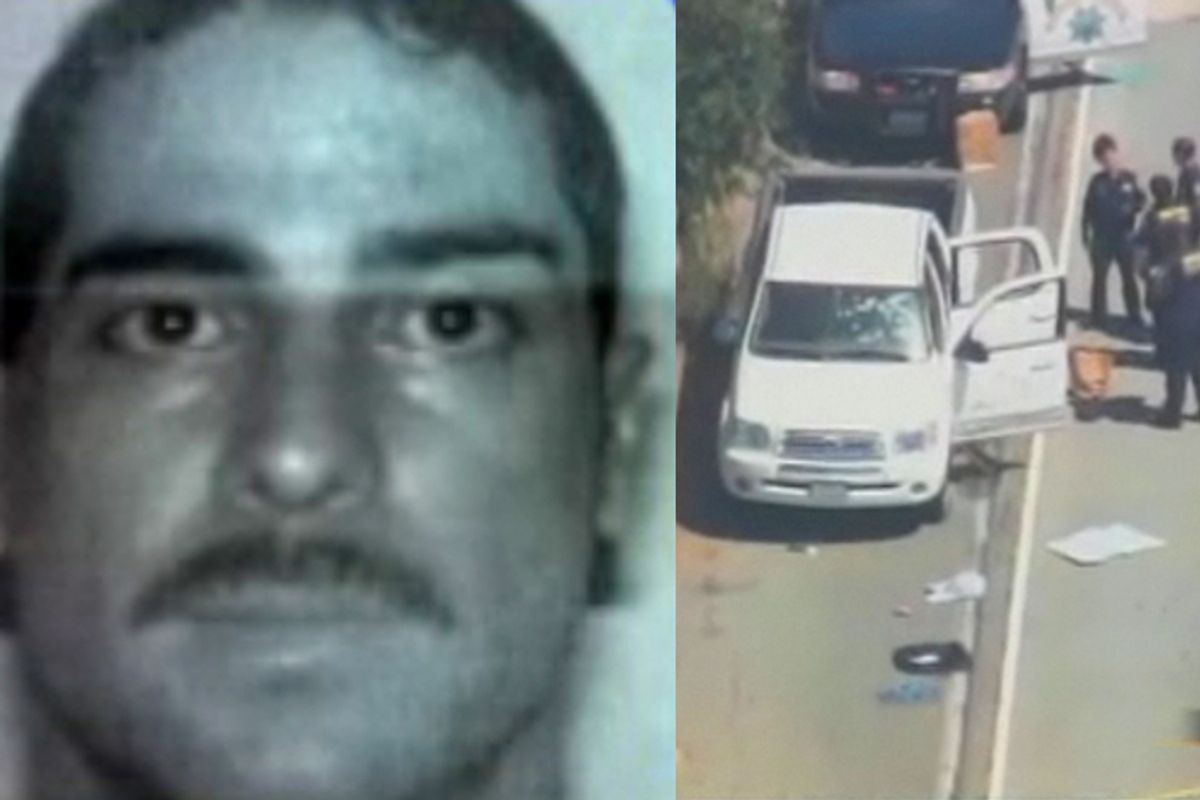
Byron Williams and a scene from the Oakland shootout. On Sunday, a heavily-armed Groveland, California, man named Byron Williams allegedly opened fire at police after they pulled over his truck in Oakland. After a dramatic shootout, two officers sustained injuries from flying shards of glass and Williams — who had a shotgun, a handgun, a rifle, and was wearing a bulletproof vest — was in the hospital in serious condition.
Williams’ mother Janice told a local ABC affiliate her son often became angry watching TV news and “[h]e feels the people of this country are being raped by our government and politicians.” She told the San Francisco Chronicle that Byron Williams was also upset at “the way Congress was railroading through all these left-wing agenda items.” Meanwhile, the San Jose Mercury News quotes unnamed law enforcement sources saying that Williams, 45, “has a history showing he is anti-government, anti-corporation and against liberal causes.
If Williams was indeed motivated by anger at the government — and it’s important to note that police still haven’t commented on motive — then this is, by our count, the third recent case of people angry at the government or the Obama Administration opening fire on police.
The other two cases share some strands with the Williams case (bullet-proof vests, lots of guns, traffic stops), but they resulted in the deaths of several police officers.
In April 2009, 22-year-old Richard Poplawski allegedly opened fire on police who responded to a 911 call from Poplawski’s mother. Poplawski, who was wearing a bullet-proof vest and was armed with an assault rifle and two other guns, survived the ensuing four-hour gun battle — but three police officers were killed. His friends said he feared “the Obama gun ban that’s on the way” and “didn’t like our rights being infringed upon.”
This past May, Jerry Kane and his teenage son Joe opened fire on police, killing two officers, when after they were pulled over on the highway in West Memphis, Arkansas. Kane and his son, who were killed by police later that day, traveled the country giving debt-elimination seminars based on an anti-government theory that all bank loans and modern finance are fundamentally illegitimate. Kane had also complained about being stopped at a “Nazi checkpoint” in New Mexico and fantasized about beating up IRS agents.
We’ll probably find out more about the Williams case in Oakland in the coming weeks. One apparent focus of the investigation is a three-ring binder labeled “California” that authorities found in his truck.
California Highway Patrol spokesman Trent Cross told Salon that the FBI, which is assisting in the investigation, showed interest in the binder. “They just put it in a bag, sealed it, and took off. They took it and are being real quiet about it,” Cross said.
An FBI spokeswoman declined to comment, referring Salon to the Oakland Police Department, which did not return a call.
Justin Elliott is a reporter for ProPublica. You can follow him on Twitter @ElliottJustin More Justin Elliott.
California’s college mess
How not to compete in the global economy: The richest state in the U.S. can't afford to educate its students
Jerry Brown (Credit: Reuters/Lucy Nicholson) If increasing access to quality higher education is as crucial to U.S. economic growth as everybody seems to think it is, then two news item from California this week deliver a simple, straightforward message: We’re screwed.
1) Ace education reporter Nanette Asimov reported on Tuesday in the San Francisco Chronicle that the California State University system is withholding around $90 million in cash grants previously allocated to graduate students in the CSU system.
Continue Reading Close
Andrew Leonard is a staff writer at Salon. On Twitter, @koxinga21. More Andrew Leonard.
California’s unregulated fracking problem
Drilling has long gone unregulated in this earthquake-prone state. And now Gov. Brown may be trying to hush it up
A gas flare burns at a fracking site in rural Bradford County, Pennsylvania January 9, 2012 (Credit: Reuters/Les Stone) Thanks to the smoking gun of Josh Fox’s sobering documentary “Gasland,” hydraulic fracturing has finally entered our renewable news cycle. Yet despite poisoning groundwater, freeing methane and literally creating earthquakes back east, fracking has a visibility problem in California.
The situation became less clear after a recent investigative report from D.C.-based nonprofit Environmental Working Group explained that California has experienced 60 unregulated years of widespread fracking, whose technical methods and geographical locations in the seismically active state exist outside of the public purview. It got darker after Gov. Jerry Brown’s administration wiped the state government’s Division of Oil, Gas and Geothermal Resources (DOGGR) website of fracking fact-sheets and documents. Good luck finding anything about fracking on the governor’s official site either.
Scott Thill is the editor of Morphizm.com. He has written on media, politics and music for Wired, the Huffington Post, LA Weekly and other publications. More Scott Thill.
Swimming with the stars
A new photography exhibition examines the cultural significance of the Southern California swimming pool SLIDE SHOW
Lawrence Schiller, "Marilyn Monroe," 1962.(Credit: Courtesy of Judith and Lawrence Schiller; Lawrence Schiller © Polaris Communications, Inc.) By turns playful, suggestive and bewitching, the photographs in a new show at the Palm Springs Art Museum propel us back through the decades, to a time when the glamour of choreographed capitalist displays had a singular hold over the American imagination.
These images, though diverse in many respects, all have one thing in common: the swimming pool. That, and their mid-to-late 20th-century Southern California backdrop.
The exhibition is part of “Pacific Standard Time,” a multi-institutional project devoted telling the story “of the birth of the Los Angeles art scene and how it became a major new force in the art world,” sponsored by the Getty Research Institute. Over the phone, curator Daniell Cornell explained the place of the swimming pool in Southern California’s cultural history, and discussed the show’s principal themes — from architecture and suburban idealism to the cult of the Hollywood celebrity. Click through the following slide show for a sun-soaked trip back in time.
Continue Reading CloseEmma Mustich is a Salon contributor. Follow her on Twitter: @emustich. More Emma Mustich.
Occupy Southern California
At least a half-dozen separate protest movements have sprung up between L.A. and San Diego
San Diego Police clash with demonstrators at the Civic Center Plaza Friday, Oct. 14, 2011 in San Diego. (Credit: AP/Lenny Ignelzi) California has long been a hotbed of political activism, so it’s no real surprise that residents across the state are expressing their solidarity with the Occupy Wall Street movement. In fact, in the relatively small tract of land between Los Angeles and San Diego, a number of groups have staged protests of their own. Here’s a roundup:
Occupy Los Angeles: A group of 10,000 to 15,000 protesters — not just Angelenos, but Californians from near and far — marched in dowtown L.A. on Saturday. According to the Los Angeles Times:
Continue Reading CloseObama’s crackdown on medical marijuana
The Justice Department shifts course and goes after California's lucrative pot industry
Right: DEA agents remove marijuana plants from a dispensary in San Francisco (Credit: AP/Salon) Back in July, I interviewed a drug policy expert about an apparent change in Justice Department policy that suggested a crackdown on medical marijuana — which is legal in many states but illegal under federal law — might be coming.
Now, with the announcement last week by California’s four U.S. attorneys that pot dispensaries will be targeted with harsh criminal sanctions, the shift feared by drug policy reform advocates appears to have come to pass. The rhetoric from candidate Barack Obama about not prioritizing medical marijuana cases now seems a distant memory.
Continue Reading CloseJustin Elliott is a reporter for ProPublica. You can follow him on Twitter @ElliottJustin More Justin Elliott.
Page 1 of 65 in California