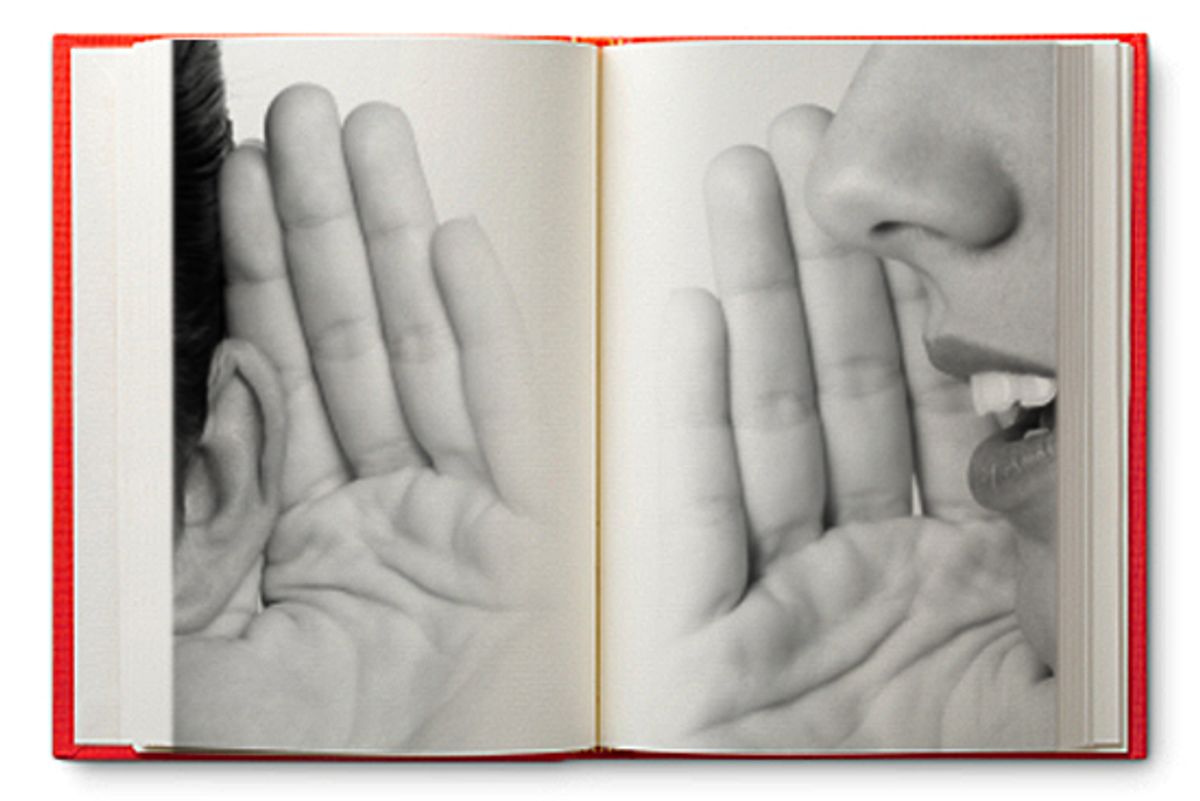
So many books, so little time, as coffee mugs are always telling us, so how do you decide what to read next? Most people rely on word of mouth from trusted friends. The seldom-acknowledged advantage to this method is that you can chew your friend out if she steers you wrong, whereas your recourse with regard to the New York Times Book Review is a lot less direct.
Since the other regular feature I write for Salon is all about recommending books, people often ask me for tips. It's a ticklish question. In a review, I can expound at length, giving readers a pretty good sense of what I like so they can judge if my preferences align with their own. One-on-one, however, what really matters to me is what you like to read.
Amazon and other online merchants have harnessed mighty algorithms to run their "If you enjoyed that, you might like this..." suggestion engines, but these are still crude instruments. Practically any novel you plug into Amazon's search engines at the moment returns the robotic announcement that people who bought it also bought one of Stieg Larsson's "Girl" thrillers — because seemingly everybody in America is buying those books. It's not like you need the world's most sophisticate e-commerce servers to tell you that.
Recognizing that book recommendation may as yet defy science, a couple of literary types are currently offering artisanal advice. Lorin Stein, the new editor of the Paris Review, has launched a column called "Ask the Paris Review," in which he suggests books and films to meet very particular needs. From the practical (a New York-themed hostess gift) to the eccentric (exquisitely boring volumes selected to cure the letter writer's case of girl-craziness) Stein's prescriptions venture far from the beaten path. (Full disclosure: Stein, when stumped, as with a recent inquiry about what to give to a nonbookish 13-year-old boy, has been known to call upon such "experts" as myself.)
"You can't recommend books to strangers without asking personal questions," Stein told me. As he pointed out, what we want to read is often pegged to transitory moods. The same book may not thrill the same person at every point in his or her life. "I don't think people read 'for' pleasure, exactly," he went on. "Of course there is pleasure in reading. But mainly we do it out of need. Because we're lonely, or confused, or need to laugh, or want some kind of protection or quiet — or disturbance, or truth, or whatever." The recommender must take this into account.
The doyen of all professional book recommenders (aside from Oprah, that is) is Nancy Pearl, a Seattle librarian who's a regular on NPR and has published several books of tips under the "Book Lust" rubric — coming out this fall is "Book Lust to Go: Recommended Reading for Travelers, Vagabonds, and Dreamers." Pearl is so iconic that when the Archie McPhee novelty company decided to create a librarian action figure, they modeled it after her.
Unsurprisingly, Pearl has a system. After determining that the petitioner is "serious" in requesting her advice, she provides a list of 16 statements. Then she asks the reader to think about a favorite book and select four statements that describe his or her experience reading it. "I also look and listen for key phrases and certain key words."
As Pearl sees it, four "doorways" allow readers to enter into any work of fiction or narrative nonfiction: story, characters, setting and language. "The difference between books is often a difference in the size of those doorways," she explained. Someone who agrees with statements like "I stayed up late to finish the book," is drawn to story, while someone who picks "I am in awe of the way the author could put words together," cares more about the beauty of the prose.
The ideal book, of course, excels in all four aspects, but such works are rare. (Pearl lists "To Kill a Mockingbird," Larry McMurtry's "Lonesome Dove," and "Angle of Repose" by Wallace Stegner as her fail-safes — that is, recommendations likely to please readers of any taste.) "For a recommendation to mean something, the book has to have a door that matches the person you're recommending it to," Pearl observes. "You can like a book that doesn't have your doorway, but you're going to have a harder time getting into it."
On the opposite end of the spectrum is the Biblioracle over at the Morning News. This savant (an alias of college instructor John Warner), asks readers to list the last five books they've read, then suggests a sixth. He doesn't even inquire if they enjoyed those five books — but then, maybe only a professional book reviewer, whose work life is dominated by assigned rather than chosen reading, would find that stipulation necessary.
The Biblioracle seems to operate on gut feeling alone. "I try to suss out a little bit about what will taste good (readingwise) according to their recent diet," Warner told me. While this may sound like a parlor trick, the results strike me as intuitively spot-on. A reader whose last five books read were "Mortals" by Norman Rush, "Solar" by Ian McEwan, "The Human Stain" by Philip Roth, "Next" by James Hynes, and "The Possessed" by Elif Batuman was nudged toward Margaret Atwood's "The Blind Assassin" — although it turned out she'd already read and loved it. The first official appearance of the Biblioracle generated an astonishing 1,045 comments, most of them requests for recommendations.
What about accountability, the great quality-control monitor for word-of-mouth recommendations? "I do get feedback on my recommendations," Warner replied, "and thus far, it's running quite positive, something like an 85 percent success rate, including my favorite, where I went on a limb and recommended 'Gravity's Rainbow' and the person said it 'changed my life.'" As for those who remain unsatisfied, the Morning News offers this consolation: "If your chosen book fails to please you, the Biblioracle will refund you the cost of your free recommendation."
Referenced in this article:
Ask the Paris Review advice column by Lorin Stein
The Biblioracle by John Warner of the Morning News
Shares