Jane Austen

The Jane Austen mash-ups we’d really love to see

Ask not what zombies can do for Austen, but what she can do for the zombies

  • more
    • All Share Services

The Jane Austen mash-ups we'd really love to see

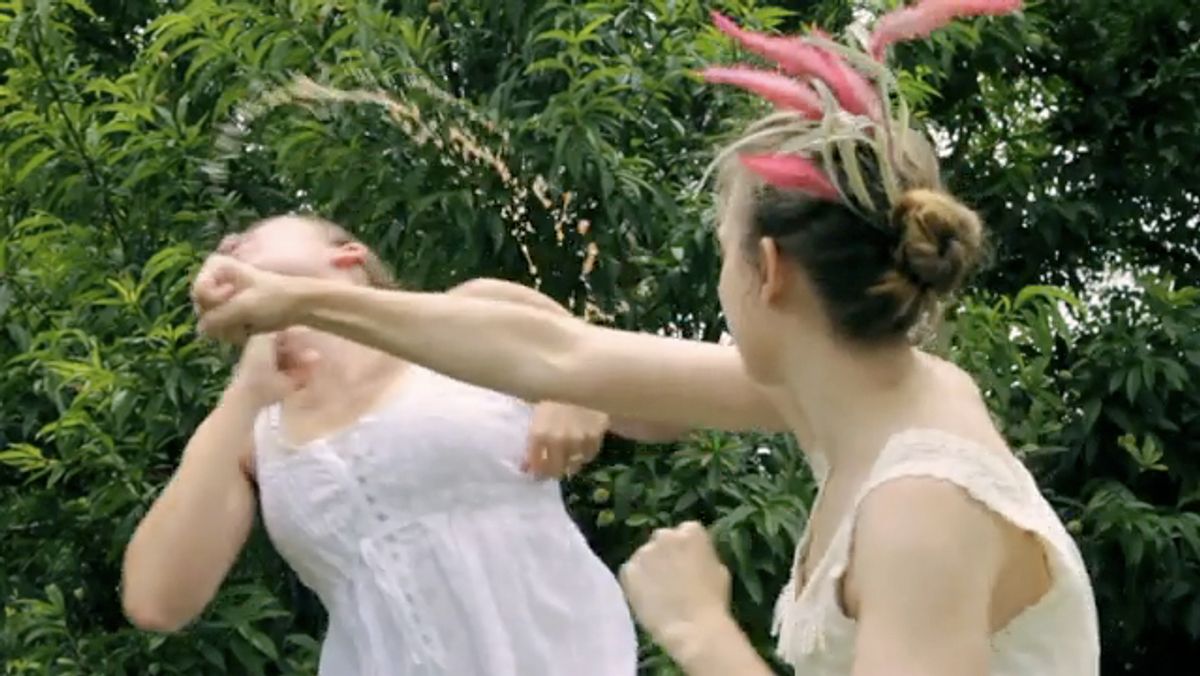
On Sunday, we learned of the latest literary mash-up, “Jane Austen’s Fight Club,” via Mashable. Unlike the trailers for the bestselling “Pride and Prejudice and Zombies” or the less-successful sequels “Sense and Sensibility and Sea Monsters” and “Mansfield Park and Mummies,” this entry doesn’t even represent a dead-tree product; there’s no book, just a video in which the female characters from “Pride and Prejudice” act out scenes from the Chuck Palahniuk novel/David Fincher movie in Regency costume.

It’s pretty funny, but a remark from Mashable’s Brenna Ehrlich got some of us at the Salon offices thinking: “We imagine,” Ehrlich wrote, “a whole lot more boys would have been OK with reading ‘Pride and Prejudice’ had Lizzy [sic] busted out with a roundhouse once in a while.” Maybe so, but we couldn’t help noticing that the vast majority of the Austen mash-ups involve injecting some action element from contemporary pop culture into Austen’s stories in order to make the novels more interesting. This seems to work for quite a few readers, but those of us who find Austen’s books sufficiently interesting on their own are left to wonder when the favor will be returned. We’ve been shown what zombies and monsters and bare-knuckle brawlers can do for Jane — when do we get to see what Jane can do for them?

As someone who has seen nearly every horror film released in the 1980s (What can I say? It was a golden age) and a goodly chunk of the ones that followed, I regard my zombie-movie-buff credentials as secure. Still, the form has gotten a bit tired: the shuffling, semi-decomposed hordes of the undead, the moaning and pawing, the obsession with brains. A good bit of the appeal of Danny Boyle’s fine “28 Days Later” was simply that the zombies in it are fast. When a variation that small can be touted as a thrilling innovation, you know a genre has gotten a bit, um, moribund.

Then take “Fight Club.” It’s a media property founded on the premise that men getting together to beat each other up represents meaningful resistance to a culture whose entertainments consist largely of depictions of men beating each other up. As social commentary goes, that’s pretty rudimentary, but compared to the mind-set behind the average action movie, it’s Thorstein Veblen. Surely action movies, as well as horror films, could benefit from an injection of Austenian wit, social satire, moral insight and depth of characterization? Because, let’s face it: Too much of popular entertainment relies on fight scenes to gin up “excitement,” and the dirty little secret is that, for a lot of us, the never-ending parade of fisticuffs, martial arts and car chases gets pretty dull.

Granted, we have a Jane Austen problem. Austen, like Jesus, is most misunderstood and misrepresented by those who claim to love her best. Somehow, a writer regarded by previous generations as among the greatest novelists of all time, widely read by both men and women, has lately been cast in the role of the grandmother of chick lit. Nostalgic fetishists of tea sets, balls, empire-waist gowns and Colin Firth choose to see the milieu of Austen’s novels as a theme park for genteel romance instead of as the unforgiving shark pond it actually was. Pop culture can only take advantage of what Austen has to offer when it realizes what’s actually there.

Still, we found it hard to imagine a better Austen mash-up — one in which an Austen character steps into an action movie scenario, for example, to liven things up. The best prototype I could come up with was sadly dated: Stella Gibbons’ brilliant comic novel of 1932, “Cold Comfort Farm.” Made into a film starring Kate Beckinsale in 1995, this is that rare thing, a satire so good it has survived the thing it satirizes. Gibbons mocked the brooding, rural gothic novels of her time by casting brisk, sensible Flora Poste (who maintains that she shares with her idol, Austen, an inability to “endure messes”) among the gloomy, mad and oversexed Starkadders of Cold Comfort Farm. She soon whips them all into shape.

There have been some nascent efforts on YouTube. One spoof splices the soundtrack of a trailer for “Pride and Prejudice” onto the trailer for “Star Wars Episode II: Attack of the Clones.” Unfortunately, it uses the awful, pandering 2005 version of “Pride and Prejudice” starring (shudder) Keira Knightley as Elizabeth Bennet. Also, “Clones” is so boring you could graft a recording of the Wichita city council meeting onto it and make it better.

So we throw a challenge out there, to Salon readers and Internet visionaries beyond: What would Emma Woodhouse have to say to John McClane (“Die Hard”) and what could Lizzie Bennet teach Jack Ryan (“Patriot Games”)? Blog your suggestions on Open Salon, just make sure to tag your posts “Austen mash-up.”

Referenced in this article:

Mashable item about “Jane Austen’s Fight Club”

“Jane Austen’s Fight Club” trailer

“Pride and Prejudice and Zombies” trailer

“Pride and Prejudice and Star Wars” trailer

Laura Miller

Laura Miller is a senior writer for Salon. She is the author of "The Magician's Book: A Skeptic's Adventures in Narnia" and has a Web site, magiciansbook.com.

Sold: The ultimate Jane Austen accessory

Updated: A rare, unfinished manuscript commands $1.6 million in London

  • more
    • All Share Services

Sold: The ultimate Jane Austen accessory

[UPDATED BELOW]

There are Jane Austen fans and Jane Austen fans. Enough die-hards fall into the latter category to fuel a lively trade in Austen-themed knickknacks, costumes and accessories — but it’s unlikely that many Jane-lovers will be able to trump Thursday’s major Austen acquisition.

Sotheby’s has sold a partial manuscript of Austen’s unfinished 1804 work “The Watsons” in London for $1.6 million. The AP says the auction house has confirmed that “it is the only major manuscript by the author still in private hands” — but the name of the buyer (person or institution) hasn’t been made public. (The rest of the “Watsons” manuscript, which resides at the Morgan Library in New York, can be seen here.)

Heartfelt though their feelings for the late English prose-smith might be, few run-of-the mill fans can afford to splurge on an original manuscript (not that they’ll get many opportunities). Here are some more modest — and, in certain cases, eccentric — options:

UPDATE: The “Watsons” manuscript was acquired by Oxford University’s Bodleian Library.

Continue Reading Close

Emma Mustich is a Salon contributor. Follow her on Twitter: @emustich.

V. S. Naipaul says women can’t write

The prizewinner slams Jane Austen and claims men are better novelists. It would be funny if it weren't so sad

  • more
    • All Share Services

V. S. Naipaul says women can't writeV.S. Naipaul

How banal life would be without the feud-picking, egomaniacal literary blowhard. Imagine if we had to rely solely on Alain de Botton’s novels, without the pleasure of his “I will hate you till the day I die and wish you nothing but ill will in every career move you make” rants to his critics. Consider a world with only John Fowles’ novels, and no boasts that “I think I understand Nabokov better than any other of his readers … I am psychologically of the same tribe.”  Contemplate the tragedy that would have been Norman Mailer as a publicity-shy recluse. And then there’s V.S. Naipaul – Booker Prize winner, Nobel Prize winner, Paul Theroux feuder, and, mostly recently, Jane Austen disser.

In an interview with the Royal Geographic Society on Tuesday Naipaul replied, “I don’t think so” when asked if he considered any woman writer his literary match. He further said, of Jane Austen, that he “couldn’t possibly share her sentimental ambitions, her sentimental sense of the world,” elaborating that women writers are “quite different … I read a piece of writing and within a paragraph or two I know whether it is by a woman or not. I think [it is] unequal to me.” 

Poor Jane Austen. She’s had to bear such an astonishing amount of the weight of the female canon all these centuries — and now some Nobel Prize winner comes along and craps all over her accomplishments anyway. And Naipaul didn’t stop there, adding, “My publisher, who was so good as a taster and editor, when she became a writer, lo and behold, it was all this feminine tosh. I don’t mean this in any unkind way.” Ladies, if you’re suffering from feminine tosh, talk to your doctor.

Naipaul’s dude-centric braggadocio would be flat out hilarious if it hadn’t provoked the inevitable soft-pedaled sexist observations of why there’s never been a female Shakespeare or Tolstoy or fill-in-the-blank, including Melanie McDonagh’s halfhearted observation in the Evening Standard that “pound for pound, women writers don’t match men in size and weight.”

Let’s forget for a minute the millennia of restrictions that made a life of letters impossible for almost all women throughout history. Ignore the questions of whether women have had equal opportunity to write important books, and get right to the heart of Naipaul’s assertion — that they’re incapable of doing it. Because what he’s really getting at is a persistent attitude that runs rampant not just in the arts but in business, in sports, and anywhere men and women congregate: that the feminine is automatically unimportant and inferior, that “size and weight,” so to speak, are the only criteria worth measuring.

Edith Wharton and Willa Cather and, for that matter, the brilliant J.K. Rowling did not write like dudes. The Brontë sisters didn’t either, although their alter egos Currer, Ellis and Acton Bell sure pulled the wool over a few eyes in their time — even if they couldn’t have fooled a lady-sniffing genius like Naipaul. The female experience in the world is unique from that of the male. Yet plenty of people, not just gasbag old men giving interviews to the Royal Geographic Society, believe different is lesser, that merit is synonymous with masculinity. That to think or run or react or write like a girl is insufficient.

The wisest observers of human nature are the ones who can illuminate without bias.  They’re the ones who can opine that “Your feelings may be the strongest but … ours are the most tender” without assuming that strength automatically has a greater value than tenderness.  And to write them off would be to miss out on the genius of a Jane Austen, an author who knew that when it comes to men and women, “I will not allow books to prove anything.”

Continue Reading Close
Mary Elizabeth Williams

Mary Elizabeth Williams is a staff writer for Salon and the author of "Gimme Shelter: My Three Years Searching for the American Dream." Follow her on Twitter: @embeedub.

Does reading great books make you a better person?

A critic says Jane Austen taught him to be a more decent man, but the world is full of well-read jerks

  • more
    • All Share Services

Does reading great books make you a better person?Detail from the cover of "A Jane Austen Education" by William Deresiewicz

Seeing a favorite critic expound at length on a favorite author is an undersung form of literary pleasure — as close as you can get to reading two great writers at the same time. William Deresiewicz’s “A Jane Austen Education: How Six Novels Taught Me About Love, Friendship and the Things That Really Matter” certainly achieves that effect for this particular reader. Like Austen, Deresiewicz is lucid, principled and knows how to think as well as how to feel, without ever sacrificing one to the other. He understands that most of us want more than just an exquisite aesthetic experience from a novel. His reviews are gratifying even when you feel inclined to quarrel with them, and (unlike a surprising number of esteemed critics) he has a sense of humor.

But I am going to quarrel, just a little, and not because “A Jane Austen Education” isn’t a delightful and enlightening book. It is both of those things. Furthermore, Austen’s reputation is sinking, quicksand-style, into that of a purveyor of romantic wish-fulfillment and empire-waist nostalgia; Deresiewicz offers it a gallant hand up. His book is a reminder of why she has long been regarded as among the greatest novelists of the English language, even by those who do not swoon for Colin Firth. The legendary prime minister Benjamin Disraeli (a man of the world if there ever was one), when asked if he found the time to read novels, replied that indeed he did: “All six of them, every year.”

Deresiewicz would surely agree with Disraeli’s prescription. In “A Jane Austen Education” he explains how his long engagement with “all six of them” helped convert him from a surly, preening grad student — “about as dumb, in all human things, as any 26-year-old has a right to be” and grandiosely convinced that anything other than “complex, difficult, sophisticated” modernist fiction was beneath him — into a decent, civilized man.

It began when a professor forced him to read “Emma.” Balky at first, Deresiewicz was soon thunderstruck by the revelation that Austen had “not been writing about everyday things because she couldn’t think of anything else to talk about. She had been writing about them because she wanted to show how important they really are.”

Each chapter in this fusion of memoir and literary criticism reflects on how one Austen novel helped Deresiewicz reach a fuller understanding of some important aspect of life: common courtesy, learning, the importance of character over charm, social status, friendship and love. He makes a good case; Austen is a profoundly moral novelist and surely meant her readers to glean some insights on how best to live from reading her books. I do not doubt that Deresiewicz improved a lot while reading them. It’s the causal relationship between the two phenomena that I doubt.

Does reading great literature make you a better person? I’ve not seen much evidence for this common belief. Some of the best-read people I know are thoroughgoing jerks, and some of the kindest and noblest verge on the illiterate — which is admittedly an anecdotal argument, but then, when it comes to this topic, what isn’t?

There’s a theory, vaguely associated with evolutionary psychology, maintaining that fiction builds empathy, and therefore morality, by inviting us into the minds, hearts and experiences of others. This is what the British children’s book author Michael Morpurgo implied recently in the Observer newspaper, when he claimed that “developing in young children a love of poems and stories” might someday render the human-rights organization Amnesty International obsolete.

While I’m all for cultivating such tastes in children, I also don’t think the love of stories has to be taught. Most children are keenly interested in stories in all their forms. (Reading is a different matter.) They always have been. Yet there has always been a need for groups like Amnesty and it seems probable there always will be, no matter how many stories we pump into our youth.

Isn’t it just as likely that many people who are already empathetic and moral will be drawn to literature because they’re curious about and interested in how others think and feel? Of course, not everyone with a literary appetite is so motivated. Quite a few, like the youthful Deresiewicz, are driven by intellectual vanity. Perhaps Deresiewicz seized on Austen precisely because he was ready to become less self-involved and her novels spoke to this shift in his taste. If they had been forced on his (presumably even dumber) 22-year-old self, would they have had the same salutary effect, or would he just have dug in his heels and sneered?

So while I thoroughly enjoyed “A Jane Austen Education,” I didn’t entirely buy it. Its narrative seemed constrained by the very American (and fairly puritanical) notion that culture proves its worth by demonstrating that it leads to self-improvement. This approach, at its worst, can make literature seem like some dull but nutritious foodstuff that must be dutifully chewed and swallowed, however little pleasure it may give. That’s not why I read Jane Austen — it’s not even why I read “A Jane Austen Education” — and I suspect it’s not why Deresiewicz reads her, either. Something tells me that he has gotten a lot more out of those six novels than life lessons, and I’d like to read about that, too.

Further reading

William Deresiewicz’ website, where you can find links to his reviews and essays

Michael Morpurgo on children, literature and human rights in the Observer

Continue Reading Close
Laura Miller

Laura Miller is a senior writer for Salon. She is the author of "The Magician's Book: A Skeptic's Adventures in Narnia" and has a Web site, magiciansbook.com.

Which literary character is a Facebook addict?

From Sherlock Holmes to Jane Austen: How classic fiction figures would have adapted to the digital age

  • more
    • All Share Services

Which literary character is a Facebook addict?

In the BBC’s clever new reboot of the Sherlock Holmes stories, the great detective plies his trade in the present day. Sir Arthur Conan Doyle’s creation is so utterly identified with late Victorian London as to make this seem almost unimaginable, but the miniseries’ creators have imagined it — specifically which aspects of 21st-century life Holmes would wholeheartedly embrace. He likes to text.

It makes sense; Holmes — played as a chilly yet frisky über-nerd by the wondrously named Benedict Cumberbatch — would naturally prefer to issue his opinions and summons without having to suffer the responses of average “idiots.” In the first episode of “Sherlock,” a beleaguered Inspector Lestrade, in the midst of a press conference about a rash of suspicious deaths, receives a barrage of one-word texts from the detective: “WRONG,” “WRONG” and “WRONG.” A moment later, the whole press corps starts getting them, too.

When it comes to integrating new technologies into familiar fictional forms, we’ve mostly seen one of three things: forgettably gimmicky novels told entirely in e-mails; hysteria about the demonic properties of the Internet; or complaints about how cellphones and GPS have ruined a handful of reliable thriller and horror tricks. It’s a lot harder these days to believably strand the hero or heroine in some remote, sinister locale, cut off from any opportunity to summon help.

But there’s no reason to assume that the devices that have transformed our daily lives must inevitably scuttle our storytelling. Some things never change. (The Dr. Watson of “Sherlock,” for example, is still recovering from a bullet wound, and he still got it in Afghanistan.) People are still people and Sherlock Holmes will certainly always be Sherlock Holmes. Which raises the question of how some of literature’s other great characters might have taken advantage of the digital age.

The ill-fated matchmaking and meddling of Jane Austen’s Emma Woodhouse, for example, was seamlessly updated to include cellphones in the 1995 movie “Clueless.” Of course, an Emma transposed to 2010 would have a field day with Facebook, nudging acquaintances to friend each other and forming little groups like “People Who Have Heard Quite Enough in Praise of Jane Fairfax,” to the dismay of Mr. Knightley. Can anyone doubt that if Holden Caulfield were around today he’d have a blog? He practically invented the blog, five decades before the things existed! As for James Joyce’s Stephen Dedalus: He’d have a Tumblr.

Would it necessarily detract from “Moby-Dick” if Ahab implanted a GPS chip in the white whale, and couldn’t Iago have spread doubt and suspicion even more insidiously as an anonymous Internet commenter? Scarlett O’Hara could have bypassed that loveless marriage to Frank Kennedy and financed the restoration of Tara by using the project as the premise for a reality TV show. That would be just like her — and the dress made out of old curtains would still play.

Josef K. would get trapped in voice-mail hell while trying to get out from under a robo-signed mortgage. Jay Gatsby and Becky Sharp would live in dread of a shrewdly executed Google search. Fagin would graduate from picking pockets to identity theft. And as for Jeeves, it’s no coincidence that an Internet search engine was once named after him; I wouldn’t be surprised if he had a secret, time-warping connection to the Web all along.

What about it, Salon readers: Which new technologies would feature in an updating of your favorite classic books? Post your responses in the comments thread.

Referenced in this article:

Website for “Masterpiece Mystery: Sherlock”

Continue Reading Close
Laura Miller

Laura Miller is a senior writer for Salon. She is the author of "The Magician's Book: A Skeptic's Adventures in Narnia" and has a Web site, magiciansbook.com.

The battle for Jane Austen

Great novelist, chick-lit pioneer, vampire. Will the real Miss Austen please stand up?

  • more
    • All Share Services

The battle for Jane Austen

“The novels of Jane Austen/Are the ones to get lost in,” wrote G.K. Chesterton, and millions of readers have done just that. Since 1995 in particular, when the BBC adaptation of “Pride and Prejudice” starring Colin Firth conquered untold numbers of female hearts, Austen and her (now) most celebrated creation, Mr. Darcy, have become touchstones for a certain strain of contemporary feminine longing. That the following year brought Helen Fielding’s “Bridget Jones’s Diary,” which borrows its plot and hero’s last name from “Pride and Prejudice,” only cemented this idea in the public mind: Jane Austen is the grandmother of chick lit.

While she didn’t quite invent the romantic comedy (Shakespeare’s “Much Ado About Nothing,” a clear inspiration for “Pride and Prejudice,” can probably claim that honor), Austen surely conceived and perfected it in its modern form; no one has ever surpassed “Pride and Prejudice,” and not due to any lack of trying. Still, literary achievement can hardly explain the Austen craze. Many books labeled “classics” can also be fairly called “beloved,” but Austen is canonical in two senses of the word at once. Who else among the acknowledged greatest novelists of all time has inspired such an abundant and robust body of fan fiction? What other author’s fan fiction gets published so extensively?

The Austenphile Web site the Republic of Pemberley lists 60 published “sequels and continuations” of “Pride and Prejudice” alone. Austen’s five other major novels have their spinoffs, as well, though none so many as “Pride and Prejudice.” That count doesn’t even include “Pride and Prejudice and Zombies,” a surprise bestseller last year and the first in a seemingly endless proliferation of classics mashups. It also doesn’t factor in all the fiction in which Austen herself is a character, such as Stephanie Barron’s mystery series in which the novelist plays detective. Or the newly published “Jane Bites Back,” in which multiple publishing trends converge to make Austen a vampire who survives to this day in the guise of a lonely middle-aged bookseller in upstate New York, miffed by her posthumous transformation into a global brand. And then there’s the subgenre of chick lit about contemporary women struggling to resign themselves to a dearth of Darcyesque beaux (“Austenland,” “Me and Mr. Darcy”). We may love to get lost in Jane Austen’s novels, but it’s worth wondering if, by this point, they haven’t gotten a bit lost in us.

Reading “A Truth Universally Acknowledged: 33 Great Writers on Why We Read Jane Austen” only deepens the mystery surrounding these phenomena. From the various essays in this collection, most previously published throughout the past century, we can see that being “slightly imbecile about Jane Austen” is a condition that predates not only the BBC adaptation of “Pride and Prejudice,” but television itself. The novelist E.M. Forster described himself using that epithet in 1936 — although he probably wouldn’t have gone so far as to check into a resort in which one can simulate life in Regency-era England, like the heroine of “Austenland.”

“A Truth Universally Acknowledged” (edited by Susannah Carson) reminds us that before all the lovelorn pining over Colin Firth in a soaked puffy shirt, Austen was read and admired by plenty of people — men included! — who considered literary merit a very serious matter indeed. Some have done so even as they marvel over the cultish allure of her novels. Martin Amis, of all people, cries out to know, “Why does the reader yearn with such helpless fervor for the marriage of Elizabeth Bennet and Mr. Darcy?” (Well might Amis ask how any novelist manages to make readers care about the fate of her characters; he might learn something.) Lionel Trilling recounts his amazement when 150 students applied for 30 spots in an Austen seminar he taught in 1973, and the “hysterical moral urgency” with which they petitioned to get in. C.S. Lewis, who never considered gravitas to be incompatible with a good read, nevertheless wrote in praise of the “hardness” of Austen’s moral rigor.

Alongside these sober gentlemen are the obsessive “Janeites,” the buffs, whom Henry James accused of turning Austen into “everybody’s dear Jane,” which is certainly a fit characterization of the Jane Austen in Michael Thomas Ford’s “Jane Bites Back.” Despite being a 200-year-old bloodsucker, Ford’s Jane has none of the merciless wit the real Austen displayed in her fiction or in letters to her beloved sister Cassandra. Instead, this current-day Austen is all too banal and “relatable,” coming home from a day in the shop to mope in her fluffy bathrobe with a book, a bar of chocolate and a glass of merlot. She even has a cat. When a suitor opens the door for her, “she couldn’t help thinking how dashing he was. A true gentleman.” It’s hard to believe that with immortality and two centuries of experience the author of “Emma” would diminish into such a lusterless fuddy-duddy. Worse yet, Ford’s Jane has been nursing an unpublished novel; limp excerpts from it — full of the kind of wheezy melodrama Austen parodied in “Northanger Abbey” — open each chapter.

Critics have been inveighing at length against the “mere mass of cozy family adulation” expressed by the garden-variety, tea-sipping Janeites since Marvin Mudrick published “Jane Austen: Irony as Defense and Discovery” in 1952. Irony (the real kind, not the Alanis Morissette variety) was Austen’s predominant mode, as Mudrick pointed out, and this not only made her “almost inhumanly cold and penetrating” but also positioned her against “all the delusions intrinsic to conventional art and conventional society.” That was the manly ’50s speaking; by the 2000s, Austen became, in the popular mind, a wistful reminder of all the chivalrous pleasures of a long-lost social order — a society that would have driven the average contemporary Janeite to insurrection if she actually had to live in it.

Like Dumbledore’s mirror, Austen’s fiction seems to have the ability to reflect whatever its readers most wish to see. Austen is the grandmother of chick lit, much as that fact may irk her highbrow admirers. But that’s not all she is, and to persuade yourself that her novels are only about being courted by rich, handsome men well-versed in ballroom etiquette is to be as dangerously silly and frivolous as Elizabeth Bennet’s youngest sister, Lydia. The chick-lit take on Austen is forever trying to subtract the brutal social and economic realities from her fiction (as well as ignoring the mortifications her heroines undergo), but there’s yet another category of Janeite that doesn’t want to take anything out. Instead, they prefer to add.

The recently published “Pride/Prejudice” by Ann Herendeen posits that before Elizabeth and Darcy united, they each had same-sex affairs: Elizabeth with Charlotte Lucas and Darcy with Mr. Bingley. Supposedly this explains why they were both so dead set against the marriages of their friends, although Austen’s novel provides perfectly adequate, if a lot less titillating, reasons. Some readers may be disappointed to see Lizzy and Charlotte’s trysts mentioned only in passing, while Darcy’s bedroom romps with Bingley and a few other fellows (he belongs to a gentlemen’s club in London — a very, very naughty gentlemen’s club) are described in considerable detail. The title of the book — “slash” is a term for fan fiction featuring the romantic pairing of male characters who are ostensibly straight in the canonical original — says it all. Within the first few pages, Bingley is archly whispering to Darcy, “Kiss me again, brute.”

Despite such lapses, Herendeen does a better job than most of approximating Austen’s style without aping it, and when Darcy and Elizabeth finally marry, she gives us the wedding night that has probably been the subject of more Janeite fantasizing than anything else. Even Amis expressed a wish for “a 20-page sex scene featuring the two principles, with Mr. Darcy, furthermore, acquitting himself uncommonly well.” (Twenty pages — really? You’re stronger man than I am, Mr. Amis.) I must confess that I’ve never felt the lack of this scene, so I can’t say whether Herendeen’s version lives up to expectations, but it does involve an awful lot of talking.

For the kind of fan who writes “Pride/Prejudice” or “Darcy & Elizabeth: Nights and Days at Pemberley” or “Mr. Darcy’s Diary” or, for that matter, “Mr. Darcy, Vampyre” (there are, in fact, two different series featuring an undead Darcy), there just isn’t enough Jane Austen, and cranking out sequels and auxiliary works is the only response to an unquenchable craving for more. Since so many of these fans have difficulty even registering those elements of her work that don’t amount to romantic wish-fulfillment and quaint gentility, you would think they’d be easily satisfied with the imitations, but this doesn’t seem to be the case; none of them has been greeted with much acclaim. How often, when we get what we think we want, do we find ourselves obscurely disappointed? Perhaps one secret of Austen’s charisma is that, like an accomplished flirt, she knows better than to grant her audience’s fondest wishes: Her romances are not as passionate as the Janeites might desire, but neither is her morality as “cold and penetrating” as the sterner scholars portray it.

The final, most startling and most successful of the Austen spinoffs, “Pride and Prejudice and Zombies,” constitutes a special category, since it’s neither a sequel nor an attempt to imagine the off-stage action from the canonical novels. Instead, it’s simply “Pride and Prejudice” (the text of which is in the public domain) with the occasional insertion of campy horror movie scenes. It’s one moderately amusing joke, run pretty much into the ground. From the reports of a bookseller acquaintance, most of the people who buy it have no intention of reading it, they’re just tickled by the cover art or want it for a gag gift. (A subsequent offering, “Sense and Sensibility and Sea Monsters” isn’t selling very well, which tends to confirm that theory.)

I wouldn’t be surprised, though, if the publisher of “Pride and Prejudice and Zombies” hasn’t inadvertently hit upon the only real antidote to Austen’s new reputation as chick lit’s progenitor and therefore a strictly feminine taste. In the pop culture universe, zombies are rather a guy thing — they exist primarily to be mowed down without remorse in video games. Zombie-based entertainment turns out to much easier to successfully churn out than Austen-quality fiction, and the true zombie aficionado has many, many other fine options to choose from when seeking to gratify his (or her) lust for slaughter and gore. “Pride and Prejudice and Zombies,” in short, hasn’t got much to offer anyone who’s seriously into zombies because the vast majority of the book still consists of the courtship tribulations of the Bennet sisters.

However, you can read “Pride and Prejudice and Zombies” pretending that you’re in it for the zombies or the laughs while secretly relishing Austen’s sublime romantic comedy. At least, that’s how I read it — not, that is, with any pretense, but, as I went along, finding myself increasingly skimming over the interjections of horror and combat to get back to the real story. Not being a Janeite myself, I had no plans to reread the novel, and so this was like running into an old, neglected friend unexpectedly, only to be reminded how delightful she is and to ask yourself how you could possibly have forgotten that. The great advantage, the secret weapon of “Pride and Prejudice and Zombies,” is that when you tire of the beheadings and the martial arts and the blood and guts, it’s still “Pride and Prejudice.” And you know that can’t be bad.

Continue Reading Close
Laura Miller

Laura Miller is a senior writer for Salon. She is the author of "The Magician's Book: A Skeptic's Adventures in Narnia" and has a Web site, magiciansbook.com.

Page 1 of 4 in Jane Austen