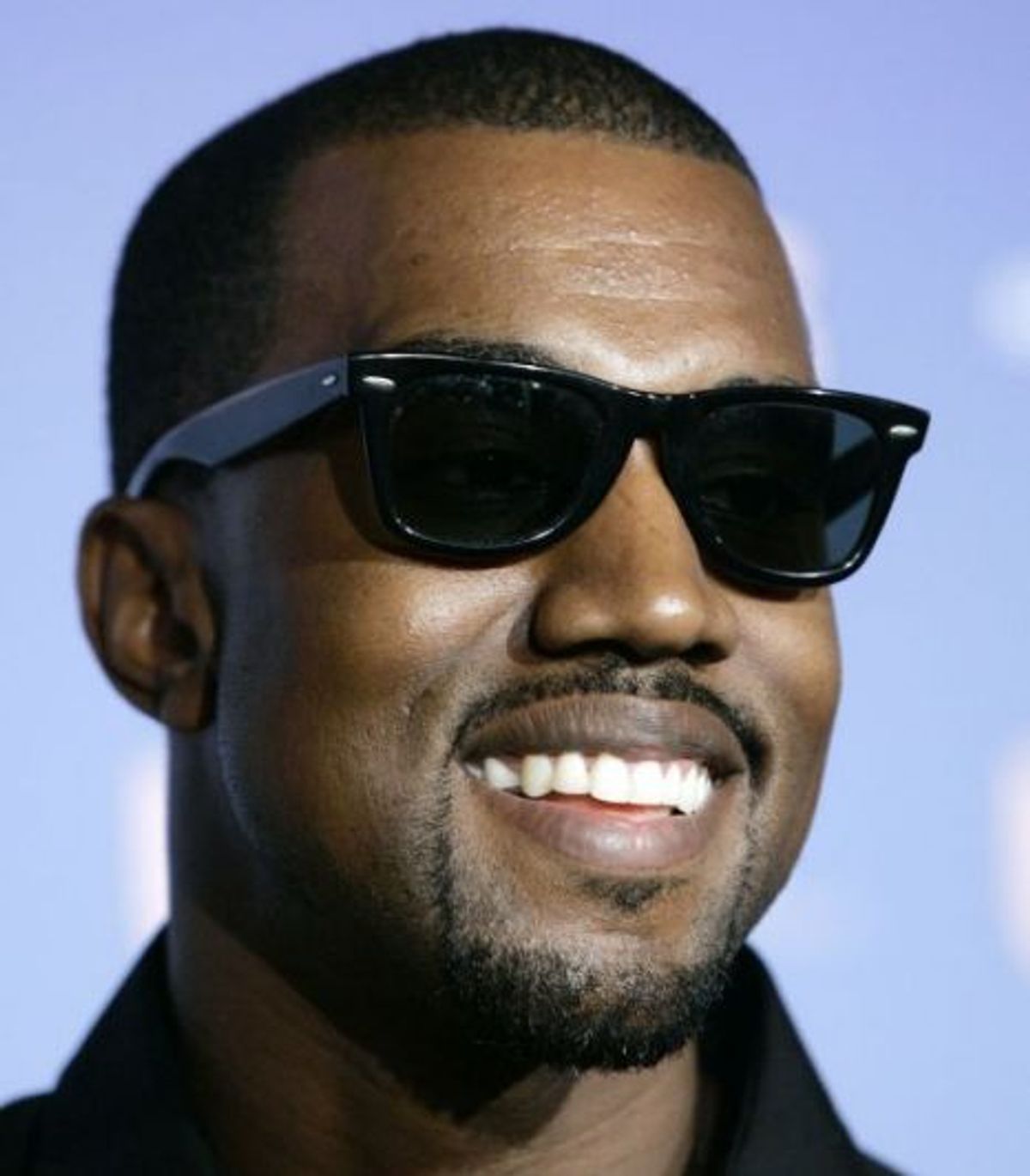
Kanye West is slowly creeping back from self-imposed exile after the Taylor Swift debacle. And it’s about time.
The bombastic, often-contentious rapper has finally gotten with the times and joined Twitter. It was an unexpected move considering West lambasted the microblogging site in 2009 for allowing an imposter to use his name. In his blog, West, ever the moral sage, ranted that Twitter was “IRRESPONSIBLE” and “DECEITFUL” and swore he would never join. He brushed it off as a waste of time.
Well, he’s changed his mind. And this is great news for hip-hop fans everywhere. If you could choose any rapper in the world to have a Twitter account, chances are high it would be Kanye West, who, as annoying and entitled and childish as he is, always makes for a good quote. Boring and Kanye West just don’t mix.
West’s first words to the Twitter world, however, were benign enough. “Up early in the morning taking meetings in Silicone Valley,” he said of his meeting at Facebook headquarters in Palo Alto, Calif. Though he did misspell “Silicon Valley” as “Silicone Valley.”
But as the day passed West got into the swing of things and was back to his usual entertaining self. He teased fans with tidbits about his upcoming album, saying, “The Album is no longer called ‘Good Ass Job’ “ — as it was rumored to be — “I’m bouncing a couple of title around now.”
West was clearly in a giving mood. He not only dropped hints about the album, he debuted a few of the tracks at the Facebook offices in a fashion only West can — a capella, on a folding table, in a slim black suit against a naked white wall — and it was still captivating.
It’s one thing when the bullies go after us. It’s something else when they go after our kids.
Writer and filmmaker dream hampton is a good mom. She’s respectful of her teenage daughter’s privacy, referring to her in her Twitter and Tumblr feeds only as “awesome daughter,” she says, “because she is, and because I’m private.”
It’s not that she’s secretive about her existence or oblivious to the reality that information can get around. She’s even used the girl’s middle name and image in her other recent writing. But as she puts it — right under a Tumblr photo of the girl in full, face obscuring fencing regalia — a mom’s job is “to love, protect and prepare” her child. So when hampton discovered that a photo she’d posted on her “very private Facebook page” of her daughter with Beyoncé at one of the singer’s recent Revel shows had popped up on Tumblr, she was not pleased. (Hampton collaborated with Mr. Beyoncé himself, Jay-Z, on his bestseller “Decoded,” and she co-wrote the uncompleted project “Black Book.”)
Unfortunately, as Stacia L. Brown first reported on Wednesday on Clutch, it didn’t take long after the image appeared for it to find its way to Twitter as well — and in both places, accompanied by negative comments about the girl’s appearance. So hampton took to Twitter to ask a user who had tweeted it: “How the fuk did you get a picture of my daughter?” and to “take it down pls.” (sic) That’s all it took for things to really get ugly, with spellcheck challenged Beyoncé obsessives ragging on hampton’s “ugly daughter” with the “furry ass face” and a “bitch” mother. Should you have the stomach to read through it, it’s a truly revolting display of cowardly cruelty aimed toward a mother and a young girl whose single crime seems to have been standing next to Beyoncé.
“People accuse me of being naïve that the picture would migrate from Facebook to somewhere else,” hampton told Salon Wednesday. “But I’ve had a Facebook account for years and this never happened. I turn down people all the time who want to friend me. There’s no way to be 100 percent protective, but I try to be thoughtful. And I’ve been surprised at every level by this. It surprises me that I see people who I think are adults, whom I assume are younger but who are grownups who pay bills, behaving like this.”
Hampton’s experience reads like a Greatest Hits of all the most pathetic aspects of online interaction — the way that a request for privacy for one’s child can be cavalierly disregarded, the way that wherever a picture of a female somehow does get out there in the world, it’s an opportunity for a bunch of jerks to snark on her looks. The way that when someone – like a concerned parent, for instance – complains about it, it’s even more fodder for the trolls to make fun of them, to tell them to “shut yo shit down.” “I have a kind daughter,” says hampton. “She doesn’t deserve this. And then my being emotional about this is getting mocked? I don’t have the energy.”
The unpleasant Beyoncé uberfans are not representative of the online community — or even the fan community. Hampton herself describes Twitter as “more loving than hateful,” and spoke fondly to Salon on Wednesday of “my friends I met through Twitter.” But, she adds, “I am surprised this happened. I am. This is about my humanity. And I’m not open to being available for this. I had already been thinking about Twitter and how it creates a false sense of things of intimacy and of importance. I think this was the last straw.”
Hampton, who has taken social media sabbaticals in the past, has decided enough is enough. She posted Tuesday, “I’m not really here for you to be tweeting me, in all kaps, what an ugly ass my child is … I’ve made amazing connections on Twitter, have been intellectually stimulated and have discovered amazing thinkers. But yes, I’m done.” And then she signed off.
People come and go online all the time. And yet the trolls will always be with us, ready to hide behind the veil of anonymity and rip apart girls for their looks. (How bad is it? Last month Alexa Chung bailed on Instagram because of all the comments about her body.) And ready, likewise, to tear into anyone who expresses the authentic human emotions of hurt or anger or displeasure, who doesn’t meekly accept viciousness as the price of participation.
Hampton says her daughter, meanwhile, “just wishes it would stop,” saying, “This isn’t her thing.” And Beyoncé herself has taken matters into her own hands. When the dust settled Tuesday, she posted the contentious photo on her own Tumblr. It’s of two smiling, happy females. They both look radiant. No further comment necessary.
Malcolm Harris (inset) and Occupy Wall Street protesters on the Brooklyn Bridge. (Credit: Sam Margevicius/AP/Daryl Lang)
Last month, Occupy Wall Street participant and Brooklyn Bridge arrestee Malcolm Harris was unable to quash a subpoena demanding Twitter hand over information about his account to the authorities. But in a surprise move this week, Twitter has come out batting for its user.
When a New York judge ruled in April that Harris did not have the standing to fight the subpoena (arguing that his tweets actually belonged to Twitter) and that there were no privacy grounds on which the individual user could refute the demand for his Twitter records, this seemed to suggest something worrying: that we have little jurisdiction over our online identities and can’t even fight for our online speech in court.
Harris’ lawyer, Martin Stolar, told me at the time that he planned to file another motion against the judge’s decision — to re-argue that his client indeed has a standing in fighting the order, and there are strong privacy grounds to resisting the authorities obtaining records of someone’s accumulated Twitter activities (including deleted messages) without a warrant. But now it seems Stolar doesn’t need to file this motion; Twitter has stepped in.
Arguing against the judge’s decision, Twitter’s lawyers point out that Harris does indeed have proprietary rights to his tweets — and has a right to challenge demands for his Twitter records. “To hold otherwise imposes a new and overwhelming burden on Twitter to fight for its users’ rights, since the Order deprives its users of the ability to fight for their own rights.” The social media leviathan’s message is clear: We’ll step in this once so that users can fight for themselves in future.
The points put forward in Twitter’s motion align with those put forward by Harris’ lawyer in the first place. If the district attorney wanted to use publicly available Twitter information as evidence in the case against Harris (which, it bears noting, is a mere violation charge for marching onto the Brooklyn Bridge), then it is possible to follow users on Twitter and glean information this way. It is another thing entirely to demand — without a warrant — an entire record of accumulated Twitter activity be handed over. (Stolar helpfully compared it to the fact that we are able to watch what a driver in a car does at any given time in public; the authorities would need a warrant to put a tracking system into the car to monitor the entirety of its activities.)
“To the extent the desired content is publicly available, the District Attorney could presumably have an investigator print or download it without further burdening Twitter or the Court,” Twitter argued.
Harris responded happily to the news: “It’s an unexpected but reassuring move, now it’s up to the prosecutor’s office whether or not to drop the whole charade. Either way, we’re setting a precedent that social media users and activists won’t be bullied by the state,” he told me via email (full disclosure: we’re friends).
His reference to a “charade” seems apt: Here we have an incident of a California-based social media company with over 140 million users having to deploy its legal resources for a New York case that, at base, is over a charge no more criminal than a traffic ticket. By nesting its little blue tweet birds on the side of its users instead of the authorities in this instance, however, Twitter have set an important precedent in defending online speech.
Harris took to Twitter to comment on the social media giant coming to his defense: “So I wasn’t expecting the two blue birds with shaved heads and ARs standing outside my door, but apparently Twitter goes hard,” he quipped.
Natasha Lennard covers the Occupy movement for Salon. A British-born, Brooklyn-based journalist, she has been covering Occupy Wall Street since before the first sleeping bag was unrolled in Zuccotti Park. One of the first journalists arrested at an Occupy action, she has managed to enrage Andrew Breitbart, Rush Limbaugh and Glenn Beck. You can follow her on Twitter (@natashalennard), and email her any Occupy updates/videos/ideas to natasha.lennard@gmail.com
More Natasha Lennard.
When Barack Obama blew America’s mind by declaring his support for same-sex marriage Wednesday, he explained that his views on the subject had long been “evolving.” But while evolution is a process that can take millennia, social media moves with considerably more swiftness. However long it took the White House (nudged though it was by Joe Biden’s Sunday blurt that he was “absolutely comfortable” with marriage equality) to get to that place, it took no time at all for Obama’s sentiments to become a meme.
It’s no accident that the president’s change of heart happened to make for a perfect sound bite. Nearly as fast as Barack Obama, leader of the free world, could utter the words “Same-sex couples should be able to get married,” to ABC News correspondent Robin Roberts, @barackobama — the president’s not-nearly-as-popular-as@JustinBieber Twitter account — was announcing “Same-sex couples should be able to get married.” As of Thursday morning, it had been retweeted over 56,000 times and counting.
And just like that, what had been a fuzzy campaign issue for Obama just a week ago became a defiant stance – and an easily forwarded post. The president’s Twitter and Facebook accounts wasted no time issuing a photo of Obama with his statement, under the heading, “history.” The campaign’s main page itself immediately splashed up the quote, along with the ABC News clip and the invitation to “stand up with the president.” And the campaign’s colorful, friendly-looking poster stating that “Every single American/Gay Straight Lesbian Bisexual Transgender/Deserves to be treated equally in the eyes of the law and in the eyes of our society/It’s a pretty simple proposition” popped into a place of honor on the Obama Pinterest and Instagram pages.
Elections can turn on a few provocative words – from “Read my lips” to “It’s the economy, stupid” to, simply, “Hope.” But there’s never been a time when a single sentiment could be parroted across so many different platforms. The Obama campaign knows this, and has shrewdly seized upon the immediate, visceral reaction that one sentence can inspire with impressive immediacy. Watch and learn, Romney. Though we’ve yet to see how the president’s “evolved” stance will shake out into real votes in November, for now, it sure makes for a whole lot of likes and pins. Whatever happens next, Obama’s won Twitter.
There’s a lot about what went down with Chicago Sun-Times columnist Joe Cowley’s painfully sexist airplane rant on Twitter this weekend that’s hilarious. There was the whining that “I’m more likely to see a Squatch before I see a hot flight attendant.” There was the concern over flying in a plane with a “Chick pilot.” There was his gloriously tone-deaf response to sportswriter Sloane Martin about his comments, culminating with a demand she “hottie up that [profile] pic a bit more.” Had he added a mention of how much he loves scotchy scotch scotch, the entire tirade could still not have felt more deliriously out of time.
But the most wildly out-of-touch element to the whole affair was what Cowley did next. He shut down his Twitter account. It’s a classic response to an online attack of verbal diarrhea — the old waving of the magic delete wand to make all the bad stuff disappear. Too bad it doesn’t work.
We’ve recently seen a surge of hopeful deletions in the aftermath of stupid tweets. Last week, Mitt Romney spokesman Richard Grenell quietly eradicated his tweets suggesting that Rachel Maddow resembles Justin Bieber and ought to “take a breath and put on a necklace,” along with other gems. According to the Associated Press, Grenell, who’s also taken pot shots on the appearance of Hillary Clinton, Calista Gingrich and Michelle Obama, scrubbed more than 800 tweets from his feed. And last month, actress and conservative windbag Patricia Heaton went on a Sandra Fluke tear, saying “you’ve given yer folks great gift for Mother’s/Father’s Day! Got up in front of whole world & said I’m having tons of sex- pay 4 it!” and suggesting that if Fluke’s followers sent her “one condom, her parents wouldn’t have to cancel basic cable, & she would never reproduce—sound good?” At least Heaton had the sense to acknowledge that she purged the tweets after she removed them, saying, “I apologized to Ms Fluke last week. I may not agree with her views but I didn’t treat her with respect and I’m sorry. I was wrong. Mea culpa.”
The hastily issued, immediately regretted tweet is part of what makes online interaction the entertaining train wreck it so often is. After this year’s Grammys, Chris Brown sent an expletive-laced message to the haters — and promptly removed it. And by now, Kanye West is almost as well known for the tweets he’s withdrawn as the ones that inspired a Josh Groban musical interlude. In a world of handlers and publicists and artfully crated personae, human beings – professional human beings who ought to know better, even — still find a way to make utter boobs of themselves. But what makes the likes of Grenell and Cowley look particularly foolish, isn’t just the inanity of their initial tweetstorms. It’s the cowardly, immature way they ran from them.
Here’s a tip: They’re called screen grabs. When you say something offensive or idiotic, or both, to the entire world, people are going to archive it. You can post it for an amount of time so brief you believe Olympic scorekeepers could not measure it. It doesn’t matter. It’s out there. And if you call yourself a journalist, you in particular should be familiar with a little something known as a correction. That way, when you mess up, you don’t come off looking like you have all the wherewithal of a toddler covering her eyes and boasting, “You can’t see me!” Yeah, we can still see you. That’s how we know how many tweets Grenell deleted. That’s how we know what Cowley said.
People screw up and say dumb things all the time. Sometimes they type them and then impulsively hit the send button. Impulse control: always a losing battle. The best people can do afterward is learn from their mistakes, apologize for them, and move on. And there’s certainly a case to be made for removing words that would cause hurt or offense. The delete button can be your friend. But it’s worthless to try to slink off and do a stealth revision of the past. What you do in public is seen in public. More significantly, it is remembered. Forever.
Malcolm Harris (inset) and Occupy Wall Street protesters on the Brooklyn Bridge. (Credit: Sam Margevicius/AP/Daryl Lang)
I tweet a lot. Sometimes I feel like I tweet more often than I have face-to-face conversations — and therein lie multiple issues that will not be addressed here (but perhaps one day, in therapy). However, in the course of constructing these 140-character-or-less nuggets of opinion, information or political agitation, never did I give much thought to whether these tweets were mine. It turns out they’re not, in the eyes of the law. For all the clamor about Twitter’s revolutionary potential in the Middle East, we have a reminder right here in New York of its revolutionary limitations.
On Monday, a Manhattan judge ruled that writer, Occupy Wall Street participant and prankster (and, for the purpose of full disclosure, my good friend) Malcolm Harris will not be able to block a subpoena on his Twitter account, including “any and all user information including email addresses” tied to it because, according to the judge, our tweets are not ours at all.
Harris, like me and more than 700 others, was arrested on the Brooklyn Bridge roadway last October in one of Occupy Wall Street’s most headline-grabbing days of action. He, like most of the bridge arrestees, was charged with disorderly conduct (a violation equivalent in legal terms to a traffic ticket) but, refusing to plea out, is taking the charge to trial. In January, the Manhattan D.A.’s office sent Twitter a subpoena. Twitter promptly informed Harris, who decided to fight the subpoena with his lawyer, Martin Stolar of the National Lawyers Guild.
In his decision Monday to deny the motion to quash the subpoena, Criminal Court judge Matthew Sciarrino Jr. revealed some potentially worrisome issues about how the law views our relationship with our tweets, which raise further questions about speech, privacy and self-representation. As Stolar explained to me, the judge decided that Harris has “no standing” to fight the subpoena in the first place — because his tweets (including direct messages, which are not publicly published) are not his, but belong to Twitter. The judge also rejected Stolar’s claim that Harris has a privacy interest in quashing the subpoena.
The question whether an individual has the standing to intervene on their own behalf to fight a subpoena served to a third party (in this case Twitter) is an interesting one. It should come as no shock that our tweets actually belong to the social media company; we agree to as much when we join Twitter and accept its terms of use. However, as Stolar points out, there’s long legal precedent for individuals intervening in subpoenas relating to, but not served to, them. For example, patients often intervene to quash subpoenas served to doctors regarding their medical records. Stolar plans to argue that Harris should have a standing in whether the government can (without a warrant) go through his accumulated, even in some parts deleted, Twitter history. Indeed, as the laywer also noted, the subpoena is both so broad and so vague that it’s hard to know how much access it would grant to Harris’ private messages and communications related to his Twitter account.
Which moves us on to the issue of privacy. It’s true that our Twitter behavior is in the public domain. But does this mean there’s no privacy interest when it comes to handing over the accumulated records of all our Twitter behavior to the authorities? Stolar offers this helpful but striking comparison: Say you have car — all your actions, driving around, parking, etc., are in public. However, the government would still need a warrant to track your car using a GPS to get an accumulated record of all your driving activity. Stolar argues that our accumulated Twitter activity should be equally considered in terms of privacy and what the authorities can or cannot demand access to.
“It’s very annoying that the judge said that no one has a privacy interest in their own communications here, their own speech,” said Stolar. I’d say it’s more than annoying — it’s downright worrisome. It should have long been obvious that Twitter is a powerful but limited tool for radical political organizing and agitating — the social media leviathan readily admits it will turn over information to legal authorities. (To its credit, Twitter has rejected gag orders in order to inform Wikileaks followers that the government had requested their Twitter information.) However, the fact that we as users are (legally) considered to have no standing or privacy interest when it comes to our own Twitter histories should serve as a chilling reminder that the nuggets of tweeted speech we send out — our very social media identities — are very distinct entities from our legal selves and the protections those selves are granted.
Of course, the lesson to take away is to tweet with caution. It’s also worth keeping in mind that, although throwing up some important insights, this court battle began over a charge for marching on a bridge. As Stolar puts it, “It’s prosecutorial overkill; using a sledgehammer to squash a gnat.” Harris agrees. He is (as he tends to be) disappointed in the state and surprised that a Harvard Law-trained ADA’s time is being used to pursue his minor charge. The precedent set, however, should give pause to those of us who live (perhaps too much of) our lives through Twitter.
Natasha Lennard covers the Occupy movement for Salon. A British-born, Brooklyn-based journalist, she has been covering Occupy Wall Street since before the first sleeping bag was unrolled in Zuccotti Park. One of the first journalists arrested at an Occupy action, she has managed to enrage Andrew Breitbart, Rush Limbaugh and Glenn Beck. You can follow her on Twitter (@natashalennard), and email her any Occupy updates/videos/ideas to natasha.lennard@gmail.com
More Natasha Lennard.