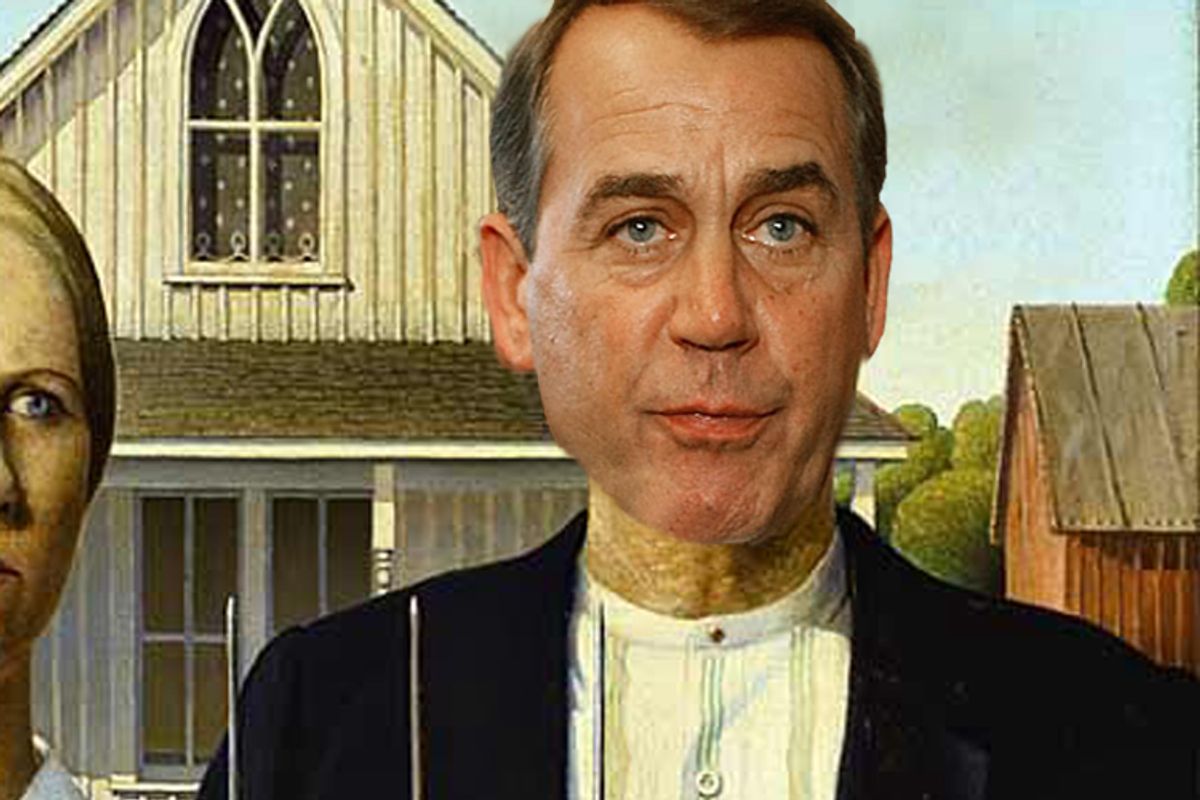
John Boehner, R-Ohio
John Boehner’s doomed political makeover
The would-be speaker may end up learning the same lesson Nancy Pelosi has
John Boehner’s image makeover effort, detailed in Politico on Thursday, seems destined to fail on two fronts.
The House minority leader — who will become the next speaker if the Republicans win back the chamber this fall — is trying to shed his “clubby” reputation on Capitol Hill and to recast himself as a wholesome product of working-class Midwestern roots. The idea is to persuade skeptical would-be donors from far outside the Beltway that Boehner is as culturally allergic to Washington as they are — and, presumably, to begin warming up the general public to the face of the House GOP.
If this all sounds vaguely familiar it’s because Nancy Pelosi tried something similar four years ago, when Democrats found themselves with the political winds at their back — and in position to end their 12-year exile from House control. Back then, Republicans were insisting that they’d retain control of the House by playing up the prospect of a Pelosi speakership — Jane Fonda with a gavel, as one GOPer said to me at the time. And more than a few influential Democrats, still spooked by the savage effectiveness with which the GOP caricatured John Kerry in 2004, feared they might be right.
And so, Pelosi launched her own preemptive image campaign, one that downplayed her San Francisco liberalism and played up her Catholicism and family life. As the GOP increasingly featured her in their attacks, the stock reply from Pelosi’s office would go something like this: Why are the Republicans attacking a churchgoing mother of five and grandmother of five? The Democrats’ triumph that November seemed to vindicate the strategy, and when Pelosi was sworn in as speaker in January 2007, she surrounded herself with nearly a dozen children from her family — hammering home the grandmother image.
What Pelosi and her fellow Democrats soon discovered, though, was that the inoculation campaign had been for naught. For all of the careful planning and message discipline that went into their image campaign, it didn’t stop the GOP from pillorying her as a clueless San Francisco liberal (or from raising big bucks off that caricature), and it didn’t buy the speaker much affection or loyalty from the general public. By the end of her first year as speaker, she sported an upside-down favorable rating — 25 to 38 percent, which she’s been stuck with ever since.
In hindsight, it’s clear what happened. Before the Democrats took power after the 2006 elections, Pelosi was largely unknown to most Americans. To the extent anyone had an opinion of her back then, it was far more likely to be favorable; only hardened Republicans, who would be inclined to view anyone identified as a Democrat unfavorably, had much of a reason to express a negative view of her. So it was that Pelosi’s favorable numbers outpaced her unfavorable, and that the ratio briefly spiked immediately after the ’06 election, when Pelosi was showered with friendly press coverage (and before she and her party actually had to do anything).
But the minute she became speaker, everything changed and Pelosi became the face of an institution that Americans perpetually dislike. When it comes to national public opinion, it seems, the best a speaker can do is to seek anonymity — sort of like Dennis Hastert, who hid in the shadows while his deputy, Tom DeLay, racked up awful headlines and dreadful poll numbers. But Pelosi was never interested in being another Hastert.
When it comes to Boehner, there’s no reason to believe his image campaign — should he become speaker — will yield any more long-term success than Pelosi’s has. The public just doesn’t seem interested in learning about and relating to the personal side of legislative leaders. Voters are never that happy with Congress; it’s just a question of how unhappy they are. And that unhappiness bleeds over into their opinions of congressional leaders.
It also seems unlikely that Boehner will convince anti-Washington conservatives — the more immediate target of his image efforts — that he’s one of them. The fact that Boehner needs to take such pains to reach out to them in the first place is telling: The GOP’s base is disenchanted with the party’s Washington leadership and is reluctant to pony up money.
This disenchantment is at the heart of the Tea Party movement, which essentially represents hard-right conservatives who have traditionally voted Republican but who no longer believe that the GOP establishment means what it says. The idea that Boehner, a 20-year House veteran who stood with his party through one woefully unbalanced Bush budget after another, can appeal to these folks with a brochure that reminds them of his Ohio high school football roots is rather far-fetched.
That’s the kind of pitch that might have worked in 1994, when Republican voters and donors could only dream of what their party would do if it ran the House. But not so much in 2010, when those same voters and donors remember only too well what the GOP — and Boehner — did do when they ran Congress.
Steve Kornacki writes about politics for Salon. Reach him by email at SKornacki@salon.com and follow him on Twitter @SteveKornacki More Steve Kornacki.
The hardy myth of “job creators”
From Ayn Rand to John Boehner, a persistent talking point
(Credit: Wikipedia/AP) With the announcement last Monday of President Obama’s plan to pay for his jobs bill with, among other things, the so-called “Buffett Rule,” we’re going to be hearing a lot more about the “job creators.” Over the last year, Congressional Republicans have consistently invoked them as a hex of sorts against any proposal to raise new tax revenue. “I am not for raising taxes in a recession,” Eric Cantor declared last November, when the Bush tax cuts were a bargaining chip in the protracted budget debate, “especially when it comes to the job creators that we need so desperately to start creating jobs again.”
Continue Reading CloseJohn Paul Rollert is a doctoral student at the Committee on Social Thought at the University of Chicago. More John Paul Rollert.
The audacity of weakness
Another embarrassing fail betrays a White House in a bubble
House Speaker John Boehner of Ohio speaks during a news conference on Capitol Hill in Washington, Thursday, July 28, 2011. (AP Photo/J. Scott Applewhite)(Credit: J. Scott Applewhite) Here was the headline on Yahoo News tonight: “Obama bows to Boehner on jobs speech.”
Bows to Boehner: I can tell you what any progressive who has been paying attention thought, “Oh boy, here we go again.”
President Obama has now changed the day of his address to Congress to accommodate the Republicans. They were having a GOP presidential debate on the original date he picked. So, Boehner told him to move his speech. He is the president for Christ’s sake. Of course, they should have accommodated him, not the other way around. But as usual, President Obama bowed.
Continue Reading CloseHow John Boehner destroyed a nation’s confidence
As the economy stalled, House Republican debt ceiling hostage-taking pushed us in the wrong direction
House Speaker John Boehner Ohio speaks during a news conference on Capitol Hill in Washington, Monday, Aug. 1, 2011, as lawmakers work to finalize the debt deal agreement with one day left to avert a default. (AP Photo/J. Scott Applewhite)(Credit: AP) Tuesday’s big U.S. stock market plunge, following so closely on the heels of the resolution of the debt ceiling crisis, prompted a bumper crop of liberal schadenfreude. A deficit reduction deal that ruled out tax increases, we were told again and again by Republicans, would build “confidence” that Obama’s free-spending ways had supposedly undermined. With their spirits newly bolstered, employers would feel encouraged to start hiring more aggressively. Voilà: an “expansionary fiscal contraction.”
Continue Reading Close
Andrew Leonard is a staff writer at Salon. On Twitter, @koxinga21. More Andrew Leonard.
The debt ceiling “mess” is almost over
The Tea Party cheers and liberals moan as the House votes to lift the debt limit
U.S. House Speaker John Boehner (R-OH) (L) shakes hands with with Majority Leader Eric Cantor (R-VA) (R) as they depart after a news conference about debt relief legislation at the U.S. Capitol in Washington August 1, 2011. Congressional leaders scrambled for enough support from skeptical lawmakers on Monday to push through an 11th-hour deal to raise the U.S. borrowing limit and avert a potentially devastating debt default. REUTERS/Jonathan Ernst (UNITED STATES - Tags: POLITICS BUSINESS)(Credit: Reuters) Our long national debt ceiling nightmare is almost over. Early Monday evening, the House of Representatives voted, 269-161, to pass the deal to hike the debt limit cooked up over the weekend by Senate negotiators. Many Democrats held off voting in favor until the last minute, in an attempt to get as many Republicans to take ownership of the bill as possible. Passage in the Senate is a foregone conclusion, and the White House has already promised that President Obama will promptly sign it into law. The most dramatic moment: A surprise appearance by Gabby Giffords, D-Ariz., who came to vote for the bill and was greeted by a standing ovation.
Continue Reading Close
Andrew Leonard is a staff writer at Salon. On Twitter, @koxinga21. More Andrew Leonard.
Finally the House does… something
John Boehner's hardline debt ceiling plan makes it through. But it has no chance in the Senate. So now what?"
Nancy Pelosi called it a “total waste of time.” Harry Reid promised it would be “dead on arrival” in the Senate. The White House threatened to veto it. Nonetheless, after much drama, the U.S. House of Representatives finally passed the new, revised, more-friendly-to-the-Tea Party “Budget Control Act” by a vote of 218-210. 22 Republicans voted no. Not a single Democrat voted yes.
Continue Reading Close
Andrew Leonard is a staff writer at Salon. On Twitter, @koxinga21. More Andrew Leonard.
Page 1 of 22 in John Boehner, R-Ohio