Afghanistan
Crazy Muslim conspiracy theories
Obama's envoy to the Muslim world is angered and "shocked" by a recitation of basic facts
Rashad Hussain (updated below)
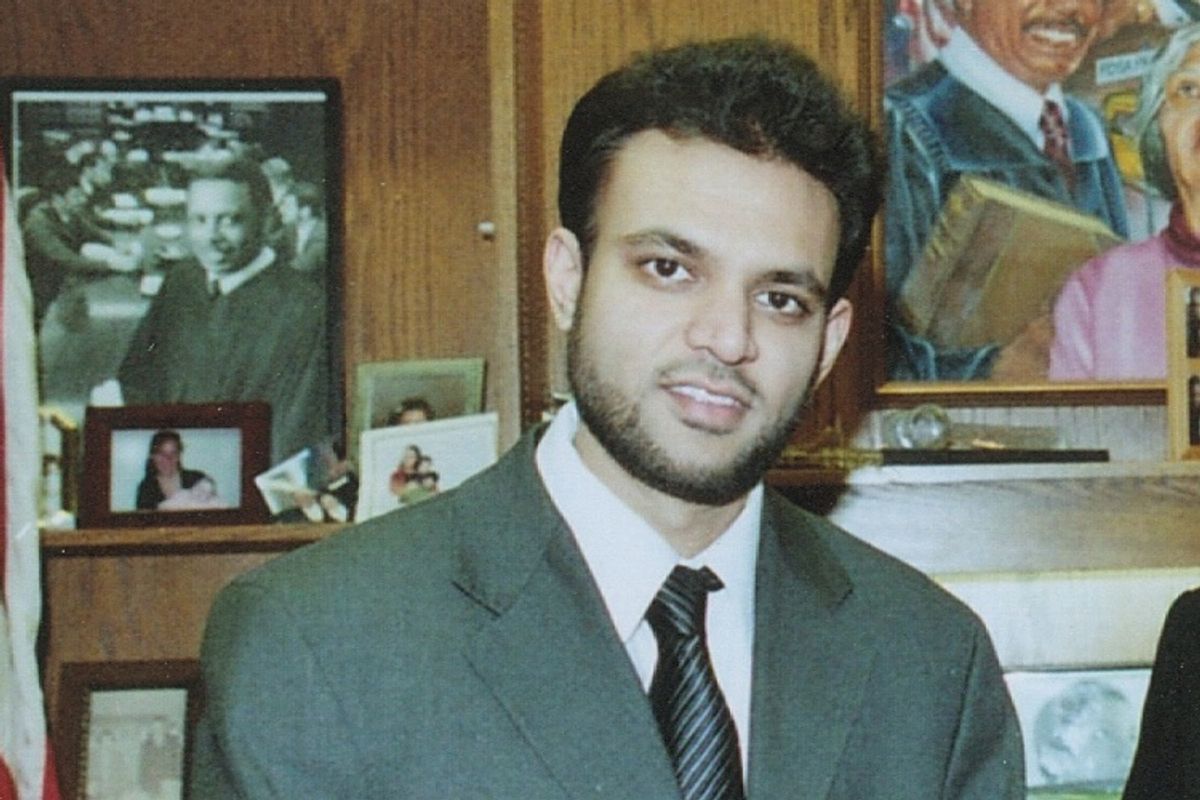
Politico‘s Laura Rozen points to this Times of India article, recounting how Rashad Hussain, the Obama administration’s envoy to the Muslim world, was angered and “shocked” yesterday when — as part of a tour of India to promote better relations with Muslims — “the head of a city-based Muslim institution [Akhtar Hasan Rizvi] slammed the US’ policies, not just in the Middle East, but towards Muslims everywhere”:
Rizvi held America responsible for many woes in the Muslim world. “You supplied arms to Iraq during the Iran-Iraq war, then invaded Iraq in the name of searching for weapons of mass destruction. You created the Taliban with the help of Pakistan. You have been backing Israel ever since its creation. First, right the wrongs that you have created if you want to establish peace in the world,” said Rizvi to applause from the students.
Shocked, Hussain who had earlier talked about the Obama administration’s resolve to partner with the Muslim world for winning hearts and minds, shot back: “I reject the conspiracy theories that are being floated” . . . . Hussain appeared so upset with Rizvi’s trenchant comments that he almost left the dais and wanted to walk out but the meeting’s conductor, Akhtar Chauhan, also director of the institute, requested him to stay back.
Are any of the accusations voiced by Rizvi actually “conspiracy theories,” or are they just all basic, undisputed facts? It certainly appears to me to be the latter. One of the favorite tactics of American political and media elites is to disparage the Muslim world as wallowing in “conspiracy theories” whenever they describe American actions in their part of the world. While there are undoubtedly some such theories in that part of the world and every other, this episode highlights that, more often that not, that claim is made to obfuscate basic truths and to deter those who would point them out. On a not unrelated note, Pakistan President Asif Ali Zardar said this week that the West “is losing the war against the Taliban because we have lost the battle for hearts and minds.”
* * * * *
For all the attempts to dismiss the WikiLeaked documents as irrelevant, boring old news, a new USA Today/Gallup poll shows a significant drop in public support for Obama’s handling of the war in Afghanistan, and strongly suggests that drop is due, at least in part, to the leak of last week and the news stories it generated. Meanwhile, a new Pew Poll shows that Americans under 50 believe the WikiLeaks leak served the public interest, while those over 50 believe it “harmed the public interest.”
UPDATE: Rozen has now added an update to her post after obtaining from Hussain the full text of Rizvi’s remarks, which make Hussain’s reaction more understandable. Though the Times of India account excluded the offending portions, there is one passage in particular that contains some fairly pure and inflammatory anti-semitism. It is likely that it was that part to which Hussain was objecting, and unfortunately, it enabled him to avoid addressing the more substantive points raised by Rizvi.
Follow Glenn Greenwald on Twitter: @ggreenwald. More Glenn Greenwald.
Memorial Day’s lessons in amnesia
If nothing else, the holiday allows us to reflect on our commitment to forgetting bloody conflicts
(Credit: Carly Rose Hennigan via Shutterstock) It’s the saddest reading around: the little announcements that dribble out of the Pentagon every day or two — those terse, relatively uninformative death notices: rank; name; age; small town, suburb, or second-level city of origin; means of death (“small arms fire,” “improvised explosive device,” “the result of gunshot wounds inflicted by an individual wearing an Afghan National Army uniform,” or sometimes something vaguer like “while conducting combat operations,” “supporting Operation Enduring Freedom,” or simply no explanation at all); and the unit the dead soldier belonged to. They are seldom 100 words, even with the usual opening line: “The Department of Defense announced today the death of a soldier who was supporting Operation Enduring Freedom.” Sometimes they include more than one death.
Continue Reading CloseTom Engelhardt, co-founder of the American Empire Project, runs the Nation Institute's TomDispatch.com. His latest book, "The United States of Fear" (Haymarket Books), has just been published. More Tom Engelhardt.
Where the wounded are
Wars don't just cause casualties among soldiers, they drain medical staff. I traveled to see the costs firsthand
A soldier is prepared for an operation at Landstuhl Regional Medical Center. (Credit: Reuters/Kai Pfaffenbach) The weather’s getting warmer in Afghanistan and the war there is heating up again. That means – as it has meant every year for more than a decade — that the pace will quicken at the Landstuhl Regional Medical Center in Germany. More casualties will be brought to this largest American military hospital outside the United States. The Critical Care Air Transport teams and their C-17 Globemasters will fly in from “downrange,” as they call the Afghan battleground, and the injured will be brought by ambulance bus from nearby Ramstein Air Force Base to the hospital front door.
Continue Reading CloseMichael Winship is senior writing fellow at Demos and a senior writer of the new series, Moyers & Company, airing on public television. More Michael Winship.
NATO invites Pakistan to summit
A sign that Islamabad is ready to reopen its western border to NATO troops on their way to Afghanistan
Oil tankers, which were used to transport NATO fuel supplies to Afghanistan, are parked at a compound in Karachi, Pakistan, Tuesday, May 15, 2012. NATO on Tuesday invited Pakistani President Asif Ali Zardari to the alliance's summit in Chicago, after signs that the country could be moving to reopen its Afghan border to NATO military supplies. (AP Photo/Shakil Adil)(Credit: AP) ISLAMABAD (AP) — NATO on Tuesday invited Pakistan’s president to the upcoming Chicago summit on Afghanistan, the strongest sign yet that Islamabad is ready to reopen its western border to U.S. and NATO military supplies heading to the war in the neighboring country.
Pakistan blocked the routes in November after American airstrikes killed 24 of its troops on the Afghan border. The attack sent ties between Washington and Islamabad to new lows, threatening regional cooperation needed for negotiating an end to the Afghan war.
Continue Reading CloseAfghanistan, I can’t quit you
My mom pushed me to join the Marines. Now that she's gone, I'm still drawn to war zones
A child flies a kite in Kabul on Tuesday Mar. 27, 2012. (Credit: Geoffrey Ingersoll) The heat. That’s what I remember most. Shimmery and bright. Blinding. Stifling. Heeee-eeaat.
The kind that’s not just on you, wrapped around you, but balled up and pulsing inside you — a desert blanket with teeth. It’s a type of heat that makes your skin cry and your eyeballs sweat, even in the shade; heat like a predator you can’t run away from.
I notice it right as I get off the plane — not just the degrees but also the dust. Dust you can smell, kicked up by a thousand years of struggle. In a region this old, I’m sure each breath carries a dose of unintended history: Inhale, Alexander the Great; exhale, the Ottoman Empire; inhale, the USSR; exhale, the Taliban.
Continue Reading CloseGeoffrey Ingersoll is a freelance journalist, documentarian, writer, photographer, and veteran of Operation Iraqi Freedom. He is the recipient of the Sam Stavisky Award for Combat Reporting. More Geoffrey Ingersoll.
What Obama didn’t mention in Kabul
Just outside the Afghan capital, the Taliban is in control and preparing for a wider war
President Barack Obama addresses troops at Bagram Air Field, Afghanistan, Wednesday, May 2, 2012. (AP Photo/Charles Dharapak)(Credit: AP) MAHMUD RAQI, Afghanistan — The office of Kapisa’s governor sits high on a hilltop overlooking the provincial capital, Mahmud Raqi. It has a beautiful view of the river below and the mountains, trees and fields that stretch into the distance.
Beneath the tranquil surface, however, lies a grim truth. Just outside town roadside bombs are planted to target NATO convoys.
Page 1 of 122 in Afghanistan