Is digital 3-D the future of cinema or an annoying, overhyped fad? The movie industry is understandably torn. On one hand, money talks, and some of the biggest hits of the last six months earned a major share of their box office take from 3-D exhibition: "Avatar," "Alice in Wonderland," "Toy Story 3." (The latest entry in this mini-movement, the tween-targeted musical sequel "Step Up 3D," made $15.5 million in its opening weekend.)
But the 3-D frenzy has also sparked a backlash. The naysayers include critics who argue that the essence of cinema is two-dimensional -- that its nature is bound up in its mural-like flatness, and that when you add another dimension, you turn it into something other than cinema (see Roger Ebert's widely quoted Newsweek piece calling 3-D "a waste of a perfectly good dimension"). Directors also resent the pressure to turn every big film into an event that costs three to five extra dollars to see -- either by shooting it in 3-D when they feel it isn't necessary, or by retroactively processing a 2-D movie to create a shoddy-looking, faux-3-D effect (this was done to three-quarters of "Alice in Wonderland" and all of "Clash of the Titans").
Ultimately, though, the current debate is misleading because the format is still, for the most part, terra incognita. Aside from a brief flowering in the '50s, an aborted comeback attempt in the '80s and the current incarnation, which apes the preceding ones with more up-to-date technology, audience have gotten a limited, distorted sense of what 3-D is and could become. Pronouncements about what it is and isn't good for strike me as premature at best, reductive at worst, like judging a feature film based on having seen a 30-second commercial.
Most contemporary 3-D movies are the same-old same-old, with something else added on top: standard blockbusters that you're mentally half-into, half-out of: part fish, part fowl. Sometimes they're satisfying in a traditional way (as commercial narrative features -- by which I mean linear, goal-driven, conservatively told stories). Other times they give us a more visceral kick, but one that temporarily shatters suspension of disbelief. (When you're thinking, "Oh my God, this 3-D makes me feel as though I'm really being attacked by a Kraken!" you're not into the movie -- you're outside of it.)
For the sake of argument, though, let's think about what might happen if 3-D movies embraced only the first or the second parts of that description -- if they became more intimate and character driven, or if they went in the other direction and became more structurally and stylistically abstract, even trippy.
The result could be genuinely revolutionary. It could let us experience movie storytelling -- and movies, period -- in a new way. It might even give rise to a new art form, one that's related to its ancestor, cinema, but that takes off in new directions and does things we can't even imagine yet because so few people in the entertainment industry have been willing to look beyond entertainment as they've always known it.
Let's take option No. 1 first: 3-D films that aren't driven solely by special effects, action or other spectacle. Imagine one of those intimate, intensely observant small dramas that English writer-director Mike Leigh is known for, only in digital 3-D. Think of what it might be like to watch this scene from Leigh's "Naked" in 3-D, feeling as though you were actually in that office building hearing these characters' circuitous arguments about sex, politics and the future of free will. Or imagine that you were standing alongside Johnny Depp in this scene from Jim Jarmusch's "Dead Man," or watching the heroine of the black-and-white animated film "Persepolis" sing "Eye of the Tiger," or watching a man tell a story to a roomful of people in Bela Tarr's "Werckmeister Harmonies."
Granted, these films and others like them might gain nothing from being made and projected in digital 3-D. But how could we possibly say so with any certainty, never having seen any small-scale, idiosyncratic 3-D movies, movies in which mood and feeling are more important than overwhelming scale or restless motion? The faux-tactile sense that you get from really good digital 3-D (which makes you feel as though you could reach out and touch the stairwell railing, or sit in that chair, or see individual filaments buzzing inside a light bulb) could transform a scene like that one from "Naked" into something other than, even deeper than, a simple encounter between characters. It could make movies feel even more like dreams than they do already: overwhelmingly convincing, totally immersive.
Granted, the combined box-office take of "Naked," "Dead Man," "Persepolis" and "Werckmeister Harmonies" would barely cover a couple weeks of catering on "Avatar." And strictly speaking, no, these films did not need 3-D to be interesting. I'm just offering them as examples of features that are often ghettoized as "art house" but which might have found wider audiences had they been positioned as something different from the 3-D usual, rather than as niche titles aimed at adventurous cinephiles.
I'd love to see 3-D movies that don't fit snugly into familiar categories and that are intriguing for precisely that reason. The post-"Avatar" common wisdom about 3-D goes something like this: Digital 3-D makes sense for spectacle-driven, big-budget films of a certain type (action pictures, science fiction and fantasy epics, 3-D animated films aimed at young children and their parents), and not for other kinds of motion pictures. But let's say it one more time for emphasis: That statement has never been tested, at least not in a sustained, purposeful way. Who knows what splendors might arise if it were?
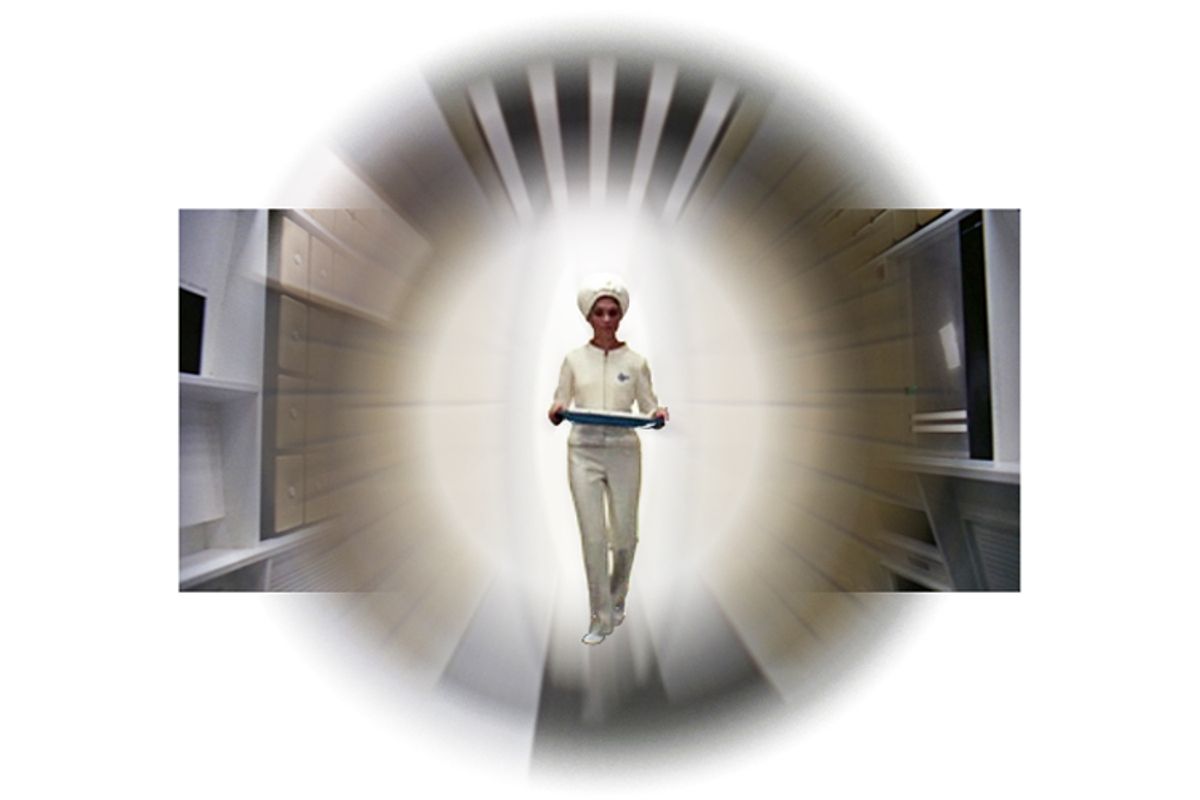
Having said that, let's shift attention to another sort of movie: one that isn't mainly about telling a linear tale in a commercially tested way. I'm talking about movies you're not just supposed to observe and process (which is what narrative features usually want you to do). I'm talking about films-as-experiences, movies that you're supposed to feel and react against and give yourself over to: Stanley Kubrick's "2001: A Space Odyssey," for instance. Or Godfrey Reggio's "Koyaanisquatisi."
Now imagine what such movies might be like if they'd been shot in digital 3-D: Stunning.
Let's go even further in this direction and ask what it might be like to watch an old-school experimental film -- one that has no pretense of linear narrative, the motion picture equivalent of an abstract painting or a multimedia installation. Something like the films of Stan Brakhage: glorified home movies that diced up mundane domestic events into free-associative patterns, or that played around with the properties of film itself. When you watch Brakhage's work, you're not reacting to a story or characters. You're reacting to shifting shapes and lines and shadows on the screen, or to places where the filmmaker has scratched the emulsion with a razor blade or drawn on the frames with a Sharpie. Look at this one-minute movie "Mothlight," then imagine a modern equivalent of this kind of movie shot in digital 3-D and projected on a 40-foot-high screen, as part of a program of shorts that were similarly daring. Experimental cinema has long been considered innately uncommercial -- but if you experienced it in digital 3-D, a format that can make you feel as though you're flying right into the image, or being enfolded by it, even the most stubbornly unimaginative cinephile might become more open-minded, and think about such films not as puzzle or homework assignments but as audiovisual experiences -- as rich and transfixing as a live concert with a conceptually arresting multimedia display attached to it.
Inconceivable? Far from it. In fact, a version of this has already been tried, brilliantly: "U2 3D." That 2007 digital 3-D feature used the format with unprecedented panache. It wasn't a mere record of an event. It was a phantasmagoric riff on the experience of watching (and remembering) a live musical performance.
Before delving into this particular feature, I need to back up for a second and point out that 3-D films aren't truly 3-D, in the sense that every part of the frame feels equally dense and present. When you watch a so-called 3-D movie, whether it was shot on film in the '50s or with recent-vintage digital equipment, the effect is more like 2 ½-D. You're seeing a couple of 2-D images shot with cameras whose spacing mimics the placement of eyes in the human head. Then the images are projected simultaneously so that they seem to lie atop each other and merge (the digital version of this is more complicated and harder to explain, but the effect on the spectator is pretty much the same). What you get from 3-D isn't true depth, not exactly. It's an illusion of depth. The various flat planes seem to coexist within the same screen, and your brain buys it all as a coherent, connected space. But you're always subliminally aware that they're not physically connected. Each individual plane is perceived by the eye as being flat, like sections of a theater set, or a page in a multiplaned popup book.
The brilliance of "U2 3D" lay in how it recognized the true essence of this technology -- the 2 ½-D effect -- and made it the beating heart of the movie's aesthetic. As I wrote in a New York Times review, the filmmakers layer the screen with"long shots and medium shots of the musicians, images of the crowd, close-up details of graphics from the big screen that the band performs in front of that make the designs abstract and merge them with the performers. The result is not a confusing mishmash of images but a musical/experimental work that visually simulates the sensation of thinking. The very idea of self-contained screen geography is thrillingly reconceived." The entire running time of "U2 3D" reminded me of the opening of "Apocalypse Now" -- a hallucinatory, time-and-space-collapsing montage that layered landscapes, faces, flames, palm trees, ceiling fans and personal effects on top of each other via dissolves, so that everything seemed to be bleeding into everything else. The film was truly mind-expanding, in that the mere act of watching it made you reconsider what you thought you knew about cinema, music and the experience of art.
None of the digital 3-D blockbusters released by Hollywood in the last few years have offered anything remotely as bold and exciting. Their idea of spectacle is replaying the same-old, same-old in a different format. They adhere to familiar genre rules and are ultimately not too different in conception and expression from what we've already seen throughout a hundred-plus years of 2-D movies. "Avatar," for instance, may have felt more immersive and powerful thanks to 3-D, but at the storytelling and aesthetic levels, it was monotonously conservative. James Cameron directed it in pretty much the same way as every other film he's made: with an aggressively moving camera and fast cutting that destroyed the sense of spatial unity that 3-D is so good at conveying.
Which isn't to say that "Avatar" would have been a bigger hit if Cameron had changed up his style a bit. I'm being argumentative, highlighting aspects of 3-D's potential that Cameron did not explore, and that could prove prove a hundred times more thrilling than living trees and drop ships and Na'vi. Fact is, none of the recent 3-D movies, including "Avatar," have fully exploited the expressive potential of their chosen format. The recent wave of 3-D blockbusters operate under the assumption that the only defensible use of 3-D is to add something extra to a tried-and-true experience. I want to see studios, theater owners, and filmmakers get beyond such thinking and regard 3-D not just as "something extra," but as a foundation upon which to build something genuinely fresh and exciting: a means of expression that is related to, but fundamentally different from, cinema as we have always known it.
I have no idea if audiences would go for such a thing. But because it's never been tried, there's no reason to assume it couldn't work. The result could be baffling and uncommercial -- the final coffin nail in the theatergoing experience. Or it could be revelatory, and so profitable that it makes the box-office take of "Avatar" look like chump change.
Shares