California
California’s choice: Build the future, or burn the planet
The most important decision Californian voters might ever make: Yes or no on the state's global warming law
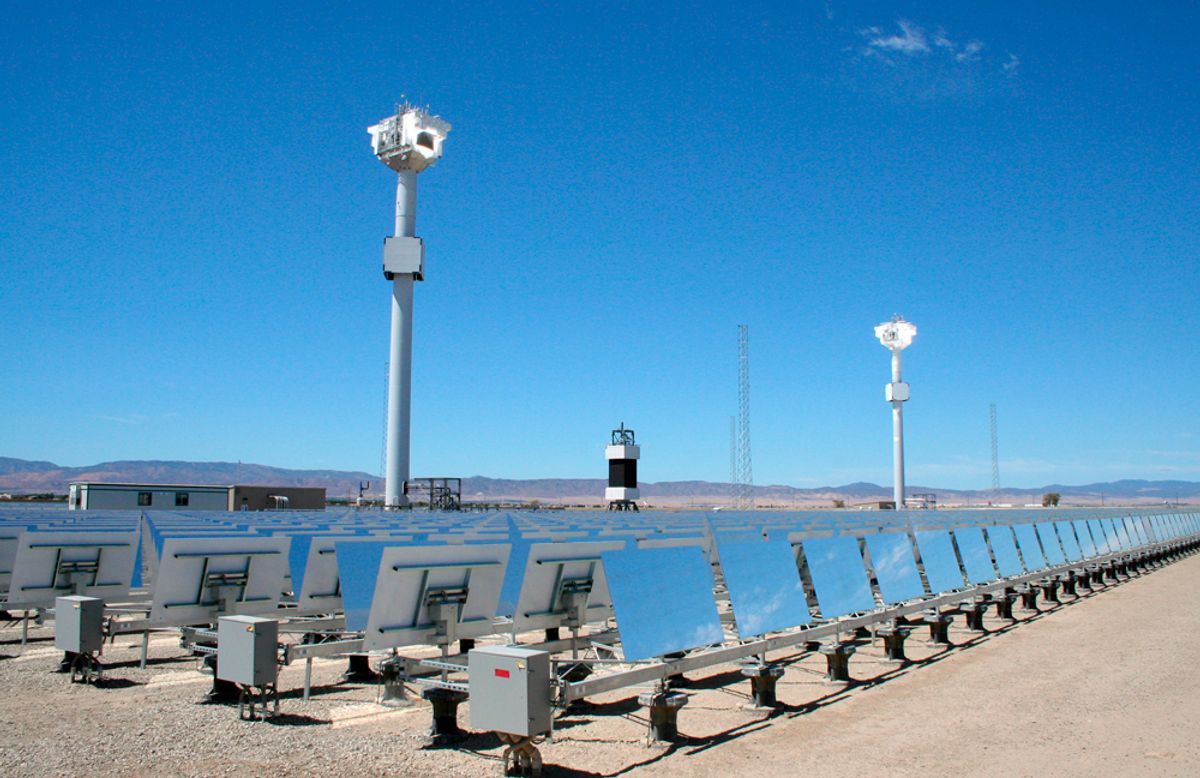
eSolar's first commercial solar power plant in the desert city of Lancaster, California is seen on its opening day August 5, 2009. NRG, whose mostly coal, natural gas and nuclear power plants generate enough electricity to serve 20 million U.S. households, already owns three land-based wind farms in Texas and earlier this year stepped into the solar arena through a $10 million investment with solar thermal startup eSolar. REUTERS/Nichola Groom (UNITED STATES ENVIRONMENT ENERGY BUSINESS)(Credit: © Staff Photographer / Reuters) As midterm elections go, California faces a doozy this November. There’s a juicy governor’s race, with former eBay CEO Meg Whitman, a Republican, determined to spend whatever it takes to deny Jerry Brown a second go-round in Sacramento. There’s an equally high-profile senatorial showdown, featuring former Hewlett-Packard CEO Carly Fiorina’s attempt to dethrone the longtime Bay Area liberal stalwart Barbara Boxer. Both races are getting plenty of national attention, and deservedly so.
But the most important choice Californians will make this year won’t be between a Republican or a Democrat. Also included on the ballot will be an initiative asking voters to decide whether to proceed as previously planned in shaping a future aggressively oriented toward clean, renewable energy, or to instead take a giant step backward.
Climate change legislation may be dead at the national level, but in California, a far-reaching law is already in place: AB 32, the “Global Warming Solutions Act of 2006.” AB 32 mandates that California must reduce its greenhouse gas emissions to 1990 levels by the year 2020. But California’s crazy government-by-initiative system means that just because a law has been passed by the California House and Senate and signed by the governor doesn’t make it secure. On the ballot this November, voters will get their own chance to weigh in on AB 32 by deciding whether or not to pass Proposition 23, the misleadingly named “California Jobs Initiative.”
Bankrolled by a couple of Texas oil companies that operate large refineries in California and are among the state’s biggest polluters (and greenhouse gas emitters), Proposition 23 is designed to gut AB 32. If it passes, it would halt implementation of AB 32′s mandate until California’s unemployment rate falls below 5.5 percent. Since California is currently laboring under a recession-induced 12 percent unemployment rate, that could take quite a long time, if ever.
One would hope that California voters will be smart enough to understand that Texas-based oil refiners do not necessarily have the best interests of Californians at heart. And while there has been relatively little polling done on Proposition 23 compared to the Senate and gubernatorial races, we can take some encouragement from the numbers delivered by a Field poll in mid-July, which reported that 48 percent of California voters opposed Prop. 23, while only 36 percent supported it.
That’s not a good starting position for a California proposition, according to the longtime California politics watchers behind Calbuzz, who argue that successful initiatives usually hit the ground running with about a 60 percent support level. But it’s still early, and in contrast to Meg Whitman, who started her general election advertising blitz the day after she won the Republican primary, the big spending on Prop. 23 hasn’t started yet.
But when it does start, both sides will be loaded. Because Prop. 23 isn’t just a classic fight between environmentalists and oil companies. It’s also a fight over the shape of California’s industrial future, as Todd Woody writes today at Grist.
[This is] a struggle between the industrial behemoths of the old fossil fuel economy and a startup coalition of environmental groups, Silicon Valley technology companies, financiers, and old-line corporations looking to profit from decarbonizing California.
John Doerr, the legendary venture capitalist, has contributed $500,000 to the No on 23 campaign, reports Woody, as has Wendy Schmidt, the wife of Google CEO Eric Schmidt. Thomas Steyer, founder of San Francisco hedge fund Farallon Capital Management, has pledged a whopping $5 million.
So both sides have cash to burn. And one line of argument you can certainly expect the No on 23 forces to be making, as Woody reported last week, is that AB 32 is already working. The prospect of tighter controls on greenhouse emissions has attracted millions of dollars of investment into the clean and renewable energy technology sector in California.
At an event at Google last week, green tech investor Vinod Khosla noted that solar companies are building factories in California even though it would be cheaper to manufacture photovoltaic panels in China.
“The markets are here, the innovators are here, the ecosystem is here,” he said, noting that the state’s global warming law, known as Assembly Bill 32, or AB 32, had created a predictable regulatory climate, spurring investment in California.
In other words, AB 32 is already creating jobs in California. So don’t screw it up! Because there are plenty of other places for those investment dollars and jobs to flow to.
Enter China. In the second quarter of 2010, China attracted $11 billion of investment into the clean energy sector. That’s more than the U.S. and the European Union garnered, combined. The influx was no accident, either; it was a direct result of Chinese industrial policy, including a law passed at the end of 2009 requiring power utilities to buy renewable energy.
China’s foresight means that China will be at the forefront of innovation in and deployment of technologies that will become ever more essential to economic growth as oil prices rise and addressing climate change inevitably becomes a higher priority. California has a shot at getting a piece of that action, thanks to its aggressive environmental stance, its high-tech industrial base, venture capital financing, and AB 32. Voters in November will have an opportunity to ratify the decision to bet on a clean energy future, or shoot themselves in the foot and slip back into carbon-dioxide-stained past. It may well end up being one of the most important votes Californians get to make in their entire lives.
Andrew Leonard is a staff writer at Salon. On Twitter, @koxinga21. More Andrew Leonard.
California’s college mess
How not to compete in the global economy: The richest state in the U.S. can't afford to educate its students
Jerry Brown (Credit: Reuters/Lucy Nicholson) If increasing access to quality higher education is as crucial to U.S. economic growth as everybody seems to think it is, then two news item from California this week deliver a simple, straightforward message: We’re screwed.
1) Ace education reporter Nanette Asimov reported on Tuesday in the San Francisco Chronicle that the California State University system is withholding around $90 million in cash grants previously allocated to graduate students in the CSU system.
Continue Reading Close
Andrew Leonard is a staff writer at Salon. On Twitter, @koxinga21. More Andrew Leonard.
California’s unregulated fracking problem
Drilling has long gone unregulated in this earthquake-prone state. And now Gov. Brown may be trying to hush it up
A gas flare burns at a fracking site in rural Bradford County, Pennsylvania January 9, 2012 (Credit: Reuters/Les Stone) Thanks to the smoking gun of Josh Fox’s sobering documentary “Gasland,” hydraulic fracturing has finally entered our renewable news cycle. Yet despite poisoning groundwater, freeing methane and literally creating earthquakes back east, fracking has a visibility problem in California.
The situation became less clear after a recent investigative report from D.C.-based nonprofit Environmental Working Group explained that California has experienced 60 unregulated years of widespread fracking, whose technical methods and geographical locations in the seismically active state exist outside of the public purview. It got darker after Gov. Jerry Brown’s administration wiped the state government’s Division of Oil, Gas and Geothermal Resources (DOGGR) website of fracking fact-sheets and documents. Good luck finding anything about fracking on the governor’s official site either.
Scott Thill is the editor of Morphizm.com. He has written on media, politics and music for Wired, the Huffington Post, LA Weekly and other publications. More Scott Thill.
Swimming with the stars
A new photography exhibition examines the cultural significance of the Southern California swimming pool SLIDE SHOW
Lawrence Schiller, "Marilyn Monroe," 1962.(Credit: Courtesy of Judith and Lawrence Schiller; Lawrence Schiller © Polaris Communications, Inc.) By turns playful, suggestive and bewitching, the photographs in a new show at the Palm Springs Art Museum propel us back through the decades, to a time when the glamour of choreographed capitalist displays had a singular hold over the American imagination.
These images, though diverse in many respects, all have one thing in common: the swimming pool. That, and their mid-to-late 20th-century Southern California backdrop.
The exhibition is part of “Pacific Standard Time,” a multi-institutional project devoted telling the story “of the birth of the Los Angeles art scene and how it became a major new force in the art world,” sponsored by the Getty Research Institute. Over the phone, curator Daniell Cornell explained the place of the swimming pool in Southern California’s cultural history, and discussed the show’s principal themes — from architecture and suburban idealism to the cult of the Hollywood celebrity. Click through the following slide show for a sun-soaked trip back in time.
Continue Reading CloseEmma Mustich is a Salon contributor. Follow her on Twitter: @emustich. More Emma Mustich.
Occupy Southern California
At least a half-dozen separate protest movements have sprung up between L.A. and San Diego
San Diego Police clash with demonstrators at the Civic Center Plaza Friday, Oct. 14, 2011 in San Diego. (Credit: AP/Lenny Ignelzi) California has long been a hotbed of political activism, so it’s no real surprise that residents across the state are expressing their solidarity with the Occupy Wall Street movement. In fact, in the relatively small tract of land between Los Angeles and San Diego, a number of groups have staged protests of their own. Here’s a roundup:
Occupy Los Angeles: A group of 10,000 to 15,000 protesters — not just Angelenos, but Californians from near and far — marched in dowtown L.A. on Saturday. According to the Los Angeles Times:
Continue Reading CloseObama’s crackdown on medical marijuana
The Justice Department shifts course and goes after California's lucrative pot industry
Right: DEA agents remove marijuana plants from a dispensary in San Francisco (Credit: AP/Salon) Back in July, I interviewed a drug policy expert about an apparent change in Justice Department policy that suggested a crackdown on medical marijuana — which is legal in many states but illegal under federal law — might be coming.
Now, with the announcement last week by California’s four U.S. attorneys that pot dispensaries will be targeted with harsh criminal sanctions, the shift feared by drug policy reform advocates appears to have come to pass. The rhetoric from candidate Barack Obama about not prioritizing medical marijuana cases now seems a distant memory.
Continue Reading CloseJustin Elliott is a reporter for ProPublica. You can follow him on Twitter @ElliottJustin More Justin Elliott.
Page 1 of 65 in California