Movie news

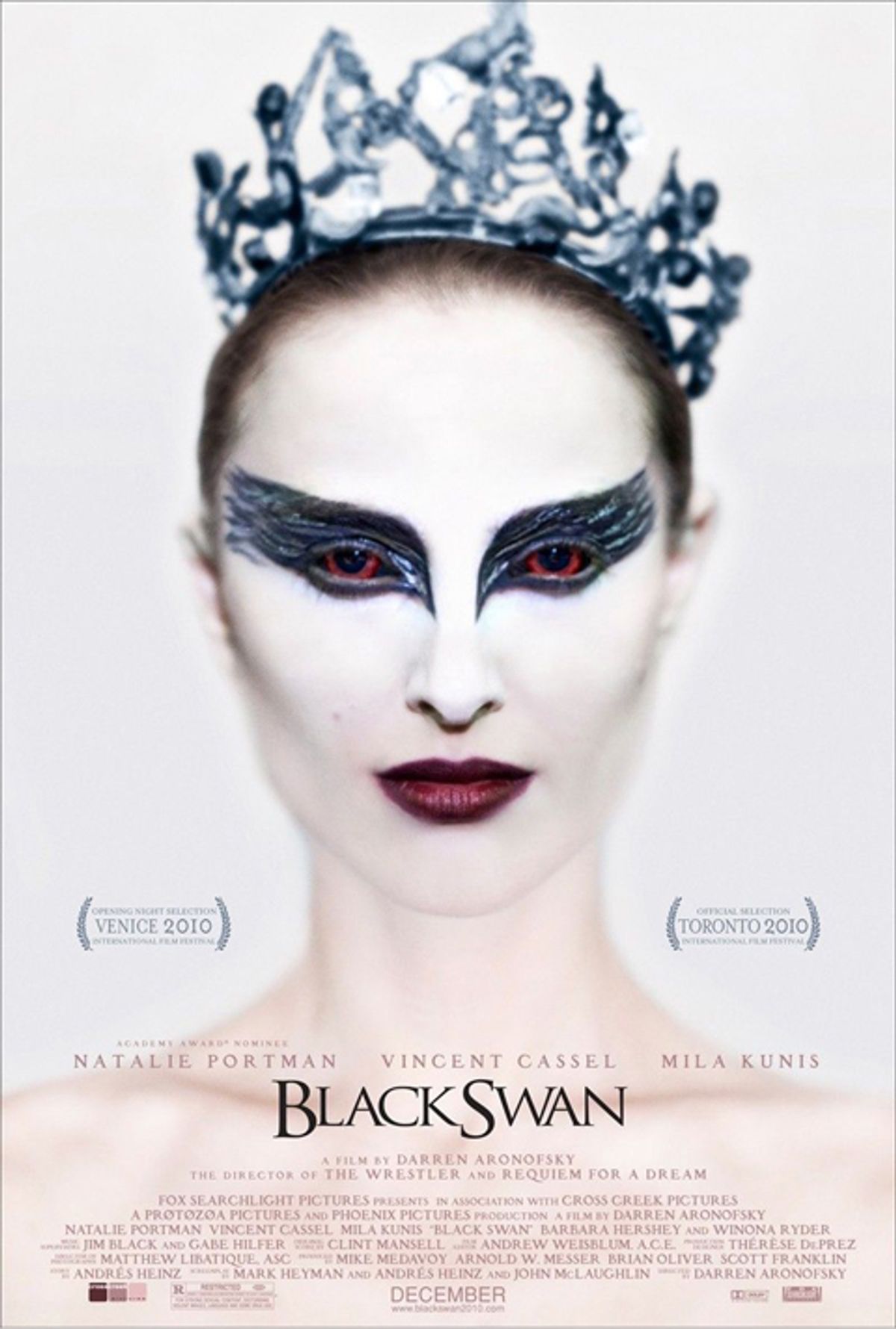
Natalie Portman’s creepy “Black Swan” trailer released online

Actress stars as a ballerina, locks lips with Mila Kunis in Darren Aronofsky's new thriller

  • more
    • All Share Services

Topics: ,

Natalie Portman's creepy

From the director of such visceral, hard-hitting dramas as “Requiem for a Dream” and “The Wrestler” comes … a film about ballet. But judging by the trailer, “Black Swan” will be far more than a slightly grittier “Save the Last Dance.”

Portman stars in “Black Swan” as Nina, an up and coming dancer who’s given the lead role in her company’s production of “Swan Lake.” Then a new dancer played by Mila Kunis arrives, threatening Nina’s position. Since this is a Darren Aronofsky film, though, the trailer also includes body mutilation, feathers, red eyes — and yes, a snippet of a makeout scene between Portman and Kunis. Just think: all of those “Star Wars” and “That ’70s Show” fantasies of yours combined into one!

Black Book predicts “Black Swan” will continue the more “mature” turn Aronofsky’s taken since “The Wrestler.” The Sun just cares about the “snog.” Portman discusses her kiss along with nude scenes at the DimeWars blog, and tells MTV News the film is like “Rosemary’s Baby.” TIME compares Nina to the conflicted women from Aronofsky’s other films. You can check out the trailer below:

Continue Reading Close

Hollywood’s no good, very bad year

"Twilight," "The Muppets" are hits, but it's bad box office news for Hollywood -- and bland blockbuster formulas

  • more
    • All Share Services

Topics: , , ,

Hollywood's no good, very bad yearKermit (Credit: "The Muppets)

It’s way too early to make apocalyptic pronouncements about the death of movies — not that that’s likely to stop anyone — but Hollywood observers were startled by the news that the weekend of Dec. 9-11 produced the lowest domestic box-office returns in more than three years. (In case you’re wondering, the No. 1 movie on that dismal September 2008 weekend was “Bangkok Dangerous,” with Nicolas Cage, and no, I didn’t see it either.) There’s already an official industry spin-control operation, best exemplified by an EW.com article which variously argues that A) things aren’t as bad as they look; and B) this is the inevitable culmination of a downward trend, and hence is no big deal.

Both things cannot quite be true. In fact, I suspect that things are not only as bad as they look for the Hollywood studios, they’re probably worse. The yearlong contraction in moviegoing — with most weekend grosses down by 10 percent or more, compared with 2010 and 2009 — represents a major failure in the film industry’s strategy of niche marketing and narrowcasting, coming in precisely the economic climate when movies are supposed to offer an affordable escape. (One of the maxims of the business is that even with higher ticket prices it will always be cheaper to take the family to the movies than to Yellowstone.) Audience interest in the major studios’ parade of teen-oriented comic-book franchises seems to have faded — either that, or this year’s batch was especially crappy. There’s increasing resistance to the premium ticket prices for 3-D screenings, and you have to applaud the American consumer for that one. Once again, 3-D has been exposed as an often-unnecessary gimmick; the cases where it adds something significant to the moviegoing experience (as in “Avatar” or “Hugo”) are few and far between.

Furthermore, one thing the silver-lining talk can’t conceal is the fact that this was supposed to be a good year at the box office. Extra dollars from 3-D screenings definitely boosted the industry in 2010, and this year’s slate featured numerous big-budget action sequels, generally viewed as a license to print money. In fact, the three biggest movies of 2011 performed just as well as any Burbank bean counter could have expected: The last “Harry Potter” film, the next-to-last “Twilight” film and the third “Transformers” film will likely reach a cumulative gross somewhere north of $1 billion. Subtract those and a couple of other big hits — “The Hangover Part II” and “Pirates of the Caribbean: On Stranger Tides” made almost $500 million between them — and 2011 doesn’t just look like a down year but an unmitigated disaster.

But while the summer months were jammed with overhyped spectacle movies that ranged from slight disappointments like “Thor” and “Captain America” to major flops like “Green Lantern” and “Cowboys & Aliens,” I think the real weakness in Hollywood’s current marketing strategy has been exposed in the latter part of the year. Almost every film aimed at adult audiences and awards voters has been crammed into a five- or six-week marathon between mid-November and Christmas Day, offering almost no opportunity for critics and moviegoers to focus on each one as an individual work with distinctive strengths and weaknesses.

Here’s what I had to review between the week before Thanksgiving and the week after: “The Descendants,” with George Clooney, long seen as a strong Oscar contender; “The Twilight Saga: Breaking Dawn Part I,” probably the biggest commercial film of the fall season; “Another Happy Day,” with an Oscar-candidate lead performance by Ellen Barkin; “The Artist,” a black-and-white French silent film that has suddenly become an awards frontrunner; “A Dangerous Method,” built around award-worthy performances by Michael Fassbender, Keira Knightley and Viggo Mortensen; “Hugo,” Martin Scorsese’s gorgeous 3-D film-history fantasy and a self-evident Oscar contender; “The Muppets,” the only family movie this season that’s actually a hit; “My Week With Marilyn,” which is almost certain to get Michelle Williams another Oscar nod; “Coriolanus,” a Shakespeare adaptation directed by star Ralph Fiennes; and “Shame,” Steve McQueen’s NC-17 drama starring Fassbender as a sex addict. That’s not even counting “Rampart,” with its widely praised performance by Woody Harrelson as a corrupt L.A. cop, or the Australian erotic drama “Sleeping Beauty,” a possible art-house hit.

In this case, it’s not the quality or variety of filmmaking on display that’s the problem: That’s a remarkable season of moviegoing, all packed into less than three weeks. In fairness, as the EW story notes, several of those films have performed well in very limited release. (Some of them are playing only in New York and L.A., to pave the way for an Oscar campaign.) But is it any wonder that none has captured the popular imagination, or become a topic of water-cooler conversation outside the rarefied circles of film critics and Academy Award prognosticators? Of course the tendency to load up the fall and winter season with so-called quality productions is nothing new, but this is ridiculous. It feels as if the film industry has abruptly arrived at a dysfunctional apartheid system: The masses in the multiplex heartland are fed a steady diet of prepackaged sequels and franchises (which they enjoy less and less), while bicoastal elite audiences face a relentless holiday-season barrage of prestige films that lose money but win awards.

This was not intentional, of course. Last year we had awards-friendly movies like “Black Swan,” “The King’s Speech” and “The Social Network,” which played festivals, racked up Oscar nominations and ran up massive paydays. Last weekend’s results suggest that we won’t see that kind of crossover success from “The Artist” or “The Descendants” or “My Week With Marilyn,” the friendliest options among this year’s Oscar contenders. Scorsese’s gorgeous “Hugo,” with its reported budget of $170 million and its old-school Hollywood goal of trying to please everyone, has returned barely $25 million in three weeks and looks to become an epic disaster. If anything, it looks like 2010 was the anomaly, a blip of intersection in the long curve of separation between the cynical movies Hollywood makes to make money and the more idealistic ones it makes to make itself feel good.

Whenever people in the movie business hear bad news, they look toward next week. So of course there’s hope that Steven Spielberg’s World War I epic “War Horse,” or David Fincher’s take on “The Girl With the Dragon Tattoo,” or Meryl Streep’s performance as Margaret Thatcher in “The Iron Lady,” will turn the tide of 2011 before the final bell rings. That isn’t terribly likely, but it’s also not like another hit or two will do anything to address the deep-seated structural problems in the American film industry. It’s been years since Hollywood abandoned its attempt to please all the people all the time in favor of a Faustian bargain with social science, slicing and dicing its audience into ever-narrower categories. This year, that model went sour in a big way, and except for a handful of big hits, Hollywood couldn’t please anybody. I don’t claim to know which way the industry will lurch in 2012, but after this desperate year, a major crisis of confidence is in full effect.

Continue Reading Close

Has the price of Silver gone up?

The new movie version of the classic western will star Johnny Depp as Tonto -- and cost $215 million. Why? VIDEO

  • more
    • All Share Services

Topics: , , , , , ,

Has the price of Silver gone up?The durable myth of the Lone Ranger -- pictured here in a comic by Brett Matthews and Sergio Cariello -- will be the subject of a $215 million Hollywood movie starring Johnny Depp. (Credit: Dynamite)

Apparently Disney has given “Rango” and “Pirates of the Caribbean” director Gore Verbinski and his star, Johnny Depp, a greenlight to shoot a new feature film version of “The Lone Ranger,” budgeted at $215 million. That might seem an exorbitant price tag for a concept that ran for years on TV in the 1950s, despite Ed Wood-level production values. But it’s a reduced price compared to what Verbinski originally envisioned; Disney pulled the plug on the project a couple of months ago because its initial price tag, $250 million, was deemed too high.

Where is the money going, you ask? Well, originally it was going to pay for all the werewolves.

Yes, werewolves.  The Lone Ranger and Tonto were going to fight werewolves.

When Disney spiked the project, citing worries about recouping its massive cost, there was an online outcry about how mind-bogglingly inappropriate it was to add frickin’ werewolves to the Lone Ranger myth, Verbinski and Depp agreed to salary cuts and went back to the drawing board, and supposedly the new film won’t have any werewolves.

But it will, apparently, have $215 million worth of production values.

My question is: Why?

I haven’t read the new script, but I’m having a hard time imagining why “The Lone Ranger” would need to cost $215 million. Are Depp’s Tonto and the Masked Man (played by “Social Network” costar Armie Hammer) going to extinguish the great Chicago fire at the end of the movie? Or battle a giant mechanical spider? Or defend Pandora against a military counterattack?

As a boy, I was enthralled by reruns of the 1950s TV version of “The Lone Ranger.” It had no production values to speak of. It didn’t need them. The show — like creators George W. Trendle and Fran Striker Jr.’s original radio plays and comics scripts — weren’t deep, but they were tremendously exciting, and their excitement had nothing to do with scope.

They were all about plot, characterization and in-the-moment decisions. They were action-packed morality plays that pivoted on choices. The Ranger and Tonto were the moral rocks that the bad guys dashed themselves against. The heroes and villains were surrounded by supporting characters and bit players who fell somewhere along the good-evil continuum; much of the suspense in the “Lone Ranger” stories came from the sight of people wrestling with whether to do the right thing or succumb to intimidation or greed.

If filmmakers have a firm grasp on all that, they don’t need to spend hundreds of millions of dollars envisioning the driving of the golden spike or the battle of Little Big Horn, or a tussle between Godzilla and Megalon in the foothills of South Dakota, or whatever they think they need $215 million for. Especially not when they’re making a western, for crying out loud.

Westerns are not about production values. They are about their western-ness, and the filmmakers’ ability to satisfy or subvert the genre’s familiar images and situations. And that’s it.

Mr. Verbinski, if you’re reading this, did you ever see “Tombstone”? A hugely entertaining film, with legs; it replays on TV constantly and millions of people own it on DVD. It cost $25 million in 1993; today it would cost $40 million, and it would still be exactly as much fun, even if you didn’t spend another dime on it. Go down the list of successful modern westerns, or neo-westerns, and you can see the same production cost-to-dramatic payoff ratio repeating itself. “Dances With Wolves,” a visually spectacular and very long movie with a big cast and several stirring action scenes, cost about $22 million back in 1990 — about $40 million today. “Unforgiven” cost $14 million in 1992, and from the looks of it, most of the money went to pay for a rather small and muddy town set; in 2011 money, that’s $23 million. Would “Unforgiven” be a better western, or a better film, period, if it had cost five times as much? What about Joel and Ethan Coen’s most financially successful film, their 2010 remake of “True Grit”? It cost $38 million and grossed a staggering $171 million. Do you know anyone who came out of “True Grit” saying, “I would have liked it better if they’d spent more money on it”?

Some films rise or fall based on the quality of their special effects, sets, costumes and so forth. But would anyone think that “The Lone Ranger” would be one of them?  The 1981 feature film version “The Legend of the Lone Ranger” cost as much as that summer’s other retro serial, “Raiders of the Lost Ark” — $18 million, or about $44 million at today’s prices. It flopped. Why? Because even though it looked great, it was a tedious, nonsensical film, and untrue to the spirit of the character.

The TV show consisted of little more than footage of the Lone Ranger and Tonto delivering exposition, arguing ethics with other characters, galloping through scrubby ranchland and having fistfights in the same nine sets over and over again, but because it was made with sincerity and energy, viewers loved it. Disney could bankroll a similarly unfussy new movie version of “The Lone Ranger” — a film with a Coen brothers- or Clint Eastwood-level budget, meaning lean — and as long as it was well-cast, well-written, imaginatively photographed and edited, true to the spirit of the character, and featured at least one action sequence scored to “The William Tell Overture,” it could be a “True Grit” or “Unforgiven”-level hit.  A $215 million “Lone Ranger” movie would have to make over $700 million — and join the list of the all time biggest box office draws — to be considered a success. I can’t see that happening, even if the film is great. We no longer live in a world in which big-budget westerns make that kind of money, unless they’re transposed to another galaxy and titled “Avatar.”

And here’s the most depressing irony of all: If a hyper-expensive “Lone Ranger” film somehow does become a huge success, it will have everything to do with the appeal of the story, characters and plot, and zero to do with the scope of the production.

But apparently no one involved with the production agrees with that thinking. Story and character are for indie film — and television. Hollywood’s bloated-is-better culture has reached the point where filmmakers and a major studio think that a “Lone Ranger” movie has to be budgeted at roughly half the cost of “Avatar” for it to be considered a worthwhile endeavor. It’s a property, a possible franchise, a toy and video game-generating machine — another thing to be packaged and sold, with or without a personal stamp. It’s also a signifier of personal clout, which means if it’s not staggeringly expensive, it’s not a “real” movie, and thus not worth making.

That’s no joke, kemo sabe. That’s tragic.

Continue Reading Close

Early signs of a “Bridesmaids” bump

A veteran producer sees not just success for Kristen Wiig's blockbuster, but signs of a lasting legacy

  • more
    • All Share Services

Topics: , , ,

Early signs of a Kristin Wiig in "Bridesmaids" and Viola Davis in "The Help"

Last week, the summer’s surprise blockbuster, “Bridesmaids,” was released on DVD, after a spectacular run both in the United States and abroad. The fortunes of the film, which starred a brace of funny women and dealt equally in fart jokes and friendship, were regarded as crucial to the future of women in entertainment.

Hollywood, perpetually on the verge of never making another movie for anyone but teenage boys, was in need of a slap in the face, reminding it that women buy tickets, fill theaters, tell friends they loved it — and know men who are occasionally eager to see the opposite sex portrayed compellingly on celluloid. “Bridesmaids” delivered a wallop, bringing in more than $280 million worldwide, and drawing an audience reported to be a third male, and largely over 30.

But has it actually whetted the film business’s appetite for more female-driven projects? Salon called Lynda Obst, producer of movies like “Sleepless in Seattle,” “Contact” and “How to Lose a Guy in Ten Days,” the television show “Hot in Cleveland,” the author of “Hello, He Lied” and all-around movie sage, to see what, if anything, has changed in her town this summer.

Did the success of “Bridesmaids” make a difference to your business?

Yes. It had the biggest impact of any women’s movie that I can remember in my career.

In your whole career, which began with “Flashdance” in 1983?

Yeah. It came at a moment when any movies for women, women’s comedies — forget dramas, there are no dramas for anybody — but women’s comedies, women’s thrillers were going to get put by the wayside forever. Women’s projects were dying everywhere. That’s why the opening of “Bridesmaids” was so critical for every woman in features, why its success was attended with such profound interest by every woman writer, producer and director in town.

The second important factor was that there were no stars in the movie and it wasn’t tracking in advance.

And that matters because it means that it was the material, not a movie star, that drew people to theaters?

Yes. Its success wasn’t automatic. A star opens a movie. Sandra Bullock opens a movie. But there was nobody in this movie who had ever been in a movie before, so it’s the hardest kind of movie to open.

It means that its success was due to the fact that people enjoyed it, and gave it good word of mouth once the movie started screening. Which leads us to the gigantic thing, which was the revelation that women can open a movie, and also, that this [women's movie] crossed over. Men came. It drew women of all ages and it drew guys and was a major hit. And not just domestically, which is part two of this gigantic thing, because the movie business right now is being driven by international box office.

Comedy doesn’t usually travel well. Movies that travel are movies with very little dialogue, usually dependent on action or family content or big international stars. But “Bridesmaids” did very well internationally. The concept was easy to understand in all languages. It gave us a clue as to what movies will work internationally with women in them. So what we learned is: Broad comedies will sell abroad, even with broads.

What are the immediate effects of this?

There are suddenly projects for women! I’m pitching one right now that is a female-based comedy and people are really responsive to it. And then my directing debut, which was dead in the water at New Line, went from having no momentum to having momentum, the weekend right after “Bridesmaids” opened. “Bridesmaids” meant that the idea of being able to make a movie about women was resuscitated.

Well, for now. What if the next female comedy flops?

If the next one flops, who knows? Two action movies flop and it means nothing; one women’s movie flops and it’s the end. But “Bridesmaids” was followed immediately by the success of “The Help,” which was terrific because that was driven by women too.

So what we’re finding in the American market is that younger male eyeballs are disappearing in large numbers, going to video games, going to the Internet. But women are going to the movies, if you make movies for them.

Now, does this mean we will stop making movies for the younger male quadrant? No, because the young male quadrant likes the same movies as international audiences — action movies, man movies.

Man movies?

“Ironman,” “Spider-Man,” “Batman.” Man movies.

Are studios pursuing women’s projects or are people just feeling like they can pitch them again?

I think the latter. But I think studios were suddenly receptive to them.

This is not the first time in recent memory that a woman’s movie has done well and studios have failed to notice in any permanent way. “The Devil Wears Prada,” your movie “How to Lose a Guy in Ten Days,” “Sex and the City” have all been big women-driven hits, and yet women’s movies were on the brink of extinction.

Studios have institutionally short memories when it comes to women’s movies. “Sex and the City II” did better internationally than it did domestically, which would have made you think that they would have noticed it. I mean, that’s what inclines Fox to make “Ice Ages”; sequels do so well internationally. But studios don’t seem to generalize by the same rules in women’s movies as they do for other movies.

Every time a woman’s movie does well, it’s a brand-new fact. Every time we rediscover the female audience, it’s astonishing.

So it’s possible that despite “Bridesmaids’” success, four years from now you and I will be having the same conversation about the death of women’s comedy?

Yes.

That’s depressing. But back to the success of “Bridesmaids.” There was a certain amount of social awareness around going to the movie. Because of the press it got, women seemed to be aware that going to see the movie was not just about enjoying it, but about sending a message to Hollywood. Do you think that had an impact on its box office?

Well, I know there was tremendous awareness in Los Angeles that we had to open this movie. I believe it happened in New York too, but I don’t know that that happened nationally.

What happened nationally was that there was a hunger for something for women to relate to, because there’s usually nothing out there for them. It’s what happens with an urban audience with Tyler Perry.

I had a sense from friends in other cities that they were going with their girlfriends and that they knew it was made for them.  It’s so rare that there’s a movie made for them. It generated such excitement.

You would think that that excitement alone would send a message that there is an eager audience out there for material about women.

Well, I think you can see a lot of that reaction on television. It is the year of women on television. Television is much more female-friendly than Hollywood. There are a tremendous number of female executives, and when they see something like “Bridesmaids,” it’s much easier to react fast to it, and there’s less institutional resistance. They love the zeitgeist.

But timing-wise, this season of television was already a done deal before “Bridesmaids” opened, so it can’t have been a reaction, can it?

Well, the [final] decisions about this current fall season were made at the upfronts, which roughly coincided [Editor's note: actually, directly coincided in mid-May] with the opening of “Bridesmaids,” so there actually could have been a connection.

But also, I have just been through the next season of creative development and let me tell you it’s just as female-friendly as the one that’s on air now. There are shows about women and girlfriends and not just couples. There is television about women, for women. Real women.

Continue Reading Close
Rebecca Traister

Rebecca Traister writes for Salon. She is the author of "Big Girls Don't Cry: The Election that Changed Everything for American Women" (Free Press). Follow @rtraister on Twitter.

The “Drive” backlash: Too violent, too arty or both?

The Ryan Gosling thriller has great reviews but dreadful word of mouth. Salon writers discuss what went wrong

  • more
    • All Share Services

Topics: , , ,

The Ryan Gosling in "Drive"

Thomas Rogers, Salon editor: So there seems to be an audience backlash against “Drive,” a movie that you and a lot of other critics have been very fond of. It had decent opening weekend numbers (about $11 million, good for No. 3 on the charts), but the problem with the movie seems to be word of mouth: Basically, people hate it. It might have something to do with the fact that it’s being advertised (at least on New York subway platforms) very ambiguously, with lots of glamorous photos of Ryan Gosling and Christina Hendricks, in a way that says very little about what the movie is about. People show up expecting a glossy sexy movie about a man driving a car, when in reality it’s basically a hyper-violent European art-house movie that offers little in the way of car chases or romance. That’s one way of thinking about it, but I honestly think the bigger problem is that this movie is too gut-churningly violent.

Andrew O’Hehir, Salon film critic: I suspect it’s really a combination of both of those things. It’s both too elliptical and too violent, and it may have been positioned incorrectly in the marketplace. This is a movie tailor-made for contemporary American critics, who are steeped simultaneously in the culture of Eurocentric art-house movies and in Hollywood B cinema of the ’70s and ’80s, all the stuff that inspired Quentin Tarantino. Although I have argued forcefully that “Drive” is not “Pulp Fiction,” for a whole bunch of reasons, there’s no denying that it belongs to a similar tradition. But the thing is, the general public really doesn’t share that peculiar combination of rarefied and populist taste, you might say. And “Drive” may seem quite mysterious to many people. It isn’t really much of an action film, even though there is considerable violence. The hero and the girl never get it on, and barely even kiss. It may be the most chaste and sexless R-rated film in history. It has, let’s just say, a highly indeterminate conclusion, with the fate of the protagonist very uncertain.

T.R.: Based on my own experiences, and the experiences of other people I’ve spoken to who’ve seen the film, I do think the biggest word-of-mouth problem for the film is the many, many horrible things that happen to people’s throats, hands, eyes and heads in it. The way I describe it to people, and the way other people have described it to me, is that “Drive” is a very good movie that I never, ever want to see again. I should disclose that I have a very low tolerance for both fork-related violence and eye-related violence, and that this movie happens to combine both of those things in a very unpleasant way at one point. But I saw the movie in a sold-out screening in New York, sitting next to two 19-year-old women who, based on their chatter, went to see it because it had Ryan Gosling in it. By the time the first person’s head exploded, 45 minutes in, they just started traumatically screaming, which echoed my own internal experience. I guess the question becomes, though, what makes this movie’s violence more unpalatable to audiences than, for example, the violence in the “Saw” movies, which tend to do fairly well at the box office?

A.O’H.: That’s an interesting question. I think the promotional campaign has highlighted the film’s style, which is gloriously accomplished, and suggests a kind of slick, sexy adventure featuring Ryan Gosling and Carey Mulligan and Christina Hendricks, something that’s going to be fun and not too serious, rather than a film with forks in eyeballs and exploding heads. Like, basically a “Fast & Furious” sequel with more aesthetic ambition and a better cast. For better or worse, American audiences have been conditioned to expect certain kinds of narratives with certain rhythms, and this movie openly defies that. While most critics have embraced it, I would point to the counter-example of Open Salon blogger Scott Mendelson, who is a staunch defender of mainstream, audience-pleasing Hollywood cinema. He totally hated “Drive,” and found it pretentious and unbearable. So here we are once again thrown back on the fact that people who watch hundreds of films a year, generally speaking, develop different tastes and different expectations from people who see a small fraction of that number. Vincent Canby of the New York Times said this years ago: You can’t watch 350 films a year and not become a specialist, of some kind.

For many critics — and I’m not sure, I may belong to this contingent, though I hope I don’t — extreme violence is first and foremost an aesthetic or stylistic element. Those of us who watch a lot of international genre movies have seen Korean gangster films or Italian horror movies that make the violence in “Drive” seem relatively tame. I kind of hate to tell you this, but at the Cannes premiere there was cheering and applause, even some laughter, after the head-explosion scene. I mean, I think it genuinely did startle and affect people, right in the moment, but then a split second later, the reaction was more like: Well done! You got us! What an awesome combination of, I don’t know, early Kubrick and ’70s grindhouse! It was as if the actual effect of the horrific violence quickly got turned into a more intellectual or analytical reaction.

T.R.: That’s odd. I found the violence in “Drive” to be the most disturbing I’ve seen in a movie in a very long time. I’ve seen a couple of Nicolas Refn’s previous movies and liked them even though they were brutal. But they were very stylized. This one struck me as particularly visceral, partly because of the slow buildup and its more realistic aesthetic, and partly because, as you mentioned, on its surface it seems like such a “Hollywood” movie. Yet the violence is extraordinarily graphic in a way you rarely see in something that is not a gritty foreign crime movie or a grindhouse film, or a horror movie.

I’m kind of fascinated by the target demographic of the movie — like, who’s supposed to see it in the first place? There are people who are going to see it because of Ryan Gosling, but I feel like the normal Ryan Gosling audience isn’t all that fond of seeing someone stomp people to death. The movie has these gay movie references — mostly to Kenneth Anger’s underground film “Scorpio Rising” — but there’s really nothing overtly gay about it. The title sequence has this campy 1980s lettering, which is duplicated in the film’s ad campaign — and a hilarious, awesome fake-’80s synth score — which makes it seem like it might have a romance or comedy element to it. But the film’s only sex scene involves two people touching a stick shift, and there’s probably only one joke in it. I think, basically, this movie manages to frustrate everybody’s expectations of it — to its great credit. I mean, it really is quite good. But then, I’m not sure anybody should be surprised if it bombs.

A.O’H.: I think that’s a very good summary, and it sums up not just the problems with this film — the marketing and P.R. problems with this film, that is to say — but also the problematic relationship between film critics and the general public. Critics, generally speaking, get most excited by seeing something they haven’t seen before, even if that very often means, as in this case, a fusion of familiar ingredients whose net effect is unfamiliar. Moviegoing audiences who are forking out 10 or 12 bucks on Saturday night generally want to see something they have seen before, delivered expertly and well constructed, maybe with a neat narrative twist or some hot new actors. It’s more complicated than that, of course, in that there are many films that satisfy both constituencies. But “Drive” seems to belong to the same category as “The American,” Anton Corbijn’s hit-man movie with George Clooney from a year ago, which was also pretty much an art film in disguise. I suppose the audience feels it has been promised one thing and delivered something quite different. And, you know, I can sympathize with that. They’re probably right.

Andrew O’Hehir is Salon’s film critic.

Continue Reading Close
Thomas Rogers

Thomas Rogers is Salon's Arts Editor.

Andrew O

Today’s must-see viral videos

Watch: Cookie Monster covers Tom Waits, Anne Hathaway spits rhymes, and a post-"Potter" Radcliffe in horror film

  • more
    • All Share Services

Topics: , , , , ,

Today's must-see viral videos"Cookie Monster's Wild Years."

1. Tom Waits and Cookie Monster, together at last:

I never noticed it before this mashup to “God’s Away on Business,” but the Sesame Street character does sound an awful lot like Tom Waits

“The piano has been eating cookies again.” “Me want whiskey!” Something about Jim Jarmusch and Jim Henson! Jokes!

2. PBS discovers “memes”:

Finally, you and your mom will be able to talk about Nyan Cat without your having to go back and explain what Buzzfeed is again.


3. Anne Hathaway raps about the paparrazi in a really scary way:

 On last night’s Conan Hathaway pulled a total Natalie Portman when she broke out with a Lil Wayne-inspired hip-hop number. She sings about cameras in her crotch. Anne seems very angry, you guys.

Um, Anne Hathaway’s kind of terrifying. And not very good at rapping. 

4. This robot can paint:

As human creator Ben Grosser tells BoingBoing:

“I call it an interactive robotic painting machine. It’s an artificially intelligent system that paints its own body of work and makes its own decisions. It also listens to its environment and considers what it hears as input into the painting process.”

Seriously, an interactive robot that can create art? What’s next … we teach these things how to love?? I think we all know how that ends. (“A.I.” or possibly “Short Circuit.”)

5. Harry Potter and the Victorian Ghosts:

Daniel Radcliffe’s first film post-”Potter” looks like the most horrifying movie of all time, what with the possessed dolls and little children and scary toys that can dance all by themselves. “Woman in Black” trailer! Don’t watch with the lights off!

So many girls are going to go as the Woman in Black for Halloween this year, I know it.

Continue Reading Close

Drew Grant is a staff writer for Salon. Follow her on Twitter at @videodrew.

Page 1 of 15 in Movie news