Avatar

James Cameron re-releases “Avatar,” dishes on sequels

The highest grossing movie ever gets a little longer and its followup goes underwater

  • more
    • All Share Services

Topics: ,

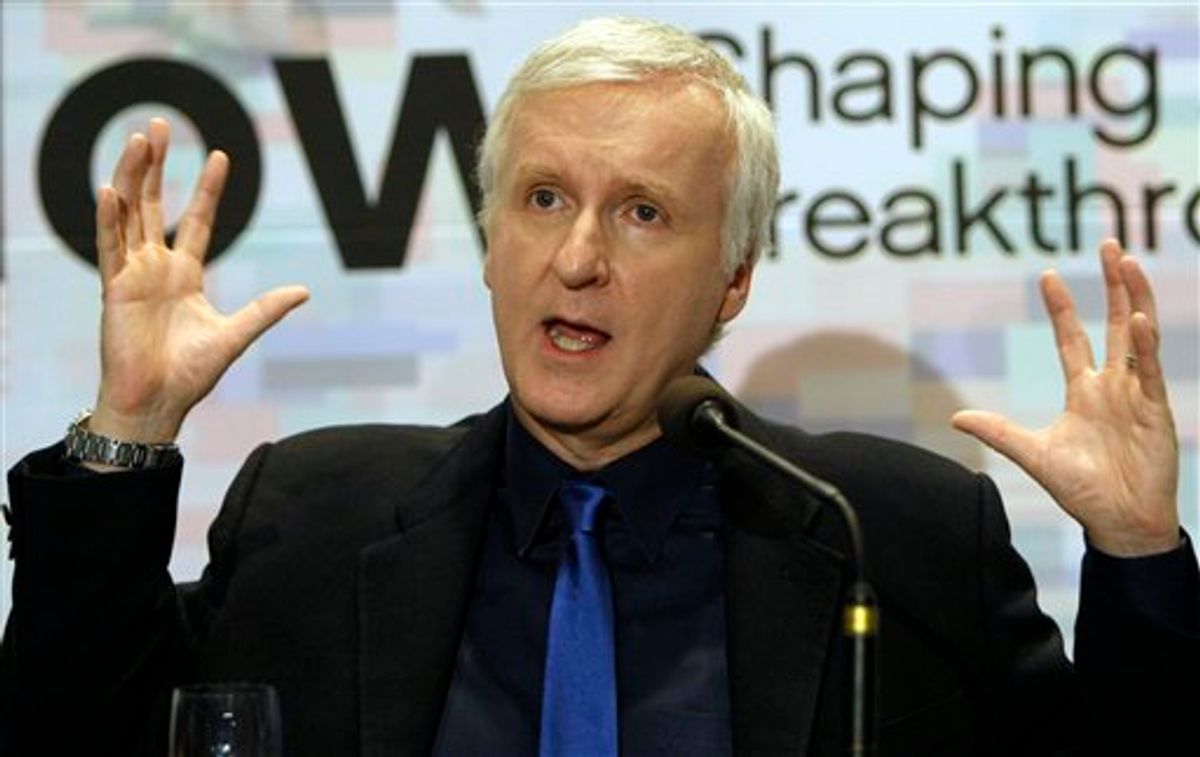
James Cameron re-releases Film director James Cameron answers reporters' question after he delivered a speech about the Renaissance Now in Imagination and Technology at the Seoul Digital Forum in Seoul, South Korea, Thursday, May 13, 2010. (AP Photo/ Lee Jin-man)(Credit: AP)

Eight months after its initial release, James Cameron’s “Avatar” returns to 3-D and IMAX theaters worldwide Aug. 27.  Apparently, the $2.74 billion gross — the highest in movie history — wasn’t enough.

So, what do we get for the $20 ticket to a movie we’ve already seen? Nine extra minutes sprinkled throughout, including (cue ’70s porno music) a new sex scene between Sam Worthington’s character, Jake Sully, and his Na’vi lover, Neytiri, played by Zoe Saldana.

The movie pushes 257 minutes — a mind-numbing length that is, as Cameron put it, “strictly for hyperfans.”

But is this rehashing any surprise?

“Avatar” was bound for milking, with two additional installments, undoubtedly with their own re-releases and myriad Criterion and collector’s editions of Blu-ray discs, which, to the normal person, are indistinguishable. It is, after all, the most lucrative movie of all time. So the sci-fi epic was bound to be a trilogy whether Cameron wanted it or not. Movie executives would be idiots to kill this golden egg-laying goose.

But if there were any doubts, they were dispelled today when Cameron gave the first details on the sequels.

The unnamed “Avatar” 2 and 3 will likely be shot back-to-back, Cameron tells MTV, and he says they won’t hit theaters until at least 2014. Which, for you impatient Avatards, should be tolerable considering the first installment took 15 years from conception to the big screen.

If that’s not enough, Cameron, an avid deep-sea diver, also hinted that the sequel will take place underwater, describing Pandora’s oceans as “equally rich and diverse and crazy and imaginative” as the setting for the first film.

Here’s an interview with Cameron discussing the future “Avatar” films:

Continue Reading Close

3-D filmmaking’s radical, revolutionary potential

Forget "Avatar" and "Step Up 3D": When filmmakers finally master 3-D, it will mark the start of a new art form

  • more
    • All Share Services

Topics: , ,

3-D filmmaking's radical, revolutionary potential

Is digital 3-D the future of cinema or an annoying, overhyped fad? The movie industry is understandably torn. On one hand, money talks, and some of the biggest hits of the last six months earned a major share of their box office take from 3-D exhibition: “Avatar,” “Alice in Wonderland,” “Toy Story 3.” (The latest entry in this mini-movement, the tween-targeted musical sequel “Step Up 3D,” made $15.5 million in its opening weekend.)

But the 3-D frenzy has also sparked a backlash. The naysayers include critics who argue that the essence of cinema is two-dimensional — that its nature is bound up in its mural-like flatness, and that when you add another dimension, you turn it into something other than cinema (see Roger Ebert’s widely quoted Newsweek piece calling 3-D “a waste of a perfectly good dimension“). Directors also resent the pressure to turn every big film into an event that costs three to five extra dollars to see — either by shooting it in 3-D when they feel it isn’t necessary, or by retroactively processing a 2-D movie to create a shoddy-looking, faux-3-D effect (this was done to three-quarters of “Alice in Wonderland” and all of “Clash of the Titans“).

Ultimately, though, the current debate is misleading because the format is still, for the most part, terra incognita. Aside from a brief flowering in the ’50s, an aborted comeback attempt in the ’80s and the current incarnation, which apes the preceding ones with more up-to-date technology, audience have gotten a limited, distorted sense of what 3-D is and could become.  Pronouncements about what it is and isn’t good for strike me as premature at best, reductive at worst, like judging a feature film based on having seen a 30-second commercial. 

Most contemporary 3-D movies are the same-old same-old, with something else added on top: standard blockbusters that you’re mentally half-into, half-out of: part fish, part fowl. Sometimes they’re satisfying in a traditional way (as commercial narrative features — by which I mean linear, goal-driven, conservatively told stories). Other times they give us a more visceral kick, but one that temporarily shatters suspension of disbelief. (When you’re thinking, “Oh my God, this 3-D makes me feel as though I’m really being attacked by a Kraken!” you’re not into the movie — you’re outside of it.)

For the sake of argument, though, let’s think about what might happen if 3-D movies embraced only the first or the second parts of that description — if they became more intimate and character driven, or if they went in the other direction and became more structurally and stylistically abstract, even trippy.

The result could be genuinely revolutionary. It could let us experience movie storytelling — and movies, period — in a new way. It might even give rise to a new art form, one that’s related to its ancestor, cinema, but that takes off in new directions and does things we can’t even imagine yet because so few people in the entertainment industry have been willing to look beyond entertainment as they’ve always known it.

Let’s take option No. 1 first: 3-D films that aren’t driven solely by special effects, action or other spectacle. Imagine one of those intimate, intensely observant small dramas that English writer-director Mike Leigh is known for, only in digital 3-D. Think of what it might be like to watch this scene from Leigh’s “Naked” in 3-D, feeling as though you were actually in that office building hearing these characters’ circuitous arguments about sex, politics and the future of free will. Or imagine that you were standing alongside Johnny Depp in this scene from Jim Jarmusch’s “Dead Man,” or watching the heroine of the black-and-white animated film “Persepolis” sing “Eye of the Tiger,” or watching a man tell a story to a roomful of people in Bela Tarr’s “Werckmeister Harmonies.”

Granted, these films and others like them might gain nothing from being made and projected in digital 3-D. But how could we possibly say so with any certainty, never having seen any small-scale, idiosyncratic 3-D movies, movies in which mood and feeling are more important than overwhelming scale or restless motion? The faux-tactile sense that you get from really good digital 3-D (which makes you feel as though you could reach out and touch the stairwell railing, or sit in that chair, or see individual filaments buzzing inside a light bulb) could transform a scene like that one from “Naked” into something other than, even deeper than, a simple encounter between characters. It could make movies feel even more like dreams than they do already: overwhelmingly convincing, totally immersive. 

Granted, the combined box-office take of “Naked,” “Dead Man,” ”Persepolis” and “Werckmeister Harmonies”  would barely cover a couple weeks of catering on “Avatar.” And strictly speaking, no, these films did not need 3-D to be interesting. I’m just offering them as examples of features that are often ghettoized as “art house” but which might have found  wider audiences had they been positioned as something different from the 3-D usual, rather than as niche titles aimed at adventurous cinephiles.

I’d love to see 3-D movies that don’t fit snugly into familiar categories and that are intriguing for precisely that reason. The post-”Avatar” common wisdom about 3-D goes something like this: Digital 3-D makes sense for spectacle-driven, big-budget films of a certain type (action pictures, science fiction and fantasy epics, 3-D animated films aimed at young children and their parents), and not for other kinds of motion pictures. But let’s say it one more time for emphasis: That statement has never been tested, at least not in a sustained, purposeful way. Who knows what splendors might arise if it were?

Having said that, let’s shift attention to another sort of movie: one that isn’t mainly about telling a linear tale in a commercially tested way. I’m talking about movies you’re not just supposed to observe and process (which is what narrative features usually want you to do). I’m talking about films-as-experiences, movies that you’re supposed to feel and react against and give yourself over to: Stanley Kubrick’s “2001: A Space Odyssey,” for instance. Or Godfrey Reggio’s “Koyaanisquatisi.”

Now imagine what such movies might be like if they’d been shot in digital 3-D: Stunning.

Let’s go even further in this direction and ask what it might be like to watch an old-school experimental film — one that has no pretense of linear narrative, the motion picture equivalent of an abstract painting or a multimedia installation. Something like the films of Stan Brakhage: glorified home movies that diced up mundane domestic events into free-associative patterns, or that played around with the properties of film itself. When you watch Brakhage’s work, you’re not reacting to a story or characters. You’re reacting to shifting shapes and lines and shadows on the screen, or to places where the filmmaker has scratched the emulsion with a razor blade or drawn on the frames with a Sharpie. Look at this one-minute movie “Mothlight,” then imagine a modern equivalent of this kind of movie shot in digital 3-D and projected on a 40-foot-high screen, as part of a program of shorts that were similarly daring. Experimental cinema has long been considered innately uncommercial — but if you experienced it in digital 3-D, a format that can make you feel as though you’re flying right into the image, or being enfolded by it, even the most stubbornly unimaginative cinephile might become more open-minded, and think about such films not as puzzle or homework assignments but as audiovisual experiences — as rich and transfixing as a live concert with a conceptually arresting multimedia display attached to it.

Inconceivable? Far from it. In fact, a version of this has already been tried, brilliantly: “U2 3D.” That 2007 digital 3-D feature used the format with unprecedented panache. It wasn’t a mere record of an event. It was a phantasmagoric riff on the experience of watching (and remembering) a live musical performance.

Before delving into this particular feature, I need to back up for a second and point out that 3-D films aren’t truly 3-D, in the sense that every part of the frame feels equally dense and present. When you watch a so-called 3-D movie, whether it was shot on film in the ’50s or with recent-vintage digital equipment, the effect is more like 2 ½-D. You’re seeing a couple of 2-D images shot with cameras whose spacing mimics the placement of eyes in the human head. Then the images are projected simultaneously so that they seem to lie atop each other and merge (the digital version of this is more complicated and harder to explain, but the effect on the spectator is pretty much the same).  What you get from 3-D isn’t true depth, not exactly. It’s an illusion of depth. The various flat planes seem to coexist within the same screen, and your brain buys it all as a coherent, connected space. But you’re always subliminally aware that they’re not physically connected. Each individual plane is perceived by the eye as being flat, like sections of a theater set, or a page in a multiplaned popup book.

The brilliance of “U2 3D” lay in how it recognized the true essence of this technology — the 2 ½-D effect — and made it the beating heart of the movie’s aesthetic. As I wrote in a New York Times review, the filmmakers layer the screen with”long shots and medium shots of the musicians, images of the crowd, close-up details of graphics from the big screen that the band performs in front of that make the designs abstract and merge them with the performers. The result is not a confusing mishmash of images but a musical/experimental work that visually simulates the sensation of thinking. The very idea of self-contained screen geography is thrillingly reconceived.” The entire running time of “U2 3D” reminded me of the opening of “Apocalypse Now” — a hallucinatory, time-and-space-collapsing montage that layered landscapes, faces, flames, palm trees, ceiling fans and personal effects on top of each other via dissolves, so that everything seemed to be bleeding into everything else.  The film was truly mind-expanding, in that the mere act of watching it made you reconsider what you thought you knew about cinema, music and the experience of art.

None of the digital 3-D blockbusters released by Hollywood in the last few years have offered anything remotely as bold and exciting. Their idea of spectacle is replaying the same-old, same-old in a different format. They adhere to familiar genre rules and are ultimately not too different in conception and expression from what we’ve already seen throughout a hundred-plus years of 2-D movies. “Avatar,” for instance, may have felt more immersive and powerful thanks to 3-D, but at the storytelling and aesthetic levels, it was monotonously conservative. James Cameron directed it in pretty much the same way as every other film he’s made: with an aggressively moving camera and fast cutting that destroyed the sense of spatial unity that 3-D is so good at conveying.

Which isn’t to say that “Avatar” would have been a bigger hit if Cameron had changed up his style a bit.  I’m being argumentative,  highlighting aspects of 3-D’s potential that Cameron did not explore, and that could prove prove a hundred times more thrilling than living trees and drop ships and Na’vi. Fact is, none of the recent 3-D movies, including “Avatar,” have fully exploited the expressive potential of their chosen format. The recent wave of 3-D blockbusters operate under the assumption that the only defensible use of 3-D is to add something extra to a tried-and-true experience. I want to see studios, theater owners, and filmmakers get beyond such thinking and regard 3-D not just as “something extra,” but as a foundation upon which to build something genuinely fresh and exciting: a means of expression that is related to, but fundamentally different from, cinema as we have always known it.

I have no idea if audiences would go for such a thing. But because it’s never been tried, there’s no reason to assume it couldn’t work. The result could be baffling and uncommercial — the final coffin nail in the theatergoing experience. Or it could be revelatory, and so profitable that it makes the box-office take of “Avatar” look like chump change.

Continue Reading Close

“Despicable Me”: Steve Carell’s adorable supervillain

"Office" star plays an irresistible ogre in the summer's most delightful 3-D experience

  • more
    • All Share Services

Topics: , , , , ,

A still from "Despicable Me"

Presumably the under-12 target audience for “Despicable Me” — which is likely to come away thoroughly delighted — will not know or care that its lovably villainous hero, a long-nosed, Russian-accented ogre named Gru, is voiced by a famous comedian who just walked away from TV’s most adored sitcom. But even if Steve Carell’s turn in “Despicable Me” and his departure from “The Office” are linked only by coincidence, this irresistible animated surprise kicks off his career as a movie star in auspicious fashion.

An enjoyable blend of sweetness and silliness, with loads of giggles and just enough dark-edged humor to keep the adult companions interested (the Bank of Evil, where Gru seeks financing for his schemes, carries a small-print legend above its grandiose portals: “Formerly Lehman Brothers”), “Despicable Me” ranks as the second-best digital-animated family film of the summer. But when the gold medal belongs to “Toy Story 3,” there’s no shame in that. And unlike every other 3-D film I’ve seen since “Avatar,” this one actually uses the technology with grace, daring and a sense of wonder. After the disgraceful gray smear of “The Last Airbender,” that’s wonderful to see. (Unlike that film, and “Alice in Wonderland,” and 2010′s other “up-converted” films, this one was actually made in 3-D, and the difference is obvious.)

Improbably enough, “Despicable Me” ought to make Universal Pictures an instant player in the realm of family-oriented digital animation, up till now dominated by Pixar and DreamWorks. Mind you, Universal didn’t actually produce this film, but in French animators Pierre Coffin and Chris Renaud and their fledgling Illumination Entertainment studio, they picked the right subcontractor. If Coffin and Renaud’s images don’t possess the fanatical level of detail and nuance found in Pixar’s films, they’re clear, brightly colored and often very funny. I’ll never think of the oodgy, slimy Squid Gun, a weapon pioneered by Vector (Jason Segel), Gru’s irritating, über-nerd rival, without chortling.

Furthermore, while “Despicable Me” doesn’t even try for the complicated emotional tone and quasi-Proustian yearning of “Toy Story 3,” its quotient of pure fun is at least as high. There isn’t much doubt, right from the beginning of “Despicable Me,” that Gru’s evilness is highly exaggerated. He’s far too kind to his army of Minions, cute little yellow guys who look like a cross between light bulbs and cough drops, and far too frightened of his own pet, which is never identified but looks something like a furry, terrestrial version of one of those scary, toothy, deep-water fishes. Needless to say, when a trio of orphan girls turns up on his doorstep hawking cookies (their ringleader, preteen Margo, is voiced by Miranda Cosgrove), Gru is absolutely petrified.

It turns out, however that the girls and their baked goods may offer Gru a way into the impregnable fortress of Vector, the spoiled and pompous new-school villain who’s driving old-line entrepreneurs like Gru out of business. There’s a nonsensical story going on here about Gru and Vector’s rival plans to shrink the moon and steal it — Vector’s already got the Great Pyramid of Giza in his yard, painted blue to blend in with the sky — but all of that’s just an enormous MacGuffin. The real story, of course, is about Gru’s not-so-stony heart turning to mush as his utterly cynical adoption of the spunky gals turns into the real thing.

Carell gets a lot of help from Ken Daurio’s consistently amusing script, but he brings tremendous complexity to a character who could easily have been a one-note, Boris-vs.-Bullwinkle gag. Gru constantly marvels at the insipid and hackneyed nature of parental love, but marvels even more at his own inability to resist it. When coerced into reading the girls one of those board books where you stick three fingers into little puppets, to become kittens drinking their milk or brushing their fur or whatever, he exclaims: “This is garbage! You like this?” But by the end of the movie, after the girls and Minions have helped him through a ludicrous lunar showdown with Vector, Gru has written his own icky-cute board book, and a hugely sweet “aww” moment it is too.

Along with Segel as the immensely smug Victor — who gets what’s coming to him, don’t you worry — “Despicable Me” also features Russell Brand, Kirsten Wiig and Julie Andrews (!) in relatively low-impact roles. You can argue that all this movie does is remix a bunch of familiar themes, tropes and gags from other family-oriented films. But Coffin and Renaud’s execution is fresh, sincere, often lovely and a great deal of fun — and in this kind of movie, and this kind of movie summer, execution is everything.

Continue Reading Close

Zoe Saldana gets engaged to longtime boyfriend Keith Britton

The "Avatar" and "Star Trek" actress decides to settle down with partner of 10 years

  • more
    • All Share Services

Topics: ,

Zoe Saldana gets engaged to longtime boyfriend Keith BrittonZoe Saldana and Keith Britton

He might not be a 10-foot-tall blue representation of Sam Worthington like her “Avatar” lover, but actor and online entrepreneur Keith Britton was still able to win the love of Zoe Saldana. The couple have decided to tie the knot after being together for 10 years. Britton is the CEO of My Fashion Database (it’s like an IMDB for the fashion industry) and has appeared in “As the World Turns,” “Cold Case,” and something called “Frat Brothers of the KVL,” which IMDB says is “the savage and lurid tale of an outlaw lacrosse fraternity.” Rad.

US Weekly broke the news about the “Star Trek” actress, but People got the confirmation direct from Saldana’s rep. For those of us who had no idea she had a man in the first place, ContactMusic had a report a few weeks ago about Zoe embarrassing Keith at an awards show by expressing her love for him. A little more from the super-private star over at SF Gate.

Fanboys must be crying over their stuffed Tauntaun dolls this week: first Megan Fox, now Zoe. Sorry guys.

Continue Reading Close

“Titans” battles to No. 1 spot with $61.4 million

The Warner Brothers action remake beat "Tyler Perry's Why Did I Get Married Too?" in its weekend debut

  • more
    • All Share Services

Topics: , , ,

The gods of Mount Olympus are the new rulers of the weekend box office.

The ancient Greek action remake “Clash of the Titans” debuted at No. 1 with $61.4 million, according to studio estimates Sunday. Adding Thursday night preview screenings, the movie totaled $64.1 million.

Released by Warner Bros., “Clash of the Titans” features “Avatar” star Sam Worthington as demigod hero Perseus and Liam Neeson as his dad, Zeus, king of the Olympian deities.

Opening at No. 2 with $30.2 million was Lionsgate’s sequel “Tyler Perry’s Why Did I Get Married Too?”, reuniting filmmaker Perry with Janet Jackson and other co-stars for another comic drama about eight friends and their relationships.

The previous weekend’s top movie, DreamWorks Animation’s Viking adventure “How to Train Your Dragon,” ran a close third with $29.2 million, raising its 10-day total to $92.3 million.

Miley Cyrus’ teen drama “The Last Song” premiered at No. 4 with $16.2 million. The Disney release raised its total to $25.6 million since opening Wednesday. Written by best-selling author Nicholas Sparks specifically for the “Hannah Montana” star, the movie casts Cyrus as a sullen teen spending the summer with her estranged father.

“Clash of the Titans” continued Hollywood’s hit run of 3-D movies, which has included “How to Train Your Dragon” and the blockbusters “Avatar” and “Alice in Wonderland.”

With $8.3 million, Disney’s “Alice in Wonderland” came in at No. 5 for the weekend, raising its domestic total to $309.8 million and its worldwide haul to $722 million.

“If three out of the top five films doesn’t spell a mandate for 3-D, I don’t know what does,” said Paul Dergarabedian, box-office analyst for Hollywood.com.

Like “Alice in Wonderland,” “Clash of the Titans” was shot in 2-D format and converted to 3-D afterward. Critics gripe that such conversions provide lower-quality 3-D images, but audiences do not seem to mind.

“You can’t tell the difference. A super-technician, somebody who does this for a living, if they look carefully enough, they can find some differences,” said Dan Fellman, head of distribution for Warner Bros. “I have to tell you, from my own personal experiences, I can’t tell.”

“Clash of the Titans” played on about 6,500 screens at 3,777 theaters, with 1,810 of those screens — or 28 percent — showing it in 3-D. Yet the movie did 52 percent of its business in 3-D format, with fans paying a few dollars more than 2-D tickets cost.

“Why Did I Get Married Too” was Perry’s second-biggest debut, behind last year’s “Tyler Perry’s Madea Goes to Jail” with $41 million. Lionsgate, which has distributed all nine of Perry’s movies, had thought his latest might come in around $25 million for the weekend.

“Every time we do one of his movies, I wake up on Saturday and think, why do I always underestimate him?” said David Spitz, head of distribution for Lionsgate. “He’s unbelievable. He knows his audience.”

Cyrus’ “The Last Song” had modest results compared with the last Sparks love story, “Dear John,” which opened with $30.5 million in early February, bumping “Avatar” down a notch after seven weekends at No. 1.

Chuck Viane, head of distribution for Disney, said “Dear John” opened in a less-crowded marketplace the weekend before Valentine’s Day, when women are more in the mood to see a love story.

“The Last Song” held its own among a flurry of other big releases, establishing Cyrus as a box-office draw without her “Hannah Montana” alter-ego, Viane said.

“It unquestionably proves that she can step outside the role and continue to wow them,” Viane said. “She’s becoming a real actress. She’s going to be an important name in this business.”

Estimated ticket sales for Friday through Sunday at U.S. and Canadian theaters, according to Hollywood.com. Final figures will be released Monday.

1. “Clash of the Titans,” $61.4 million.

2. “Tyler Perry’s Why Did I Get Married Too?”, $30.2 million.

3. “How to Train Your Dragon,” $29.2 million.

4. “The Last Song,” $16.2 million.

5. “Alice in Wonderland,” $8.3 million.

6. “Hot Tub Time Machine,” $8 million.

7. “The Bounty Hunter,” $6.2 million.

8. “Diary of a Wimpy Kid,” $5.5 million.

9. “She’s Out of My League,” $1.463 million.

10. “Shutter Island,” $1.462 million.

——

On the Net:

http://www.hollywood.com/boxoffice

——

Universal Pictures and Focus Features are owned by NBC Universal, a unit of General Electric Co.; Sony Pictures, Sony Screen Gems and Sony Pictures Classics are units of Sony Corp.; Paramount and Paramount Vantage are divisions of Viacom Inc.; Disney’s parent is The Walt Disney Co.; Miramax is a division of The Walt Disney Co.; 20th Century Fox, Fox Searchlight Pictures and Fox Atomic are owned by News Corp.; Warner Bros. and New Line are units of Time Warner Inc.; MGM is owned by a consortium of Providence Equity Partners, Texas Pacific Group, Sony Corp., Comcast Corp., DLJ Merchant Banking Partners and Quadrangle Group; Lionsgate is owned by Lions Gate Entertainment Corp.; IFC Films is owned by Rainbow Media Holdings, a subsidiary of Cablevision Systems Corp.; Rogue Pictures is owned by Relativity Media LLC; Overture Films is a subsidiary of Liberty Media Corp.

Continue Reading Close

Oscars: Hollywood’s war against itself (continued)

Oscar voters picked the lowest-grossing winner in history -- artistic integrity or commercial suicide?

  • more
    • All Share Services

Topics: , , , , , , , , ,

I’m grateful to have been thoroughly and completely wrong about the best-picture race — as were a great many other supposedly knowledgeable stooges — for a whole bunch of reasons. First and foremost, Kathryn Bigelow’s historic sweep was a genuinely moving and surprising capper to one of the most tedious Oscar broadcasts in recent memory. All that industry hand-wringing, a much-touted new production team, and what do we get? Interpretive dance numbers set to fragments of the nominated scores. Seriously? If they’d hired the Sparkle Motion dance team out of “Donnie Darko,” it couldn’t have been any lamer. (Actually, that would been a lot more fun to watch.)

Although I have mixed feelings about “The Hurt Locker” itself, and about the cultural-psychological reasons for its ascendancy, Bigelow herself is a genuine and strange cinematic genius who has paid her dues several times over and richly deserves her moment of triumph. (Is “Hurt Locker” her best film? Probably not. Her second-best? Not even sure about that.) I wish producer-screenwriter Mark Boal hadn’t complicated Bigelow’s big moment on the stage of the Kodak Theatre by persistently tugging on her elbow, like a kid in a department store who needed to use the john. That was odd.

Did it take a grueling, ¿Quién es más macho? war thriller for a female director to win a pile of Oscars? I know there are counter-arguments — mainly, there just haven’t been that many Oscar-scale movies made by women — but I kind of think, yeah, it did. This may have more to do with the Academy’s recent preference for “serious,” male-coded film genres than with simplistic sexual discrimination. Hollywood legend Joseph L. Mankiewicz won back-to-back writing and directing Oscars in 1950 and 1951 for “A Letter to Three Wives” and “All About Eve,” but it’s difficult to imagine such female-centric movies garnering those kinds of honors today.

Taking the longer view, this year’s Oscar campaign and its conclusion offered some crucial flashes of insight into how the Academy works in the 21st century, which is a whole lot different from the way it used to work. Although this goes against nearly everything I believe about life on Planet Earth, I have concluded that Academy voters as a group are less cynical and calculated than I thought — but also that there is a conflict or schism between the membership and the needs and desires of the Academy’s leadership, or at least its image-management and P.R. teams.

I exchanged e-mails late on Sunday night with a critical colleague, one who’d made the same misguided assumptions that I had about the inevitable victory of “Avatar,” notwithstanding the accolades heaped upon “Hurt Locker” by every critics’ group and industry trade organization. Our fundamental error, we concluded, lay in believing that after several years of victories by mid-budget Indiewood pictures the Academy’s collective thinking, and voting behavior, would at some point return to “normal.” What we meant by normal, of course, was an ingrained institutional preference for big-budget spectacle. But that old normal is dead, and here’s the new normal: Hollywood’s central trade group doesn’t like its own movies that much.

Allow me to quote an esteemed expert: “One thing that’s become clear is that the film industry feels no confidence about the cultural significance of its own products. Hollywood’s self-appointed division of self-importance, the Academy of Motion Picture Arts and Sciences, passed up the chance to honor one of the most ambitious and successful films the American movie factories have ever made in order to hand out hardware to a mid-budget, semi-independent production made in Jordan without movie stars.”

OK, the expert is not all that esteemed. It’s me, and other than replacing “India” with “Jordan,” that’s taken verbatim from the article I wrote last year about the Oscar victory of “Slumdog Millionaire” and the shunning of “The Dark Knight.” If anything, the contrast is even starker this time around. “Avatar” is, of course, a much bigger hit than TDK, and its use of motion-capture technology and 3-D clearly points toward the Hollywood future. “The Hurt Locker” is a genuine indie production, financed and made entirely outside the studio system, which grossed less than $15 million in the United States.

Comparing different eras of financial and cinematic history is rife with pitfalls, but that clearly makes “Hurt Locker” the lowest-grossing best-picture winner in Oscar history. (No. 2 is probably “The Last Emperor” from 1987, but when you adjust for inflation, Bernardo Bertolucci’s costume drama made almost three times as much money as Bigelow’s war epic.) It’s delicious and strange and at least potentially ironic that this happened in the year when the Academy expanded the best-picture category from five to 10 nominees, in an evident effort to make the competition more commercial and more attractive to mainstream audiences.

Honestly, the only conclusion I can draw is that Academy members are voting with their hearts. Who’da thunk it? Maybe an earlier generation of Oscar voters was more persuaded by box-office numbers, mass popularity and marketing muscle — or was simply more in tune with mass taste — but they evidently don’t give a damn about those things now. Personally, I’d have ranked a couple of other nominees above “Hurt Locker” — definitely “A Serious Man,” maybe “An Education” — but it’s an idiosyncratic film made by a genuine visionary. Even setting aside the history-making element of this vote (which was surely a consideration) it’s a respectable choice.

Now, the Academy brass, especially its marketing mavens and the shepherds of its lucrative contract with ABC, may take a more jaundiced view of the membership’s sudden attack of integrity and independence. Oscar’s long relationship with the wider moviegoing public has always been tempestuous, but both as a television franchise and a touchstone of cultural relevance, the Academy Awards cannot afford to be seen as some elitist, out-of-touch coastal bastion of indieness. If we allowed ABC execs a free spin in the time machine, and a chance to replace the last four or five years’ worth of Oscar-winners with movies heartland consumers actually paid to watch, they’d take it in a heartbeat.

Still, at least in terms of water-cooler controversy, this year’s Oscars were largely successful. Mind you, the telecast was a misbegotten mishmash, and the toxic, unfunny repartee of Alec Baldwin and Steve Martin made Hugh Jackman’s 2009 song-and-dance numbers look like the height of showbiz professionalism. But viewership was up, reaching the best numbers since the “Crash on Brokeback Mountain” showdown of 2006, and the huge roster of nominated films yielded contradictory but complementary results: Multiple nominations for hugely popular films, and an underdog victory. A lifetime achievement award for Jeff “The Dude” Bridges (let’s be honest; that’s what it was), and shocking proof that Sandra Bullock is not just a human being but a funny, warm and generous-spirited one as well.

But the repercussions of “The Hurt Locker’s” victory over “Avatar” go well beyond Kathryn Bigelow’s historic breakthrough, and well beyond questions of which movie you or I like better, or which one made more money. It’s another salvo in Hollywood’s peculiar, long-running war against itself, a war unlikely to have any winners.

Continue Reading Close

Page 1 of 6 in Avatar