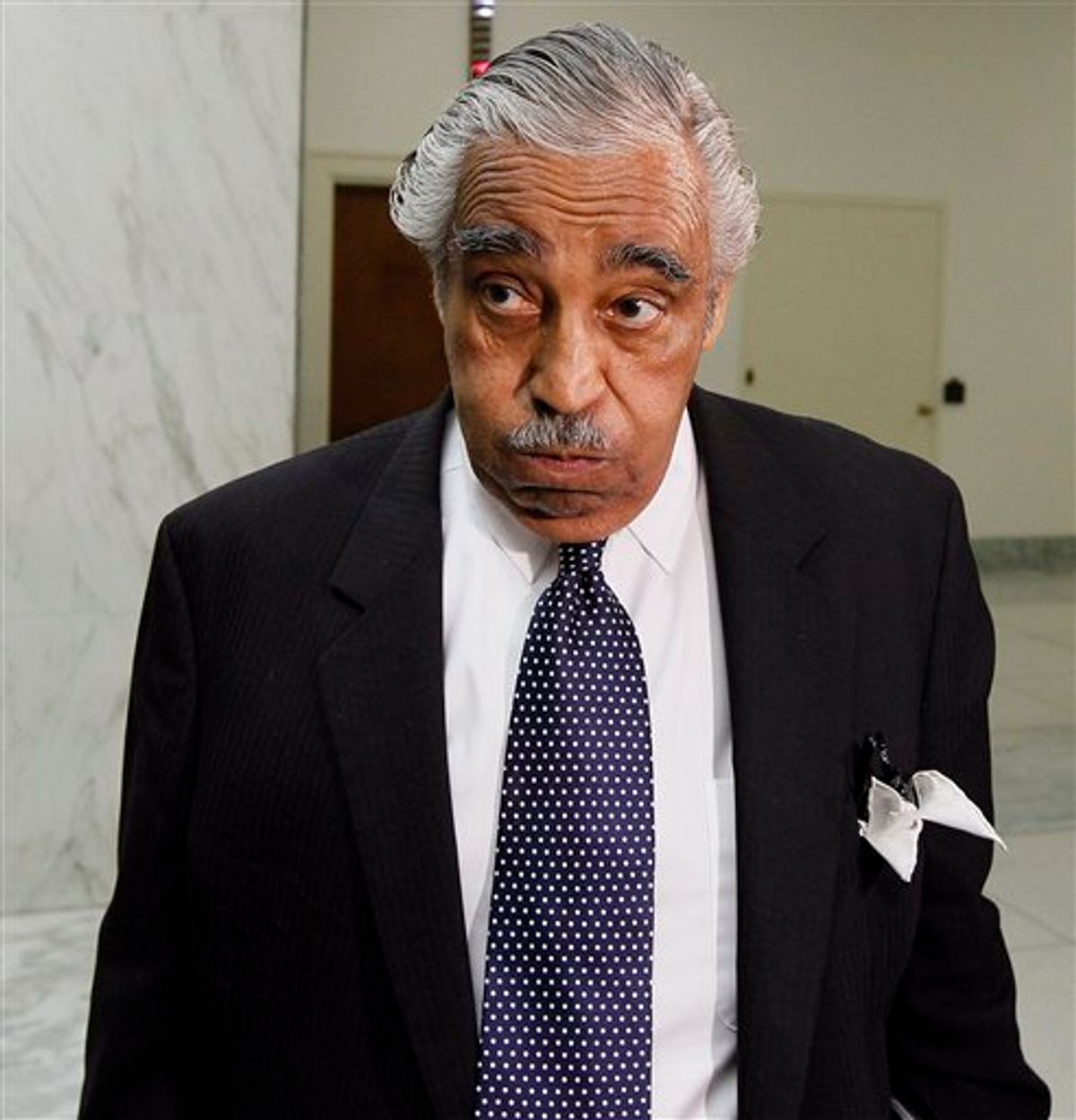
Charlie Rangel, D-N.Y.

Rangel knocks Obama for “dignity” remark

The president hasn't "been around long enough to determine what my dignity is," Rangel says

  • more
    • All Share Services

Topics:

Rangel knocks Obama for Rep. Charles Rangel, D-N.Y. waits for an elevator on Capitol Hill in Washington, Tuesday, Aug. 10, 2010. (AP Photo/Alex Brandon)(Credit: AP)

New York Rep. Charles Rangel has shot back at President Barack Obama’s recent comment that he “end his career with dignity.”

Speaking at a candidate’s forum Monday night in New York City, Rangel said the president hasn’t “been around long enough to determine what my dignity is.”

The 80-year-old congressman said it was more likely he would protect Obama’s dignity over the next two years.

A House ethics panel has accused the 20-term Democrat from Harlem of ethics violation charges. Rangel has vowed to fight the charges and is refusing to resign. He says he is focusing on his re-election.

Obama said three weeks ago that he was sure Rangel wanted to “be able to end his career with dignity” and said he hoped it would happen.

——

Information from: The New York Times, http://www.nytimes.com

Charlie Rangel defense begins with fancy chart

The longtime New York congressman looks to avoid official censure by convincing his peers that he's not so bad

  • more
    • All Share Services

Topics: , ,

Charlie Rangel defense begins with fancy chartCharlie Rangel

Representative Charlie Rangel would really prefer it if the House didn’t censure him. He was found guilty of 11 counts of ethics violations, and the ethics committee voted nine-to-one to recommend that the full House censure him, but he thinks a reprimand would be just fine, thank you.

How does Rangel plan to convince his colleagues that he’s not worthy of censure? With a really great chart, obviously. 10 Reasons Why Rangel NO Censure

It is titled “10 Reasons Why Rep. Charles B. Rangel Should NOT Receive Censure,” but it is not a hilarious Letterman-style Top Ten List. It is actually a list of other representatives who were censured for doing things that were “worse” than what Charlie Rangel did, and a list of people who were only reprimanded for doing things that were “worse” than what Charlie Rangel did (like Newt Gingrich).

Will it work? No, probably not. But censure is still an extraordinarily goofy 19th-century relic, so it really won’t be so bad, Charlie.

Continue Reading Close
Alex Pareene

Alex Pareene writes about politics for Salon and is the author of "The Rude Guide to Mitt." Email him at apareene@salon.com and follow him on Twitter @pareene

Rangel wants House to reject censure

Congressman plans to ask that his punishment for ethics violations downgraded to a reprimand

  • more
    • All Share Services

Topics:

Rangel wants House to reject censureRep. Charles Rangel, D-N.Y., listens to House ethics committee chairman Rep. Zoe Lofgren, D-Calif, on Capitol Hill in Washington, Thursday, Nov. 18, 2010. The committee recommended censure for Rangel, suggesting that the New York Democrat suffer the embarrassment of standing before his colleagues while receiving an oral rebuke by the speaker for financial and fundraising misconduct. (AP Photo/Harry Hamburg)(Credit: AP)

Rep. Charles Rangel is ready to make a last stand to salvage his reputation and tell the House that a censure should be reserved for crooked politicians.

He will argue that he’s not one of them.

The 80-year-old Democrat from New York’s Harlem neighborhood wants his punishment for ethics violations downgraded to a reprimand, according to congressional and nongovernment sources who are in touch with Rangel but are not authorized to be quoted by name.

Rangel will ask the House ethics committee chairman, Rep. Zoe Lofgren, D-Calif., for time to plead his case on the floor of the House, where he has served for 40 years, including a stint as chairman of the tax-writing House Ways and Means Committee.

The ethics committee voted 9-1 on Nov. 18 that Rangel should be censured for committing 11 counts of fundraising and financial misdeeds that violated House rules.

There is precedent for Rangel’s argument that censure — the most severe punishment short of expulsion — is too harsh in his case. It won’t be easy because he’ll have to overcome the overwhelming vote of a committee that has an equal number of Democrats and Republicans.

Rangel plans to argue that censure has been imposed for violations including bribery, accepting improper gifts, personal use of campaign funds and sexual misconduct; none is present in his case.

The ethics committee, in explaining its recommendation, agreed in a report that the discipline usually is reserved for lawmakers who enrich themselves. In Rangel’s case, the committee said, its decision was based on “the cumulative nature of the violations and not any direct personal financial gain.”

The committee’s chief counsel, Blake Chisam, responding to a question from a committee member, told Rangel’s ethics trial that he saw no evidence of corruption.

The House will take up Rangel’s discipline in the postelection session that resumes Monday, but no date has been set for decide his punishment.

To the public, a censure and a reprimand appear similar. Both punishments are meted out on the floor of the House and include a vote disapproving a member’s conduct.

A censure goes beyond the vote and requires the disciplined member to appear at the front of the chamber — called the “well” — and receive an oral rebuke from the speaker that includes a reading of the resolution.

A reprimand is simply a vote of disapproval. It can be a separate resolution or a vote to adopt the ethics committee’s findings. The punished lawmaker is not required to stand in the well.

Rangel was found to have improperly used official resources — congressional letterheads and staff — to raise funds from businesses and foundations for a center named after him at the City College of New York.

Some of the donors, the committee found, were businesses and foundations with issues before the House Ways and Means Committee. The contributions left the impression that the money was to influence legislation, although Rangel was not charged with taking any action on behalf of donors.

He also was found guilty of filing a decade’s worth of misleading annual financial disclosure forms that failed to list hundreds of thousands of dollars in assets, and failure to pay taxes for 17 years on his rental unit in the Dominican Republic — an embarrassment for someone who presided over tax legislation.

In addition, the committee told Rangel to pay any taxes he still owed.

The sources said Rangel complied last week, sending the Internal Revenue Service a check for $10,422 and a check for $4,501 to New York state.

Rangel has apologized and admitted his mistakes, although he denied any intent to violate standards of conduct.

Twenty-two House members have been censured while nine have been reprimanded. The last censures were in 1983, when the House disciplined Reps. Gerry E. Studds, a Massachusetts Democrat, and Daniel Crane, an Illinois Republican. Both were cited for sexual misconduct with teenage pages — Studds with a male page, Crane with a female one.

Rep. Joe Wilson, R-S.C., was the last to be reprimanded. He was disciplined in September 2009, in a partisan vote, for shouting “You lie!” at President Barack Obama during a nationally televised speech to Congress.

Continue Reading Close

Defending myself against Andrew Sullivan

Raising questions about some of the attacks on Charlie Rangel isn't the same as claiming that he's being railroaded

  • more
    • All Share Services

Topics: ,

Defending myself against Andrew SullivanUS Representative Charles Rangel (D-NY) talks on his mobile phone as he waits for the panel to return from a break in his ethics hearing before the House Adjudicatory subcommittee at Capitol Hill in Washington, November 18, 2010. REUTERS/Jonathan Ernst (UNITED STATES - Tags: CRIME LAW POLITICS) (Credit: Reuters)

[Updated]When a friend e-mailed a short while ago to congratulate me on my nomination for the Moore Award, I was puzzled: Why was I under consideration for the University of Tennessee at Chattanooga athletic department’s A.C. “Scrappy” Moore Award, an honor typically reserved for the Moccasin student-athlete who “best personifies comprehensive excellence — academically, athletically and socially”?

Then I discovered that I’d actually been nominated for the other Moore Award — the one that blogger Andrew Sullivan doles out for “divisive, bitter and intemperate left-wing rhetoric.” How exciting!

Sullivan recognized me for a piece I wrote Thursday about Alabama Republican Rep. Jo Bonner’s harsh attack on Charlie Rangel as the House ethics committee was concluding its proceedings on Thursday. Specifically, Sullivan claimed, I argued “that the grandstanding of the GOP’s ranking member on the ethics committee was fueled by racism and not Rangel’s eleven ethics violations.”

I should say: I knew when I wrote it that it would be easy to reduce my argument to “Clueless Kornacki can’t fathom that Rangel did anything wrong, blames racism instead.” But that wasn’t the point I was trying to make. Clearly, Rangel is guilty of 11 ethics violations. His transgressions are his fault, and his fault alone, and the punishment that he is set to receive — the first censure since 1983 — seems about right. I am not — and was not — claiming that he is being railroaded because of his race.

What bothered me as I watched Bonner’s speech — which came after Rangel had been found guilty and after he had asked for mercy — was that it clearly reeked of showboating.  As I wrote, there’s an understandable partisan motivation here; Democrats would pile on (and have piled on) a Republican in a similar situation. But knowing the history of the Alabama district that Bonner represents, there was something (to me, anyway) somewhat disturbing about the scene. More than perhaps any other district in the country, Alabama’s 1st demonstrates the political transformation that the modern Republican Party’s use of race (busing, affirmative action, “law and order,” “illegals”) has brought about. As the Washington Post noted back in 1984, when Bonner’s mentor (Sonny Callahan) was running for Congress for the first time, Republicans had succeeded in poisoning the district’s white voters against the Democratic Party (which almost all of them had been raised to support) by painting it as “the party of Jesse Jackson.”

Since ’84, of course, the GOP has only become more dominant in the South — something that is purely the function of even more white voters defecting from the Democrats for good. After the Nov. 2 midterms, practically the only Democratic congressmen left in the region are African-Americans from majority-minority districts that were created under the Voting Rights Act after the 1990 census. Today’s Republican Party in the South has become what the Democratic Party was before 1964: the default home for white voters. Are these voters only Republicans because of racial politics? No. But is the GOP’s emphasis on issues like affirmative action and “illegals” — subjects that foster a victim mentality, a sense that the liberals in the Democratic Party are out to take from “us” to give to “them” — especially resonant with white Southerners? You bet it is.

I don’t think it’s unreasonable to consider Bonner’s decision to grandstand against this backdrop — nor do I think that raising the issue should be equated with an effort to let Rangel off the hook. He’s guilty. He did it. He should be punished. But when Sonny Callahan’s protégé goes out of his way to rub it in, pardon me for wondering if some of his constituents will take it as a reminder that the party of Jesse Jackson is, well, still the party of Jesse Jackson.

I’m reminded a little of the last time the House censured any of its own, back in 1983 when Gerry Studds and Dan Crane were rebuked for having sexual relationships with underage congressional pages. Both were guilty and both deserved their punishments. But I always found it interesting how much more exercised many on the right were by Studds’ conduct. That he was a Democrat and Crane was a Republican was surely a factor, as was the fact that Crane pretty much disappeared after losing his reelection bid in 1984. But, inarguably, I think, the fact that Studds was involved with a male page while Crane was involved with a female played a role too. Every Republican leader, conservative activist, and right-wing direct mail copywriter who invoked Studds’ name and slammed him for his conduct in the years after ’83 was, on one level, absolutely justified: Studds was guilty, just as Rangel is now guilty. But was there another reason they kept going back to the well? It’s not an unreasonable question.

Anyway, time will tell if Bonner’s attack will end the Rangel matter for the GOP, or if he’ll get the Studds treatment in the years ahead. It may be that I overreacted while watching Bonner’s speech; I’m certainly willing to admit the possibility.

Update: Josh Benson, writing in defense of my piece, notes that Bonner was one of only 33 members of the House — all of the Republicans, and virtually all of them from the old Confederacy — to vote against the reauthorization of the Voting Rights Act in 2006. “Is it OK to suggest that that was probably good politics for him, too?” Benson writes. “Or is that being divisive?”

Continue Reading Close
Steve Kornacki

Steve Kornacki writes about politics for Salon. Reach him by email at SKornacki@salon.com and follow him on Twitter @SteveKornacki

Ethics panel recommends censure for Rep. Rangel

If it passes, he faces humiliation of standing before his colleagues and receiving an oral rebuke by the speaker

  • more
    • All Share Services

Topics:

The House ethics committee is recommending that 20-term Rep. Charles Rangel of New York be censured and pay any unpaid taxes for financial and fundraising misconduct.

The House will likely consider a censure motion after Thanksgiving. If it passes, Rangel would suffer the embarrassment of standing before his colleagues and receiving an oral rebuke by the speaker.

The five Democrats and five Republicans deliberated for several hours behind closed doors Thursday. The vote was 9-1. Earlier, at a sanctions hearing, Rangel apologized for his misconduct but said he was not a crooked politician out for personal gain.

THIS IS A BREAKING NEWS UPDATE. Check back soon for further information. AP’s earlier story is below.

WASHINGTON (AP) — The House ethics committee is recommending that 20-term Rep. Charles Rangel of New York be censured and pay any unpaid taxes for financial and fundraising misconduct.

The House will likely consider a censure motion after Thanksgiving. If it passes, Rangel would suffer the embarrassment of standing before his colleagues and receiving an oral rebuke by the speaker.

The five Democrats and five Republicans deliberated for several hours behind closed doors Thursday. Earlier, at a sanctions hearing, Rangel apologized for his misconduct but said he was not a crooked politician out for personal gain.

Continue Reading Close

Race and the GOP’s Charlie Rangel grandstanding

Exactly who was Jo Bonner, a white Alabama Republican, performing for when he tore into the Harlem Democrat today?

  • more
    • All Share Services

Topics: ,

Race and the GOP's Charlie Rangel grandstandingU.S. Representative Charles Rangel (D-NY) appears before the House Adjudicatory subcommittee on Capitol Hill in Washington, November 15, 2010. Rangel faces up to 13 charges concerning ethics and federal regulations covering public officials. REUTERS/Jonathan Ernst (UNITED STATES - Tags: POLITICS)(Credit: © Jonathan Ernst / Reuters)

There was something unnerving about the scene that played out as Charlie Rangel’s House ethics trial concluded Thursday afternoon.

An ethics subcommittee had already found Rangel guilty (unanimously) earlier in the week of violating New York City’s building code, improperly using congressional letterhead, and failing to file his taxes correctly. The purpose of Thursday’s full committee session was to determine Rangel’s punishment. It was gaveled to order hours after Rangel, who had stormed out of the trial on Monday, released a statement throwing himself on the mercy of the committee — and after Rangel used his clout to shut down rallies that his supporters had planned for him.

In other words, there wasn’t much to accomplish on Thursday. Rangel’s guilt had been established and he was seeking mercy. Plus, precedent clearly established that expulsion — the most dramatic punishment available — was not a viable option for the committee. Rangel would be receiving some sort of formal rebuke; the only thing left to do was to announce exactly what form that rebuke would take.

But none of this was going to stop Jo Bonner, a fifth-term Alabama Republican who serves as his party’s ranking member on the ethics committee, from climbing on his high horse and — with the cameras rolling, of course — reading a blistering and at times petty eight-minute statement that repeatedly challenged Rangel’s honor.

Rangel’s transgressions, Bonner asserted, demonstrated “so little regard and respect either for the institution he has claimed to love or for the people in his district in New York that he has claimed to proudly represent for more than 40 years.”

“Sadly, Madam Chairman,” he said, “it is my unwavering view that the actions, decisions and behavior of our colleague from New York can no longer reflect either honor or integrity.”

And on and on it went. At other points, Bonner claimed to be speaking on behalf of tenants in New York City and other cities and small businesswomen who had faced tax trouble. He also invoked a three-year-old incident on the House floor during which Rangel lashed out at one of Bonner’s Republican colleagues. 

As noted above, by the time Bonner spoke, Rangel had already been found guilty and it was already clear what his punishment would — and wouldn’t — be. So it has to be asked: Why was Bonner so intent on rubbing it in? Certainly, simple partisan politics — highlighting the ethical lapses of a prominent member of the other party — had something to do with it. But it’s also worth considering how the spectacle of their congressman lashing out at Rangel — who in some ways is the face of black urban politics in America — is likely to play with Bonner’s constituents back home.

This is where things get a little troubling, because Bonner’s 1st District was ground zero for the South’s race-based transformation from Democratic stronghold to Republican bastion. I wrote about this evolution — which was largely set in motion by the passage of the Civil Rights Act of 1964 — earlier this week. The South had been a uniformly Democratic region since Reconstruction, but the GOP’s decision to nominate Barry Goldwater, who had joined segregationist Southern Democrats in their futile effort to block the Civil Rights law, prompted mass defections to the GOP in the fall of ’64. Even as Goldwater racked up just 38 percent of the national popular vote, he carried five Southern states — some by absurd margins (87 percent in Mississippi).

Bonner’s 1st District illustrated this shift powerfully. Like just about every other Southern district, it had been represented by Democrats since Reconstruction. But because of civil rights, Goldwater carried it in a rout in ’64 — and his coattails helped a Republican, Jack Edwards, win election to Congress from the district. Edwards went on to hold the seat for 20 years; when he retired in 1984, he asked Sonny Callahan, then a former Democratic state senator, to switch parties and run to replace him. Callahan obliged.

The ’84 GOP ticket that Callahan ran on was headed by Ronald Reagan and George H.W. Bush. At one point, Bush was dispatched to campaign with Callahan. The vice president’s visit was notable for what it revealed about how civil rights and race were reshaping the South’s partisan balance. Here’s how a Washington Post story at the time reported on Bush’s campaign swing:

[T]the GOP strategy appears to play into old racial tensions in the Deep South. The Reagan administration has retreated from affirmative-action and civil-rights legislation embraced by the Carter administration, and the Democratic Party has tightened its links to the black community in this campaign.

According to a prominent Alabama Democrat who asked not to be identified, the Democratic Party, historically powerful in the South as the party of the whites, is now seen by many white and black southerners as the party of Jesse L. Jackson.

Mayor Emory Folmar of Montgomery, Ala., head of his state’s Reagan-Bush finance committee, said the GOP saw a surge of white support in Alabama after the Democratic convention, and he attributed it to Jackson’s prominence in the proceedings. Folmar said white southerners are uncomfortable not just with “the race thing” but also with Jackson’s support of increased federal spending.

When Bush campaigned for House hopeful Sonny Callahan Monday before an all-white audience in Mobile, he drew boisterous cheers when he declared, “The party of Mondale and Ferraro and Tip O’Neill is not the Democratic Party that the people of Alabama remember . . . . The Democratic Party has left the people of Alabama.”

Jackson, of course, had run for president as a Democrat in 1984. Callahan went on to win and to serve for 18 years in the House. One of his top aides during that time? You guessed it — a man named Jo Bonner, who would succeed Callahan in the House after the 2002 elections.

This back story is what makes Bonner’s speech on Thursday somewhat disturbing. The civil rights battle of the ’60s and the GOP’s subsequent emphasis on busing, affirmative action and “law and order” helped remake Bonner’s once-Democratic district into a Republican stronghold. Bush summed it up perfectly in his ’84 speech to an almost all-white crowd: The Democratic Party of Jesse Jackson was “not the Democratic Party that the people of Alabama remember.”

So when Bonner launches a very public, very unnecessary attack on a black Democrat from Harlem, it’s worth keeping in mind the effect it’s likely to have on more than a few voters back home.

Continue Reading Close
Steve Kornacki

Steve Kornacki writes about politics for Salon. Reach him by email at SKornacki@salon.com and follow him on Twitter @SteveKornacki

Page 1 of 11 in Charlie Rangel, D-N.Y.