Afghanistan
Child abuse in Afghanistan
Sexual relationships are shockingly common between men and young boys, thanks in part to women's inequality
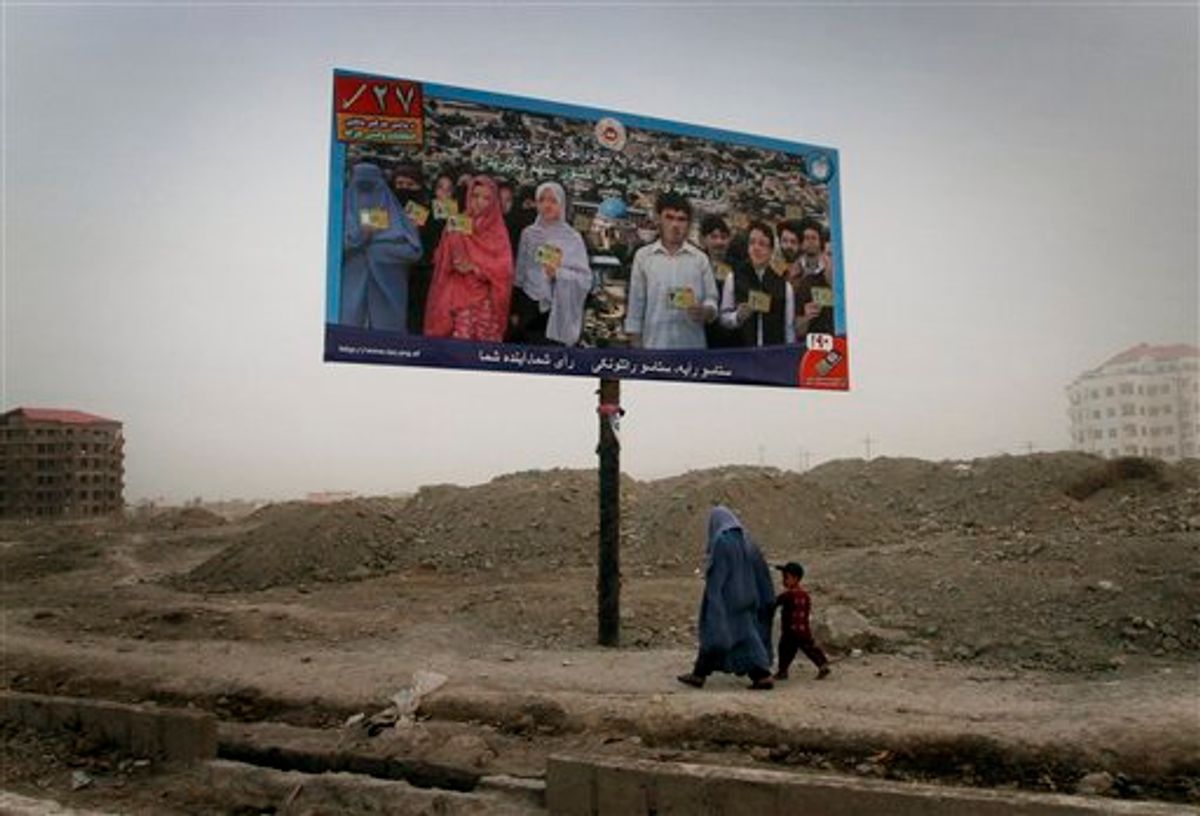
In this Monday, Aug. 23, 2010 photo, an Afghan woman walks with her son under an election billboard asking people to vote for upcoming parliamentarian election in Kabul, Afghanistan. Afghans will go to the polls for parliamentary elections in September. After a fraud-ridden presidential election last year that nearly undermined President Hamid Karzai's legitimacy and international support, the Sept. 18 parliamentary ballot is being watched closely as a test of whether the Afghan government is serious about reform. (AP Photo/Musadeq Sadeq)(Credit: AP) As though we needed more reason to feel uneasy about the situation in Afghanistan, a piece in Sunday’s San Francisco Chronicle detailed the shocking prevalence of child sexual abuse in the southern part of the country. Joel Brinkley, a journalism professor at Stanford University, explains that, according to a report commissioned by the Defense Department, many Pashtun men (half of the tribal members in Kandahar, according to some accounts) develop sexual relationships with boys as young as 9.
The technical term for these men is “bacha baz,” which translates to “boy player” (although “pedophile” works just as well). In popular weekly events, “young boys dress up as girls, wearing makeup and bells on their feet, and dance for a dozen or more leering middle-aged men who throw money at them and then take them home,” writes Brinkley. I could spill several hundred more words relaying fascinating details about this centuries-old cultural phenomenon — but for our purposes on this here lady blog, the most interesting element of the story is the theory of why and how this practice came to be. Brinkley explains:
Sociologists and anthropologists say the problem results from perverse interpretation of Islamic law. Women are simply unapproachable. Afghan men cannot talk to an unrelated woman until after proposing marriage. Before then, they can’t even look at a woman, except perhaps her feet. Otherwise she is covered, head to ankle.
It isn’t just that women’s bodies are kept under lock and key. Men are also taught that women, what with their monthly curse, are “‘unclean’ and therefore distasteful.” Brinkley writes: ”That helps explain why women are hidden away — and stoned to death if they are perceived to have misbehaved.” It also helps explain why boys are dressed up as girls for men’s sexual entertainment: it allows for titillation without the female threat of contamination and corruption.
“Even after marriage, many men keep their boys, suggesting a loveless life at home,” Brinkley explains. The man-boy relationships are seen as an exception to the Islamic ban on homosexuality, since there isn’t “love” involved. As a local saying goes: “Women are for children, boys are for pleasure.” There lies the justification for a cycle of sexual abuse spanning several generations. There are no easy words of wisdom here, but I will say that this seems an especially powerful reminder that women’s inequality hurts more than just women.
Tracy Clark-Flory is a staff writer at Salon. Follow @tracyclarkflory on Twitter. More Tracy Clark-Flory.
Memorial Day’s lessons in amnesia
If nothing else, the holiday allows us to reflect on our commitment to forgetting bloody conflicts
(Credit: Carly Rose Hennigan via Shutterstock) It’s the saddest reading around: the little announcements that dribble out of the Pentagon every day or two — those terse, relatively uninformative death notices: rank; name; age; small town, suburb, or second-level city of origin; means of death (“small arms fire,” “improvised explosive device,” “the result of gunshot wounds inflicted by an individual wearing an Afghan National Army uniform,” or sometimes something vaguer like “while conducting combat operations,” “supporting Operation Enduring Freedom,” or simply no explanation at all); and the unit the dead soldier belonged to. They are seldom 100 words, even with the usual opening line: “The Department of Defense announced today the death of a soldier who was supporting Operation Enduring Freedom.” Sometimes they include more than one death.
Continue Reading CloseTom Engelhardt, co-founder of the American Empire Project, runs the Nation Institute's TomDispatch.com. His latest book, "The United States of Fear" (Haymarket Books), has just been published. More Tom Engelhardt.
Where the wounded are
Wars don't just cause casualties among soldiers, they drain medical staff. I traveled to see the costs firsthand
A soldier is prepared for an operation at Landstuhl Regional Medical Center. (Credit: Reuters/Kai Pfaffenbach) The weather’s getting warmer in Afghanistan and the war there is heating up again. That means – as it has meant every year for more than a decade — that the pace will quicken at the Landstuhl Regional Medical Center in Germany. More casualties will be brought to this largest American military hospital outside the United States. The Critical Care Air Transport teams and their C-17 Globemasters will fly in from “downrange,” as they call the Afghan battleground, and the injured will be brought by ambulance bus from nearby Ramstein Air Force Base to the hospital front door.
Continue Reading CloseMichael Winship is senior writing fellow at Demos and a senior writer of the new series, Moyers & Company, airing on public television. More Michael Winship.
NATO invites Pakistan to summit
A sign that Islamabad is ready to reopen its western border to NATO troops on their way to Afghanistan
Oil tankers, which were used to transport NATO fuel supplies to Afghanistan, are parked at a compound in Karachi, Pakistan, Tuesday, May 15, 2012. NATO on Tuesday invited Pakistani President Asif Ali Zardari to the alliance's summit in Chicago, after signs that the country could be moving to reopen its Afghan border to NATO military supplies. (AP Photo/Shakil Adil)(Credit: AP) ISLAMABAD (AP) — NATO on Tuesday invited Pakistan’s president to the upcoming Chicago summit on Afghanistan, the strongest sign yet that Islamabad is ready to reopen its western border to U.S. and NATO military supplies heading to the war in the neighboring country.
Pakistan blocked the routes in November after American airstrikes killed 24 of its troops on the Afghan border. The attack sent ties between Washington and Islamabad to new lows, threatening regional cooperation needed for negotiating an end to the Afghan war.
Continue Reading CloseAfghanistan, I can’t quit you
My mom pushed me to join the Marines. Now that she's gone, I'm still drawn to war zones
A child flies a kite in Kabul on Tuesday Mar. 27, 2012. (Credit: Geoffrey Ingersoll) The heat. That’s what I remember most. Shimmery and bright. Blinding. Stifling. Heeee-eeaat.
The kind that’s not just on you, wrapped around you, but balled up and pulsing inside you — a desert blanket with teeth. It’s a type of heat that makes your skin cry and your eyeballs sweat, even in the shade; heat like a predator you can’t run away from.
I notice it right as I get off the plane — not just the degrees but also the dust. Dust you can smell, kicked up by a thousand years of struggle. In a region this old, I’m sure each breath carries a dose of unintended history: Inhale, Alexander the Great; exhale, the Ottoman Empire; inhale, the USSR; exhale, the Taliban.
Continue Reading CloseGeoffrey Ingersoll is a freelance journalist, documentarian, writer, photographer, and veteran of Operation Iraqi Freedom. He is the recipient of the Sam Stavisky Award for Combat Reporting. More Geoffrey Ingersoll.
What Obama didn’t mention in Kabul
Just outside the Afghan capital, the Taliban is in control and preparing for a wider war
President Barack Obama addresses troops at Bagram Air Field, Afghanistan, Wednesday, May 2, 2012. (AP Photo/Charles Dharapak)(Credit: AP) MAHMUD RAQI, Afghanistan — The office of Kapisa’s governor sits high on a hilltop overlooking the provincial capital, Mahmud Raqi. It has a beautiful view of the river below and the mountains, trees and fields that stretch into the distance.
Beneath the tranquil surface, however, lies a grim truth. Just outside town roadside bombs are planted to target NATO convoys.
Page 1 of 122 in Afghanistan