Now that we know that the world is filled with opinionated, neurotic busybodies and compromised idealists just like us, our contempt springs to the surface so easily. We resent recognizing bits of ourselves in so many others, seeing how much more effectively (and photogenically!) these people put their ideals into action, through their daily yoga classes and lucrative yet admirable jobs as environmental lawyers, through the whimsical crafts and organic layer cakes they make with their creative, adorable children, through the two-week vacations they take in Maui or the Wakefield dressers they refinish for junior's bedroom. Instead of bringing us together, the Internet shows us that we not only aren't remotely unique, but everyone else out there is pursuing the same lifelong dreams and embracing the same hobbies with far more focus, style and energy than we could ever hope to muster.
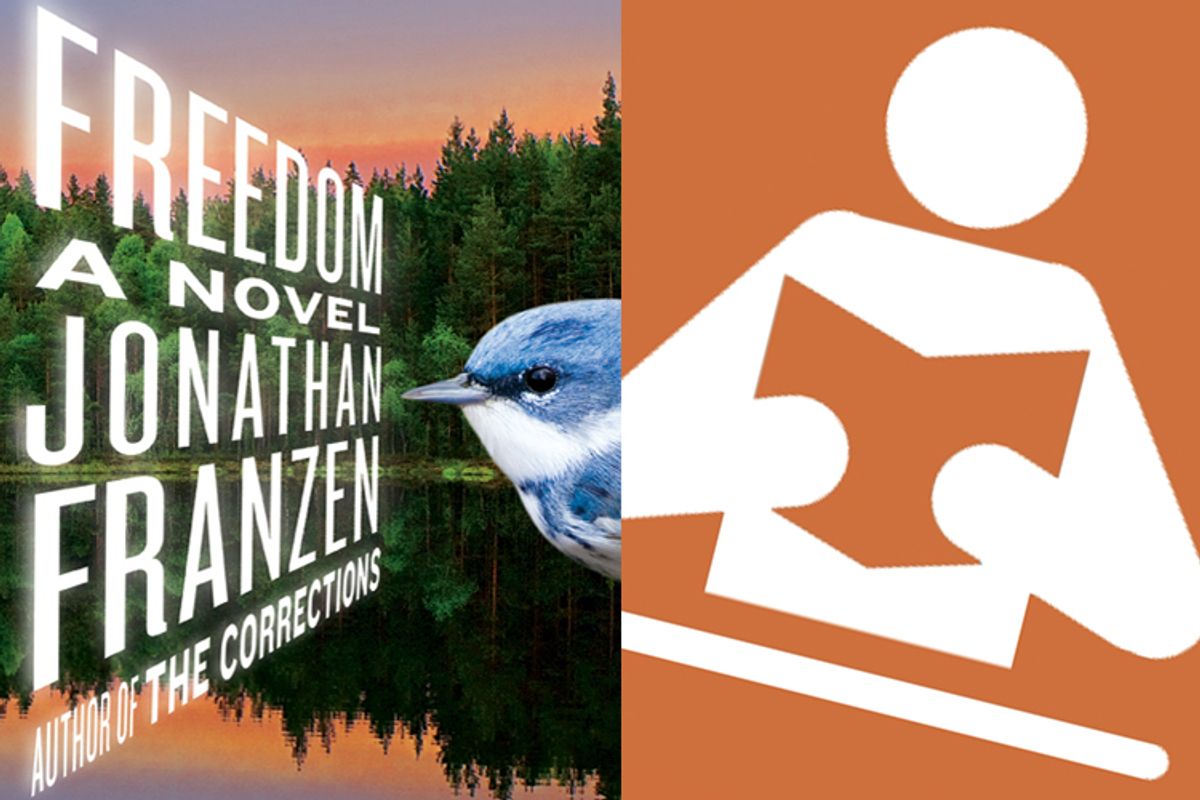
Jonathan Franzen captures this particularly divisive moment in our culture with breathtaking clarity and wit in his new novel, "Freedom," yet he may as well be one of these somewhat distasteful characters himself. Best misunderstood as the snooty genius who recoiled at the sight of an Oprah's Book Club logo on the cover of his widely lauded novel "The Corrections," Franzen's actual comments on the subject were hardly ferocious.
No matter. In the age of the echo chamber, popularity and talent and lofty ideals, when combined with a tendency to split hairs, will only win you the widespread resentment of other, far less popular fallen idealists. It's not surprising, then, that Franzen is garnering a new wave of contempt in anticipation of the Aug. 31 release of his new novel. Thanks to a gushing, preemptive New York Times review ("a masterpiece of American fiction") and reports that Obama himself, at this very moment, may just be perusing the pages of "Freedom" on Martha's Vineyard, we are forced to encounter Franzen much as we encounter the faintly competitive urban perfectionists he portrays in his new novel: We have just enough information to revile him, but not enough information to truly understand him.
Or at least, that's how Franzen quite cleverly begins his story. We meet Patty and Walter Berglund first through the neighborhood gossip about them. There is nothing at all wrong with this couple, and that's precisely what's so wrong with them. "They paid nothing for their Victorian then killed themselves for ten years renovating it," Franzen writes, and we know this pair immediately. As Franzen puts it, they are the sorts of privileged liberals who have the time to wonder, "Was bulgar really necessary?" and "How elaborate did a kitchen water filter actually need to be?" Patty Berglund, an overachieving homemaker, alienates her neighbors with her relentless attention to detail, yet she sprinkles self-deprecation into all of her conversations, to the point where they wonder if such exaggerated self-loathing is the tic of someone who is "trying to spare the feelings of less accomplished homemakers" -- or maybe she's just trying to disguise her superiority complex.
The almost cartoonish exaggerations and gossipy distance of the first section of the novel are a neat trick, really: By the time Patty's overzealous child-rearing backfires and her intolerance for those who don't share her values starts to emerge, we're primed to enjoy watching her take a hard fall.
This is when Franzen brings us in closer, in an autobiographical segment ostensibly written by Patty herself, about her childhood, the mistakes she made in child-rearing, and her regrets concerning her marriage. Thanks to a particularly brutal betrayal by her socially conscious but somewhat callous parents, Patty's overbearing nature is soon rendered not only understandable, but almost valiant. And yet, Patty remains a recalcitrant, demanding, obnoxiously pushy force throughout the course of the novel, always saying too much and then regretting it, always lavishing love and attention on her favorite son while showing inadequate appreciation of her devoted husband. We sense that Patty's many resources -- time, money, love, luck -- only bring her the luxury of misery. It's as if the more room she's given to thrive, the more she creates enemies and neglects her allies and eats herself alive. Patty is a delectable reflection of the times, in other words: good intentions undone by pent-up anger, misguided devotion, and the insatiable demands of an oversize ego, an ego that goes unchecked because Patty has the impulse control of a small child.
Even as Franzen sets forth this conflicted modern archetype and others -- at once loathsome and likable, self-deluded and admirable, self-serving and self-sacrificing -- he dares to nurture his affection for each of them. He has the same sense of humor about his characters that John Updike once did: He pokes fun at them, but he delves into their pasts so we can see how their weaknesses and flaws were once adaptive traits that pulled them out of dead-end situations. Walter Berglund strikes us as a self-righteous, prim little man, until we see how he's dedicated most of his life to taking care of his alcoholic father and misguided but sweet mother, no matter the cost. His friend Richard Katz is a prototypical egocentric rocker type, with all of the effortless charisma and lady-slaying tendencies that entails, but his devotion to (and envy for) Walter hints at an undercurrent of self-loathing beneath his ennui. Walter and Patty's son, Joey, is the ultimate blustery, handsome golden child whose petulant lashing out at his parents would be intolerable, if not for the loyalty and sweetness in him that he has trouble accessing and expressing. It's hard not to feel for these characters. Although we're often suspicious of their motives or question their loyalty and goodness, we still want them to get what they want, even when we know it's all a big, misguided mistake.
Of course, the really impressive feat here is Franzen's larger portrayal of the misguided mistakes of middle-class America: the delusions we indulge in our pursuit of happiness, the ways we neglect the greater good for the sake of our little family units, and the difficulty of setting aside our personal needs to save a world on the brink of total collapse. We're free, yes, and we use our freedom to build our own little fussy, claustrophobic, granite-countertopped islands, while the rest of the world goes straight to hell around us. Sooner or later, with our racing thoughts and our cruelly competitive urges, we join them there, Maui vacations and Wakefield furniture be damned.
"Freedom" is a multilayered, richly imagined novel, full of big ideas and provocative characters and a riveting plot. But even as we delight in Franzen's characters and understand how they got to be the way they are, we don't quite feel how it is to be inside their skin. Maybe that's because the characters themselves seem to watch their own actions from a distance. When Patty is pushed to the brink of ruining everything she's built, she remains oddly detached. "There came to her, with curious vividness, a kind of PowerPoint list of names in descending order of their owners' goodness." When Walter becomes tempted to give in to an obsessive distraction that's been dominating his life for several months, he never seems to lose himself to it completely. "There was no controlling narrative: he seemed to himself a purely reactive pinball in a game whose only object was to stay alive for staying alive's sake." Even moments of extreme passion are described with all of the feverishness of high-level diplomatic negotiations: "He would have liked to just be held by her for a while, but her body had other ideas, and his own body agreed with them."
This distance may reflect a conscious attempt by Franzen to capture the alienated thinking of the modern neurotic. There are heated arguments, dark nights of the soul and crystalline moments when something new is revealed about this or that character, but even the players involved observe most of it from the psychiatrist's leather chair. "Walter was frightened by the long-term toxicity they were creating with their fights," Franzen writes of a low point in Walter's marriage. "Her level of distress seemed borderline dangerous," Joey rationally observes of his depressed girlfriend. At another point Joey wonders, "Why had he stuck with Connie? The only answer that made sense was that he loved her." Even as Franzen zooms in, the messy, indistinct core of each character's experience is never fully breached. And when the emotionally catastrophic events take place, they're described in retrospect or observed with casual indifference: "On the whole, he felt that his decision not to dive from the bridge in Washington had been a good one."
At other times, Franzen uses intellectual distance to demonstrate the impossibility of separating the personal from the political. As betrayal and death and other twists loom on the horizon, we're treated to lengthy passages on how to resolve the estate of the deceased, or we disappear into the folds of mountaintop removal mining in West Virginia. These diversions fit into the rather tight premise of the novel, concerning as it does the push and pull of capitalist pressures against honoring the greater good. As much as we might enjoy a more visceral experience of Patty or Walter or Richard, these are characters who never quite manage to get to the heart of any matter without being led astray by their own neuroses.
Ultimately, "Freedom" is a complexly layered, richly imagined domestic tale about personal responsibility that dares to challenge the long-term global ramifications of our most private choices. Because, when even the hair-splitting idealists among us are ricocheting around in their little pinball machines instead of standing up for what they believe in, the world really is in big trouble.
Shares