
Sex Work

Sex ads linger on Craigslist

The company shuts down its "adult" section, but posts offering erotic services abound

  • more
    • All Share Services

Sex ads linger on Craigslist

A single question came to mind when I heard that Craigslist had taken down its “adult services” section on Saturday: Where will sex workers turn next? So far, the answer seems to be … Craigslist.

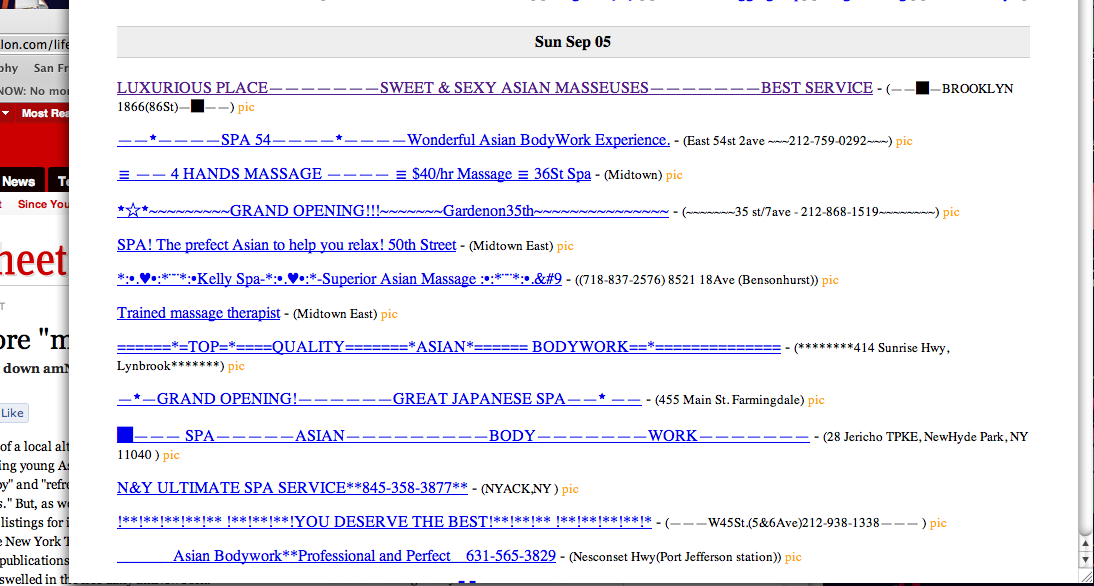
At the start of the Labor Day weekend, the company replaced the front page link to the “adult services” section with a single word: “censored.” It’s a provocative response to mounting pressure from activists and 17 state attorneys general who argued that the site was enabling pimps and sex traffickers to exploit women and girls — but it’s unclear how much it will change. The “therapeutic services” section already appears to have absorbed a lot of the content you would have previously found in “adult services,” although it is much more toned down. There are “full body” rubs, “four-hand massages” and promises of “SWEET & SEXY ASIAN MASSEUSES.”

The Associated Press reports that “some ads still carried in Craigslist’s personals section look like they could fall in similar territory” and gives one example of a post found in “casual encounters”:  “I am the perfect lunchtime or after-5 companion for businessmen that jet-set, work long hours or have family obligations.” ABC News similarly found “several ads across a number of regional Craigslist sites that explicitly mention monetary exchange for sexual favors, seek ‘fun time$,’ offer a massage from an ‘attractive independent female’ or seek a ‘mutually beneficial’ meeting.”

It seems that the sex workers and pimps who were pushed out of the virtual red light district are now spreading throughout the site. That certainly makes buying and selling sex on Craigslist more difficult, because it isn’t so clear what is what. Users will likely flag inappropriate posts, but it remains to be seen how well that will work and whether these spillover ads will be policed in any official capacity. Craigslist staff screened each “adult services” ad, which is why they cost $10 a pop (and $5 to repost). It’s unlikely the company will be able to apply the same standards now that sexually oriented ads are proliferating throughout the site.

M. Ryan Calo, a research fellow at the Center for Internet and Society at Stanford Law School, told the AP that this will make it harder to investigate and screen online prostitution: “Instead of being in a small stream, it’s going to be in a big ocean.” Business is likely to spread not just throughout Craigslist but also to similar sites, of which there are several. Valleywag made that clear in a cheekily servicey article — headlined “Your Post-Craigslist Guide to Buying Sex Online” — which included a list of six thriving X-rated online classified sites.

Stopping the sale of sex on the Internet is like trying to keep frogs in a bucket. You can shutter the most popular online venue for prostitution, but that doesn’t eliminate the demand. Independent sex workers will find other ways to do business, and so will pimps and traffickers. The question here is whether sex workers, and trafficking victims, will be safer without Craigslist’s “adult services” section, or whether they’ll just be less visible.

Tracy Clark-Flory

Tracy Clark-Flory is a staff writer at Salon. Follow @tracyclarkflory on Twitter.

Taxing strip clubs for rape

Politicians are holding adult entertainment venues responsible for funding sexual assault services

  • more
    • All Share Services

Taxing strip clubs for rape (Credit: iStockphoto/wragg)

It used to be that strip clubs were merely blamed for society’s ills. Now they’re actually being charged for it.

In recent years, measures have been introduced in Georgia, Pennsylvania, Texas, Illinois and, most recently, California to apply special taxes to strip clubs — specifically to fund sexual assault services. Now, even if you aren’t inclined to view erotic entertainment as the source of all evil, this might seem an appropriate aim — who wants to argue against additional support for rape survivors? It would seem even more so when you consider politicians’ and activists’ repeated claims of solid scientific evidence showing a link between strip clubs — specifically those that sell alcohol — and sexual violence.

That is, until you look at the alleged proof.

The key study advocates point to is one commissioned by the Texas Legislature in 2009. But that very report states, “no study has authoritatively linked alcohol, sexually oriented business, and the perpetration of sexual violence.” What’s more, when I talked to Bruce Kellison, director of the Bureau of Business Research at the University of Texas at Austin, and one of the authors of the report, about the alleged link between strip clubs and sexual assault, he said, “That’s not really what our study was trying to do.”

What it was trying to do was review the research on whether clubs have a “negative secondary effect” (in other words, harmful side effects). “Most of the [research] has found that there is a moderate amount of increased criminal activity outside of clubs,” he said. That’s a point contested by some: Daniel Linz, a communications and law professor at the University of California, Santa Barbara, says studies used to support restrictive zoning or special taxes on strip clubs are methodologically flawed — they fail to use appropriate controls and rely on inconsistent and unreliable data sources. Take, for example, that zoning laws often relegate strip clubs to shadier parts of town, where, of course, there is greater crime. Without an appropriate control, that crime can’t be attributed to the club itself.

According to a study Linz conducted, “Those studies that are scientifically credible demonstrate either no negative secondary effects associated with adult businesses or a reversal of the presumed negative effect.” He tells me, “We’ve done crime map after crime map after crime map of many cities and there just aren’t clusters of crime around [strip clubs]. Most crime in most cities tends to occur around high schools.” Tax the teens!

That’s just to speak of crime in general. The important thing here, given the aim of these tax initiatives, is sex crime. The Texas report looked at the incidence of sexual violence in particular inside the clubs and found that there wasn’t “additional sexual assault violence going on in the clubs,” says Kellison, or even around the clubs.

Again, as with many things in this arena, that’s contested by some. Richard McCleary, a criminology professor at the University of California, Irvine, whom Linz says he’s had a “10-year scientific battle with,” argues that there is a sexual violence impact, but not the kind that these initiatives imply. He cites a 1998 survey of “a small sample” of adult entertainers that found a high rate of reported sexual victimization inside or nearby the club. This contradicts the findings of the Texas report, however. It’s also important to note that the proposed special taxes don’t go directly toward victimized dancers; the intended target is much broader than that.

McCleary also backs up his assertion saying that street prostitutes “are attracted to the neighborhood because of the clientele and that tends to be an extremely violent trade.” Even if we’re to presume that street prostitutes are driven to strip club neighborhoods in droves, and that they in general experience a high level of violence in their work, it isn’t a direct consequence of the venue itself. As Judith Hanna, an anthropologist and author of “Naked Truth: Strip Clubs, Democracy and a Christian Right,” told me, decriminalizing prostitution would be a much more effective way to address the violence that street prostitutes face.

Hanna is particularly sympathetic to the cause. She’s worked as a volunteer for over a decade with a program for victims of sexual assault, and yet she says, “I never, nor have others in the program, known of a sexual crime victim related to a strip club.” She’s quick to point out that “there is a plethora of evidence that clergy have committed sexual crimes against women, boys and girls.” Where’s their sexual violence tax?

Kellison cuts to the chase: “The reason that many advocates say the strip club industry is being tied directly to the effort to raise funds for rape crisis centers is not because there is increased sexual assault behavior going on inside the clubs or outside the clubs or as a result of a guy going to a strip club,” he says. “That is a very difficult argument to make. What the advocates will say is that it’s an industry that is primarily run with the use of women for, generally speaking, male purposes, male benefit. And that’s why advocates have seen it reasonable to ask the industry to support a tax that would fund services that are primarily geared toward women.”

Well, they rarely actually come out and say it so plainly without the cover of alleged evidence, but that is the fundamental moral judgment behind these initiatives.

Now, there is a strong link between alcohol consumption and sexual violence, but, as Linz says, “any location that is serving drinks, whether it’s a strip club or a regular bar is going to have this societal effect.” He adds, “Compared to other businesses that serve alcohol in the community, these places are no better and no worse.” In other words, it’s the booze, not the boobs.

McCleary, on the other hand, argues that there’s evidence that those who have consumed both alcohol and adult entertainment are more violent than those who have consumed only one or the other. But this is based on laboratory research, which McCleary admits is a far cry from the real world. He also says “it’s very difficult to establish a causal link.”

Critics say these measures have advanced because of courts holding them to a low standard of proof. While some circuits require “reliable social science evidence” to establish negative secondary effects, says Linz, others essentially say, “The city can pick and choose among findings and come to whatever conclusion they want.” Some argue that secondary effects — which were originally used to justify zoning restrictions but have since been applied to even regulations on the content of dances and the degree of nudity — have trumped First Amendments rights. David L. Hudson Jr., a research attorney at the First Amendment Center, calls exotic dancing “a First Amendment stepchild” and writes in a report on the topic, “Many free-speech advocates claim that the secondary-effects doctrine has allowed municipal officials an easy path to censorship.”

Speaking of censorship, Hanna sees crusading religious moralism at work. “A segment of the politically active Christian right are not only opposed to these clubs but they are working like the Tea Party works,” she says. “They have alliances, they have big money and they’re fighting it. Sometimes it’s indirect, they’re electing their people to legislative bodies — you only need one person to start making big noise.”

These measures are a crystal clear reflection of extreme conservative views of sexuality and gender. As Hanna tells me, “The Christian right believes that if you see a nude woman you’re gonna go out and rape the first woman you see.” She also points to the stereotype of “men as a volcano of testosterone ready to be ignited.” From that vantage point, the leap from strip clubs to rape makes intuitive sense — but it doesn’t make it fact.

There’s also just plain financial desperation behind these initiatives. Several sponsors have admitted that the tax is a response to devastating budget cuts to sexual assault resources. Sin taxes — those applied to alcohol, cigarettes and gambling — are not new and have only increased as cities face severe budget cuts. What’s unique about the strip club taxes is not only that boozy adult entertainment venues are being singled out — as opposed to the broader category of liquor — but also that the taxes are being directed toward a cause that is empirically unrelated.

When it comes to adult entertainment, though, critical thinking often falls by the wayside. Strip clubs are an easy target for religious moralizing and political pandering — and one few are willing to defend.

Continue Reading Close
Tracy Clark-Flory

Tracy Clark-Flory is a staff writer at Salon. Follow @tracyclarkflory on Twitter.

The politicization of the Secret Service scandal

What was once one of the right's favorite government agencies becomes a symbol of waste and moral degradation

  • more
    • All Share Services

The politicization of the Secret Service scandalPresident Obama, surrounded by members of the Secret Service, upon his arrival in San Diego, Sept. 26, 2011. (Credit: AP/Pablo Martinez Monsivais)

It’s hard to work up much outrage about the Secret Service prostitution scandal, in which 11 members of the president’s elite protective service and various military personnel were found to have picked up escorts in Colombia, where they were doing advance work for the president’s visit. I guess it is probably not a good idea for the people in charge of protecting the president to leave themselves vulnerable to sexual blackmail, but on the other hand we do not live in a John Le Carré novel or “24″ episode, and I don’t think the threat of a honey-trap assassination conspiracy plot is very credible. If members of the Secret Service want to get drunk and hire escorts after work, that is their business. (As Melissa Gira Grant says, the only actual scandal here — and the reason this became an international incident — is that all these guys tried to bilk one of the women out of the money she was owed.)

But the predictable Washington mixture of prurient interest and moral posturing has turned this incident into grist for the scandals-and-investigations mill. And now we have the attempts at somehow making this a winning partisan issue for Republicans. Chuck Grassley, the senator from Iowa who triumphed over adversity and became the ranking Republican on the Senate Judiciary Committee despite being functionally illiterate, would like to know whether any White House staff also slept with escorts that evening. No one has made the claim, but Grassley’s asking just in case. (For a live peek at a future paranoid right-wing myth in its embryonic stage, read the comments on that Washington Times story: “I can just hear those paper shredders going a mile a minute in the white house, and the document forgers are being called in, you know the same ones that did the birth certificate.”) Grassley was on Fox last night to make sure viewers repeatedly heard baseless speculation as to the involvement of White House staff.

Rep. Pete King, Long Island Republican and stalwart publicity monger, has sent Secret Service Director Mark Sullivan a list of 50 questions about the scandal in order to make it appear that he is very seriously investigating this very serious incident.

For those outside Congress, for whom insinuating escort patronage by unnamed White House staff seems a bit of a reach, the game is to attempt to use the scandal to prove some point the fecklessness of Obama as a leader and his shameful failure to make everyone in Washington stop being so awful and wasteful all the time.

NRO’s Mark Steyn, after praising the fiscal discipline of the agent who attempted to bilk his escort (ugh), suggests that the moral of the story is that we pay too much for presidential security, and that all those agents and fancy bullet-proof Suburbans are wastes of taxpayer funds and evidence of broke post-Imperial America’s profligacy. Sarah Palin, who had every right to be personally aggrieved for once, after it was reported that the agent at the center of the scandal wrote gross sexist things about her on Facebook, was among the first to declare that the problem was with the “culture” Obama has created at the White House. (Karl Rove, smarter than most of these people, suggested that politicizing a Secret Service scandal was dumb and counterproductive. Secret Service Director Mark Sullivan, coincidentally, was elevated to his position under George W. Bush.)

The makeup of the Secret Service, obviously, has very little connection to the political party of the person occupying the White House. Like most American law enforcement agencies, it’s primarily white and overwhelmingly male, and, historically, the culture of the agency has had more than a whiff of machismo. These are not exactly the sort of public sector employees right-wingers get off on demonizing.

In fact, the right has had for years a sort of Clint Eastwood-inspired fantasy of the Secret Service agent as folk hero. Decent, hard-working men putting their lives on the line to protect a bunch of elitist ingrates. That ingratiating phony Bill Clinton and his frigid, hectoring monster of a wife weren’t deserving of such stolid, unflinching loyalty and service.

The fullest expression of this fantasy is in this classic chain email that made its way to every inbox in the nation during the second president Bush’s first term. According to this email, attributed to the unnamed author’s former neighbor, the president’s security detail was constantly disrespected by those awful Clintons and their terrible staff. Hillary Clinton was “arrogant and orally abusive.” “She forbade her daughter, Chelsea, from exchanging pleasantries with” agents. “Al Gore resented Bill Clinton and thought he was to centrist. He despised all republicans.” Agents prayed for Bush to win the election, and their reward was the joy they all felt in the presence of President Bush and his amazing, wonderful wife.

This nonsense has its roots in fake anti-Hillary attacks, attributed to imaginary Secret Service members, that Republican operatives spread to sympathetic media voices starting more or less the day Bill took office. Former Secret Service agents do plenty of gossiping and bitching, most frequently to Ronald Kessler, but their complaints don’t tend to track quite so directly to right-wing fantasy narratives.

But a popular trope is of the upstanding agents blanching at being asked to look the other way as libidinous Democratic presidents — Kennedy, Johnson, and Clinton — womanized. (Clinton was said to have threatened to fire agents who stymied his attempts to have trysts with Monica Lewinsky, though the agent who made the claim admitted to having invented it.) The pat moralism of the conservative Secret Service fantasy makes the agency’s lurid misadventure a bit funnier. It also explains why various people have to somehow convince themselves that the Obama administration somehow degraded the agency, through a lack of “management skills” or the widespread embrace of sexual deviance that is the logical end result of repealing the military’s ban on out gays and lesbians.

Continue Reading Close
Alex Pareene

Alex Pareene writes about politics for Salon and is the author of "The Rude Guide to Mitt." Email him at apareene@salon.com and follow him on Twitter @pareene

My favorite john: My very own “Pretty Woman”

Hector was a handsome Argentine. I was the male escort he hired. What happened next surprised us both

  • more
    • All Share Services

My favorite john: My very own (Credit: ArrowStudio, LLC via Shutterstock)

When people learn that I’m a gay male escort, they invariably ask me how much my life is like the movie “Pretty Woman.”

“It’s more like ‘Daddy Day Care,’” I usually quip. And while that’s meant to be a joke, there’s also some truth to it. I spend a good amount of my work time offering support and advice to men in their 30s and 40s who are just coming out of the closet. Surprised? I was too, at first. But then I thought, where else are these guys going to catch up on two decades of sexual and social experience? Until someone comes out with “Gay for Dummies,” the next best thing is a trained professional.

A few years ago, for example, a charming man from Vancouver hired me every night for a week while he was in Las Vegas for a conference. By the time he went home we’d checked off every item on his wish list, and he was finally comfortable lying naked with another man. It was strangely gratifying to help a guy learn the ropes.

But nothing prepared me for Hector: Thirty-nine years old, handsome, stocky, with a full black beard. Born and raised in Argentina, he lived in Chicago and owned a seat on the stock exchange. He was successful but lonely, and so intensely left-brained that he had carefully engineered a self-improvement plan: He took a sabbatical from work to get himself together. Among other things, he needed to admit he was gay and better understand how that fit into his life. That’s where I came in.

When I first spotted him I thought, “Damn, this guy needs new pictures.” He was much better looking than he’d led me to believe, and more socially adept as well. We clicked instantly. And I don’t know where he learned how, but he kissed like the devil himself.

We had a suite at the Bellagio and spent the weekend like a couple of princes. We went to the spa on Sunday, and then stayed in our bathrobes and ordered appetizers from room service while we watched the Oscars, like two teenagers pretending to be Hollywood royalty.

We also made practical plans, mapping out the next few months on a calendar, scheduling what we’d do and where we’d go. He came back to Las Vegas twice, and we traveled together to Washington (for the cherry blossoms), Provincetown, Montreal, Miami, Hawaii and – wait for it – Paris for the French Open. This was the best gig ever.

Now, I can be what my friends kindly refer to as “an acquired taste.” I have a classic Irish temper, I talk too much, and I tend to be too clever by half. I can also be moody, needing to go off by myself for no discernible reason. So while I wasn’t concerned I’d get bored with Hector, I was a little worried he might get tired of me. But we only had one serious confrontation.

I tried a little too hard to share my love of nude beaches, for which Hawaii is especially famous. He tolerated the one we found on Maui; it was beautiful, and it wasn’t crowded. But the one on the Big Island was another story. It required a treacherous climb to get to, and was filled with too much tie-dye and the kind of bodies no one wants to see naked. Long story short: We didn’t stay very long.

We were spending a few days in Hilo, which is not a town most people recommend. The best hotels haven’t been renovated since the ’70s and there are very few sandy beaches within city limits. As we were driving back, Hector grew quiet, and I tried to fill the air with idle chatter.

“Can we not talk until we get back to the hotel, please?” he asked.

Eventually we stopped for coffee.

“I’m really angry right now,” he started, “so I have to ask you this and hope I get an honest answer.” A beat. “Was that beach the whole reason we came to Hilo?”

I’m not usually very good with confrontation, and my knee-jerk response is to raise my voice. But Hector was calm and his tone was more inquisitive than accusatory, so I tried to follow his lead. “If you knew me any better,” I answered, “I’d be really pissed off that you asked me that question. I don’t manipulate people, and I really don’t like being accused of it.”

“And if I knew you better,” he said, “I probably wouldn’t have to ask. But I do.”

I understood where Hector was coming from, especially given the number of disappointments we’d already met with in Hilo. I explained to him that I didn’t even know about the nude beach until we’d planned to come here. I wanted to come to Hilo for the botanical gardens and the waterfalls we’d seen that morning.

“OK,” he said. “Makes sense. But we’re done with nude beaches.”

It was the only time he ever pulled rank, and within a day the story was a joke between us, the mere mention of Hippie Hollow eliciting mutual groans.

The “Hippie Hollow Incident” was the most mature disagreement I have ever had – including fights with my parents, everyone I’ve ever worked for, and all of my boyfriends. The guy I lived with for four years? We’d have had two weeks of drama and a ruined vacation at the very least. Instead, Hector and I grew closer because of it.  Was this because this was ultimately a business deal and we weren’t arguing as much as negotiating? Or was it because we were especially adept at communicating with each other? Who can say?

Whatever the reasons, the rest of our time together only became more enchanted: sunset dinners on the beach in Kona, orchestra seats for “Follies” at the Kennedy Center, watching Federer’s narrow victory over Monfils from a box at the French Open. It was the kind of magic that would make even a chick-flick aficionado roll her eyes and say, “Yeah, right.” And yet there we were.

Until we weren’t.

The last time I saw Hector was in the Newark airport after we came back from Paris. We’d planned to meet up again in San Francisco for one last week before he returned to work. Instead, he canceled a few days before our meeting. His leave had gone terribly over budget, he said, and he wanted to spend time alone before heading back to work. We’d do a long weekend in the fall, after he’d readjusted to work. Sounded good to me.

I tried to arrange a rendezvous over Thanksgiving and then again over Christmas, but both times he demurred. I was on the East Coast for New Year’s and I asked him if I should stop in Chicago on my way home. He never gave me a straight answer until I pushed the issue. He said it wasn’t a good time.

So our story is unfinished. We send each other text messages several times a week, and I consider him one of my best friends. And yet, I still can’t help wondering what things would be like if we’d met under different circumstances.

Once, while walking along the Seine (you can’t make this stuff up), he told me how sad he was that our time together was drawing to a close. Half-joking, I suggested he take me away from my life of crime and make an honest man of me. He said he wished he could, and I believed him. I still believe him. But I also know that we live in a real world where people click and then discover all kinds of complications. We just happened to know the complications in advance, and then went on the honeymoon, only then to discover how much we liked each other. For now, I continue to mentor guys in the ways of love with other men. Hector has returned to work with confidence, and he has no trouble meeting guys. I encourage him to date. If I know the way Hector’s mind works he won’t even think about embarking on any kind of serious relationship – with me or anyone – until he’s had more practice. In the process he might meet the one guy who’s perfect for him, and good for him if he does.

I know nothing serious could grow between us until I retire from the skin trade. I certainly couldn’t date a hooker – I’m way too insecure for that – and I wouldn’t expect anybody else to. But I’m not planning to escort for the rest of my life. I expect I’ll leave Vegas eventually too; there’s way too much world out there for me to stay in the desert. I don’t expect anything as widescreen as a limo or flowers or being “saved” by anyone (with or without a lot of money); I gave up on that fantasy a long time ago. What’s different for me now is that I’m able to imagine somebody else – maybe Hector, maybe not – in the picture with me on whatever comes next. And that means seeing things through a whole new lens.

Continue Reading Close

Rusty McMann is the professional name of a working call bear.

Ontario legalizes brothels

In an effort to protect prostitutes, the Canadian province's top court strikes down some restrictions on sex work

  • more
    • All Share Services

Ontario legalizes brothelsSex workers listen to a presentation at the 16th International AIDS conference in Toronto (Credit: Reuters/JP Moczulski)
This article originally appeared on GlobalPost.

Ontario’s top court has legalized brothels in the Canadian province, a ruling that is meant to protect the safety of sex workers.

Global PostThe landmark decision taken Monday, decided that the dangerous work of prostitution could be made more safe if it occurred under one roof with security staff, reported the Globe and Mail.

The Appeals Court of Ontario said that some of the country’s anti-prostitution laws were unconstitutional as they restricted the prostitute’s ability to protect themselves — a ruling already made by a lower court in 2010 but appealed by the provincial and federal governments.

The court also said that it would re-model the law against pimps, which prohibits living off the work of others by adding “in circumstances of exploitation,” reported PostMedia News.

This is thought to allow violent or manipulative pimps to be arrested, while permitting prostitutes to be able to hire drivers and security staff for their safety.

Prostitution is legal in Canada with many caveats.

According to the Associated Press, while sex work might be legal, soliciting sex and operating a brothel are both criminal acts.

While the latter provision was struck down, the court upheld the ban on soliciting sex in public.

According to the National Post, the new laws will likely prompt similar challenges in other provinces around the country.

The case was brought forward by an appeal by the provincial and federal governments, which opposed the earlier lower court ruling.

The case took nine months of deliberation and a week of oral arguments with more than 25,000 pages of evidence, according to the National Post.

Witnesses at the hearings included current and former prostitutes, police, activists, politicians and journalists.

Both sides said they will take their case to the Supreme Court of Canada if they lost.

The new laws, which will be binding in Ontario, will come into effect next year.

Continue Reading Close

“Are you on the cover of a magazine?”

During a trip to the bookstore, my mom wandered into the gay section -- and saw my face

  • more
    • All Share Services

(Credit: Unzipped.net)
This article is the second in a new series of oral histories by former and current sex workers, in which they describe the moment they told their family what they do.

I’ve lived in San Francisco for 18 years, and I’ve always been around porn. For a long time, I worked behind the scenes, at a couple of companies’ websites and stuff like that, but I had never wanted to do porn because I wasn’t secure with the way I looked or I had a boyfriend who was against it. Around 2009, those weren’t problems anymore. I got approached to do some nude photo shoots, and one of them ended up being picked up by Men Magazine, which at that time was kind of a big thing. At the same time, a friend of mine was directing a video that he wanted me to be in. At first I just wanted to be an extra, and then he was like, “Why not just have sex in it?” And so I did. Then another director found out about me, and then another, and then I was scheduled in four videos in pretty much the same time.

I liked doing porn. Though I never wanted to be in a situation where I was doing it to pay my rent, I wanted to do it to enrich my life, so I could do things I wanted to do or so I could go on a vacation I wanted to go on. I was making good money, and all that kind of stuff. I filmed my first films in the beginning of 2009, and things started to come out in August 2009. I got tons of press and everything, but I didn’t tell my mom — not because I was skittish about it. My mother was a free love hippie-type person, and she’s always been very sex positive. But it was not something I needed to tell her. My parents divorced when I was really young, but I don’t talk to my dad. I came out to him when I was 17 or 18, but he is very anti-gay, so I haven’t spoken with him in 17 years.

Then in February of 2010 I got a phone call from my mom. My mom never calls me. Never. It’s like pulling teeth to get her to talk on the phone, but she called me and she was like, “Are you on the cover of a magazine?”  I had been voted Man of the Year in Unzipped Magazine that month, so I said, “Yeah … how do you know that?” And so she told me this story: It was a Saturday night, and she had had a date with a guy and he had stood her up. She wanted to entertain herself so she went to the adult bookstore to buy a dildo, and she decided to browse the gay magazines because she said that’s where the hottest guys always were. And there I was on the cover of the magazine.

Later on she called me again. She had read the article that went with my photos in the magazine, and she said it was really beautiful. She cried a little bit and I was like, “Oh, that’s really nice.” I think at one point she wishes she could have done porn, which is a strange thing to hear from your mom. Now we talk a lot more and there’s always the feeling that I don’t need to be hiding anything from her. If you’re open to your mom with the fact that you do porn there’s not really any other secret you can have.

Porn is much more out there these days. So many celebrities have sex videos, and everybody has naked pictures on their phones, and there are so many amateur porn tube sites. But I know a lot of people who come from conservative religious backgrounds whose parents have completely disowned them or distanced themselves from them, and it’s unfortunate. It’s hard to come out as a gay person, but it’s even more difficult to also come out as a person who has sex for a living. It can be hard for some family members to take. But that’s their loss, unfortunately.

My partner also does porn and his porn coming-out started when his aunt, who had a lot of gay friends, found his blog online. Then she told his mother. And she was shocked at first. But now she’s completely accepted it and makes jokes about it, like, “If I do porn, my porn name is going to be Luscious Lynn.” My mother is actually coming to visit in a week for a few days, and she’ll be meeting my partner for the first time, which is great.

I’ve never seen doing porn as a negative thing — ever. Just because it’s sex doesn’t mean it’s not moral. I’m not swindling people. There are plenty of white-collar jobs with bigger ethics and morality issues. I know the rest of society doesn’t see it that way, and it’s always a little frustrating to be an intelligent, educated, articulate person doing porn and have people thinking that you’re a high school dropout.

My mom’s just happy that I’m successful and not on drugs and happy. Anything else is a bonus.

As told to Thomas Rogers. 

Samuel Colt is a gay porn performer living in San Francisco. 

Continue Reading Close

Page 1 of 39 in Sex Work