Salon Home
Topic

Wall Street

Tuesday, Sep 7, 2010 4:01 AM UTC2010-09-07T04:01:00Zl, M j, Y g:i A T

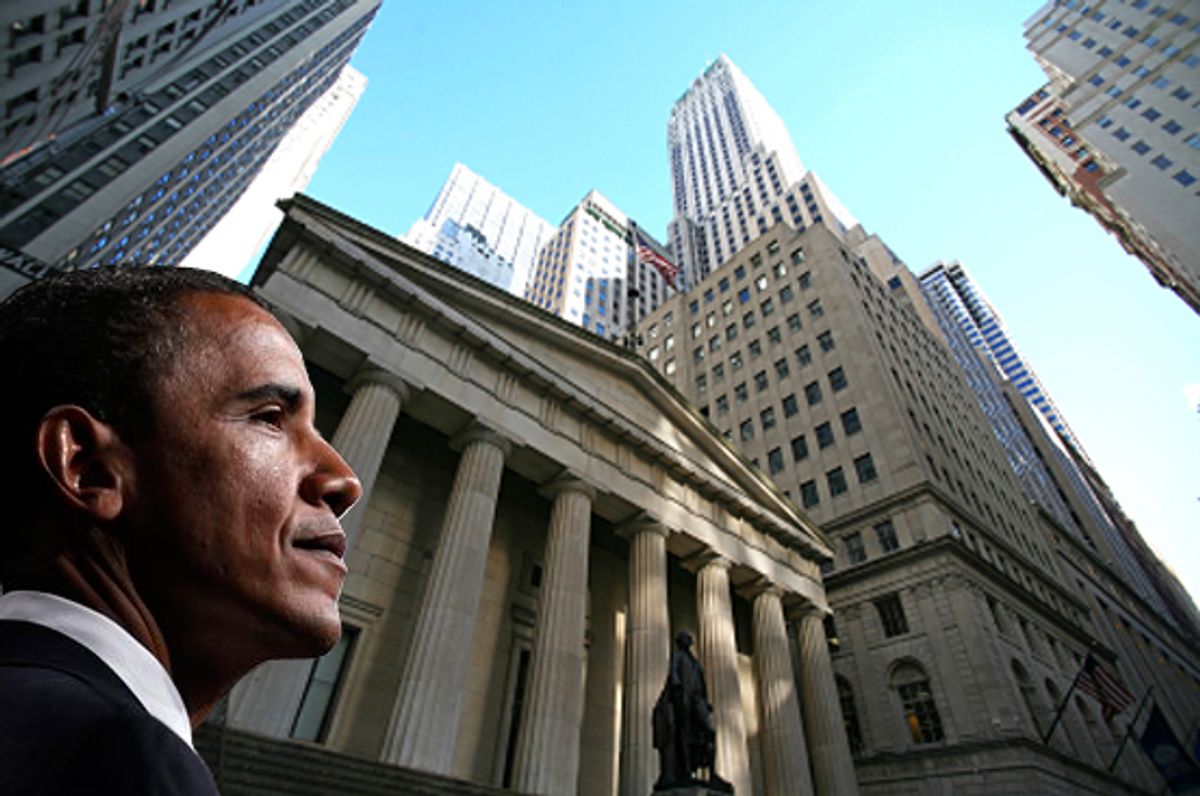
Wall Street’s anti-Obama strategy: Absurd analogies

Obama is to Wall Street as ... Hitler was to Poland?

Wall Street's anti-Obama strategy: Absurd analogies

Has the war of metaphors gone too far? Historians, constitutional lawyers and even zoologists have jumped into the fray provoked by Wall Street critics of the Obama administration and Congress.

It all began when Stephen A. Schwarzman, a co-founder (with right-wing Republican deficit hawk Pete Peterson) of the Blackstone Group, a major private equity firm, said that the Obama administration’s proposals for taxing partners in firms like his brought to mind “when Hitler invaded Poland in 1939.”

Schwarzman’s critics have included fellow members of the financial industry like Robin Plunder of Dewey, Schwindel and Howe, a major U.S. pump-and-dump firm. “That comparison was way too kind to President Obama,” Plunder wrote in his monthly letter to his co-conspirators. “Let’s remember that Poland provoked Hitler, after all. But Wall Street had nothing to do with the financial crisis.”

Continue Reading

Michael Lind’s new book, "Land of Promise: An Economic History of the United States", will be published in April and can be pre-ordered at Amazon.com.   More Michael Lind

Tuesday, Feb 14, 2012 6:00 PM UTC2012-02-14T18:00:00Zl, M j, Y g:i A T

An offensive advocate for LGBT rights

By choosing Goldman CEO Blankfein as a spokesman, HRC signals that corporate malfeasance is perfectly acceptable

Lloyd Blankfein

Lloyd Blankfein  (Credit: AP/Alessandro della Valle)

Topics:,

Last week, the Human Rights Campaign, the organization that advocates for equal rights for gay, lesbian, bisexual and transgender people, announced that Goldman Sachs CEO Lloyd Blankfein will be its first “national corporate spokesman for same-sex marriage.” HRC’s move was almost universally portrayed in the media as a laudable one for the cause of equality: a supposed Nixon-goes-to-China-esque coup that aligned a politically conservative icon with a liberal cause. As one HRC executive told the New York Times: “Lloyd Blankfein is not someone average Americans would think is going to support marriage equality.”

Continue Reading
David Sirota

David Sirota is a best-selling author of the new book "Back to Our Future: How the 1980s Explain the World We Live In Now." He hosts the morning show on AM760 in Colorado. E-mail him at ds@davidsirota.com, follow him on Twitter @davidsirota or visit his website at www.davidsirota.com.  More David Sirota

Wednesday, Feb 8, 2012 2:00 PM UTC2012-02-08T14:00:00Zl, M j, Y g:i A T

Preet Bharara’s toothless bite of Wall Street

Time magazine's favorite federal prosecutor chases the bottom feeders and avoids the sharks

Wall Street isn't worried

Wall Street isn't worried  (Credit: Salon)

Two intriguing magazine cover stories are on the stands this week, on more or less the same topic. New York magazine shows a man clutching between his knees, with the headline: “The Emasculation of Wall Street.” Time’s cover has the impassive puss of Preet Bharara, the U.S. attorney in Manhattan, and “This Man Is Busting Wall St.”

Seeing these two covers side by side, you’d think that Bharara was Wall Street’s Great Emasculator. The Time article is subtitled “Prosecutor Preet Bharara collars the masters of the meltdown,” while the New York piece describes how the Street is reeling from “a crisis that would not be flip to call existential.” Yet nowhere in Gabriel Sherman’s well-researched piece in New York is there even one mention of Preet Bharara.

Continue Reading

Gary Weiss is a journalist and the author of "Ayn Rand Nation: The Hidden Struggle for America's Soul," to be published by St. Martin's Press on February 28, 2012. Follow him on Twitter @gary_weiss.  More Gary Weiss

Monday, Feb 6, 2012 9:12 PM UTC2012-02-06T21:12:00Zl, M j, Y g:i A T

Wall Street’s song of Obama woe

Self-pitying bankers lament a bygone era of fat bonuses and easy money

one_percent_trouble

 (Credit: iStockphoto/JerryPDX)

Topics:

There are at least three different ways to read Gabriel Sherman’s fascinating and provocative report on Wall Street’s incredible shrinking profits in New York magazine, “Is This the End of Wall Street as They Knew It.”

1) As a vehicle for excessive schadenfreude indulgement.

Sherman’s piece is loaded with quotes from bankers bemoaning their changed circumstances. A prime example comes from a banker mulling the news that Morgan Stanley is capping annual bonus payments at $125,000.

Continue Reading
Andrew Leonard

Andrew Leonard is a staff writer at Salon. On Twitter, @koxinga21.  More Andrew Leonard

Thursday, Feb 2, 2012 3:20 PM UTC2012-02-02T15:20:00Zl, M j, Y g:i A T

Lieberman, Cantor defend Capitol Hill’s inside traders

Wall Street's favorites resist the effort to ban profiteering on non-public information

Inside traders

Inside traders  (Credit: AP/Reuters)

“Send me a bill that bans insider trading by members of Congress,” President Obama told the assembled members of the House and Senate in his State of the Union address last week, “and I will sign it tomorrow.”

If only it were that simple.

The Stop Trading on Congressional Knowledge (STOCK) Act, a bill that prohibits legislators and federal officials from knowingly profiting off of nonpublic information related to impending legislation and regulatory decisions, looks certain to pass the Senate this week. On Monday, senators overwhelmingly approved a motion to cloture on S.2038 preventing the bill from being filibustered. But on Wednesday in the House of Representatives Reps. Tim Walz, D-Minn., and Louise Slaughter, D-N.Y.,  demanded a straight up or down vote on a different bill, HR 1148, also known as the STOCK Act. The House bill already has 271 sponsors.

Continue Reading

Sam Knight is a freelance journalist and writer living in Washington, D.C.. Follow him on Twitter @samknight1  More Sam Knight

Monday, Jan 30, 2012 7:07 PM UTC2012-01-30T19:07:00Zl, M j, Y g:i A T

Wall Street’s gilded frat party

At an opulent annual blowout, bailed-out bankers haze newbies, mock OWS and show just how out of touch they are

wallstreet2

 (Credit: Library of Congress)

A week or so ago, we read in The New York Times about what in the Gilded Age of the Roman Empire was known as a bacchanal – a big blowout at which the imperial swells got together and whooped it up.

This one occurred here in Manhattan at the annual black-tie dinner and induction ceremony for Kappa Beta Phi.  That’s the very exclusive Wall Street fraternity of billionaire bankers, and private equity and hedge fund predators. People like Wilbur Ross, the  vulture capitalist; Robert Benmosche, the CEO of AIG, the insurance giant that received tens of billions in bailout money; and Alan “Ace” Greenberg, former chairman of Bear Stearns, the failed investment bank bought by JPMorgan Chase.

They got together at the St. Regis Hotel off Fifth Avenue to eat rack of lamb, drink and haze their newest members, who are made to dress in drag, sing and perform skits while braving the insults, wine-soaked napkins and petit fours – those fancy little frosted cakes — hurled at them by the old guard. In other words, a gilt-edged Animal House, food fight and all.

This year, the butt of many a joke were the protesters of Occupy Wall Street. In one of the sketches, the bond specialist James Lebenthal scolded a demonstrator with a face tattoo, “Go home, wash that off your face and get back to work.” And in another, a member — dressed like a protester – was told, “You’re pathetic, you liberal. You need a bath!”

Pretty hilarious stuff. The whole affair’s reminiscent of the wingdings the robber barons used to throw during America’s own Gilded Age a century and a half ago, when great wealth amassed at the top, far from the squalor and misery of working stiffs. Guests would arrive in the glittering mansions for costume balls that rivaled Versailles, reinforcing the sense of superiority and the virtue of a ruling class that depended on the toil and sweat of working people.

That’s consistent with the attitude expressed by several of these types after Occupy Wall Street sprung up; bankers told the Times on the record that they could understand the anger of the protesters camped on their doorstep;  but privately, a  hedge manager said, “Most… view [it] as ragtag group looking for sex, drugs, and rock ’n’ roll.”

So sayeth the winners in our winner-take all economy. The very guys who were celebrating at the St. Regis because they were too big to fail. Even when they fell flat on their faces, the government was there to dust them off, bail them out and send them back to fight the class war with nary a harsh word or punishment. Talk about a nanny welfare state.

None of this was by accident. The last three decades have witnessed a carefully calculated heist worthy of Robert Redford and Paul Newman in “The Sting” — but on a massive scale. It was an inside job, politically engineered by Wall Street and Washington working hand-in-hand, sticky fingers with sticky fingers, to turn the legend of Robin Hood on its head – giving to the rich and taking from everybody else. Don’t take our word for it – it’s all on the record.

The biggest of the big boys was Citigroup, at one time the world’s largest financial institution. When the meltdown hit in 2008, the bank cut more than 50,000 jobs and you and other taxpayers shelled out more than $45 billion to save it. And how are Citigroup executives doing? Nicely, thank you. Last year, its CEO, Vikram Pandit, took home $1.75 million in base salary, and was awarded $3.7 million in deferred stock.

According to the Times, “Citigroup is expected to disclose the rest of his pay, cash, be it upfront or deferred, in March. In addition, while not necessarily for work performed in 2011, Mr. Pandit last year was awarded a $16.7 million retention bonus, plus stock options that could add $6.5 million to the package’s overall value.” Makes you want to cry out, “Retain me! Retain me!”

To be fair, Vikram Pandit was at the World Economic Summit in Davos, Switzerland last week, where he told Bloomberg News, “It’s important for the financial system to acknowledge that there’s a great deal of anger directed at it… Trust has been broken. Banks have to serve clients, not serve themselves.” What’s more, he has said that the “sentiments” expressed by Occupy Wall Street demonstrators were “completely understandable.”

This, in contrast to the financial industry official who told a reporter that the protesters’ issues were “a lot of sound and fury, signifying nothing.” Or, as they used to say while partying down at the court of Louis XVI and Marie Antoinette, let them eat petits fours.

Bill Moyers is managing editor of the new weekly public affairs program, "Moyers & Company," airing on public television. Check local airtimes or comment at www.BillMoyers.comMore Bill Moyers

Michael Winship is senior writing fellow at Demos and a senior writer of the new series, Moyers & Company, airing on public television.   More Michael Winship

Page 1 of 82 in Wall Street

Other News