Islam

Why they want to burn the Quran

Conservatives encourage (or ignore) demonizing of Islam -- and then claim to be infuriated by Pastor Jones

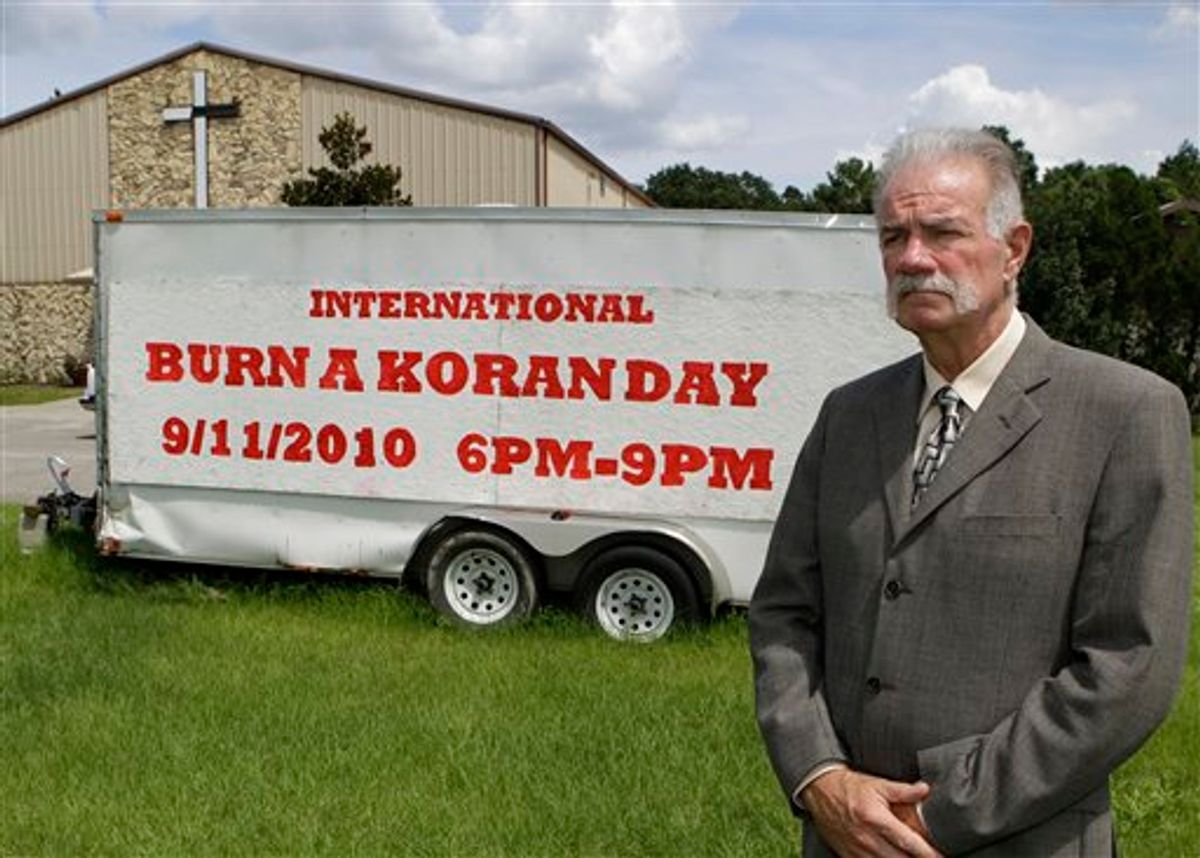
Rev. Terry Jones at the Dove World Outreach Center in Gainesville, Fla., Monday, Aug. 30, 2010. Jones plans to burn copies of the Quran on church grounds to mark the Sept. 11, 2001 terrorist attacks on the United States that provoked the Afghan war. (AP Photo/John Raoux)(Credit: AP)

Had Gen. David Petraeus never condemned a Florida church’s ceremonial destruction of the Quran scheduled for Saturday, Sept. 11, it is hard to imagine that many of his admirers on the political right would have protested. But with the general’s warning that video of such a provocative act of hate would endanger the lives of American personnel abroad, both military and civilian, and serve the purposes of our enemies, he etched a line of demarcation. Suddenly, prominent right-wing commentators sprang forth to agree that burning books is beyond the limit of tolerable intolerance and denounced Pastor Terry Jones and his Dove World congregation as stupid, tasteless, repugnant and all too reminiscent of Nazism.

Or at least some did, even as Republican politicians remained silent on the Florida outrage. What should have been an opportunity for reflection on the national mood of Muslim-bashing bigotry — and especially how that mood was conjured — instead became an occasion to preen and pretend that the little band of idiotic rubes in Florida could not possibly have been inspired by the “sophisticated” critics of Islam on Fox News, talk radio and the Internet.

Nobody is more repelled by the prospect of flaming Muslim holy books than Jonah Goldberg, according to him. But having forthrightly declared his dismay, the National Review blogger seems bewildered by the reaction of his readers — some of whom sharply question his tart condemnation of Jones and suggest that he and Petraeus were promoting Islam over Christianity. The distressed Goldberg, who pilloried liberals as “fascists” in his own famously tortured interpretation of history and didn’t bother to note the irony in his discovery that there are real live book-burners on his side of the spectrum. And notwithstanding this experience, he may still believe, as he wrote in late August, that “Americans who oppose what amounts to an Islamic Niketown two blocks from ground zero are the real victims of a climate of hate, and anti-Muslim backlash is mostly a myth.”

Obviously, Goldberg isn’t listening to the likes of Newt Gingrich, the former House Speaker and aspiring presidential nominee, who compared Islam to Nazism and Japanese imperialism in symbolic offensiveness to Americans. Having repeatedly denounced the construction of the Park51 center as a “radical Islamist” provocation that should be prohibited by Congress, Gingrich has yet to emit a tweet admonishing those who would torch the Quran.

Still, most conservatives would no doubt be alarmed by a book burning, whether of the Quran or any other work. Yet they seem strangely oblivious to how Islam was relentless demonized by figures in their movement, especially over the Park51 controversy, and how that furious drumbeat would encourage the burning of the Quran. They consistently refuse to take responsibility for their own role in encouraging those rancid emotions.

Indeed for many years, neoconservative intellectuals have allied themselves with the religious right, which is scarcely news; they agree on many issues, most notably in their unquestioning defense of Israeli policy. And they agree — or agree not to disagree — on attitudes toward Islam. In practice, those tacit agreements have meant that conservatives and neoconservatives disregard the sulfurous flood of anti-Muslim rhetoric and “revelation” spewing from preachers far more influential than Pastor Jones. Rarely condemning the faith-based hostility of their allies, the conservatives and neocons have chosen to ignore it.

A telling incident occurred during the 2008 presidential race, when John McCain sought and received the endorsement of a nationally known Texas pastor named John Hagee. When Hagee’s sickening quotes about Catholics, Jews and Muslims were disclosed in media reports, McCain dumped him. But Bill Kristol spoke up on behalf of his friend Hagee — who looks forward to a “final confrontation” between the West and Islam because the Quran supposedly commands Muslims to murder and enslave Christians and Jews. “I think, actually, some of the attacks, especially on Reverend Hagee, are unfair,” said Kristol on “Fox News Sunday”. He knows, of course, that none of the criticism of Hagee was unfair — unless it was unfair to quote him accurately from his own books and sermons.

Despite the constant outpouring of anti-Muslim demagoguery from religious right figures such as Hagee, Rod Parsley, Franklin Graham and literally dozens of others, it is also true that Christian and Jewish leaders, including important evangelicals, have behaved with considerably more vigilance and principle in defending the religious liberties of Muslims than conservative politicians and commentators.

With very few exceptions, the failure of the political right to defend those liberties is so broad and complete that a recent word of dissent from that quarter is well worth quoting at length — particularly because it comes from a surprising source. The credentials of Daniel Pipes as a critic of radical Islam can scarcely be questioned; he has gone so far as to justify the Japanese-American internment as a precedent for profiling American Muslims. Anyone who doesn’t believe that Islamophobia has infected the right should listen carefully to him.

Even as Pipes hails the rise of an “angry, potent movement” in the reaction to Park51, he sounds worried:

The energetic push-back of recent months finds me partially elated: Those who reject Islamism and all its works now constitute a majority and are on the march. For the first time in fifteen years, I feel I may be on the winning team.

But I have one concern: the team’s increasing anti-Islamic tone. Misled by the Islamists’ insistence that there can be no such thing as “moderate Islam,” my allies often fail to distinguish between Islam (a faith) and Islamism (a radical utopian ideology aiming to implement Islamic laws in their totality). This amounts to not just an intellectual error but a policy dead end. Targeting all Muslims is contrary to basic Western notions, lumps friends with foes, and ignores the inescapable fact that Muslims alone can offer an antidote to Islamism.

What Pipes and his cohort won’t acknowledge is that an angry movement against the construction of an Islamic community center inevitably encourages a movement against Islam and Muslims itself. Yes, most conservatives despise the burning of the Quran — but shouldn’t they ask themselves who lighted the match?

Joe Conason blogs in Salon several times a week and writes a weekly column for the New York Observer. His latest book is "It Can Happen Here: Authoritarian Peril in the Age of Bush."

The final unraveling of Afghanistan?

The massive anti-Quran-burning protests may mark the beginning of the end of America's military misadventure

Afghan policeman aims at protesters by a burning police truck set alight during an anti-U.S. demonstration over burning of Qurans at a U.S. military base in Afghanistan, in Herat, Friday, Feb. 24, 2012. (Credit: AP Photo/Hoshang Hashim)
This originally appeared on TomDispatch.

Is it all over but the (anti-American) shouting — and the killing? Are the exits finally coming into view?

Sometimes, in a moment, the fog lifts, the clouds shift, and you can finally see the landscape ahead with startling clarity. In Afghanistan, Washington may be reaching that moment in a state of panic, horror and confusion. Even as an anxious U.S. commander withdrew American and NATO advisors from Afghan ministries around Kabul last weekend — approximately 300, military spokesman James Williams tells TomDispatch — the ability of American soldiers to remain on giant fortified bases eating pizza and fried chicken into the distant future is not in doubt.

No set of Taliban guerrillas, suicide bombers or armed Afghan “allies” turning their guns on their American “brothers” can alter that — not as long as Washington is ready to bring the necessary supplies into semi-blockaded Afghanistan at staggering cost. But sometimes that’s the least of the matter, not the essence of it. So if you’re in a mood to mark your calendars, late February 2012 may be the moment when the end game for America’s second Afghan War, launched in October 2001, was initially glimpsed.

Amid the reportage about the recent explosion of Afghan anger over the torching of Qurans in a burn pit at Bagram Air Base, there was a tiny news item that caught the spirit of the moment. As anti-American protests (and the deaths of protestors) mounted across Afghanistan, the German military made a sudden decision to immediately abandon a 50-man outpost in the north of the country.

True, they had planned to leave it a few weeks later, but consider the move a tiny sign of the increasing itchiness of Washington’s NATO allies. The French have shown a similar inclination to leave town since, earlier this year, four of their troops were blown away (and 16 wounded) by an Afghan army soldier, as three others had been shot down several weeks before by another Afghan in uniform. Both the French and the Germans have also withdrawn their civilian advisors from Afghan government institutions in the wake of the latest unrest.

Now, it’s clear enough: the Europeans are ready to go. And that shouldn’t be surprising. After all, we’re talking about NATO — the North Atlantic Treaty Organization — whose soldiers found themselves in distant Afghanistan in the first place only because, since World War II, with the singular exception of French President Charles de Gaulle in the 1960s, European leaders have had a terrible time saying “no” to Washington. They still can’t quite do so, but in these last months it’s clear which way their feet are pointed.

Which makes sense. You would have to be blind not to notice that the American effort in Afghanistan is heading into the tank.

The surprising thing is only that the Obama administration, which recently began to show a certain itchiness of its own — speeding up withdrawal dates and lowering the number of forces left behind — remains remarkably mired in its growing Afghan disaster. Besieged by demonstrators there, and at home by Republican presidential hopefuls making hay out of a situation from hell, its room to maneuver in an unraveling, increasingly chaotic situation seems to grow more limited by the day.

Sensitivity Training

The Afghan War shouldn’t be the world’s most complicated subject to deal with. After all, the message is clear enough. 11 years in, if your forces are still burning Qurans in a deeply religious Muslim country, it’s way too late and you should go.

Instead, the U.S. command in Kabul and the administration back home have proceeded to tie themselves in a series of bizarre knots, issuing apologies, orders and threats to no particular purpose as events escalated. Soon after the news of the Quran burning broke, for instance, General John R. Allen, the U.S. war commander in Afghanistan, issued orders that couldn’t have been grimmer (or more feeble) under the circumstances. Only a decade late, he directed that all U.S. military personnel in the country undergo 10 days of sensitivity “training in the proper handling of religious materials.”

Sensitivity, in case you hadn’t noticed at this late date, has not been an American strong suit there. In the headlines in the last year, for instance, were revelations about the 12-soldier “kill team” that “hunted” Afghan civilians “for sport,” murdered them, and posed for demeaning photos with their corpses.  There were the four wisecracking U.S. Marines who videotaped themselves urinating on the bodies of dead Afghans — whether civilians or Taliban guerrillas is unknown — with commentary (“Have a good day, buddy… Golden — like a shower”).  There was also that sniper unit proudly sporting a Nazi SS banner in another photographed incident and the U.S. combat outpost named “Aryan.” And not to leave out the allies, there were the British soldiers who were filmed “abusing” children.

And that’s just the tip of the iceberg when it comes to how Afghans have often experienced the American and NATO occupation of these last years. To take but one example that recently caused outrage, there were the eight shepherd boys, aged six to 18, slaughtered in a NATO air strike in Kapisa Province in northern Afghanistan (with the usual apology and forthcoming “investigation,” as well as claims, denied by Afghans who also investigated, that the boys were armed).

More generally, there are the hated night raids launched by special operations forces that break into Afghan homes, cross cultural boundaries of every sort, and sometimes leave death in their wake.  Like errant American and NATO air operations, which have been commonplace in these war years, they are reportedly deeply despised by most Afghans.

All of these, in turn, have been protested again and again by Afghan President Hamid Karzai.  He has regularly demanded that the U.S. military cease them (or bring them under Afghan control). Being the president of Afghanistan, however, he has limited leverage and so American officials have paid little attention to his complaints or his sense of what Afghans were willing to take.

The results are now available for all to see in an explosion of anger spreading across the country. How far this can escalate and how long it can last no one knows.  But recent experience indicates that, once a population heads for the streets, anything can happen.  All of this could, of course, peter out, but with more than 30 protesters already dead, it could also take on a look reminiscent of the escalating civil war in Syria — including, as has already happened on a small scale in the past, whole units of Afghan security forces defecting to the Taliban.

Unfolding events have visibly overwhelmed and even intimidated the Americans in charge. However, as religious as the country may be and holy as the Quran may be considered, what’s happened cannot be fully explained by the book burning.  It is, in truth, an explosion a decade in coming.

Precursors and Omensstrong

After the grim years of Taliban rule, when the Americans arrived in Kabul in November 2001, liberation was in the air. More than 10 years later, the mood is clearly utterly transformed and, for the first time, there are reports of “Taliban songs” being sung at demonstrations in the streets of the capital. Afghanistan is, as the New York Times reported last weekend (using language seldom seen in American newspapers) “a religious country fed up with foreigners”; or as Laura King of the Los Angeles Times put it, there is now “a visceral distaste for Western behavior and values” among significant numbers of Afghans.

Years of pent up frustration, despair, loathing and desperation are erupting in the present protests. That this was long on its way can’t be doubted.

Among the more shocking events in the wake of the Quran burnings was the discovery in a room in the heavily guarded Afghan Interior Ministry in Kabul of the bodies of an American lieutenant colonel and major, each evidently executed with a shot in the back of the head while at work.  The killer, who worked in the ministry, was evidently angered by the Quran burnings and possibly by the way the two Americans mocked Afghan protesters and the Quran itself.  He escaped.  The Taliban (as in all such incidents) quickly took responsibility, though it may not have been involved at all.

What clearly rattled the American command, however, and led them to withdraw hundreds of advisors from Afghan ministries around Kabul was that the two dead officers were “inside a secure room” that bars most Afghans. It was in the ministry’s command and control complex. (By the way, if you want to grasp some of the problems of the last decade just consider that the Afghan Interior Ministry includes an area open to foreigners, but not to most Afghans who work there.)

As the New York Times put it, the withdrawal of the advisors was “a clear sign of concern that the fury had reached deeply into even the Afghan security forces and ministries working most closely with the coalition.” Those two dead Americans were among four killed in these last days of chaos by Afghan “allies.”  Meanwhile, the Taliban urged Afghan police and army troops, some of whom evidently need no urging, to attack U.S. military bases and American or NATO forces.

Two other U.S. troops died outside a small American base in Nangarhar Province near the Pakistani border in the midst of an Afghan demonstration in which two protestors were also killed.  An Afghan soldier gunned the Americans down and then evidently escaped into the crowd of demonstrators. Such deaths, in a recent Washington Post piece, were termed “fratricide,” though that perhaps misconstrues the feelings of many Afghans, who over these last years have come to see the Americans as occupiers and possibly despoilers, but not as brothers.

Historically unprecedented in the modern era is the way, in the years leading up to this moment, Afghans in police and army uniforms have repeatedly turned their weapons on American or NATO troops training, working with, or patrolling with them.  Barely more than a week ago, for instance, an Afghan policeman killed the first Albanian soldier to die in the war.  Earlier in the year, there were those seven dead French troops.  At least 36 U.S. and NATO troops have died in this fashion in the past year.  Since 2007, there have been at least 47 such attacks.  These have been regularly dismissed as “isolated incidents” of minimal significance by U.S. and NATO officials and, unbelievably enough, are still being publicly treated that way.

Yet not in Iraq, nor during the Vietnam War, nor the Korean conflict, nor even during the Philippine Insurrection at the turn of the twentieth century were there similar examples of what once would have been called “native troops” turning on those training, paying for and employing them.  You would perhaps have to go back to the Sepoy Rebellion, a revolt by Indian troops against their British officers in 1857, for anything comparable.

In April 2011, in the most devastating of these incidents, an Afghan air force colonel murdered nine U.S. trainers in a heavily guarded area of Kabul International Airport.  He was reportedly angry at Americans generally and evidently not connected to the Taliban.  And consider this an omen of things to come: his funeral in Kabul was openly attended by 1,500 mourners.

Put in the most practical terms, the Bush and now Obama administrations have been paying for and training an Afghan security force numbering in the hundreds of thousands — to the tune of billions dollars annually ($11 billion last year alone).  They are the ones to whom the American war is to be “handed over” as U.S. forces are drawn down.  Now, thanks either to Taliban infiltration, rising anger, or some combination of the two, it’s clear that any American soldier who approaches a member of the Afghan security forces to “hand over” anything takes his life in his hands.  No war can be fought under such circumstances for very long.

Apologies, Pleas and Threats

So don’t say there was no warning, or that Obama’s top officials shouldn’t have been prepared for the present unraveling. But when it came, the administration and the military were caught desperately off guard and painfully flatfooted.

In fact, through repeated missteps and an inability to effectively deal with the fallout from the Quran-burning incident, Washington now finds itself trapped in a labyrinth of investigations, apologies, pleas and threats.  Events have all but overwhelmed the administration’s ability to conduct an effective foreign policy.  Think of it instead as a form of diplomatic pinball in which U.S. officials and commanders bounce from crisis to crisis with a limited arsenal of options and a toxic brew of foreign and domestic political pressures at play.

How did the pace get quite so dizzying?  Let’s start with those dead Afghan shepherd boys.  On February 15th, the U.S.-led International Security Force (ISAF) “extended its deep regret to the families and loved ones of several Afghan youths who died during an air engagement in Kapisa province Feb 8.”  According to an official press release, ISAF insisted, as in so many previous incidents, that it was “taking appropriate action to ascertain the facts, and prevent similar occurrences in the future.”

The results of the investigation were still pending five days later when Americans in uniform were spotted by Afghan workers tossing those Qurans into that burn pit at Bagram Air Base.  The Afghans rescued several and smuggled them — burnt pages and all — off base, sparking national outrage.  Almost immediately, the next act of contrition came forth.  “On behalf of the entire International Security Assistance Force, I extend my sincerest apologies to the people of Afghanistan,” General Allen announced the following day. At the same time, in a classic case of too-little, too-late, he issued that directive for training in “the proper handling of religious materials.”

That day, White House Press Secretary Jay Carney was on the same page, telling reporters that the burning of the Muslim holy books was “deeply unfortunate,” but not indicative of the Americans’ feelings toward the religious beliefs of the Afghan people. “Our military leaders have apologized… for these unintentional actions, and ISAF is undertaking an investigation to understand what happened and to ensure that steps are taken so that incidents like this do not happen again.”

On February 22nd, an investigation of the Quran burnings by a joint ISAF-Afghan government team commenced.  “The purpose of the investigation is to discover the truth surrounding the events which resulted in this incident,” Allen said. “We are determined to ascertain the facts, and take all actions necessary to ensure this never happens again.”

The next day, as Afghan streets exploded in anger, Allen called on “everyone throughout the country — ISAF members and Afghans — to exercise patience and restraint as we continue to gather the facts surrounding Monday night’s incident.”

That very same day, Allen’s commander-in-chief sent a letter to Afghan President Hamid Karzai that included an apology, expressing “deep regret for the reported incident.” “The error was inadvertent,’’ President Obama wrote. “I assure you that we will take the appropriate steps to avoid any recurrence, to include holding accountable those responsible.’’

Obama’s letter drew instant fire from Republican presidential candidates, most forcefully former House speaker Newt Gingrich, who called it an “outrage” and demanded instead that President Karzai issue an apology for the two Americans shot down by an Afghan soldier.  (Otherwise, he added, “we should say goodbye and good luck.”)

Translated into Washingtonese, the situation now looked like this: a Democratic president on the campaign trail in an election year who apologizes to a foreign country has a distinct problem. Two foreign countries? Forget it.

As a result, efforts to mend crucial, if rocky, relations with Pakistan were thrown into chaos. Because of cross-border U.S. air strikes in November which killed 24 Pakistani soldiers, ties between the two countries were already deeply frayed and Pakistan was still blocking critical resupply routes for the war in Afghanistan.  With American war efforts suffering for it and resupply costs sky-high, the U.S. government had put together a well-choreographed plan to smooth the waters.

General Martin Dempsey, Chairman of the Joint Chiefs of Staff, was to issue a formal apology to Pakistan’s army chief.  Secretary of State Hillary Clinton would then follow up with a similar apology to her Pakistani counterpart.

Fearing further Republican backlash, however, the Obama administration quickly altered its timetable, putting off the apology for at least several more weeks, effectively telling the Pakistanis that any regrets over the killing of their troops would have to wait for a time more convenient to the U.S. election cycle.

Trading apologies to Afghans for those to Pakistanis, however, turned out to mean little on the streets of Afghanistan, where even in non-Taliban areas of the country, chants of “Death to America!” were becoming commonplace.  “Just by saying ‘I am sorry,’ nothing can be solved,” protester Wali Mohammed told the New York Times. “We want an open trial for those infidels who have burned our Holy Quran.”

And his response was subdued compared to that of Mohammed Anwar, an officer with the U.S.-allied Afghan police.  “I will take revenge from the infidels for what they did to our Holy Quran, and I will kill them whenever I get the chance,” he said. “I don’t care about the job I have.”

A day later, when Anwar’s words were put into action by someone who undoubtedly had similar feelings, General Allen announced yet another investigation, this time with tough talk, not apologies, following.  “I condemn today’s attack at the Afghan Ministry of Interior that killed two of our coalition officers, and my thoughts and prayers are with the families and loved ones of the brave individuals lost today,” he said in a statement provided to TomDispatch by ISAF. “We are investigating the crime and will pursue all leads to find the person responsible for this attack. The perpetrator of this attack is a coward whose actions will not go unanswered.”

Allen also took the unprecedented step of severing key points of contact with America’s Afghan allies.  “For obvious force protection reasons, I have also taken immediate measures to recall all other ISAF personnel working in ministries in and around Kabul.”

Unable to reboot relations with allies in Islamabad due to the unrest in Afghanistan (which was, in fact, already migrating across the border), the U.S. now found itself partially severing ties with its “partners” in Kabul as well.  Meanwhile, back home, Gingrich and others raised the possibility of severing ties with President Karzai himself.  In other words, the heat was rising in both the White House and the Afghan presidential palace, while any hope of controlling events elsewhere in either country was threatening to disappear.

As yet, the U.S. military has not taken the next logical step: barring whole categories of Afghans from American bases.  “There are currently no discussions ongoing about limiting access to ISAF bases to our Afghan partners,” an ISAF spokesperson assured TomDispatch, but if the situation worsens, expect such discussions to commence.

The Beginning of the End?

As the Quran burning scandal unfolded, TomDispatch spoke to Raymond F. Chandler III, the Sergeant Major of the U.S. Army, the most senior enlisted member of that service.  “Are there times that things happen that don’t go exactly the way we want or that people act in an unprofessional manner? Absolutely. It’s unfortunate,” he said. “We have a process in place to ensure that when those things don’t happen we conduct an investigation and hold people accountable.”

In Afghan eyes over the last decade, however, it’s accountability that has been sorely lacking, which is why many now in the streets are demanding not just apologies, but a local trial and the death penalty for the Quran burners. Although ISAF’s investigation is ongoing, its statements already indicate that it has concluded the book burnings were accidental and unintentional. This ensures one thing: those at fault, whom no American administration could ever afford to turn over to Afghans for trial anyway, will receive, at best, a slap on the wrist — and many Afghans will be further outraged.

In other words, twist and turn as they might, issue what statements they will, the Americans are now remarkably powerless in the Afghan context to stop the unraveling. Quite the opposite: their actions are guaranteed to ensure further anger among their Afghan “allies.”

Chandler, who was in Afghanistan last year and is slated to return in the coming months, said that he believed the United States was winning there, albeit with caveats. “Again, there are areas in Afghanistan where we have been less successful than others, but each one of those provinces, each one of those districts has their own set of conditions tied with the Afghan people, the Afghan government’s criteria for transition to the Afghan army and the Afghan national police, the Afghan defense forces, and we’re committed to that.” He added that the Americans serving there were “doing absolutely the best possible under the conditions and the environment.”

It turns out, however, that in Afghanistan today the “best” has not been sufficient. With even some members of the Afghan parliament now calling for jihad against Washington and its coalition allies, radical change is in the air. The American position is visibly crumbling. “Winning” is a distant, long-faded fantasy, defeat a rising reality.

Despite its massive firepower and staggering base structure in Afghanistan, actual power is visibly slipping away from the United States.  American officials are already talking about not panicking (which indicates that panic is indeed in the air). And in an election year, with the Obama administration’s options desperately limited and what goals it had fast disappearing, it can only brace itself and hope to limp through until November 2012.

The end game in Afghanistan has, it seems, come into view, and after all these fruitless, bloody years, it couldn’t be sadder. Saddest of all, so much of the blood spilled has been for purposes, if they ever made any sense, that have long since disappeared into the fog of history.

To stay on top of important articles like these, sign up to receive the latest updates from TomDispatch.com here.

Continue Reading Close

Tom Engelhardt, co-founder of the American Empire Project, runs the Nation Institute's TomDispatch.com. His latest book, "The United States of Fear" (Haymarket Books), has just been published.

Nick Turse is the associate editor of TomDispatch.com and the winner of a 2009 Ridenhour Prize for Reportorial Distinction as well as a James Aronson Award for Social Justice Journalism. His work has appeared in the Los Angeles Times, the Nation, In These Times, and regularly at TomDispatch. This story is a joint investigative project of Salon, AlterNet, and Brave New Foundation.

Welcome to the first annual celebrity religion swap

Leaders of the world's most powerful faiths convene to trade their famous converts -- and improve their image

(Credit: AP/Salon)

Muslims worldwide groaned upon hearing the news that Oliver Stone’s son, Sean, converted to Islam while filming a documentary in Iran.

Although we — the collective 1.5 billion Muslims worldwide — assume Sean Stone is a fine, upstanding man and sincerely wish him spiritual contentment, we earnestly ask Allah why Islam only attracts controversial celebs (in this case, the son of a controversial celeb) who further tarnish our already toxic brand name?

We plead to the heavens for an answer as to why he converted in Iran, of all places, which is currently the most feared and loathed country in America and about as popular as herpes.

We have patiently endured, oh, Allah.

We miraculously survived Mike Tyson, who converted to Islam while incarcerated, and then angrily threatened Lennox Lewis in an infamous interview: “I want your heart. I will eat his children. Praise be to Allah.”

Awesome.

Islam has the lowest favorability rating of any religion in America. If Islam were a world economy, it would be Greece. If it were a professional athlete, it would be San Francisco 49ers punt returner Kyle Williams, who muffed two critical punts, which helped the New York Giants reach the Super Bowl. If Islam went to the prom, it would be the ugly girl with freckles and an overbite standing in the corner with a bucket of pig’s blood teetering precariously over its head.  If Islam were a Republican presidential candidate, it would be Newt Gingrich.

A diverse jirga of American Muslim leaders decided “enough was enough” and held an emergency meeting at Lowes’ Home Improvement store in Dearborn, Mich., to strategize how to bolster Islam’s faltering image.

A consensus emerged that we needed to draft popular, mainstream celebrities whose successful addition to our starting lineup would boost our international brand name. After all, 1,400 years of civilization and the religious practices of 1.5 billion solely rest on the tanned shoulders of the rich, famous and beautiful.

Inspired by comedian Dave Chappelle, one of the few Muslim converts who could be considered a net gain, the Muslims held a “Religious Draft” this week, inviting major religions to participate on hallowed ground: McDonald’s.

The following is a summary of the proceedings.

THE FIRST ROUND PICK

Since it was universally accepted Islam was the 2011 Indianapolis Colts of world religions, they had first pick.

Predictably, the Muslims drafted free agent Liam Neeson, who recently said, “There are 4,000 mosques in [Istanbul]. Some are just stunning and it really makes me think about becoming a Muslim.” The Irish actor is experiencing a pop cultural rebirth as the 21st century embodiment of uncompromising, kick-ass masculinity and sage paternalism. On behalf of Muslims, he took revenge against France, which recently caved into hysteria and banned the burqa. Neeson single-handedly destroyed the entire country with his bare fists in the blockbuster action film “Taken.” Muslims believe Neeson will help rebrand them as Jedi Knights, due to his portrayal of Jedi Qui-Gon in “Star Wars: The Phantom Menace,” and replace their current image as Dark Lords of the Sith.

Rumors circulated that many Evangelical Christians felt slighted by this pick since Muslims stole their digital Avatar of Jesus: Neeson voices “Aslan the Lion” from the “Narnia” movies.

The rest of the day’s picks were organized according to different types of celebrity.

ATHLETES

In a surprise move, the Buddhists requested Mike Tyson from the Muslims. Exhausted from voluntarily suffering for the past 2,500 years, the Buddhists decided Tyson’s crushing right uppercut could “really eff up China.”

In turn, the Buddhists decided to offer the Beastie Boys — the aging, versatile, hip-hop trio from Brooklyn –  sensing they peaked with their 1998 “Hello Nasty” album. The Muslims accepted, acknowledging the songs “Sabotage” and “Shake Your Rump” as perennial favorites in Egypt and Lebanon.

The Buddhists selflessly threw in Richard Gere and DVD copies of “American Gigolo” to sweeten the deal.

The Jews intervened and said they wanted the Beastie Boys back on their team. They offered the Muslims Ben Roethlisberger, two-time Super Bowl champion quarterback of the Pittsburgh Steelers. Having read about Big Ben’s dubious history of sexual impropriety, the Muslims passed, but decided to donate Mike D of the Beastie Boys to the Jews as a truce offering. Allegedly, the Muslims could never forgive Mike D for the horribly weak rhyme “Everybody rappin’ like it’s a commercial, acting like life is a big commercial” on the song “Pass the Mic.”

The Jews accepted the offer.

The Muslims, feeling emboldened, made an ambitious pitch to the Christians for Denver Broncos quarterback Tim Tebow, who “just wins.”

Muslims offered former NBA all-star Shaquille O’Neal, who fell from their graces after he acted as a giant genie in the box-office bomb “Kazaam.” They also threw in Mahmoud Abdul-Rauf, the controversial Denver Nuggets star who converted to Islam and refused to stand for “The Star-Spangled Banner” before games. The Christians were initially enticed, seeing this as a perfect “born-again” moment, but they passed.

The Muslims went aggressive and promised they wouldn’t supplant the Constitution with Shariah and replace the White House with minarets unless Tebow and Mel Gibson crossed over.

The Christians, anxious to excommunicate Gibson, agreed. For the 2012 NFL season, Tebowing will now consist of prostrating and praising Allah after every touchdown. The Christians asked the Muslims to preserve Tebow’s chastity and not introduce him to Miss USA Rima Fakih or hot Arab women from the reality TV show “All-American Muslim”; the Muslims said they’d try, but they promised nothing.

COMEDIANS

The Jews made a play for comedian Dave Chappelle, a Muslim, citing his hit series on Comedy Central “Chappelle’s Show” as a creative juggernaut that still influences the masses — especially several rabbis, who apparently love saying, “I’m Rick James, bitch!” after performing circumcisions.

The Muslims immediately rejected the offer, saying Chappelle is perhaps the only living proof that Muslims can be intentionally funny.

Instead, they offered Iranian President Mahmoud Ahmadinejad as an example of an unintentional comedian and provocateur in exchange for Israel cooling down its dangerous rhetoric of a preemptive strike on Iran.

Furthermore, the Muslims offered the newly acquired Mel Gibson straight up for Jerry Seinfeld.

The Mormons tried to intercept Seinfeld by playing one of their highest cards: “Napoleon Dynamite” actor Jon Heder. The Jews pretended not to hear this mockery and allowed the Mormons to slink away with some shred of remaining dignity.

The Jews finalized a deal with the Muslims and rumors have circulated since that Mel and Ahmadinejad are under house arrest in Tel Aviv, forced to watch “The Chosen” and “Fiddler on the Roof” on repeat while listening to Jerry Lewis perform comedy.

MUSICIANS

Sensing friendly relations, the Jews humbly approached the Muslims for rapper Ice Cube, citing his immense street cred and respect from the hip-hop and African-American communities. The Jews conceded the Matisyahu experiment, although initially promising, had failed, as the Hasidic reggae rapper never lived up to his “King Without a Crown” potential.

The Muslims mulled it over for a considerable time. The jirga decided they would retain eternal rights to Cube’s 1993 hit single “It Was a Good Day” from his multi-platinum album “Predator,” but ultimately release him because he inexplicably starred in the awful family comedy “Are We There Yet?”

Muslims in return asked the Jews for Kabbalah-worshipping Madonna, sensing serious comeback potential after her excellent Super Bowl halftime show.

Catholics made a request for multi-talented actor and hip-hop artist Mos Def from the Muslims, who soundly rejected any and all future offers, stating the entirety of the Middle East and North Africa could never bear to part with Def’s song “Ms. Fat Booty.”

Instead, Muslims counter-offered with alternative rock artist Everlast, whose 1998 single “What It’s Like” has made a surprising comeback on radio stations due to the economic recession. The Catholics still remember Everlast as the lead singer of the hip-hop band House of Pain, who produced the classic party anthem “Jump Around,” before his conversion to Islam. The Catholics accepted; South Asian Muslims danced to “Jump Around” one last time; and the Muslims in return received Taylor Swift and her legions of pubescent female fans, along with her former boyfriend Taylor Lautner, who played the ethnic werewolf in the “Twilight” movies.

The Muslims had finally secured their most promising young-adult celebrity.

POLITICIANS

The Mormons halfheartedly offered Mitt Romney. The Evangelicals promised Michele Bachmann and her lifetime supply of blinks. The Catholics, out of sheer desperation and embarrassment, bartered Newt Gingrich and his third wife, Callista.

The Muslims decided to stick with their boy, Barack Hussein Obama, in hopes of retaining the White House  in 2012.

MISCELLANEOUS

Muslims threw a Hail Mary and asked fundamentalist Christians for Chuck Norris, who so thoroughly kicked the Middle East’s entire ass during the ’80s. The Muslims respected Norris for his ability to fire an Uzi, perform a roundhouse kick and wave an American flag at the same time. In return, Muslims offered the infamous WWF wrestler the Iron Sheikh and even agreed to teach the Christians the impregnable camel clutch. Norris, humbled by the offer, respectfully declined, and admitted that although he enjoyed killing hordes of fictional Arabs in jingoistic action movies like “Delta Force,” he currently fancied himself an intellectual and activist committed to exposing the nonexistent threat of Shariah infiltrating America. The Muslims were saddened, but collectively agreed to watch Norris in the summer action film “Expendables 2.”

The Hindus decided to play their strongest card, actress Julia Roberts, and made a request for journalist Lauren Booth, former British Prime Minister Tony Blair’s sister in law, who converted to Islam in 2010. The Hindus saw her as the perfect revenge and giant, henna-painted middle finger to England for the British Empire’s previous colonization and exploitation of India’s resources. The Muslims thought this was reasonable and now the “Pretty Woman” flashes her million-dollar smile behind a burqa.

THE CHOSEN ONE

Finally, the draft ended with all the religions coveting “the chosen one,” who would single-handedly redeem their public image both at home and abroad.

The Mormons offered former Republican presidential candidate Jon Huntsman, highlighting his excellent Chinese and fine hair. The Muslims initially offered NBA Hall of Famer and current cultural ambassador Kareem Abdul Jabbar. They sweetened the deal and threw in President Obama. The Jews presented Steven Spielberg and his entire film library. The Hindus humbly offered Bollywood actors Amitabh Bachan, Aishwarya Rai and a picture of Gandhi signed by Ben Kingsley. The Buddhists presented Tina Turner, Herbie Hancock and Tiger Woods.

But, it was sadly to no avail.

The Christians and Church of New York decided to keep NBA superstar and New York Knicks point guard Jeremy Lin. Rumors circulated that they were talking to China about a potential trade to ensure the ambitious superpower does not ask the United States to repay its debt, thus financially crippling and utterly destroying our great nation.

All in all, “it was a good day” for the Muslims in the first Religious Draft.

Continue Reading Close

Wajahat Ali is a playwright, attorney, journalist and essayist. His award winning play"The Domestic Crusaders," was published by McSweeney's in 2011. He is the lead author of "Fear Inc., Roots of the Islamophobia Network in America." He is currently writing a pilot for HBO. He is co-editing the anthology "All American: 45 American Men on Being Muslim" published in June 2012.

What if Tim Tebow were Muslim?

The NFL star has been praised for his public Christianity. It's been different for athletes who follow Islam

Denver Broncos quarterback Tim Tebow (15) prays in the end zone before the start of an NFL football game against the Chicago Bears, Sunday, Dec. 11, 2011, in Denver. (Credit: AP/Julie Jacobson)

Tim Tebow’s profession of faith has thrust the mixture of sport and religion into the national spotlight in a way that few can remember.

Students have been suspended for “Tebowing” — dropping to one knee to pray, even if you’re the only one doing it — in a school hallway in New York. Rick Perry claimed that he would be the Tim Tebow of the Iowa caucuses. “Saturday Night Live” lampooned Tebow’s fan-boy love for Jesus. In response, Pat Robertson has claimed that the skit demonstrates “anti-Christian bigotry.” His supporters even called for a boycott of HBO after a Bill Maher tweet made fun of Tebow and his relationship to Jesus after his Denver Broncos lost to the Buffalo Bills.

After an overtime upset of the Pittsburgh Steelers last weekend, Tebow’s Broncos play the top-seeded New England Patriots on Saturday. For at least one more media cycle, there will appear to be no way to separate Tim Tebow – the person, the quarterback, the Christian – from his religion.

But back in September, the cultural critic Toure asked a fascinating question in ESPN the Magazine. In a piece called “What if Michael Vick were white?,” Toure argued with those who said the quarterback would not have received a two-year sentence for dogfighting if he was white. Would he have been involved with dogfighting? Would an entourage have led him to the same mistakes? Would he have had a stronger paternal relationship?

So I ask, what if Tim Tebow were Muslim? How would our society react if during every interview, Tebow said “Insha’Allah” or “Allāhu Akbar” rather than thank his Lord and Savior, Jesus Christ? Or instead of falling to one knee and praying,  Tebow pulled out a prayer rug and faced Mecca? A recent study by the Pew Research Center suggests it would not be well received. While American Muslims in general tend be satisfied with their lives and communities in the United States, 55 percent report that being Muslim in the U.S. has become more difficult since Sept. 11. Twenty-eight percent report that people have viewed them with suspicion and 22 percent report having been called offensive names. The TLC show “All-American Muslim” has lost advertisers who were pressured by groups claiming that the show was Islamic propaganda. Yet Pat Robertson claims that the United States is a breeding ground for anti-Christian bigotry.

I don’t have answers to these questions. We can’t know the answers until we are faced with a prominent Muslim athlete who is willing to be so visible with his faith. In a country that consistently prides itself on freedoms – freedom of speech, freedom to assemble, freedom of religion – we can hope that Muslim athletes who are visible with their faith would find themselves just as revered as Tebow is for his.

But professional Muslim athletes are hard to find. Ahmad Rashād. Rashaan Salaam. Kareem Abdul-Jabaar. Hakeem Olajuwon. Rasheed Wallace. Most of these athletes are retired and went about their religious lives quietly. But it is to that list of retired professionals that we must look to find someone as outspoken about their faith as Tim Tebow – Mahmoud Abdul-Rauf and Muhammad Ali, for example.

In 1990, Chris Jackson was drafted by the Denver Nuggets out of Louisiana State University. In 1991,  Jackson converted to Islam. In 1993, he changed his name to Mahmoud Abdul-Rauf. In 1996,  Abdul-Rauf refused to stand for the national anthem at an NBA game. A religious storm followed.

Everyone had an opinion, from fans to sports writers to radio hosts. Sports Illustrated reported that some people suggested Abdul-Rauf be deported. Mahmoud Abdul-Rauf was born in Mississippi, however, and deportation from Colorado to Mississippi is rare. Two Denver-area radio hosts even walked into a mosque with a stereo playing the Star Spangled Banner. One was wearing a turban. And a Mahmoud Abdul-Rauf T-shirt. While broadcasting live, on air.

Abdul-Rauf claimed in a 2010 interview with HoopsHype.com that “[a]fter the national anthem fiasco, nobody really wanted to touch me.” He played only three more seasons in the NBA before going overseas to play professionally. In that same interview, he discusses how his home in Mississippi was burned down just a few months prior to Sept. 11. He eventually left the state.

So Mahmoud Abdul-Rauf stood up (or in this case, sat down) for his religious beliefs. He made his religion a visible aspect of his life and a visible aspect of his professional basketball career. Just like Tim Tebow. The difference of course being that Tim Tebow was satirized on “Saturday Night Live.” Mahmoud Abdul-Rauf had his home burned down and felt blacklisted from the NBA.

Mahmoud Abdul-Rauf pales in comparison to the outspoken nature of Cassius Clay. In 1964, Cassius Clay announced his membership in the Nation of Islam, and  changed his name to Muhammad Ali. In 1966, Ali spoke out against the draft and became a conscientious objector to the Vietnam War based on his religious beliefs. In 1967, Ali was convicted of draft evasion.

But even before his conviction, Ali was causing controversy. Sports Illustrated dubbed Ali the most hated athlete in the world in April 1966. In the same article, Ali’s faith was referred to as being a part of his “fanatically religious side.” Instead of being something to admire, his faith was inconceivable fanaticism. No Christian leader supported Ali’s display of Islamic faith in the same way that Muslim leaders have supported Tebow’s display of Christian faith. Just like Tebow, though, Ali – the person, the boxer, the Muslim – could not be separated from his religion. This was never clearer than in his conscientious objection to the war in Vietnam.

By now, even casual boxing fans are familiar with Ali’s quote “I ain’t got no quarrel with them Viet Cong … No Viet Cong ever called me nigger.” That one quote made Ali a social activist. And his social activism was based on his faith. Ali claimed that Islam prohibited war unless called for by Allah. That one belief made Ali’s religion a wider social issue. What followed was public outcry. Ali was stripped of his championship belt, had his boxing license suspended, and was convicted of draft evasion. The Supreme Court ultimately overturned it. But for four years, Ali, arguably the greatest boxer of all time, did not fight.

So Muhammad Ali stood up (or in this case, sat out) for his religious beliefs. He made his religion a visible aspect of his life and a visible aspect of his professional boxing career. Just like Tim Tebow 40 years later. Just like Mahmoud Abdul-Rauf 30 years later. Ali was an outspoken proponent of his religion, Islam, but was vilified for his outspoken religious beliefs. His Islamic beliefs.

Again I ask, what if Tim Tebow were Muslim? He’s not. So maybe it doesn’t matter. There is no way to separate the man and the religion. Some people praise him for it, others recoil. When this happens, avid defenders of Tebow invoke freedom of religion. But as Tebowmania makes its way into politics, sports, religion and the everyday life of the mainstream United States, it is important to think about how we approach religion in this country. How we approach religious freedom in this country. Do we accept freedom of religion, any religion? Or do we accept freedom of Christianity?

Continue Reading Close

Hateful campaign targets “All-American Muslim”

In a shameful move, Lowe's pulls its ads from a Learning Channel show that dares present young Muslims as people

And now, a dispatch from the Department of Corporate Cowardice: The home improvement chain Lowe’s has pulled its advertising from TLC’s documentary series “All-American Muslim” (Sundays 10 p.m./9 Central) because … Well, because … It’s baffling, really. I guess it’s because the series portrays the vast majority of American Muslims as law-abiding citizens who just want the same right to life, liberty and the pursuit of happiness enjoyed by others. It’s the 21st-century Muslim-American version of a show that might have run on network TV during the civil-rights era in hopes of persuading bigots that black folks weren’t just looking to knock the white man down and take his women.

Lowe’s immediately became the target of online boycott campaigns. On its corporate Facebook page, Lowe’s said that: “It appears that we managed to step into a hotly contested debate with strong views from virtually every angle and perspective – social, political and otherwise – and we’ve managed to make some people very unhappy. We are sincerely sorry.”

The stated reason for the pullout, according to Lowe’s, is that the show was “a lightning rod” for controversy. That means the company and others were subjected to an organized email campaign by the Florida Family Association, a … whoops, I nearly typed “conservative group,” but the attitudes expressed in the FFA statement approving Lowe’s decision should shame anybody to the left of Ann Coulter.

“The Learning Channel’s new show ‘All-American Muslim’ is propaganda clearly designed to counter legitimate and present-day concerns about many Muslims who are advancing Islamic fundamentalism and Sharia law,” stated an article that ran on the group’s web site in advance of the series’ November premiere. “The show profiles only Muslims that appear to be ordinary folks while excluding many Islamic believers whose agenda poses a clear and present danger to liberties and traditional values that the majority of Americans cherish. One of the most troubling scenes occurred at the introduction of the program when a Muslim police officer stated ‘I really am American.  No ifs and or buts about it.’ … The show portrayed a Roman Catholic who converted to Muslim to marry.  However, there was no mention of a Muslim who attempted to convert to Christianity which has resulted in a multitude of conflicts in America and abroad. Many woman were shown wearing hijabs and many who were not, but the program did not show what happens if one of the hijab-wearing women decides to take it off.  Such conflicts would conflict with The Learning Channel’s agenda to inaccurately portray Muslims in America. There is no mention of the honor killing of Jessica Mokdad who lived not far from where this show was taped in Dearborn. The show fails to mention many Islamic believers’ demeaning treatment of women or great disdain for non-Muslims (infidels).

This is a request for “balance” that would actually have moved “All-American Muslim” closer to the Coulter/Rush Limbaugh/Fox News Channel idea of fairness, which amounts to a full-on conspiratorial panic attack. It’s akin to a 1960s reactionary group organizing a letter-writing campaign against a network documentary attempting to humanize workaday African-Americans on grounds that it didn’t include sections on drug dealers, gangsters, unwed mothers, junkies and other negative archetypes. The TLC series is nothing less than an attempt to depict mundane, and, heaven forbid, positive aspects of Muslim life that rarely get addressed in American journalism and popular culture, except in patronizing “Hey, don’t worry ,.. We don’t totally hate you!” pieces that run during Ramadan. Airing in a country in which Shariah law has become the latest right-wing creeping menace, the show is an ideological counterweight if anything, and it only omits things that get covered to death on cable news outlets to the exclusion of anything neutral, much less positive.

Nevertheless, Lowe’s backed out. “Lowe’s has received a significant amount of communication on this program, from every perspective possible. Individuals and groups have strong political and societal views on this topic, and this program became a lightning rod for many of those views. As a result we did pull our advertising on this program.”

It’s important to note, however, that Lowe’s is not the only advertiser to pull its ads from “All-American Muslim.” It is just the only one to issue a press release acknowledging the decision and see it turned into a news story. Also notable: While the FFA is the public face of pressure on the TLC series, it’s far from the only group to target the show’s advertisers.

“The Washington-based Council on American-Islamic Relations (CAIR) said Thursday that “the calls for an advertiser boycott are coming from Internet hate sites like Bare Naked Islam, which recently featured a number of threats of violence targeting U.S. and European mosques, and right-wing groups such as the Florida Family Association and American Decency.”

Updates to the FFA article bragged, “TWENTY FIVE (25) out of TWENTY SEVEN (27) NEW ADVERTISERS targeted in the November 29th email alert did not advertise again during the December 4th and 5th episodes. … SIXTY FIVE (65) companies that Florida Family Association targeted with emails did NOT advertise again during the only two episodes of All-American Muslim that aired this past week (meaning the week of Dec. 4). ”

You can see the complete list of who did and didn’t fold at the link above. It’s quite a list of deserters.

This morning, Bare Naked Islam celebrated the campaign in a post headlined “WOO-HOO! Our crusade against TLC’s ‘All-American Muslim’ has gone viral!”

“I wonder why they aren’t bothering all the other sponsors who pulled their ads from All-American Muslim after the first show?” the site asked rhetorically. “I guess it’s because only Lowe’s went public with their decision to stop advertising there.”

Continue Reading Close

How turkey came to our Thanksgiving table

Once shunned by my Muslim family, the bird finally found a place in our home, just like so many American traditions

(Credit: SunnyS via Shutterstock)

My Pakistani and American Muslim social circles celebrate Thanksgiving each year alongside our Eid festivities and Super Bowl Sunday parties, featuring homemade guacamole dip, chips and samosas. But it wasn’t always like this. For my family, this marriage between East and West was three decades in the making.

The 1980s:  An “Amreekan Holiday”

As a child, I often asked my mother what we were eating for Thanksgiving.

“Food,” she replied matter-of-factly.

“Are we eating a turkey?” I asked.

“No, only Amreekans eat turkey.”

Any immigrant or child of immigrants understands that “Amreekan” is a code word for “the mainstream,” which really means “white people.” In addition to celebrating Thanksgiving with a turkey, here are some other things we learned only “Amreekans” do:

  • Wear shoes inside the home
  • Receive “time out” as a valid form of punishment for unruly behavior
  • Talk back to elders
  • Have sex before marriage
  • Put grandparents in senior homes
  • Sleep over at friends’ homes
  • Tattoos
  • Christmas trees
  • Cable television
  • Shop at stores other than Ross, K-Mart, outlet stores, Marshalls and Mervyns (RIP)

Now, I don’t begrudge my parents their position toward turkey. It’s a confounding bird for most immigrants, who are generally more comfortable with the bleats of a goat or a lamb, the squawks of the simple-minded chicken. The turkey was an enigma: a heavy, feathered bird with its “gobbledygook” mutterings, freakish red wattle and vast supply of dry, juiceless meat.

“Do the Amreekans realize it is dry?” ask my still perplexed relatives living in Pakistan. “Where is the masala? The taste? The juices? Why do they eat this bird?”

Besides, most first-generation immigrants in America retain the romantic, deluded concept that “We will eventually go back home to the Motherland.” They will never be “Amreekan.”

Of course, they never do go back and instead firmly plant their familial, cultural, economic, religious and political roots in this foreign yet welcoming “Amreekan” soil. They have second-generation kids — yours truly — who are as “Amreekan” as apple pie, burritos and biryani.

And so Thanksgiving traditions began to leak into our old-school immigrant mentality. I watched the annual Macy’s parade, hoping to see a Spider-Man float. I played Super Mario on my Nintendo and looked forward to spending the evening with Snoopy, Linus, Charlie Brown and the gang, all the while eating a traditional Pakistani dinner. No turkey — yet.

The ’90s: Introducing the Thanksgiving Chicken

In my teen years, I discovered hair in new places and found the courage to demand authentic “Amreekan” requests from my parents.

“Give me turkey, woman!” I once commanded my mother for the upcoming Thanksgiving festivities.

“Here’s some money. You buy it and make it yourself if you like it so much,” she replied.

Foiled again. She knew my inherent culinary uselessness and overall laziness far too well. Well played, Mother. Well played.

During this decade of grunge and Bill Clinton, the immigrant generation in our family gradually replaced the “We will go back to the motherland” mantra with disillusioned rants about how “The motherland is going to hell” after they returned from visiting.

American pop culture effortlessly coexisted within the confines of our Pakistani-American home. Visiting from college one day, I descended the stairs to Nusrat belting out a qawwali in Punjabi. Moments later my father changed the track to Jimi Hendrix’s “Purple Haze.” He was in the kitchen rubbing traditional South Asian spices into pieces of steak he would later cook on his brand-new George Foreman grill.

My mother relented to my requests and made a meal on Thanksgiving. Instead of cooking a turkey, though, she insisted on roasting two whole chickens.

“What’s the point of having a chicken on Thanksgiving of all days?” I asked. “It’s like passing out omelets to kids on Easter instead of colored eggs.”

“I like chickens. I can cook a chicken. Chickens are tasty,” my mother replied. “I’m not wasting my time cooking a dry bird.”

She ruled the kitchen with an Iron Ladle.

But the consumption of “some form of a bird” on Thanksgiving was remarkable progress toward fully celebrating this Amreekan holiday. Furthermore, the religious clergy in our communities realized the obvious: Thanksgiving dinner is actually harmonious with Muslim values. After all, aren’t we reconciling with our family and communities and being thankful and grateful for all of our blessings? Isn’t that what Muslims are supposed to do on a daily basis?

Score one for theology in supporting rational arguments to consume dead birds.

That night, we ate two fully roasted whole chickens (quite tasty), and my mother also made basmati rice, daal (lentls), chicken khorma (curry) and kheema (South Asian ground beef.)

It wasn’t perfect — but it was a start.

The new century: Let there be turkey

The 21st century opened the culinary floodgates. It was a brave new world. Turkeys were unleashed to South Asian and Muslim American homes on Thanksgiving with wild abandon. No American holiday would be left unattended and no holiday sale would be forsaken by the immigrant communities! The musings of “going back to the motherland” have now transformed into semi-annual visits to see relatives and nothing more.

Even Muslim butchers are readily selling Halal turkeys in their local community shops. (Halal meat refers to animals slaughtered according to Islamic custom similar to Kosher slaughtering practices for Jews).

2002 was the “Great Turkey Explosion,” when Chandni, the neighborhood South Asian restaurant/wedding reception hall/religious ceremony hall/miscellaneous space used for all celebrations, started offering an “authentic Thanksgiving buffet” for $11 on Nov. 24-25. I had heard rumors of this awesomeness, but I had to drive there and witness morsels of turkey flesh swimming in a broth of fat and oil to believe it myself. And, lo and behold, in front of the South Asian buffet table — which featured lamb karahi, chicken tikka masala, and saag ghosht (spinach with meat) — there was “Thanksgiving” buffet table with turkey, gravy, mashed potatoes and bread rolls.

In our home, my father made the official decree that the Ali family would now and forever more eat turkey on Thanksgivings – provided he could successfully cook it, which meant “Not cooking it like the Amreekans who always make it too dry.” He felt ambitious in his old age and wanted to test his expanding baking skills by finally tackling the Gobbling-Goliath.

His initial attempt in 2003 was conservative, baking the turkey over several hours as per custom. There was also corn. The mother made some chicken khorma as emergency along with Basmati rice. Some cans of mango and lime pickle achar (relish) were opened just in case. The turkey was both edible and tasty. The family had successfully conquered the mythical bird and stuffed it with so much masala juice it developed a South Asian accent, bhangra dance moves, good credit and IT tech support skills.

A few years later, the family decided to up the ante and “brine” the turkey after some intense Googling sessions researching “Best Way to Cook + Turkey.” This time, we added gravy, mashed potatoes and soft rolls to the menu, along with corn.

Some Thanksgiving staples, however, remained foreign. Yams could only be justified if it was added with meat to a curry. Pumpkins were still regarded as an “exotic vegetable” only to be seen and carved on Halloween. Cranberry sauce was something you drank out of a bottle as a juice concentrate and never ate on the side. “Stuffing” was still only understood as a verb and not an edible noun.

Fast-forward a few years to 2011, and lo and behold, our turkeys have been successfully baked, roasted, brined, deep fried — and thoroughly enjoyed. The annual turkey now sits on a large dining table next to homemade sweet yams, mashed potatoes and gravy, corn bread, rolls, corn on the cob, and store-bought pumpkin pie and cranberry sauce. And yes, there is always a South Asian curry dish just in case.

We also wash down the gluttony with the American Muslim version of Cristal: Martinelli’s Apple Cider.

But this isn’t just a story about how we integrated a strange-looking bird into our dinners. It’s how my American Muslim Pakistani family integrated into the American cultural fabric. It’s the same messy, colorful but inevitable way immigrants all over enter the American narrative, bringing their own flavors to collide, merge and spill outside the pot.

It’s as Amreekan as turkey and chicken khorma.

Continue Reading Close

Wajahat Ali is a playwright, attorney, journalist and essayist. His award winning play"The Domestic Crusaders," was published by McSweeney's in 2011. He is the lead author of "Fear Inc., Roots of the Islamophobia Network in America." He is currently writing a pilot for HBO. He is co-editing the anthology "All American: 45 American Men on Being Muslim" published in June 2012.

Page 1 of 69 in Islam