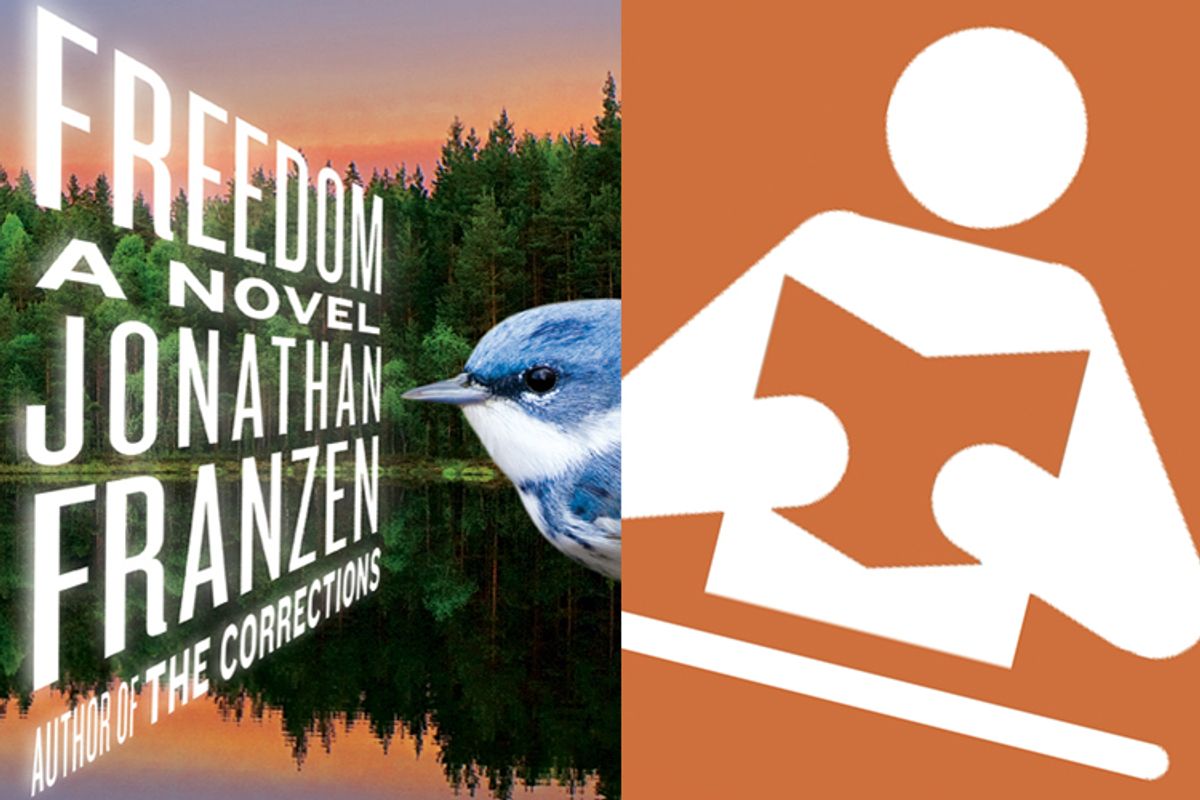
Welcome to the second session of Salon's Reading Club, everyone. For those just joining us, we're discussing Jonathan Franzen's new novel, "Freedom." Last week, we talked about the first part of the book, "Good Neighbors," through the end of Patty's "autobiography" (pages 1 through 187). This week, we'll consider half of the second part, "2004," reading through the end of the chapter titled "Enough Already" (pages 191 to 382). On Sept. 18, we'll talk about the conclusion (See the sidebar to the right for more information on the Salon Reading Club.)
As before, I'm going to start the discussion with a few questions and observations, but, as always, feel free to take the conversation wherever you like in the comments thread. Just try to restrain yourselves from discussing anything that happens after "Enough Already," so you don't spoil the story for everybody else. And it should go without saying that if you haven't gotten to Page 382 yet and don't want to be spoiled, then don't read any further. Finally, if you have questions for Jonathan Franzen himself, don't forget to post them, since we'll be interviewing him at the end of the month.
This middle section of the book offers us a view of the story from the perspective of characters other than Patty: Walter, Richard and Joey. Perhaps it's just the imprinting of those 180 pages of "autobiography," but for me, Patty will always feel like the novel's central character. I did want to see her as the men in her life see her, but the narrative lost a tiny bit of its momentum when her struggles weren't on center stage. I suspect that this is also partly because Patty does wrestle with herself so mightily, whereas Walter and Richard feel more like fixed quantities looking for a way to settle into the world, seeking the place where their piece of the puzzle fits.
All of this raises a question I've been wanting to ask since we started, concerning an observation people often make about Franzen's (and many other authors') characters, which is that they are "unlikable." I confess, I've grown to hate such remarks. It makes me feel like we're all back in grammar school, talking about which kids are "nice" and which kids are "mean." It's a willfully naive and blinkered way to approach a work of literature.
James Wood, in his book "How Fiction Works," wrote that this complaint implies that "artists should not ask us to try to understand characters we cannot approve of -- or not until after they have firmly and unequivocally condemned them." That we might recognize a character's unappealing qualities while simultaneously seeing life through her eyes, "and that this moving out of ourselves into realms beyond our daily experience might be a moral and sympathetic education of its own kind," doesn't seem to occur to far too many readers. Wood calls this sort of criticism, so common in Amazon reader reviews, a "contagion of moralizing niceness."
Patty is not nice. She does some bad things, and she can be grouchy and bitter. I wouldn't necessarily want her as a friend, but then that's not really an option because she's not a real person. She's a literary character -- which means it's not imperative that we take a moral stance on every single thing she does. Literature is an experiment of the imagination, and if we don't try to leave behind our contemporary compulsion to pass judgment on everything and everyone when we enter into that experiment, then we are the ones who lose out.
Speaking of "beyond our daily experience," I for one found Richard's views on "female bullshit" fascinating and astringently delightful. Few women ever get a glimpse of the inside of a consummate womanizer's mind, and I, like axelrod, underlined the passage where a client's flirtatious wife makes what she thinks are challenging remarks about Richard's music and then "waited, with parted lips and a saucy challenge in her eyes, to see how her presence -- the drama of being her -- was registering." How I love that miniature, well-barbed character sketch!
So, fellow Salon Reading Club members, what do you think? Do you find the characters in "Freedom" likable or not -- and does it matter?
Shares