Air Travel
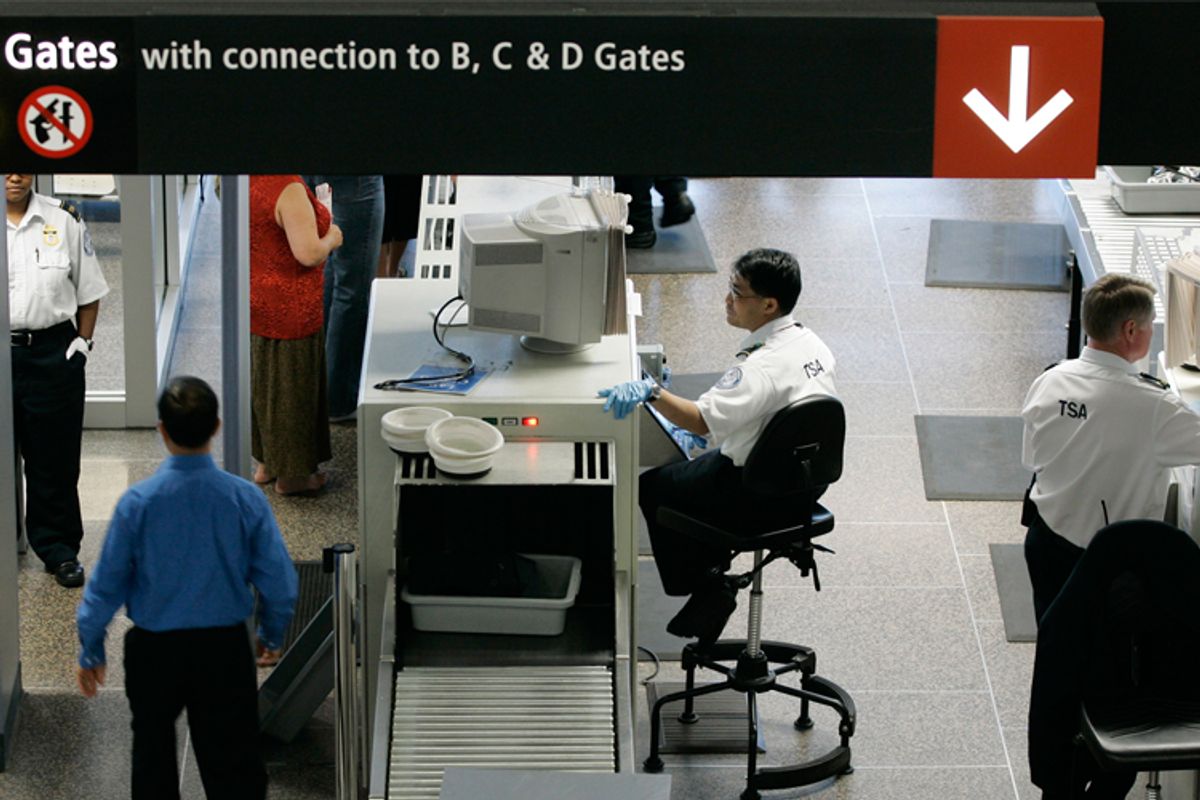
Two ways of looking at TSA
Yes, the concourse screeners sometimes drive us nuts, but there are signs of intelligent life behind the scenes
The other day I was riding the subway out to Logan Airport. A Transportation Security Administration guard was also on the train, and I got to looking at his uniform. The TSA emblem, if you haven’t seen it, is a circular thing with an American flag backdrop and a sort of petrified, puffed-out eagle. The guard had one of these on his left shoulder.
Around the ugly eagle were three words, and I peered in to read them. The results were even more banal than I expected. It said: “integrity, team spirit, innovation.”
That last one is the only one of substance, potentially. “Integrity” is generic and meaningless. “Team spirit”?
Pardon me for taking this so seriously, but why is TSA’s motto about them, and not about us, the people whose safety they are entrusted with? Should it not reflect the mission, rather than the way the agency feels, or wants to feel, about itself? I’m thinking along the lines of the old “to protect and to serve” of the LAPD.
As it stands, and depending on how you read it, TSA’s annoying choice of words seems a touch hostile and confrontational.
Then again, judging from the behavior of many concourse screeners, maybe those are the words — “hostility” and “confrontation” — that ought to be sewn onto the emblem. You could put “touching” on there too, maybe. A friend of mine swears she was groped recently by an overzealous screener during a pat-down, echoing similar allegations made by hundreds of other travelers.
Now, having gotten that off my chest, allow me to break with tradition and say something positive about TSA.
I was in Africa a few weeks ago and had a rather encouraging conversation with one of the TSA bigwigs there, whose team is in charge of assessing and certifying African airports so that U.S. carriers can operate there safely. It is better if I don’t say his name or reveal any specifics, but I was impressed and surprised by much of what he told me. The biggest criminal threat to commercial aircraft overseas is essentially the same thing it has been for several decades: the smuggling aboard of bombs and explosives, be it in carry-on bags or, more worryingly, in checked luggage. I have been writing — warning, if you will — about this for years. Watching the typical concourse charade, and its silly fixation on pocket knives and toothpaste, it’s easy to think that TSA has blinded itself to a dangerous reality and in doing so put all of us at greater risk. In fact, there are intelligent and resourceful people at TSA who know exactly what the threats are and exactly what they are doing. This is true, as well, for the corporate security experts working at and for the major airlines, a few of whom I also spoke to recently. For carriers, remember, the stakes are huge and the liabilities enormous.
For reasons that are perhaps obvious, most of what these people do goes on behind the scenes; we don’t see or hear about it. While we can never be fully protected — something even the most confident security specialist is quick to acknowledge — we’re safer for their efforts.
No, none of this is an excuse for the foolishness we see on the concourse. And when I got to this subject with the TSA man in Africa, he nodded, winced a little, and measured his words carefully. “It’s partly about perception,” he said. “The American people want to see that we’re doing something.”
Maybe they do. Though not, I suggested, at the expense of the millions of wasted dollars, millions of wasted hours, and millions of frayed nerves blown every day in a perverse form of theater. Americans are, or should be, smarter than that.
- – - – - – - – - – - -
Do you have questions for Salon’s aviation expert? Contact Patrick Smith through his website and look for answers in a future column.
Patrick Smith is an airline pilot. More Patrick Smith.
Behind the underwear bomb
The latest airplane terror plot wouldn't have been foiled without airport security -- but not the kind we all know
Travelers line up at a TSA checkpoint at Los Angeles International Airport.
(Credit: Reuters/Danny Moloshok) Another deadly plot taken down in the planning stages. This time, thanks to the work of a CIA double agent, officials were able to infiltrate a Yemen-based al-Qaida plot to destroy a U.S.-bound jetliner using a nearly undetectable underwear bomb.The moral of the story: Airport security works!Am I being facetious? Not necessarily. It depends on your definition of airport security.
In my mind, the key to keeping airplanes safe is, and always has been, stopping acts of sabotage while they are still in the planning stages. Here in the age of the TSA checkpoint, with its toothpaste confiscations and obsession with pointy objects, we tend not to think this way, preoccupied instead with a kind of airport Kabuki — the tedious, fanatical screening of passengers and their carry-ons. Real airport security takes place offstage, as it were. It is the job of the folks at the CIA and the FBI, working together with foreign authorities. And while TSA has an important role here too, we can do without the spectacle of airport guards rifling through innocent people’s bags in a pathological hunt for what are effectively harmless items.
Continue Reading ClosePatrick Smith is an airline pilot. More Patrick Smith.
How the rich took over airport security
Security checks were one of America's most democratic places -- until rich passengers got their own speedy lines
(Credit: Reuters/Salon) The other day at Bergstrom Airport in Austin, Texas, I witnessed a striking manifestation of the new American plutocracy. Along with getting a photo at the Department of Motor Vehicles and sitting in a jury pool, standing in line at airport security with a mob of other people, miserable though it is, remains one of the few examples of civic equality in our increasingly oligarchic republic. Much airport security, of course, is theater, designed to provide alibis for bureaucrats and politicians in the event of a terrorist attack. But while we can debate what a rational airport security system would look like, no rational system would discriminate among passengers on the basis of ability to pay.
Continue Reading CloseMichael Lind’s new book, "Land of Promise: An Economic History of the United States", will be published in April and can be pre-ordered at Amazon.com. More Michael Lind.
When parents drug their kids
Antihistamines can knock out even the loudest child on a plane. Is it safe -- or just bad parenting?
(Credit: Ilya Andriyanov and KAMONRAT via Shutterstock) When I wrote last week about the 2-year-old girl who, along with her whole family, was kicked off a JetBlue flight for having a tantrum, I expected an outpouring of responses. What I hadn’t imagined was how much of it would be in favor of sedating kids as a practical means of getting them from point A to point B. “You know how I traveled with toddlers?” the stay-at-home mother of two tweeted to me. “Benadryl. Works like a charm.”
Continue Reading Close
Mary Elizabeth Williams is a staff writer for Salon and the author of "Gimme Shelter: My Three Years Searching for the American Dream." Follow her on Twitter: @embeedub. More Mary Elizabeth Williams.
When a flight becomes “pre-schoolers gone wild”
A family with toddlers is ejected from a JetBlue plane -- and kicks up a storm about kids and travel
(Credit: Kenneth Man via Shutterstock) Very few venues in this world — especially ones that invlove confined spaces — are thrilled to welcome a 2-year-old. Unless you’re at a Wiggles reunion show, the most common response is a lot of rolled eyes, anticipatory grimacing and the question “Can we change our seats?” So when JetBlue staff noticed young Natalie Vieau boarding a flight from Turks and Caicos with her parents and her 3-year-old sister last month, it’s possible they were already steeling themselves for Natalie to behave exactly like, well, a 2-year-old. When young Miss Vieau complied, pitching a fit that would have made Chris Brown proud, the crew kicked her and her family off the plane. Discuss.
Continue Reading Close
Mary Elizabeth Williams is a staff writer for Salon and the author of "Gimme Shelter: My Three Years Searching for the American Dream." Follow her on Twitter: @embeedub. More Mary Elizabeth Williams.
The things I carry
All those gadgets, chargers, adapters and cords are supposed to make my life easier. I'm not so sure
(Credit: Patrick Smith) The scourges of modern-day air travel.
I can think of a few: TSA, delayed flights, garbage in your seat pocket. Screaming kids and misdirected luggage. “CNN Airport News.”
Or, how about the blizzard of cardboard placards that hotel chains insist on littering their rooms with? I spend a quarter of my life in hotel rooms, and I resent having to spend the first five minutes of every stay gathering up an armful of this diabolical detritus and heaving it into a corner where it belongs. Attention, innkeepers: This is fundamentally bad business. One’s first moments in a hotel room should be relaxing. The room itself should impart a sense of welcome. It shouldn’t put you to work.
Continue Reading ClosePatrick Smith is an airline pilot. More Patrick Smith.
Page 1 of 122 in Air Travel