Food fights

The end of the greatest American fishery?

Threatened by mines, Bristol Bay, Alaska, is a place of beauty and heart, dependent on salmon. Plus: A slide show

  • more
    • All Share Services

Topics: , , ,

The end of the greatest American fishery?

View the slide show


If fish can be heroes, salmon have a heroic story — returning after years out in the world, they fight their way upriver back to where they were born, slipping past eagles and dodging bears to find a place for their children. But the natural order is both grislier and more beautiful than that. Those eagles and bears will stave off their hunger and snatch their fill of fish from the water. And the salmon that survive will spawn, wither and then die, their bodies nourishing the ecology with nutrients collected from the ocean.

Bristol Bay, Alaska, is home to the largest wild salmon run in the world. Every summer, up to 50 million sockeye come pounding through the bay, turning it silver. The salmon run is what brings life back to this place. It defines it. “It’s incredibly moving to see the first fish surge,” Kate Taylor, a wilderness guide, said to me. “That’s when everything starts. You see the bald eagles come out, the osprey, the wolves, the bears. Soon, you see trout up the river feeding on the salmon eggs. All this life starts to come out of this barren landscape.” And then there are the people: the fishermen gearing up for the season. The natives who have subsisted on this fish for nearly 10,000 years. The thousands of workers who come here, swelling these villages to 20 times their off-season size.

But what if the salmon don’t come? The future is unclear, as Bristol Bay also happens to be an enormous copper deposit, and Canadian and British energy corporations are planning a massive mine at the headwaters of the bay. Considering that the Pebble Mine is in a seismic zone and will require what is essentially the world’s largest earthen dam to hold back the lake of sulfuric acid it will produce, many are fearful that, whether catastrophically or just through seepage, the mine will destroy this nearly untouched wild habitat, where the air smells all the time of tundra, a perfume of herbs and flowers and moss. But for now, as I looked out to the water, waiting for a tug on my fishing line, I thought what an incredible privilege it was to be here, at the very cusp of watching a whole world come awake, and to meet some of the people who live among the salmon.

The fisherman

David McRae has fished for sockeye salmon in these waters, under this enormous sky, for 30 years. A handsome man in the Eastwood vein, his face is strong, rectangular. His hair is short and gray, his skin weathered to a toughness, and yet he smiles easily, almost beatifically, which was a relief when I hopped clumsily into his boat, nearly tripping on the nets piled on the floor. I tried to find a spot to stand, suddenly conscious of how goofy I am in my too-big borrowed rubber jacket.

His nephew Jay was also on the boat, solidly built and quiet in that way that may mean that he’s shy, or that may mean that he’s there to fish, not make friends with people with cameras and notepads. As David motored us toward their site, I could see in the distance the decaying remains of an old cannery, a reminder of how long people have been fishing here. The permit for this site has been in their family for generations. When his watch ticked to the official opening of the day, David and Jay launched into a flurry, unfurling their net into the bay.

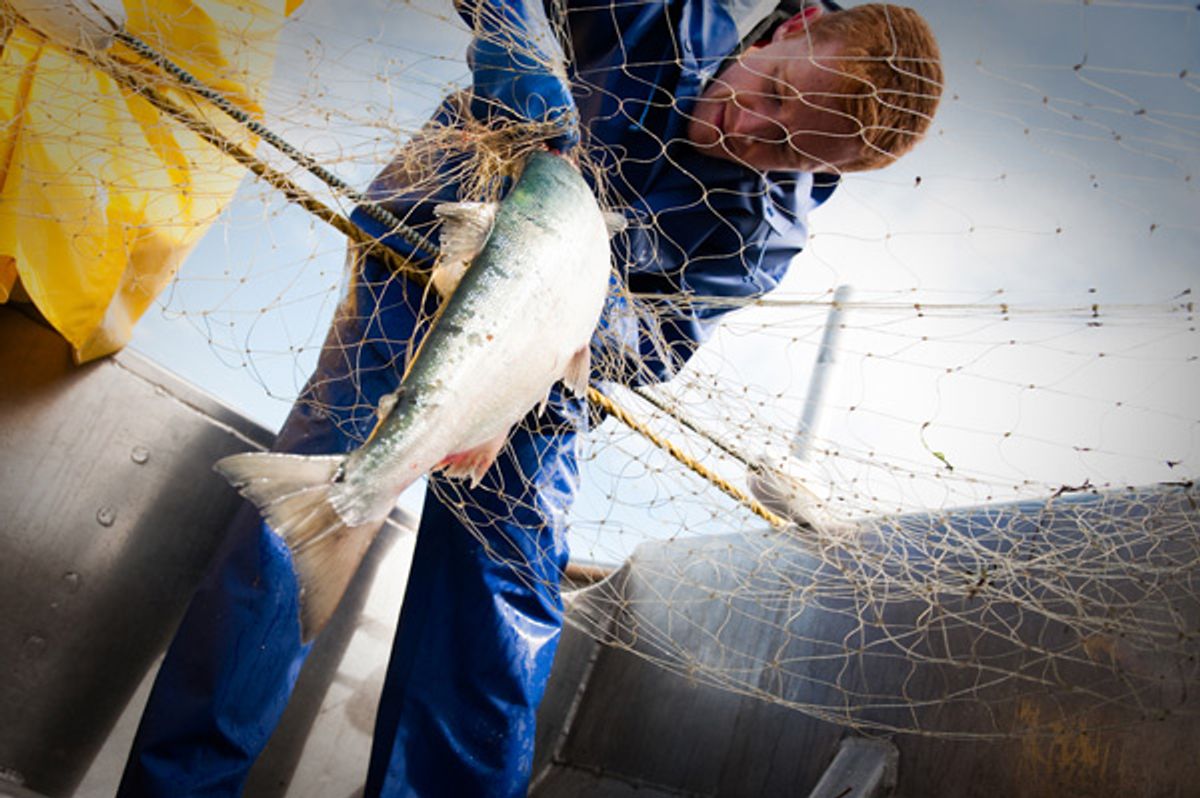
Later we worked the gear, which means we took the skiff to one end of the net and, with our arms and backs as the motors, tug our way to the other side, picking salmon out of the webbing. The boat felt light and I pulled with excitement, but 15 minutes into it, my back announced some displeasure. I imagined what it would be like to pull a boat sagging with 1,200 pounds of fish back and forth across the gear, all day long, for the entire season.

We pulled up an occasional salmon. The easy ones fall out of the net with a gentle tip. But others come up tangled, the fish suspended in a thin, wiry web that would have M.C. Escher gnashing his teeth. Fish after fish, Jay directed me: “Give that one a good hard shake. Flip the net around. Pull that one up and over.” I had no idea what he was looking at, how he could see a path for the fish out of the gear, and he took over. Plunk, plunk — the salmon fell to the deck. At peak season, they catch a dozen fish for every couple feet of net. “Throw in a 30-knot wind at night in the rain with headlamps and the boat rolling,” David laughed. “Like trying to figure out puzzles in a washing machine.” While playing a 12-hour game of tug of war, my back reminded me.

He mentioned proudly that despite its small size, his boat consistently comes in over the catch average — even against the big boats drifting out on the horizon, their bows a dozen feet off the water, mechanical winch nets hauling fish up through the air like they were climbing Jacob’s Ladder.

“How’d you get into this?” I asked him, and he talked about family and heritage — fishing with grandparents; an aunt and uncle who took him onto their boat when he was in high school. He spoke in years by the dozens, but then said something that surprised me: “I’ve never really identified with being a fisherman.”

“What do you mean?” I asked.

“It’s something I really enjoy, but you can go to school, be creative, do art, do architecture, or fly airplanes: all these other things I love to do. But my roots here are very tangible. I’ve seen the same family names on those set net sites for decades. It’s a community.”

He’d retired from fishing entirely to fly planes, but he decided to come back when Jay asked him to. “Jay’s mom and I used to work that site, just the two of us. He started helping us out when he was 14. I don’t want to make it too flowery and romanticized, but there’s a feeling of wanting to pass on the ways,” David said.

The home pack

“Welcome to our crazy little fish plant,” Izetta Chambers said when we arrived at Naknek Family Fisheries. It’s a new-looking facility of gleaming stainless steel … in what is not much larger than a shack. She giggled when she picked up a broom to bang a light on and then introduced us to her grandmother, Violet.

A bright-eyed woman with a round face and rounder curls, maybe 5 feet tall if you give her a shoebox to stand on, Violet is the kind of person you want to hug immediately. Her hands were covered in blood and wielding 12 inches of sharpened steel. I didn’t want to hug her that badly.

She was cutting fish for smoking, part of the family’s “home pack” — the catch you keep for yourselves.

Bristol Bay has an unemployment rate at times nearly double statewide figures. It’s a real problem — one Pebble Mine proponents point to constantly — but the numbers may be misleading, because they count off-season fishermen among the unemployed, and because out here, there is a real subsistence economy, which is a planner’s dead-dull way of saying that most people here hunt and fish for a lot of their food. For many native families, nearly 80 percent of their calories can come from the land, starting with the salmon they catch and preserve for the rest of the year.

“Do you sell your smoked salmon?” I asked Violet.

“No,” she said with great seriousness. “We take care of ourselves first.”

“Do you trade it for anything?” Subsistence fishing permits don’t allow you to sell your catch, but do allow for barter.

“Yeah, cash!” she laughed.

Violet laid her fillets on a board her husband made for her, with slits in it to guide her knife, cutting it into even strips like she learned to do 70 years ago. I asked for her brine recipe. “Oh, the brine,” she said. “I put a potato in the brine to see if it’s right — it floats when there’s enough salt.” I nodded excitedly, getting ready to write down a recipe. “But I didn’t have a potato today, so I’m just guessin’,” she laughed. I put my notebook away.

We chatted lightly as she kept cutting. When I mentioned the Pebble Mine, though, her head jerked up. “Ah!” she exclaimed, putting down the salmon in her hands. “We cannot have Pebble come. We cannot have Pebble come,” she said. She looked down at her brine. “Sometimes I try to imagine what life would be without fish,” she continued, saying that last word as the locals do, with a long, soft tailing off: fisssssshh. “And I can’t imagine it.”

Once Violet hung the strips of salmon like red icicles on rods to go into the smokehouse, Izetta led us to the smokehouse out back.

In her 30s, Izetta started fishing at 9. She moved away, to Arizona, where she went to college and eventually law school before coming back home to open this little plant, where she cleans, cuts and markets fish caught by the fishermen in her family.

“You have to really love it,” she said. “It wrecks your clothes, you get fish blood all over you.”

“So do you love it?” I asked.

“Sometimes, I have to get torn out of that plant. I work in education, where you’re trying to change attitudes and beliefs, but it’s so ethereal. But in the plant, I can count what I’m doing, how many meals I’m going to provide.”

We got to the smokehouse, which really is a shed. She lit a fire and started chuckling. “My daddy came up from North Dakota, wanted to find a native lady, have her put up a bunch of salmon and treat her like a ‘squaw.’ My mom was like, ‘You’ll have to go farther away for that!’” And Izetta began putting up the salmon.

The processor

Leader Creek Fisheries is hundreds of times the size of Izetta’s little fish plant, but it might be just as crazy. For years, its strategy has been to actively decrease the number of fish it handles and sells. Izetta told me about treating the fish as other than a commodity — not in a touchy-feely spiritual sense, but in the “canned goods commodity food” sense. Better handling, higher quality is what distinguishes her product, and Norm Van Vactor, Leader Creek’s manager and three decades removed from when he was on the cutting floor himself, was showing how that idea plays out at scale.

As we toured, Norm explained how each step in his process preserved the quality of the fish. Standing at a conveyor where the salmon are pumped out of the boats was like a “Daily Show” “Moment of Zen,” watching fish fall through the air into a pool frothy with other fish. “The water keeps them from getting bruised; they’re not all banging into one another,” Norm said.

We walked through the line, past all the heading, the gutting, the trimming, and, well, in an objective sense, it wasn’t pretty. But for an operation of this scale, it was strikingly clean, orderly, panic-free and efficient.

“Too little time, too much volume is all you used to hear people say when they talked about Bristol Bay salmon,” he said to me. But Leader Creek is happy to buy fewer fish for more money — offering fishermen nearly a quarter more per pound, for fish that’s harvested slowly and treated with more care.

The remaking of this commodity into a high-quality product is, to Norm, a form of activism. Higher quality can command higher prices and a higher profile … and more of an economic argument to protect this place.

“I only live here during the season,” he said, calling himself a “Gussick,” a native term for an outsider. “But in many ways, this is really my home. Up here, everybody is so interconnected, and all my best friends live in these villages. I could become destitute tomorrow and know that I would never go hungry. Someone would offer a roof over my head. It’s just the way these folks are.”

He grew up the child of travelers, and he first came to Alaska in college to make money during summer. As he spoke, I thought of how growing up constantly on the move might compel you to fall in love with a place where people live where their ancestors did.

Norm is a fierce anti-Pebble Mine activist, but not when he first heard about it eight years ago. “Back then, the seafood industry wasn’t doing well. If there was a better place for my employees to be, I wanted to help them get there. I come from South Dakota gold miners; I’m not anti-mining.” He invited the Pebble Partnership to come by. It was early then, before lines were drawn, and the discussion was candid: A marine biologist the miners hired said he doubted the mine could keep its toxins out of the water. “I couldn’t sleep after hearing that,” he said, so the next day he flew his plane over the Pebble site, looking down at the mesh of land and water, and said, “That’s the heart of Bristol Bay. It’s where it all comes together.”

“Still, who was I, a Gussick, to come and tell people, ‘You gotta keep this industry outta here’?” he said. “But I heard villagers say, ‘What we have is more important. This is short-term pay for some, and we have a way of life that’s been here for 10,000 years.’” And so he’s been fighting the mine since. He told me about a package he happened to receive the day before, trinkets from an airport gift shop. They were from an elderly native woman, with a note: “I want you to have souvenirs of Alaska always, because of what you’ve done for my community.”

We walked out of the plant through the roe room, where workers separated sacs of fish eggs according to size. There was bright orange oil and slime coating their hands, but the eggs sat, bright and bubbly, like jewels. “Isn’t that beautiful?” Norm asked.

We piled into our van and shut the door, but Norm trotted out and stuck his head in. “Hey, I’m sorry, I should’ve said this at the beginning,” he started. “But … thank you. Thanks so much for coming this far away to see what we’re all about up here.” He paused. “Thank you for coming to see this place.” He closed the door and turned to go back to the fish. He was crying.

View the slide show 


View the slide show

Continue Reading Close

Francis Lam is Features Editor at Gilt Taste, provides color commentary for the Cooking Channel show Food(ography), and tweets at @francis_lam.

Is the Grim Reaper gunning for Wisconsin's cheeseheads?

An advocacy group unleashes a warning about dairy -- but winds up with egg on its face

  • more
    • All Share Services

Topics:

Is the Grim Reaper gunning for Wisconsin's cheeseheads?

There are certain culinary boundaries you just don’t mess with — beloved foods that are not just synonymous with their native lands, but a source of deep local love and pride. You don’t kvetch to New Yorkers about the carbs in bagels. You don’t chide Napa Valley residents about the benefits of teetotaling. And you will pry the cheddar out of Wisconsin’s cold, dead, non-beer holding hands. 

The Physicians Committee for Responsible Medicine is trying to do just that.

Led by Neal D. Barnard, the nonprofit PCRM shares similar goals with PETA: the promotion of veganism for the benefit of both health and animal rights. And lately, it’s had something else in common with it — attention-getting stunts. Where better to pick a fight than the heart of dairy country, with a big billboard near Lambeau Field, home of the Green Bay Packers, featuring a cheesehead grim reaper. The sign warns football fans that “Cheese can sack your health. Fat. Cholesterol. Sodium.” Don’t forget deliciousness!

Cheese, of course, is to Wisconsin what suicide-inducing rain is to Seattle: a way of life. So it’s unlikely that too many Packers fans driving Route 41 this weekend to watch the Super Bowl champions do their thing will screech to a halt in the road and declare, “Maybe I’ll just have a Miller and some soy feta today.” What the PCRM is shrewdly banking on here is the power of  location. By defiantly taking its case to the heart of dairy country with an in-your-face, “cheese kills” message, the organization knows it’s sure to rile up controversy — and spark conversation.

Sure enough, the battle lines have already been drawn. Surprisingly, though, the first retort came not from angry cheese lovers but from the company Foamation Inc. — makers of the iconic cheesehead. Speaking to the Milwaukee Journal Sentinel, office manager Denise Kaminski declared, “We by no means would condone that.  We’re a dairy state, for gosh sakes.” She reiterated Foamation’s pro-cheese stance — and proved that there are still places in America where people say “for gosh sakes.”

In a hasty display of butt covering, the PCRM’s general counsel responded that, “There’s no way that anyone could perceive this as an attack on a hat. We have no intention of impugning Cheeseheads as individuals, we have no intention of impugning Cheeseheads as articles of clothing.” I just want to take a step back here and remind everybody that we are talking about an image of the Grim Reaper. Brandishing a scythe and wearing cheese on his hooded head.

Absurd as the whole contretemps is, it does present an opportunity to examine our less-than-stellar American eating habits. The PCRM notes that we are eating triple the amount of cheese we did back in 1970 — an artery-clogging 33 pounds a year. And its list of the delicacies at Lambeau Field are enough to make even the strong-stomached reach for the Lipitor: “deep-fried Wisconsin cheese curds; Cheesehead Beer Cheese Soup, made with cheddar cheese, beer and then topped with more cheese; and nachos piled with cheddar cheese and sour cream.” And in a state where “one-third of children and half of adults are already either overweight or obese,” all that cheddar can’t be helping the public health.

But should the treats at Lambeau, as the committee has asked Green Bay Mayor Jim Schmitt, get warning labels? And is cheese, as PCRM spokeswoman Susan Levin says, a “junk food”? Surely 65 million French people would say non. Or as Mayor Schmitt calls the whole thing, that’s “kind of silly.”

We live in an all-or-nothing culture. For some, that works out fine. But not everyone who savors the occasional fondue or croque monsieur is headed down the road of arterial blockage. Dairy products, in moderation, can be a reasonable source of calcium and protein. Cheese can also be one of the most beautifully crafted, deeply complex foods human beings can create. If you think understanding wine is complex, talk to someone who knows cheese.

And that’s the distinction. Taking aim at “cheese” is like dissing “bread.” It doesn’t recognize the distinctions of varieties; it doesn’t allow for the different ways in which it can be created and consumed. Which, by the way, is not a put-down on those fried cheese curds, which sound kind of amazing.

The American diet needs to be examined, and if you’re living on all nachos, all the time, you’re begging for health problems. But it doesn’t necessarily follow that everybody driving down the road to a Packers game needs the icy finger of death wagged in their faces — especially when many of those people make their living in the industry the PCRM is trying to shame. Scolding doesn’t change minds or habits. Fear rarely does either. And though shock tactics may get publicity, do they ever really help win anyone’s goodwill? Life, health and work are far more complex than a smug message on a billboard. And maybe next time the PCRM wants to get people to cut the cheese, they can start with a campaign that doesn’t stink.

Continue Reading Close
Mary Elizabeth Williams

Mary Elizabeth Williams is a staff writer for Salon and the author of "Gimme Shelter: My Three Years Searching for the American Dream." Follow her on Twitter: @embeedub.

Today’s must-see viral videos

Watch: The contested winners of annual hot dog eating contest, robots as second-class citizens, and more

  • more
    • All Share Services

Topics: , , , , , ,

Today's must-see viral videosI am robot, hear me roar.

1. 365 days of makeup

 ”Natural Beauty” answers that burning question once and for all, “What would you look like if you put on a year’s worth of makeup all at once?”


2. “District 9″ … with robots

Kibwe Tavares’ short film “Robots of Brixton” imagines a world where sentient machines are given inhuman treatment by humans. An interesting memorial to the 1981 Brixton riots.


3. Joey Chestnuts, official winner of Nathan’s Famous hot dog eating contest

For the fifth year in a row, Joey “Jaws” Chestnuts won Nathan’s annual hot dog-scarfing contest in Coney Island. 


4. Actual winner of hot dog eating contest

Professional eater Takeru Kobayashi technically ate more ‘dogs on the Fourth than Joey (setting a world record with 69 buns and beef) , but was considered ineligible for the Coney Island event since he won’t sign an exclusive contract with Major League Eating. 


5. Twin infants sync laughter

Well, this is almost as creepy/adorable as those talking babies

Continue Reading Close

Drew Grant is a staff writer for Salon. Follow her on Twitter at @videodrew.

911 called over botched Chinese food order

What do you do when your dinner isn't delivered properly? Call the police, of course

  • more
    • All Share Services

Topics: , , , , ,

911 called over botched Chinese food orderThe police are not here to deal with your delivery mix-up.

How many times has this happened to you? You go home and try to enjoy a nice dinner of Chinese food delivery. But when your meal arrives, they’ve got the order completely wrong!

Do you:

A) Call back the restaurant and ask for a refund;

B) Just eat the food and promise to deal with it next time;

C) Call the police

If you answered C, you are not alone. A woman in Savannah, Ga., called 911 to rectify her dinner order yesterday. This was the result:


Sadly, these kinds of calls aren’t as uncommon as you might think. In March 2009 a woman called the police after being given the wrong order of McNuggets at McDonald’s.

That wasn’t even the first time that year an emergency hotline was called because of fast food. In fact, it happened quite a bit in 2009. (Maybe McDonald’s was just particularly sucky that year.)

Regardless, it’s 2011 now and we’re all grown-ups. That doesn’t mean we expand our 911 repertoires to calling in about botched Chinese food orders. It means that we stop tying up the police phone line unless we actually have an emergency that doesn’t involve a delivery service.

Continue Reading Close

Drew Grant is a staff writer for Salon. Follow her on Twitter at @videodrew.

The five most ridiculous defenses of Ronald McDonald

A watchdog group is calling for the clown mascot's retirement, but is being creepy grounds for firing?

  • more
    • All Share Services

Topics: , , , , , ,

The five most ridiculous defenses of Ronald McDonaldWho wouldn't accept food from this guy?

McDonald’s is under attack again for force-feeding our nation’s children greasy, delicious fries. A group called Corporate Accountability International took out full-page ads today in several prominent newspapers, titled “Doctor’s Orders: Stop Marketing Junk Food to Children.

And while this grievance might not seem new, exactly, CAI is launching another campaign on Thursday against Ronald McDonald himself, whom the watchdog group called a “Deep Fried Joe Camel.” They claim Ronald’s the equivalent of a drug pusher for MSG-addicted kids.

But how “friendly” is Ronald? A new study done by outside marketing group Ace Metric found that in a survey group of 500, an overwhelming amount found a guy with big red lips and white greasepaint more creepy than cute.

McDonald’s refuses to give up on Ronald, though, and its defense on why it needs to keep a terrifying clown as its mascot would be charming if it weren’t so ridiculous and backward. Below, five of the responses McDonald’s has given for keeping Ronald on the payroll.

1. Complaint: “It’s really remarkable how often I saw the word ‘creepy’ [in regards to Ronald],” says the V.P. of a company that conducted the survey.

McDonald’s response: “For everyone who may feel that way, there are more who feel the opposite.”

2. Complaint: Ronald McDonald is an evil clown.

McDonald’s response: “He is a force for good,” says McD’s CEO, Jim Skinner.

3. Complaint: Too many damn clowns running around.

McDonald’s response: “There’s only one Ronald,” McDonald’s chief creative officer Marlena Peleo-Lazar said in response to several questions about how many actors portray the smiling clown.

4. Complaint: He is hurting a brand image that is trying to be more adult … like Starbucks.

McDonald’s response: He is the brand image. “It would be almost as if the Geico gecko disappeared, or the Aflac duck,” says one marketing strategist. God forbid.

5. Complaint: Ronald encourages childhood obesity.

McDonald’s response: Around 2004, McDonald’s christened Ronald as a “balanced, active lifestyles ambassador,” and stuck him in commercials where he trained for the Olympics. He got workout clothes. He got a tuxedo. He moved from McDonaldLand into the real world. 

You know who can also move into the real world after being trapped in a fantasy land? Freddy Krueger.

It’s actually in CAI’s favor to have a scary mascot act as a deterrent for children trying to buy fries. It should be thanking McDonald’s for keeping such a creepy figure right in front of the golden arches.

Continue Reading Close

Drew Grant is a staff writer for Salon. Follow her on Twitter at @videodrew.

Bogus showdown alert: Foodies vs. techies

The New York Times reports a culture clash between geeks and fast food critics. Surprised? You should be

  • more
    • All Share Services

Topics: , ,

Bogus showdown alert: Foodies vs. techies

New York Times opinion columnist Virginia Heffernan alerts us today to a “great clash” of civilizations that many of us may not even have realized was occurring: “the clash between foodies and techies.”

An intriguing premise! Who knew that there was bad blood between the geeks and the locavores; or that hackers were manning the barricades against the baleful influence of Michael Pollan and Alice Waters? I certainly didn’t, and out where I live, in Berkeley, Calif., I find it a challenge to shop for organic scallions without bumping into half a dozen iPhone app writers and  free-range, vegetarian-fed egg connoisseurs. Usually, everyone is very nice to each other, (although, it is true, some of the older hippies can get grouchy when you block them from easy tofu-counter access).

But Heffernan sees culture war!

While foodies look back and see the 1950s as the marshmallow-riddled dark ages of American culture, techies see a radiant renaissance. Not only could you get frozen spinach and canned chicken stock at the supermarket, but the first commercial computer appeared. The FORTRAN programming language and artificial intelligence were developed. IBM produced the first dot-matrix printer. To a techie, who cares if some ’50s housewives opted to skip the tedium and carpal-tunnel woes of flour-sifting by using yummy Betty Crocker cake mixes? The major turn in postwar American culture was that computers were invented.

The argument, such as it is, seems to be that techies have no problem with labor-saving shortcuts — microwaved bacon! — while foodies demand that every meal be a five-course extravanganza freshly prepared from scratch from ingredients grown in your own backyard. I say “seems to be” because Heffernan does a very poor job of defining the term “foodie.”

“Foodies complain about Twitter while they make emu-egg cassoulet with creme fraiche,” she writes, and are driven “crazy” by “invocations of efficiency and convenience.”

The concept of convenience in food preparation is steeply at odds with the idea that all food is sacramental, and eating expensive, rich foods is a devotional act that is somehow also politically progressive.

I would like to believe that Heffernan is purposely trying to be jaw-droppingly provocative here by overstating her argument to get a rise out of knee-jerking malcontents like myself. Because the alternative — that she actually intends what she says in that paragraph to represent something even vaguely akin to reality — is just too depressing. Unfortunately, previous experience with Heffernan — such as her notorious declaration almost exactly a year ago that “white flight” to the iPhone and iPad were causing the (unlamented) “death of the Open Web” — suggests that we have to take her at face value.

Sure, there is an annoying subset of “foodies” who fetishize the gourmet experience and don’t fully appreciate the time constraints that limit what a working parent can put on the table for the kids (or the whopping per-pound cost of fresh salmon). But there’s a larger context that Heffernan doesn’t even bother to wave her hands at — the ecological and physiological consequences of a food industry that has taken efficiency and convenience far, far beyond the land of useful tradeoffs out into a dark realm of outright unhealthy dysfunction. Maybe Heffernan doesn’t think there’s a connection between rising levels of obesity and the kinds of foods most Americans eat today, or that monoculture corn and soybean production are an ongoing ecological disaster, but if you’re going to imagine a great cultural clash between “foodies” and “techies” then maybe, just maybe, you should strive to fairly represent the issues that are actually at the heart of meaningful critiques of the status quo.

But even more ridiculous than Heffernan’s caricature of “foodies” is the idea that the class of “techies” somehow stand in opposition to the class of people who regard the question of what to eat with some level of seriousness. Speaking as someone whose mother was taking a class in FORTRAN while pregnant with her son, and yet still happens to prefer wild-caught Pacific King salmon to farmed Chilean factory fish, I feel fully overqualified to say fiddlesticks! There is absolutely no contradiction between the premise that advances in technology can improve our life and that we could stand to pay more attention to where our food comes from and how it is “made.” Call me crazy, but I believe in rural electrification, washing machines and grass-fed beef. And indeed, the connections between the ideologies of technological liberation and the “foodie” movement” are deeper than one might immediately imagine.

I’m guessing that Heffernan may not have read her New York Times’ colleague John Markoff’s fascinating tale of how hippie values intersected with technological innovation, “What the Dormouse Said: How the Sixties Counterculture Shaped the Personal Computer Industry.” Because if she had, she’d know that the same impulses that inspire the Michael Pollans and Eric Schlossers of the world to reimagine our food system — the same passion that finds nirvana in an heirloom tomato — was also present in the hearts and minds of the visionaries who saw the personal computer and Internet as tools for human enlightenment.

Some of those hippies became Silicon Valley moguls, while some started organic farms in Sonoma County — but to this day, those value systems still merge. Since when do foodies complain about Twitter? The foodies I know are swapping recipes in a world of food blogs that offers more would-be cooks more access to information about ingredients, cooking techniques, and quick 20-minutes-of-prep dinner meals than has ever before been possible in the history of humanity on this planet. The foodies I know can use the Web to tweak the contents of the farm box full of fresh vegetables and fruits that is delivered to their front door every week! The foodies I know are quick to head to Twitter to spread the news of the latest delicious recipe or stupid column.

The foodies I know believe in progress. They believe that we can do better, that our children can grow up healthier, our environmental impact can be more sustainable, and our diets can be less controlled by the chemists who work for giant agribusiness multinationals. And they know that the communication technologies of today are awesome tools to help achieve those goals.

All hail the techie-foodie harmonic convergence! Maybe you don’t like broccoli. But I guarantee you that a little elbow grease applied to your iPhone will usher you into a magical world of broccoli wonder. It’s easy. Try it. You might like it.

Continue Reading Close
Andrew Leonard

Andrew Leonard is a staff writer at Salon. On Twitter, @koxinga21.

Page 1 of 5 in Food fights