
Eating and Talking

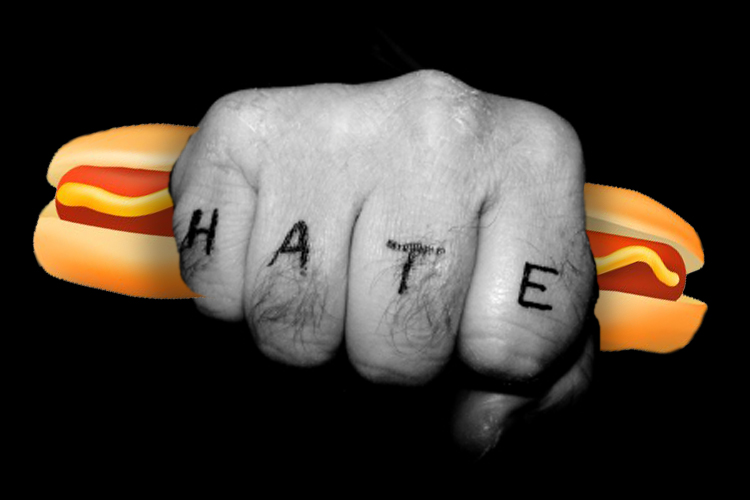
The most depressing hot dog stand in America

A classic Chicago dive sells the world's greatest franks, but turns into a boiled-over hate fest every weekend

  • more
    • All Share Services

Topics: , ,

The most depressing hot dog stand in America

Here is what you can expect in a good Chicago hot dog: an absurdly juicy frank (most likely from the excellently logoed Vienna Beef), a luxuriously smushy bun, and a cavalcade of condiments: yellow mustard, chopped onions, a wedge of pickle, tomato slices, hot sport peppers, a few dashes of celery salt, and an otherworldly neon green relish, so bright you can read by it. These are hot dogs in their highest form. The flavors combine and recombine in endless variation as you eat, and the textures are all there: crunch, snap, chew, squish. This is a sandwich that inflames Midwestern passions.

And so it was no surprise when my friend Emily told me about the Wiener’s Circle, a classic dog dive famous for its hot-tempered service. “It’s just people screamin’ and cussin’,” she said. “And women taking their shirts off. I grew up going there, but then I had to stop.”

Emily is a sweet soul, good-natured and kind, and so I just chalked up her resistance to prudishness. After all, Chicago is a town filled with colorful dogs, and even the gentle of tongue can have their fill of tube-steak fun. Take Chubby Wiener, which, even aside from the more-than-you-wanted-to-know name, offers a special called the Capitalist Pig: $250 for one of their superlative dogs and a bottle of Johnnie Walker Blue Label Scotch. Or the appropriately named SuperDawg, which works under the watchful eye of a 20-foot frank, broad-chested and strapping in his yellow Tarzan loincloth, impressing the females of his species with flexed muscles.

So I head over to the Wiener’s Circle, decades-old and looking like it in a long-gentrified upper-middle-class neighborhood. The dogs were fantastic, classic and perfect, with the slight tweak of an optional char on the grill (purists like them steamed). I marveled at the kitchen, where the cooks’ main activity seemed to be yelling unintelligibly at one another, despite the fact that it was the middle of the afternoon and there was hardly anyone to make hot dogs for. Still what orders that did come in — additions, substitutions and all — got filled swiftly and exactly, from memory and maybe telepathy. Where people extend their arms to take the food from the counter window, there was an empty mayonnaise container, on which there was a message: “YOU WILL TIP THE JAR, BITCHES!” You won’t see that at an Applebee’s.

I didn’t know how to feel, then, for a young woman, roughly the size of a fire hydrant, who came back to the window with a complaint about her lunch. “It’s …” she started, then, more softly, “a little burnt.” The man behind the counter, thin and bony and all hard angles, looked down at her. “Burnt? Huh?” he said with a menacing drawl, taking her hot dog in his hand.

“Next time, go with the steamed,” I prayed for her.

“Burnt?” he said again. She looked straight ahead, as if nothing was happening. “F*@# burnt! That motherf#$@*er CRISPY!” he yells, pointing her coal-black dog in the face of one of the cooks. He turns to smile at the woman with a tinge of flirtation. “We’ll get another one for you,” he says.

“See?” I told Emily after seeing that random act of, er, kindness. “It’s cool! It’s all a joke!” She shook her head. “At night is when it gets bad.”

Turns out she was right. The scene at the Wiener’s Circle is markedly different at night, late on a weekend night, that is, when people are coming in from the bar. There are no more flirty smiles with the taunts. It becomes a face-twisting orgy of aggression, where the social contract of respect between customer and server isn’t playfully broken, it’s set on fire and waved in your face.

Suddenly, you hear women get called the names of various domestic and wild animals, and you get all kinds of lessons in human anatomy from both the kitchen and the customers, hurling invective on the attack and in defense. It’s possible, for a while, to think it’s all good theater, that everyone is just letting off steam, but the tell is in people’s faces when they’re not open-mouthed and screaming. The crowd is laughing, having fun, and you hear people comment, titillated, on the quality of the show. But the staff look tired, and maybe a little bit sick to their stomachs. This is their job.

At some point, the room becomes a chorus of curses and racial epithets, and it becomes impossible not to notice that the staff, the battle-hardened staff, are all black, and the crowd nearly entirely white, male and drunk. Some of the cracks are funny, especially from the people who work there, who have had plenty of time to sharpen their tongue and their wit. But it becomes hard to laugh when you can feel how hard that clever crack is working as a shield, trying to defend against all the rage in the room.

Chants of “Chocolate milkshake” stir in the crowd. Rhythmic, pulsing, the voices calling for the chocolate shake get louder, with people banging on things, even in the kitchen. The place is in an utterly warlike state. A server, a woman, looks uninterested and annoyed, and then, exasperated, starts demanding money. When she gets enough, her shirt comes up, and the crowd cheers, victoriously, at the sight of her enormous, quivering breasts. They got their chocolate shake. I hear the tips are great. I hate this place. 

Continue Reading Close

Francis Lam is Features Editor at Gilt Taste, provides color commentary for the Cooking Channel show Food(ography), and tweets at @francis_lam.

Donald Trump responds to Pizzagate 2011

Does eating a pepperoni slice with a fork and knife make you un-American? Probably

  • more
    • All Share Services

Topics: , , , ,

Donald Trump responds to Pizzagate 2011Donald Trump, eating pizza.

You see, President Obama? This is how a real leader deals with rumors and accusations when they arise from the public’s yammering maw: You squash them like a bug in a public address (vlog).

As many of you have heard by now, King Donald Trump was recently seen eating pizza with Sarah Palin in New York City. Nothing wrong with that, right? Just a couple of buddies hanging out, probably have loads in common for conversation fodder, like how great it is to be very American. But the story turned sour when Trump and Palin began to masticate their delicious NYC-style slices … with forks and knives!

Who does that? Certainly not Joe the Plumber. British people, maybe. But here in the U.S. of A. we eat pizza (and most other things) with our hands. Well, Donald wants you to know he’s taking these accusations very seriously.

And by the way, he doesn’t even know if Sarah Palin is running in 2012. They didn’t talk about that. Because that’s what you were asking about, right? Not “Does Donald Trump carry forks and knives on his person?” Because the answer to that, as we now know, is, “No, he does not.”

Also, Donald Trump doesn’t like crusts. ISSUE RESOLVED. 

Continue Reading Close

Drew Grant is a staff writer for Salon. Follow her on Twitter at @videodrew.

Learning to make Mom’s dumplings

OK, so they're technically not my mom's dumplings. But I wish she were here

  • more
    • All Share Services

Topics: , ,

Learning to make Mom's dumplings

“My mom is the best cook in the world” is one of those sentences that is inherently not to be trusted, like “there is no kitten cuter than my kitten” and “our Bobby is the most talented artist in his class.” But my friend Winnie does not play when it comes to her mother’s cooking, and especially when it comes to her pot-sticker dumplings. And to prove it, while her mom was in town last week, Winnie invited some friends over for dinner. Twenty of them.

I arrived early, to catch a dumpling-making lesson (which I’ll share with you tomorrow), but it wasn’t long before I saw what was really going on: a full-scale onslaught of weapons-grade motherly overdoing-it-ness, Asian Momma style. Winnie’s mom, Mei, had filled not one but two entire grocery carts with food, and piles of vegetables were lying all around the kitchen, as if houseplants. I saw dried noodles soaking in water, ready for cooking. I saw racks of ribs marinating. I saw a school of fish waiting to be fried. I saw a massive pot that had become the final resting place for two whole ducks. I saw a mound of ground meat roughly the size of a beach ball.

And somewhere in the middle of this Chinese cornucopia, I saw a woman no bigger than the average American middle-schooler racing around from fridge to sink to stove. I shook Mei’s hand, fighting off the instinct to call her “Aunty.” Winnie said hi, her voice barely audible, vanishing from a terrible cold.

Within moments, Mei was showing me how to mix the filling for her dumplings, a process that involved sticking my hands forearm-deep into raw meat, constant worry that the kiddie-pool-size mixing bowl we had was still not big enough, and getting a man stronger than I to squeeze the water out of napa cabbage. (The recipe, as written, calls for “1 assistant, 5’9″, 200 pounds, athletic build.”)

Old friends of Winnie’s started to stream in, happy to see Mama Yang after years of leaving their homeland of St. Louis. And because conversations of the past tend to extend in that direction, I asked Mei how she learned to cook in the first place.

“I didn’t learn at home,” she said. She’s the second youngest of eight, and in her Taiwanese home, the oldest of her sisters took care of the kids-helping-in-the-kitchen department. But when she moved to America in the ’70s, to Utah, of all places, the sudden vanishing of all the flavors she grew up with inspired in her a sort of culinary awakening. By memory and osmosis and a group of chatty friends, she taught herself how to cook, inventing techniques when there were none she could recall, and in the process coming up with a dumpling recipe made so often she does it all by feel and sight.

Once, a neighbor asked if she could come watch her cook, to learn about this food. But it wasn’t long while watching Mei painstakingly roll out dumpling skins, filling and pleating and pinching each one shut, before the neighbor came through with some good old American ingenuity: “Mei, this is so dumb! Why don’t you just do it like a pie, like we do? Have all the filling and just put the dough on top!”

Mei huffed as she told this story, now two, maybe three decades old. “Hmph. This is three thousand years of history. That’s the beauty.” Then she added, “No machine can do this.”

“No, just the manual labor of children,” Winnie cracked softly, though it was hard to tell if the volume was because of her cold or if she was saying it so that her mom couldn’t hear. I giggled, now rolling out skins, only a dozen in and already feeling soreness in the pads of my fingers.

Winnie’s father, whose quiet shuffling about made me miss my own dad, came to the table to help with the skins. It was a watershed moment; in the lifetime that Mei’s been making these, he’d never before been seen commandeering a rolling pin. His grasp slipped, knocking over a glass of water, and Mei summoned her best Tiger Mother: “Next time, practice. At home!” I think she was joking, but it was the kind of joke that carried with it some weight. He smiled and carried on, in that adorable Papa kind of way.

Now six or seven helpers deep, Mei let the dumpling operation go and started cracking at the stove. Soon food began piling up, spreading over two tables. Ribs came out of the oven, ducks laid on a bed of stir-fried greens, noodles squiggled into an enormous pan. Fish began their swim in hot oil, and it was soon clear that it takes about a quarter of this much food to feed 20.

Then Mei started in on the dumplings, frying them crisp on the bottoms before steaming them soft and tender up top. All told, we had made almost 250 dumplings, and nearly everyone was already full by the time the first batch of them emerged from Mei’s kitchen. Still, the gobbling masses stormed the table. They were lovely, gingery and tender, deeply browned and satisfying.

At the edge of the kitchen, I saw Winnie on her couch, looking sick and exhausted. I caught her peering at the piles of food populating her apartment like guests themselves. She offered and then began pleading for people to take home leftovers. Someone opened her freezer door to help store the uncooked dumplings, then cracked, “Well, there’s no room in the freezer. Hell, there’s no air left in the freezer.”

And then I saw in Winnie’s eyes something familiar, the particular kind of feeling overwhelmed that can only come from your parents. The kind of overwhelming that happens when they only get a handful of chances a year to show you that they love you, and that they show you that they love you by doing things for you and feeding you, and that they do so with such intent, unsmiling force that it’s physically exhausting to receive it. (And to pack away the leftovers.) It’s overwhelming on its own, but then you feel like an ingrate that you feel this way, and that leads to Parental Overwhelming Version Two, which is an altogether more complicated mess of love and fear and exasperation and feeling like a kid again even though you’re an adult and wishing they will just leave you alone but hoping that you will never, ever have to see them go away.

But maybe I was just projecting.

Maybe I was thinking of my own mom and the rolls of paper towels she tries to cram into my tiny apartment and the weeks’ worth of leftovers whenever she gets to cook for me and the freezer that’s still full of the food she bought for me when she came to take care of me after an operation two years ago.

And maybe I was thinking of my own dad, and the one time I ever saw him fill a dumpling in our kitchen, which he did with an unexpected grace and speed. He told me, as I picked up a spoon to help him, that he learned to do this when he was young, when he worked in a Chinese restaurant in between classes to pay for college. And about to go off to college myself, I realized that there was so much about him that I didn’t know, even as we sat there silently tucking meat into wrappers.

And maybe I was especially thinking of these things today, the Chinese New Year, and of all the pesky instruction my mother used to give me: Clean your room before you go to bed, so you don’t sweep out the good luck in the new year! Eat candy to start the year sweet! Wear your new red clothes!

Today I woke up 1,500 miles from my parents. I ate candy and wore my dad’s old red sweater and rued that my apartment is a mess. And I missed Mom and Dad terribly.

Continue Reading Close

Francis Lam is Features Editor at Gilt Taste, provides color commentary for the Cooking Channel show Food(ography), and tweets at @francis_lam.

My new grandmother’s cooking changed me forever

I thought her bland New Delhi fare would bore me, but she taught me about simplicity and connecting to the earth

  • more
    • All Share Services

Topics: , , ,

My new grandmother's cooking changed me foreverAmma, the author's husband's grandmother, during a Delhi winter.

Like most brides, I was nervous on my wedding day. I was worried about food. Specifically that marriage was going to condemn me to years in a culinary wasteland.

Let me explain: The gastronomic offerings in my husband’s hometown of New Delhi had been sorely disappointing. Going out involved eating heavy, unimaginative curries — the kind of generic “Indian” food that’s served at restaurants called Bombay Palace and Taj Mahal the world over. Staying in and eating at his parents’ home seemed to mean simple, almost ascetic meals of roti and subzi (bread and vegetables).

During my initial pre-engagement trips there, I didn’t complain. I figured we’d be visiting Delhi only occasionally once we got married. But then it turned out that Sid had plans for us to live there for at least a year and perhaps even longer.

I panicked. I live to eat. Moving to Delhi was going to be a slow, flavorless death.

After marriage, my new-bride status dictated that I eat with my husband’s family every night. I’d go to bed mildly hungry and distinctly homesick, missing the eclectic foods I’d eaten in my cosmopolitan hometown of Bombay. My family had a tight dinner schedule that traveled several time zones: tacos on Tuesdays, falafels on Fridays, Thai on Thursdays, etc. — and I desperately missed all the culinary continent-hopping we did from our kitchen.

Yet, after a few weeks, I found myself looking forward to those meals with Sid’s family. It wasn’t the food but the conversation and the company that I’d begun to enjoy. Amma, Sid’s heavy-set, 87-year-old grandmother, was in charge of dinner. Isolated by her bad knees to a room on the top floor of the house, dinner was when Amma’s brood gathered around her, talking, laughing, eating her food. And Amma, who is as talkative as she is temperamental, loved the opportunity for an audience.

Soon I was regularly sitting with Amma for a half hour before dinner. She loved that like her, I was vegetarian. She’d often want to know what my favorite vegetables were. (Okra, if you’re interested. Yes, I actually love the slime). And I’d find them on the dinner table the next day. She’d share with me stories from her childhood in a village in North India, tales of waiting feverishly for the first flush of the tiny saffron-hued pairee mango, for the joy of sucking it bone dry and fighting over its pit; of sitting crossed-legged on the kitchen floor, in anticipation of the next hot, butter-filled roti that would be dropped into her plate.

Until then, I knew little about the Bhargava community, the small, tightly knit group of North Indian Brahmins that my husband’s family belongs to. Sid, with his itinerant childhood, didn’t care to talk about his heritage. But Amma wanted me to know. She told me about their traditions and festivals — the beautiful ritual the family performed every year to celebrate the arrival of spring, throwing fistfuls of wheat husk into a crackling fire as an offering to the gods, and the way the entire family eats from a single silver plate during Diwali, the festival of lights. “We have our own customs, and they are nothing like the North Indian customs shown in Bollywood films,” she’d say proudly, referring to the Punjabi rituals that have come to dominate India’s cultural landscape.

During one particularly ordinary meal — tiny apple gourds stuffed with chickpea flour and dal (lentils) — it occurred to me that everything that Amma had been saying about the specificity of the community’s traditions was true also of the food I’d been eating. This wasn’t some watered-down version of the staple Indian meal of dal, roti and subzi, nor was it the creamy, heavy Punjabi food stereotypically tied to the area; it was a wholly different cuisine. I began to realize that these were spices and flavors I’d never tasted before — the apple gourds tasted tantalizingly of nigella seeds, and the dal was seasoned with lashings of tart dried-mango powder. Other meals had exposed me to combinations I hadn’t seen anywhere else: caraway seeds sprinkled on parathas; lentils stuffed inside soft, silky puris (fried, puffed bread); and lentil balls soaked in a watery soup of coriander and dried mango powder. Amma had even completely transformed vegetables that I had hated back in Bombay — bitter gourds were peeled, washed, stuffed and shallow-fried until crisp so that only a pleasant hint of their former bitterness remained.

Just like the little-known Bhargava rituals and customs, here was the little-known Bhargava food — light and simple, devoid of onion and garlic, and free from a heavy dependence on dairy. Influenced by the community’s far-reaching spread, it fused the foods of four Indian states: Rajasthan, Uttar Pradesh, Madhya Pradesh and Haryana. I’d moved to Delhi expecting to become thoroughly familiar with oily, calorific curries and fat, doughy nans, but instead had encountered something new — an enduring culinary tradition that had gotten ignored for its more famous cousins.

And slowly, I found that I’d even begun to enjoy Amma’s food. Eating this earthy cuisine had taught me to rein in my philandering taste buds. I’d gotten married expecting to be limited by a restricted diet, but instead, the focused eating forced me to take note of every hint of flavor, to find pleasure in the very suggestion of a spice, and to thoroughly enjoy every individual component of a dish. I even found a spiritual lesson in my experience — this was a call to live in the present, to experience fully the here and now, and to be more conscious of my incessant desire for the new.

Amma’s food also taught me to taste the weather outside. Bombay is located on a little cusp of land that juts into the Arabian Sea. It sees only two seasons: hot and wet. Foods vary somewhat with the season, but the changes aren’t particularly noticeable. You never feel the chill of winter, but you also never taste spring in a pod of peas. In Delhi, I saw the intimate connection between earth and kitchen. Amma helped me experience the joy of rootedness through the simple act of eating, and she showed me the wonder of nature’s bounty — creamy pumpkins in the fall and winter, simple chhuke matter (tossed peas) in the spring, and gourds, cucumbers and melons in the summer.

Before I knew it, my time in Delhi was up. I moved to New York and found myself in a food fantasyland far more diverse and exciting than even Bombay. Everywhere I looked there was something new to eat — a novel flavor, an unexplored cuisine. And yet I craved Amma’s seasonal cooking. I realized then that Delhi had changed me in ways I never would’ve imagined. I can never go back to my hedonistic, almost reckless eating. I still love new flavors, but I’m now rooted in the understanding that a straightforward dish of pumpkin cooked in mustard seeds eaten in the dusk of the North Indian autumn can be as satisfying as tacos on Tuesday and Thai on Thursday.

Amma attempted to teach me some of her recipes over the phone, but they never turned out the way they did when I was at her dinner table, gazing at the darkening sky. As Sid and I approach the one-year anniversary of our time away from Amma’s kitchen, I share with you two of my favorite recipes — Bhargava-style chhote aloo (baby potatoes) and kaddu ki subzi.

Bhargava-style baby potatoes (Chhote aloo)

I love this dish because it’s tart and spicy, and completely unlike any potato-based curry I’ve eaten before. Disclaimer: The name is my own since I couldn’t find any sort of formal name for the recipe .

Ingredients

  • 2 tablespoons olive oil
  • 1 teaspoon cumin seeds
  • ½ teaspoon asafetida
  • 1 teaspoon turmeric powder
  • 2-inch piece fresh ginger, peeled, crushed and minced
  • 1 pound baby potatoes (smallest you can find), washed and scrubbed (skins kept on)
  • Salt to taste
  • 2 tablespoons coriander powder
  • 1 teaspoon garam masala
  • ½ teaspoon red chile powder
  • 2 tablespoons amchur (dried mango powder)
  • ¼ cup cilantro leaves, torn

Directions

  1. Heat oil in a large wok or deep pan. Add cumin seeds, asafetida and turmeric. When the spices start sputtering, add half the ginger.
  2. Add the scrubbed potatoes, sprinkle with salt, stir and cover the wok. Reduce the heat to medium-low. Let it cook for 10-15 minutes, stirring every 5 minutes. Once the potatoes become tender (pierce with a fork to check), add the coriander, remaining ginger, garam masala, chile powder and amchur.
  3. Mix well and cover again for 5 minutes. Remove from heat and finally add the cilantro leaves and mix well.

Pumpkins cooked in fenugreek seeds (Kaddu ki subzi)

This recipe probably comes from Uttar Pradesh. I love it because the addition of heat really adds to the pumpkin’s natural sweetness. It’s popular in many North Indian kitchens but impossible to find on a restaurant menu.

Ingredients

  • 1 tablespoon olive oil
  • ½ teaspoon fenugreek seeds
  • Pinch of asafetida
  • 1 small hot green chile, chopped
  • About 1 pound of a pumpkin (probably about half a small pumpkin), peeled, seeded and cubed
  • ½ teaspoon coriander powder
  • ½ teaspoon turmeric powder
  • 1 teaspoon sugar
  • Salt to taste
  • ½ teaspoon amchur (dried mango powder)

Directions

  1. Heat oil in a pan. When the oil is hot, toss in the fenugreek seeds. They will soon start to sputter and change color. Then, add the asafetida and green chile and sauté for a little less than a minute. (Be careful not to burn the fenugreek seeds.)
  2. Now add the pumpkin pieces, coriander, turmeric, sugar and salt. Add enough water to cover the bottom of the pan, and lower the flame. Cover and cook until the pumpkin becomes soft and tender.
  3. Add the dried mango powder and mix well. Cook on low heat until the water evaporates.
  4. Serve with whole-wheat roti.


Continue Reading Close

Riddhi Shah is an editorial fellow at Salon.

Coffee banana pudding with family baggage

I meant to write about my grandma's best dessert for Mother's Day, but stories have a way of changing themselves

  • more
    • All Share Services

Topics: , , ,

Coffee banana pudding with family baggage

This column started, a little black-heartedly, as a Mother’s Day anti-tribute to my grandmother. I grew up terrified of her: always dressed in amorphous black dresses, a dark cloud that literally lived in our basement, quick with a lashing with her tongue, sticks or an open hand.

She was a great cook, but this wasn’t going to be one of those “her food saved our relationship” stories. She once accidentally dropped sugar into a wok of fried rice. When I asked her why it was sweet, she snapped at me for being too stupid to understand anything. No, it was going to be a bitter story of salvaging the one true good memory I have of her cooking: the velvety coffee banana pudding she would make for parties.

But it’s not going to be that story, because it turned into something else when I asked my mother if she knew how to make it.

“I thought she just bought coffee Jello and put bananas in it! But I’ll call her up and ask her!” she replied perkily in an e-mail. (Mom is the world’s perkiest replier of e-mails, averaging more exclamation points than sentences.)

It wasn’t easy for Mom to do that, probably. To this day, she can’t get on the phone with her mother without enduring an hour of haranguing on a wide range of subjects, starting from the terrible way the beds were made for her last visit and usually leading back to her complete failure as a daughter, mother, sister and human being. When Mom is with her siblings and the phone rings, they look at each other and laugh nervously. “You pick it up,” they say, men and women in their 60s tossing a cellphone back and forth like a game of hot potato.

But there Mom was, intrepidly calling the woman who’s always treated her in a way that I won’t write about in public, to ask for my pudding. I suddenly remembered being 17 — long too big for Grandma to hit, too dismissive to let her insult me — casually saying how I still hated her. “You shouldn’t hate her,” Mom said gently. “Without her you wouldn’t have your own mother. Whatever she did, she still gave birth to me, and she still raised me. So we should respect her.”

Over the next week, I got daily e-mails from Mom, reporting on what Grandma told her about the pudding, telling me her own memories in her mother’s kitchen:

When we were small, she made a lot of cakes to entertain her mah-jongg friends, and I was the poor kid having to mix it. So I got all the calluses on my right hand! Then when we were young, she constantly made ma-tai-go (horse shoe cake) and when she lived with us in New Jersey, she liked making the coffee pudding, every time to an extent we were afraid of them. Now we MISS them!

She volunteered to test the recipe she gleaned from her mother’s shaky memory, describing her process — in the poetry of immigrant English — as “try an error.” She wrote me the next day, describing in hundreds of words how she did it (now you see where I get it from), and finishing her e-mail with a section titled “What boo-boos I made.” Naturally, she forgot to use half of this and tried to add in twice of that, and it was all boo-booed up. So she offered to make it again, and again.

“Mom! I forgot to tell you I need pictures to run with the story!” I texted her yesterday. And last night, at 4:30 in the morning, she texted back, “I found some, from around the time she like to make that pudding. We look so much younger!” And at 5:30 I got another text telling me that she can’t figure out how to use the scanner, and so she’ll have to try again in the morning.

And at some point, while I was mixing up my own batch of my grandmother’s coffee and banana pudding, getting another e-mail from Mom about how hers was turning out, I remembered being in sixth grade, up until midnight for the first time doing my homework and crying from tiredness, when my mother came in to sit by me and urge me on. And it occurred to me: This story is not about my grandmother, and it’s not about this dessert. It’s about my mom, and how she will still, to this day, drop everything and give up sleep to help her kid out with his homework.

So thank you, Ma. I love you. Happy Mother’s Day.

And thank you, too, Grandma, for giving her to me.

Grandma Lee’s Coffee and Banana “Pudding”

Serves 4-6; recipe easily doubles for a party with aunties and uncles

This probably isn’t much like any pudding you have ever made, but rather, a “pudding” style popular in Hong Kong that’s set with gelatin, much more like a panna cotta than a soft custard. My grandmother would make this in a bundt cake pan or jello mold. It’s firm enough to just barely be sliceable, but melts deliciously on the tongue, rich but not heavy.

You may well want to add more coffee — and especially sugar — than I have here, but this is more like what my grandmother would serve. As my Mom puts it, this “suits the Orientals’ tastes.”

1 envelope powdered unflavored gelatin (measure it to make sure it’s 7 grams by weight, or 2 teaspoons)
9 ounces cold water (that’s 1 cup + 2 tablespoons)
9 ounces evaporated milk (the stuff in cans; not sweetened condensed milk)
3 ounces heavy cream
1 tablespoon instant coffee, or more to taste (forgive me, Barista, for I have sinned)
3 tablespoons sugar, or more to taste
Pinch salt
1 medium banana

Special equipment: A cute jello mold is nice (silicone is easiest), but a wide, flat bowl or even a baking dish works fine as a mold. Or chill in individual molds or bowls.

  1. Measure your gelatin, and make sure you have 7 grams or 2 teaspoons of the stuff. I know I already mentioned this in the ingredients. Just make sure you do it, because they have a habit of filling the envelopes inconsistently.
  2. Pour about half the water into a large bowl, and sprinkle in the gelatin; it’ll clump if you just dump it in. You can whisk it out if that happens, but then you’d have to smell it. You don’t really want to smell it. For a tasteless, odorless thing, gelatin has a habit of being rather animal-smelling when it hits water at first. Give the mixture a stir or two to get all the powder hydrating and “blooming.”
  3. Heat evaporated milk, remaining water, sugar and a pinch of salt over moderate heat, stirring constantly. I like to use a heat-proof rubber spatula, making sure to get all the sides and the bottom. Keep heating and stirring until a pale froth of tiny bubbles coats the surface, and the liquid trembles as if afraid when the spatula moves through it. It should be steaming fairly vigorously, and there may be tiny bubbles threatening to boil around the edges.
  4. Take the milk mixture off the heat and stir in the instant coffee. The reason not to heat the coffee in the milk directly is that coffee that reaches the boiling point can release a substance that can actually destroy gelatin. Black magic!
  5. Stir the hot coffee milk into the bloomed gelatin. Adjust with sugar and coffee to taste, remembering that sugar tastes less intense in cold things, so you may want to sweeten it just a little beyond what you think tastes perfect.
  6. Whisk in heavy cream, and whisk it in good, for a few solid seconds. You’ll kick up some froth, but don’t worry about it.
  7. Let cool to room temperature. If there’s still froth from the whisking floating, use your spatula to gather and smear it against the sides of the bowl to pop all the bubbles.
  8. Slice banana into ¼-inch coins, stir them into the cooled coffee mixture and pour into mold. If you want to be fancy, lay the bananas down decoratively at the bottom of your mold, pour in a very thin layer of the pudding and chill in the freezer until set, then gently pour in the rest over the back of a spoon. (Otherwise, the bananas will float all willy-nilly.) Wrap tightly in plastic, and chill at least 4 hours.

Serve straight from the mold or turned out onto a dish (careful!). For help turning it out, run a thin knife around the edges. If it still doesn’t want to come out quickly, dip the whole mold in hot water for a few seconds, turn the dessert out, and then chill again in fridge for 20 minutes before serving. Best served within a day, but will keep for several. 

Continue Reading Close

Francis Lam is Features Editor at Gilt Taste, provides color commentary for the Cooking Channel show Food(ography), and tweets at @francis_lam.

Cutty’s amazing roast beef and crispy shallot sandwich

It wasn't meant to be the star of this shop's menu, but its charms will not be denied. A recipe, of sorts

  • more
    • All Share Services

Topics: , , , ,

Cutty's amazing roast beef and crispy shallot sandwich

My friend Chuck didn’t set out to make the World’s Greatest Roast Beef Sandwich, but it’s not for lack of ambition. Ambition he has by the kilo. When he first started telling me about Cutty’s, his newborn sandwich shop, he said, “Listen. I’m going to create the iconic sandwich of Boston. It’s going to be awesome. Italian cold cuts, mozzarella I’m making myself, and this olive salad that’s just pure goodness. I want people eating this stuff at Fenway. When people think of Boston, I want them to think of Cutty’s spuckie sandwich.”

“When I think of Boston, I think of angry drivers and angrier sports fans,” I said. I’m from New York. I can’t help it.

“OK, well, I’ve got my work cut out for me,” Chuck said.

But who knew the spuckie’s biggest challenge to iconic status would not be coming from provincial rubes like myself, but from his own kitchen? Because despite the excellence of the spuckie, its path to dominance is thwarted by the utter amazingness of Chuck’s roast beef sandwich.

“I can’t believe how much roast beef I sell,” Chuck said. “I mean, it’s just a roast beef sandwich. Why do people love it so much?” A friend of mine from Seattle, who happened to visit Boston and be taken to Cutty’s, raved to me about it. For three days. When I was there last week, it looked at one point like everyone in the shop had one in their hands and one to take home. I puzzled at the sight of a man hunching over weirdly at the wall, until I saw that he was writing on it: “I came all the way from Worcester to have the roast beef again!” I drove past Worcester on the way here. It’s an hour away.

What inspires such devotion? Well, the beef, first of all, is magic — tender with a flavor of supreme beefiness, the result of salt-rubbing it overnight before roasting it. Thousand Island is always a pleasure, sharp cheddar gives it a rich tang, and the buttery, soft brioche bun lets the whole thing go down nice and easy. But the key is the fried shallot chips, caramel-sweet with a beguiling, mellow onioniness. They give crackle to every bite. “Dude,” I said with dressing on my lips and crumbs falling from my mouth. “This is incredible. How do you not understand the people’s love for it?”

Chuck took a bite. He chewed. “I never eat this,” he said. “After I made it up, I just taste each component as I make it to make sure it’s right, but I never think to actually eat them together.”

He took another bite. “Damn. That’s pretty good.”

A few days later, he asked a friend to take a photo of the roast beef for me, the one you see above. “Oh,” he e-mailed me. “And I ate the fuck out of that sandwich afterwards, too.”

Cutty’s Roast Beef and Crispy Shallot Sandwich

The bread: Cutty’s uses a black pepper brioche roll, but any good-quality soft roll will work. Toast it. And if it’s not brioche, toast and lightly butter it. The size is important here; a 4-inch diameter will let the meat mound up nicely. (But sometimes things aren’t perfect. “It’s artisan, handmade bread,” Chuck says. “That’s what they’ll tell you when they fuck up the shape of the bread.”)

The spread: Use your favorite Thousand Island dressing, and stir in prepared horseradish to taste, enough to give it a noticeable, but still pleasant, flare. Chuck says: “The one time I was in the Thousand Islands, I was actually at a restaurant eating Thousand Island dressing. No lie! And they had a little horseradish in it. Roast beef and horseradish have always been natural, so I added some more horseradish to the dressing to make the spread for this sandwich; little memories like these are what let food ideas come together in your head.”

The cheese: Sharp cheddar, thinly sliced

Crispy shallots: You can buy these at Southeast Asian grocery stores, but they’re fresher and livelier when you make them. And if you’re going to bother to make them, make a bunch; they freeze well and are delicious sprinkled on nearly anything. Eight large shallots will give you about ½ cup fried, enough for about 6 sandwiches. But you might eat half of them before the sandwiches are ready.

  1. The key with these is to slice them 1/8 of an inch. Too thin and they burn before they evaporate all their moisture and crisp, too thick and they fry up a little leathery. They don’t need to be perfectly uniform, but if you have the patience, a mandolin slicer will give you even cuts all the way through.
  2. Dry the shallots out by laying the slices in one layer on a towel-lined baking sheet for an hour or two. (This step is optional, but gives you a bigger margin for error while frying, since most of the frying time is spent evaporating the moisture from the shallots anyway.)
  3. To fry, use canola or another neutral-flavored vegetable oil, about twice the volume of sliced shallots, meaning if you have 1 cup of shallots, use 2 cups of oil. Combine the shallots and room-temperature oil in a saucepan or pot that leaves you with plenty of room, and set them over a high flame. Bring the oil to a fierce frying bubble, then turn it down, maybe to a medium-low flame. Watch for the bubble action here and adjust the heat accordingly; you want a brisk simmer — not a wild deep fry, and not a lazy bubble. Stir often. They take a while, at least 15 minutes, longer if you’re doing a larger batch. Keep an eye on them: They’ll be a stringy, kind of melty mass, but will eventually start to puff up and get “fluffy,” turning a nice golden brown.
  4. Take them out when they’re fluffy-looking and almost rust-colored, and drain on lots of paper towel. Spread them out so they’re not sitting in a big pile; as close to one layer as is reasonable. They won’t be crisp yet; that comes as they cool, but they will be as sweet as hell. “Every time I taste them I can’t believe how sweet they are. And when I leave the cover off the oil, I can smell it when I open the door in the morning,” Chuck says. “Because everything else in the sandwich is so well-seasoned, I don’t season these with salt. But they’re good when you do.” And keep the oil; it’s delicious drizzled over noodles, on rice, whatever.

Roast Beef: Cutty’s uses great quality beef, but a relatively inexpensive cut: the chuck eye roll. It’s traditionally more often used for stewing and braising, but when you salt it overnight, slice it very thin, and slow-roast it, the toughness disappears and you have incredibly beefy-tasting meat. (These instructions assume a roughly 5-pound roast, tied for even shape. Ask the butcher to tie it for you, and cooking times are always approximate anyway — use a meat thermometer and keep an eye on the oven.)

  1. Salt the meat: Salting the meat overnight does wonders. First, the salt tastes good, and giving it time lets it work its way deep into the roast. Then, it unwinds the proteins in the meat, making them less rigid and more tender. Use kosher salt, which is less dense, and less salty, than table salt. I’ll let Chuck take it from here: “I just kinda go crazy with the salt, up to 2 or 3 tablespoons per roast. Don’t, like, pack it in salt, but sprinkle enough all over the meat so it looks like a light snow on your beef. Someone’s going to walk in and be like, ‘Whoa, that’s a lot of salt!’ and you can yell back, ‘It’s called flavor, you asshole!’” Rub it in, get it to stick as much as possible, and put it in a shallow baking dish to catch the juices. Cover it with plastic wrap and put it in the fridge overnight.
  2. Dry the meat: “The next day, pat the beef very dry with paper towels, and put it on a roasting pan. You can roast straight from the fridge; it’s almost better that way. Preheat your oven to 475 degrees. I do mine at 500, but 500′s kind of an irresponsible number to tell people. At that level, most people’s ovens are like, ‘Fuck, you want me to turn it up, I’ll turn it up!’ and they go crazy. 475 is adequate. You’re just trying to kick-start the browning process.”
  3. Get cooking: Roast the beef, and check on it at about 30 minutes. It should be lightly browned — not a deep, crusty brown, but a nice, overall, light brown. If not, let it ride for a bit longer. Take it out, turn the oven down to 300, flip the roast over, and put it back in the oven. It’s important not to put it cut side down, where the roast is tied together. If you roast it sitting on the cut side, it tends to overcook.
  4. Start checking in 45 minutes to see where you are, with a thermometer in the middle of the roast. Aim for 135 degrees. It can take another 45 minutes, it can take another 90; it really just depends on your oven. But what you should have by the end is a dark brown crust with 135 in the center.
  5. Let it rest: When the beef comes out of the oven, let it sit for at least 45 minutes.
  6. Slice: Ideally, use a machine slicer for very thin cuts; not paper thin, but just thick enough so they still hold together, not falling apart. If you’re slicing by hand, just do it as thin as you can. This really helps with the tenderness.

Assemble the sandwich: Dress the toasted bun on both sides. Add ¼ pound of beef, a slice of cheese, and a nice sprinkle of shallots. 

Continue Reading Close

Francis Lam is Features Editor at Gilt Taste, provides color commentary for the Cooking Channel show Food(ography), and tweets at @francis_lam.

Page 1 of 4 in Eating and Talking