Comic Books
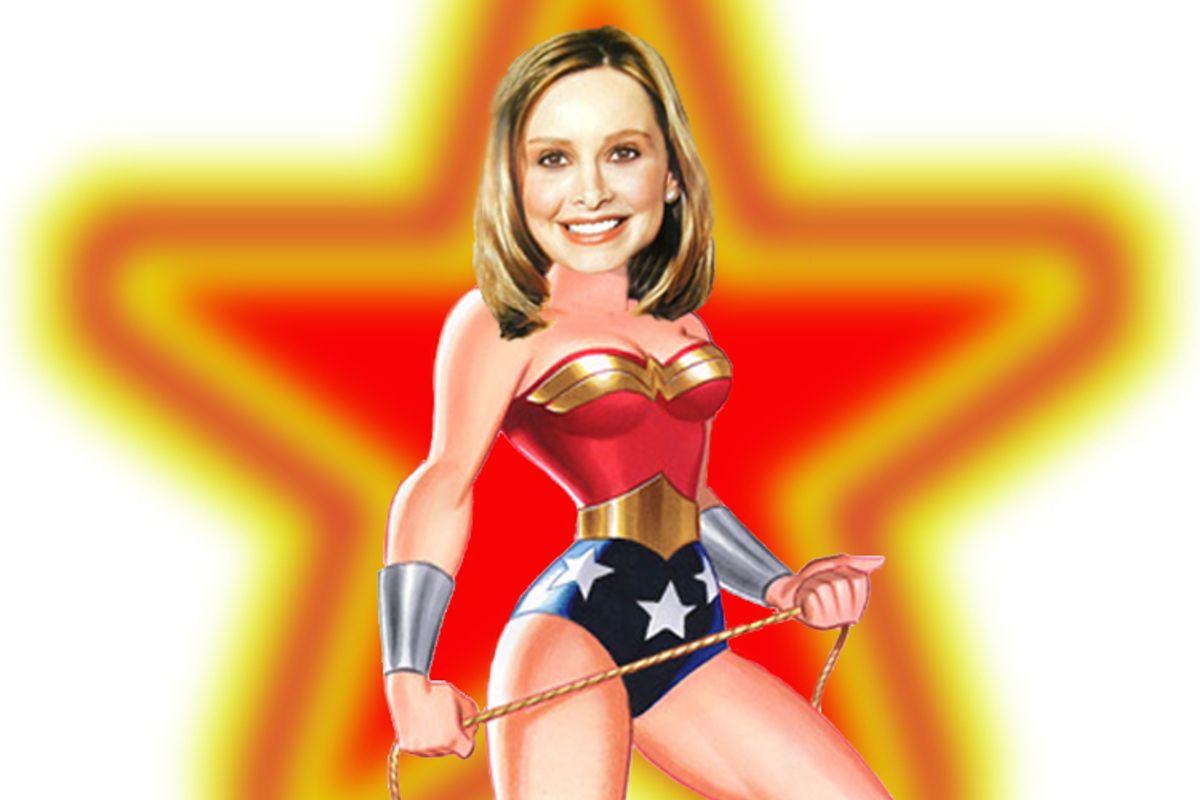
Will David E. Kelley dumb down Wonder Woman?
The man behind feminist villain Ally McBeal is tapped to bring the superhero to the small screen. I'm worried
The guy who killed feminism is reviving Wonder Woman. Well, that’s just great.
To be fair, David E. Kelley didn’t directly kill feminism. It was his most famous creation, Ally McBeal, that short-skirted, romantically challenged, possibly insane television lawyer who notoriously graced a 1998 Time magazine cover that pondered the death of the movement. And in the interest of further fairness, it should be noted that for Time magazine to place such a burden on a fictional character has generally come to be regarded as one of the dumbest things that happened in the ’90s, right after the Starr report and the Macarena.
Yet when the news broke late Friday that the much-promised, oft-postponed reimagining of the ultimate female superhero was to become a TV series written and produced by the man who gave us a dramedy about female lawyers called “Girls Club,” perfectly manicured eyebrows across the land raised in skeptical unison. Kelley? The guy who gave us “The Practice” and “Boston Legal”? Has anybody told the guy that the Justice League is not an eccentric New England law firm?
It’s not that a man can’t do a fantastic job delivering strong, memorable female television characters. Without J.J. Abrams, there would be no Felicity, no Sydney Bristow, no Kate Austen. Without Matthew Weiner, we wouldn’t have Joan, Betty or Peggy. Could anyone do equal justice to the job Alan Ball has done with Sookie Stackhouse? For years, the name most closely associated with the Wonder Woman revamp was the world’s most trusted purveyor of kickass babes, Joss Whedon. Nor has Kelley built a career strictly limiting himself to dragon lady stereotypes and flinty, bitter wedding planners. This is also the man who steered Christine Lahti to her Emmy-winning role of Kate Austin on “Chicago Hope” and gave us the complicated Ellenor Frutt on “The Practice.”
But few other writers have built an empire creating characters who play so beautifully to male fantasies. Will Wonder Woman get a boyfriend who’s yet another gleefully cake-and-eat-it-too alleged satire of sexists like the dogs of “Boston Legal”? Will she engage in pseudo lesbianism, client seducing, or late-night pining for an ooga chaka baby to ride shotgun in her invisible plane? The superheroine occasionally known as Diana Prince isn’t just some lasso-twirling bimbo in an eagle-emblazoned bustier, dying to make some gimmicky speech to a judge somewhere, you know. She wears pants now and everything. Yes, David E. Kelley. I said pants. Can he provide a heroine like that, a woman whose strength and character and righteous left hook generations of girls have grown up idolizing?
Whether Kelley can deliver the goods and the golden bracelets remains to be seen. He currently still has his hands full with the NBC midseason series “Harry’s Law.” It’s about a law firm — and there’s a leggy, designer shoe-loving blonde who wears short skirts. The veteran writer and producer sure knows his wheelhouse. And perhaps that’s why when it comes to our superhero women, when Kelley’s involved we’ve got to wonder.
Mary Elizabeth Williams is a staff writer for Salon and the author of "Gimme Shelter: My Three Years Searching for the American Dream." Follow her on Twitter: @embeedub. More Mary Elizabeth Williams.
That’s not the original Hulk!
Even in books dedicated to his work, famed comic artist Jack Kirby's drawings never appear on the cover
(Credit: Dean White)
Jack Kirby is widely recognized as one of the most important comic creators of the 20th century. Co-creator of Captain America, the Fantastic Four, the Hulk, the X-Men, and creator of Darkseid, The Demon, OMAC and myriad others, he still can’t get no respect.
Early in 1992 my phone rang. At the time I was an art director at a book publisher in Manhattan, and it was some time before I learned the art of being taken to lunch. On the other end was a book agent. “Do you want to go to lunch?” “No thanks,” I replied. “Then I guess you don’t want to meet Jack Kirby?” Less then an hour later I walked into the lobby of the hotel where the Kirbys were staying. I was the first to arrive, and walked over and introduced myself to Jack and Roz. The raison d’être for the meeting was that Jack and Ray Wyman were shopping around “The Art of Jack Kirby.” I will save the details of that meeting for another time, but suffice it to say Jack regaled me with war stories over lunch, and I met one of the greatest influences on my early life. Unfortunately I could not convince my publisher how important I believed the book to be. Sadly, almost exactly two years later I learned Jack had passed.
Continue Reading CloseSteven Brower is a graphic designer, writer and educator and the former Creative Director/ Art Director of Print. He is the author/designer of books on Louis Armstrong, Mort Meskin, Woody Guthrie and the history of mass-market paperbacks. He is Director of the “Get Your Masters with the Masters” low residency MFA program for educators and working professionals at Marywood University in Scranton, Pa. @stevenianbrower More Steven Brower.
Comic books’ undercover hero: Tibet
An exhibition at New York's Rubin Museum showcases the Asian country's surprising prominence in comic culture SLIDE SHOW
From the cover of "Green Lama."(Credit: Rubin Museum of Art) Which Himalayan country has had guest-starring gigs in some of the century’s most popular comics? If you guessed Tibet — a safe choice based on this interview’s headline — you’re spot on.
A new exhibition at New York City’s Rubin Museum (an institution wholly dedicated to the art of the Himalayas) will show you “the most complete collection of comics related to Tibet ever assembled.” A number of them may already be familiar to you; as curator Martin Brauen explained to me this week, popular comic figures like Donald Duck, Lara Croft and Tintin all make appearances. All the comics — from the obscure and frivolous to the overtly political — capture Tibet as it has been perceived by artists and readers at different points over the course of past several decades.
Continue Reading CloseEmma Mustich is a Salon contributor. Follow her on Twitter: @emustich. More Emma Mustich.
Tales from the other Comic Con
Unlike its San Diego cousin, the Long Beach version is still all about cartoons and graphic novels


Kevin Eastman
These days, the so-called San Diego “Comic” Con’s main attraction is sugary TV and movie confectionery. But if you enjoy graphic novels and cartoons – and, well, scary stuff – you may have attended the recent Comic & Horror Con at Long Beach, Calif.’s Convention Center.
Continue Reading CloseAssassinating Russia’s ultimate archvillain
A compelling new graphic novel reimagines the killing of the mysterious Grigori Rasputin
“Murder is the emperor of political action,” says an eager conspirator in the graphic novel “Petrograd.” In this case the murder is the notorious assassination of Grigori Rasputin, and the political action is a conspiracy orchestrated by agents of the British Secret Service at the height of World War I. Author Philip Gelatt and artist Tyler Crook demythologize the killing of Rasputin — a figure so buried in legend that this task borders on the herculean — largely by substituting a not wholly implausible counter-historical fiction.
Continue Reading CloseInside “Maus”
25 years later, Art Spiegelman gives us a behind-the-scenes look at his seminal Holocaust graphic novel
Among those of a certain age, is there a soul who doesn’t remember how brilliantly “Maus” lit up the night when it burst upon the scene in 1986? A deeply serious comic strip of the Holocaust before the category of graphic novel was common coin, with Jews depicted as timorous mice and Nazis as bestial cats, “Maus” was scandalous in concept, jaw-dropping in execution, and, beneath its transgressive exterior, humbling in its rigorous yet gentle understanding of the victims of one of the seismic events of the 20th century.
Continue Reading CloseDaniel Asa Rose is the author, most recently, of "Larry's Kidney: Being the True Story of How I Found Myself in China With My Black-Sheep Cousin and His Mail-Order Bride, Skirting the Law to Get Him a Transplant ... and Save His Life" – named one of the top books of the year by Publishers Weekly. More Daniel Asa Rose.
Page 1 of 19 in Comic Books


L.A. graphic designer Kenny Keil loves to parody superhero comics. And horror, crime and romance comics. And just about every other comics genre and trope from the 1940s onward. His primary conceit is to turn the medium’s typical hyperbolic bombast on its head. For instance, he promotes “Tales to Suffice,” a trade paperback collection of his self-published comic book series of “mind-blowing adequacy,” as “Quite possibly too much comic!”


Can anyone save us from monopolistic, corporate greed and help restore balance to New York?


Libraries usually loan books, but at this convention Long Beach Public Library’s Youth Services Officer Francisco Vargas and Manager Darla Wegner were giving away shelves of them for free. Attendees could help themselves to everything from a David Sedaris paperback to a “Pirates of the Caribbean” pop-up. My kind of neighborhood outreach!


Put on your André Kostelanetz platters and pour yourself a highball. Tina Schmidt paints the 


Prism Comics is an organization with a mission: to support LGBT comics, and to link their creators with appreciative readers. Its booth was selling a rainbow assortment of gay and lesbian comics literature authored by a spectrum of creators, from 1960s underground comix stalwarts such as 

By day, Mark dos Santos is a staffer at Pasadena’s 

Erotica, yes: because “porn ‘toons” sounds so déclassé. Whatever you call it, Tony Raiola’s got it. Tony launched his Pacific Comics Club, a publishing and distribution venture, in the mid-1960s in France and Italy. But his current home turf is Long Beach.


