Salon Home
Topic

Pakistan

Thursday, Oct 14, 2010 4:35 PM UTC2010-10-14T16:35:00Zl, M j, Y g:i A T

“I wonder, why was I victimized?”

Pakistani victims of U.S. drone strikes speak out in a new report on increasing civilian casualties in the region

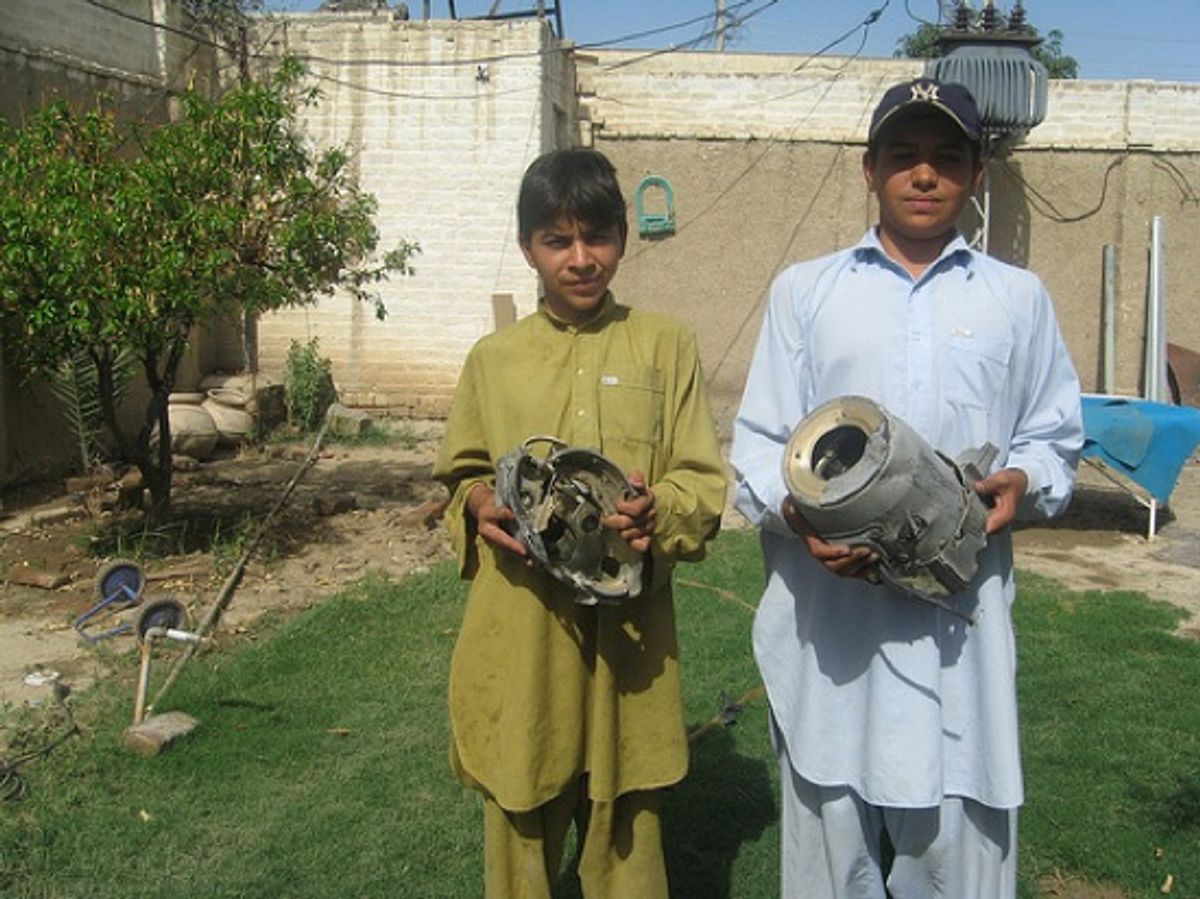
Children in North Waziristan with debris from drone missile

Children in North Waziristan with debris from drone missile

A new report from the Campaign for Innocent Victims in Conflict (CIVIC) concludes that innocent civilians in northwest Pakistan are getting hammered by all sides — the U.S. (drone strikes), the Pakistan military (ground and aerial bombardment) and local militants (terrorist attacks). 

Christopher Rogers, the Harvard-trained lawyer who authored the report, did some great reporting. He interviewed many family members of slain Pakistani civilians — voices that are virtually never heard in the U.S. media. Here, for example, is his summary of the first drone strike on President Obama’s watch, way back in January 2009:

Continue Reading
Justin Elliott

Justin Elliott is a Salon reporter. Reach him by email at jelliott@salon.com and follow him on Twitter @ElliottJustin  More Justin Elliott

Monday, Feb 20, 2012 4:29 AM UTC2012-02-20T04:29:00Zl, M j, Y g:i A T

Hypnotized into an endless dirty war

America has decided it has the right to kill whoever it wants, whenever it wants.

pak01

If in the year 2000 the U.S. president had told the American people that the government would soon begin using robot planes to track people, including U.S. citizens, all over the world, and would reserve to itself the right to kill them without trial, it is safe to say there would have been an enormous uproar. But that is exactly what is happening today, and nobody cares. The majority of Americans, including those who were opposed to the war in Iraq, have no problems with their government killing at will, so long as the killing is done in the name of “national security.”

Continue Reading

Gary Kamiya is a Salon contributing writer.  More Gary Kamiya

Wednesday, Nov 30, 2011 4:03 PM UTC2011-11-30T16:03:00Zl, M j, Y g:i A T

America: The ally from hell

In Washington, the Pakistan-bashers are having a field day avoiding U.S. responsibility

Protesters hold up a burning mock drone aircraft during a rally against drone attacks in Pakistan.

Protesters hold up a burning mock drone aircraft during a rally against drone attacks in Pakistan.  (Credit: Reuters/K. Pervez)

Topics:

If there is one thing Republican presidential candidates agree on, it’s the treachery of Pakistan. Rep. Michele Bachmann leads the pack. At last week’s GOP debate, she called Pakistan “violent” and “more than an existential threat” to the United States, because it is “a nation that lies, that does everything possible that you could imagine wrong.” Texas Gov. Rick Perry said Pakistan has “shown us time after time that they can’t be trusted.” He called for a cutoff of aid, a line that drew applause from the audience. Former Utah Gov. Jon Huntsman said on Sunday that America might have to “look for a new partner in the region” and also suggested a cutoff in aid might be in order.

It is not only GOP leaders who are obsessed with Pakistan. “The Ally From Hell,” screams the cover of this month’s Atlantic. New York’s Democratic Rep. Gary Ackerman called Pakistan “perfidious” recently, saying the country was not an ally, a friend, a partner or a teammate. “Pakistan is on its own side, period,” Ackerman said at a House Subcommittee Hearing on Afghanistan and Pakistan.

One would think from all this talk that America’s behavior vis-à-vis Pakistan has been pure and good. But the reality could not be further from the self-righteous claims persistently emanating from Washington’s complainers. America has acted no better than Pakistan in the relationship, and may even have been the worse partner. Understanding the fury over NATO’s recent killing of 24 Pakistani soldiers requires a deeper look at the relationship.

Let’s begin near the beginning. Within days of the 9/11 attacks, then-Deputy Secretary of State Richard Armitage was deputized to meet with a Pakistani official. According to Pakistan’s then-President Pervez Musharraf, Armitage said that Pakistan, if it did not cooperate unconditionally with the United States, needed to be prepared to be “bombed backed to the stone age.”

Armitage was only reinforcing Secretary of State Colin Powell’s message to Musharraf, which included a list of demands, among them full use of Pakistani airspace, closure of its borders with Afghanistan, and use of its territory as a staging base. In return, Pakistan was granted loads of cash — and the pleasant experience of not being bombed back to the stone age.

“If the signals America gave Pakistan had been subtle, they would have been ignored,” says Anthony Cordesman, who frequently advises the U.S. government on the South Asia/Middle East region. Maybe so, but the ultimatum delivered to Pakistan established unrealistic expectations on what could be delivered. No understanding was made of Pakistan’s own interests. No attempt was made to consider Pakistani public opinion. Pakistan was not treated as an ally. It was treated as a vassal.

Continue Reading

Jordan Michael Smith writes about U.S. foreign policy for Salon. He has written for the New York Times, Boston Globe and Washington Post.  More Jordan Michael Smith

Tuesday, Nov 8, 2011 4:56 PM UTC2011-11-08T16:56:00Zl, M j, Y g:i A T

Has Pakistan missed its “Arab Spring” moment?

After a young man sets himself on fire to protest living conditions, the nation's response is muted

Pakistan's opposition lawmakers rally outside the parliament in Islamabad, Pakistan, Thursday, Oct, 6. 2011

Pakistan's opposition lawmakers rally outside the parliament in Islamabad, Pakistan, Thursday, Oct, 6. 2011 (Credit: AP)

This article originally appeared on GlobalPost.

HAJI SAINDAD RIND, Pakistan — It could have been an Arab Spring moment. Taking an apparent cue from the young Tunisian who, tired of the poverty in which he lived, set himself on fire and launched a protest movement around the world, Raja Khan, 23, went to Pakistan’s parliament late last month and did the same.

Global Post

But in a country where poverty and unemployment is more a norm than an exception, the reaction has been muted.

Continue Reading

  More Suzanna Koster

Friday, Oct 7, 2011 3:25 PM UTC2011-10-07T15:25:00Zl, M j, Y g:i A T

Dick Cheney interviewed by Liz Cheney at “Ideas Forum”

The Atlantic Magazine's celebration of Washington's power elite culminates in a pleasant father-daughter chat

Former Vice President Dick Cheney, accompanied by his daughter Liz, addresses the Washington Ideas Forum on Thursday.

Former Vice President Dick Cheney, accompanied by his daughter Liz, addresses the Washington Ideas Forum on Thursday.  (Credit: AP/Manuel Balce Ceneta)

This week, the Atlantic Media Co. held its “Washington Ideas Forum,” one of many regular events held for Washington’s political elite to gather and congratulate themselves for having so many ideas. The Atlantic — which also publishes a monthly magazine, I’m told — throws these pricey orgies of self-regard each year, in Washington and Aspen. One of the big “ideas” presented at this year’s forum was actually a pretty old one: that no matter how awful and criminal certain people’s behavior is in office, they will never, ever be kicked out of the Washington elite.

Continue Reading
Alex Pareene

Alex Pareene writes about politics for Salon. Email him at apareene@salon.com and follow him on Twitter @pareene  More Alex Pareene

Monday, Aug 15, 2011 12:16 PM UTC2011-08-15T12:16:00Zl, M j, Y g:i A T

Pakistani belief about drones: perceptive or paranoid?

President Obama's former National Intelligence Director makes the case that drones are counter-productive

Pakistani belief about drones: perceptive or paranoid?
Topics:

Two weeks ago, President Obama’s former Director of National Intelligence, Adm. Dennis Blair, excoriated the White House for its reliance on drones in multiple Muslim nations, pointing out, as Politico put it, that those attacks “are fueling anti-American sentiment and undercutting reform efforts in those countries.”  Blair said: ”we’re alienating the countries concerned, because we’re treating countries just as places where we go attack groups that threaten us.”  Blair has an Op-Ed today in The New York Times making a similar argument with a focus on Pakistan, though he uses a conspicuously strange point to make his case:

Continue Reading
Glenn Greenwald

Follow Glenn Greenwald on Twitter: @ggreenwaldMore Glenn Greenwald

Page 1 of 44 in Pakistan

Other News